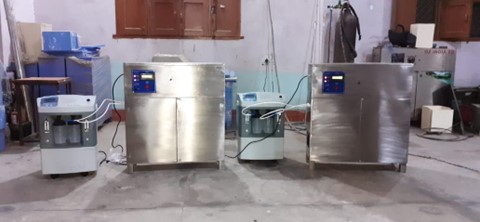
Ozone generator for STP plant CPCB compliance India is the most effective solution for Indian sewage treatment plant operators facing increasingly stringent Central Pollution Control Board discharge standards. India is in the midst of the largest STP infrastructure expansion in its history — over 1000 new sewage treatment plants are under construction under NMCG, Smart City Mission and AMRUT 2.0.
Simultaneously CPCB is tightening discharge standards for colour, odour, BOD, COD and coliform in treated effluent. For STP operators across India, traditional biological and chlorination treatment is proving inadequate. Ozone India Technology, based in Ghaziabad and Noida, has manufactured CE and ISO certified ozone generators for STP applications for 11 years, supplying 200 plus installations across Delhi NCR, Mumbai, Hyderabad and Ahmedabad.
Why Traditional STP Treatment Is Failing CPCB Standards
Most Sewage Treatment Plants in India use Activated Sludge Process, Moving Bed Biofilm Reactor or Sequential Batch Reactor as their primary treatment technology. These biological processes are effective at removing BOD and suspended solids. However they have critical limitations that are causing STP operators to fail CPCB compliance checks and face penalties.
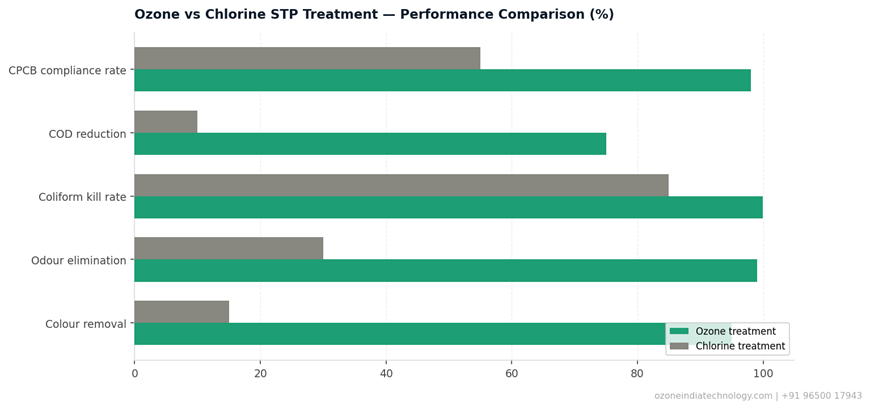
The most significant limitation is inability to remove color from treated sewage. Sewage in Indian cities, particularly in areas with textile, dye or industrial effluent contribution, contains chromophoric compounds that resist biological degradation. Even a well-operated biological STP may produce treated water with visible color that fails CPCB color standard of 5 to 7 Hazen units.
The second major limitation is odour. Biological treatment produces hydrogen sulphide and other volatile compounds. CPCB standards increasingly require STP discharge water to be odour-free. Chlorination not only fails to remove odour but adds chemical smell and creates carcinogenic trihalomethane byproducts.
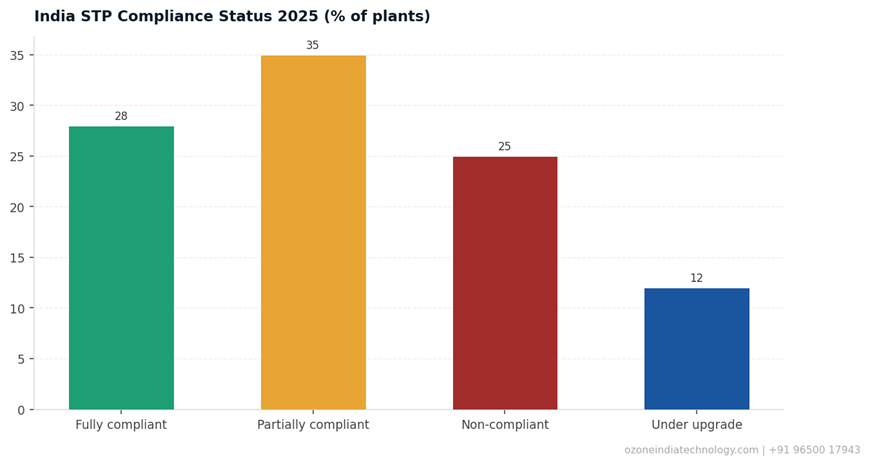
[INSERT CHART 1 HERE — from charts section above]
How Ozone Generators Solve STP Treatment Challenges
Ozone — the molecule O3 — is the most powerful oxidant available for water treatment. With an oxidation potential of 2.07 volts compared to 1.36 volts for chlorine, ozone is 1.5 times more powerful than chlorine as a disinfectant and far more effective at removing colour, odour and recalcitrant organic compounds that resist biological treatment.
When applied to secondary STP effluent, ozone attacks colour-producing chromophore groups through Advanced Oxidation. The ozone molecules break chemical bonds responsible for colour within 15 to 30 minutes of contact time. The result is treated water meeting CPCB 5 to 7 Hazen unit colour standard consistently.
Ozone eliminates odour by oxidising volatile organic compounds and hydrogen sulphide. Unlike chlorine which masks odour temporarily, ozone oxidatively destroys the odour-causing molecules. Treated water leaving an ozone-equipped STP is genuinely odourless and acceptable for reuse in landscape irrigation and road washing. An ozone generator for STP plant CPCB compliance India must be correctly sized for the actual secondary effluent flow rate and quality.
Technical Requirements — Ozone Generator for STP CPCB Compliance
Selecting the correct ozone generator capacity for an STP application requires understanding three key parameters — the STP flow rate in KLD, the target ozone dose for the specific treatment objective, and the ozone demand of the particular effluent.
For colour removal from secondary STP effluent — typical ozone dose is 8 to 15 mg per litre depending on initial colour and COD levels. For disinfection to achieve zero coliform — typical ozone dose is 1 to 3 mg per litre applied after colour removal step. For combined colour removal plus disinfection — typical ozone dose is 10 to 20 mg per litre.
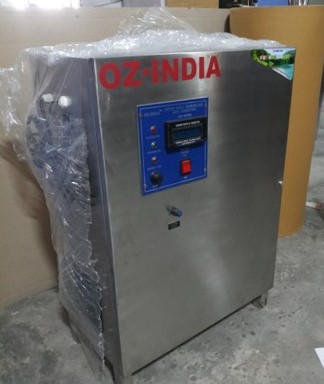
Ozone India Technology manufactures ozone generators from 2g per hour for small residential STP applications to kilogram-scale systems for large municipal STP plants. All STP ozone generators use corona discharge technology — the most efficient and reliable ozone generation method for industrial applications. Systems are CE certified, ISO 9001 certified and supplied with complete CPCB-aligned operation and maintenance documentation.
Case Study — STP Compliance Turnaround in Noida Apartment Complex
A residential apartment complex in Noida Sector 77 was receiving monthly UPPCB compliance notices for their on-site STP. Their 300 KLD STP using MBBR technology was producing treated effluent that consistently failed colour and coliform standards. Their gardening team complained about odour from the treated water used for landscape irrigation.
Ozone India Technology installed a 20g per hour corona discharge ozone generator at the secondary treatment outlet, with an ozone contact chamber sized for 30 minutes of contact time. Within one week of installation, treated water colour dropped from 45 Hazen units to below 5 Hazen units. Coliform count dropped to zero. Odour was completely eliminated.
The apartment complex has since received zero compliance notices and uses treated water for all common area irrigation, saving significant municipal water charges. Payback period for the ozone system was under 8 months when factoring in municipal water savings and eliminated compliance fine risk.
CPCB General Standards for STP Discharge — What You Must Achieve
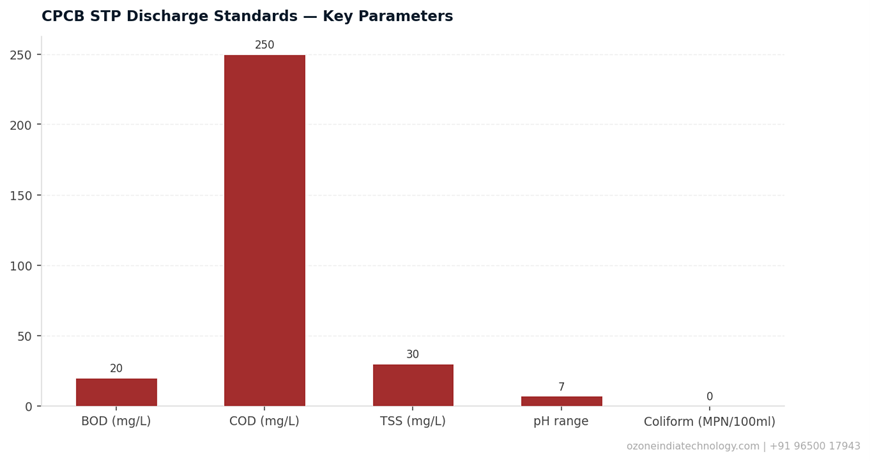
The Central Pollution Control Board general standards for STP discharge, specified under the Environmental Protection Act, set the following key parameters. BOD 5-day at 20 degrees C — 20 mg per litre maximum for discharge into streams and coastal areas. COD — 250 mg per litre maximum for CPCB primary standards with many State PCBs specifying more stringent limits. Total Suspended Solids — 30 mg per litre maximum for surface water discharge. pH — 5.5 to 9.0 for all discharge categories. Faecal Coliform — must not be detectable in MPN per 100 ml for treated STP discharge used for irrigation. Colour — 5 to 7 Hazen units for treated STP effluent in visible colour assessment.
Ozone treatment applied to secondary STP effluent can achieve all of the above parameters simultaneously when correctly sized and operated. This makes ozone the single most impactful upgrade an STP operator can make to achieve comprehensive CPCB compliance.
Why Ozone India Technology for Your STP Ozone System
Ozone India Technology has been manufacturing ozone generators specifically for STP applications for 11 years. Our IIT Patna MBA team provides free effluent quality assessment and ozone generator sizing for every enquiry. We manufacture from 2g per hour to kilogram-scale — the complete range required for STP applications from small residential complexes to large municipal plants.
All our STP ozone systems are CE certified and ISO certified, supplied with CPCB-aligned documentation, operation and maintenance manuals and periodic testing reports for compliance record-keeping. Factory-direct pricing with no dealer margin means our ozone generators for STP CPCB compliance India are 30 to 40 percent below imported alternatives. Trusted by residential complexes, commercial buildings, industrial plants and municipal corporations across Delhi NCR, Mumbai, Hyderabad and Ahmedabad.
Frequently Asked Questions
Q: How does an ozone generator help STP achieve CPCB compliance?
A: Ozone removes colour, eliminates odour, reduces COD by 60 to 80 percent and kills all coliform bacteria including chlorine-resistant organisms. A correctly sized ozone generator for STP plant CPCB compliance India installed at the secondary treatment outlet can achieve all CPCB discharge parameters simultaneously in 15 to 30 minutes of contact time.
Q: What size ozone generator do I need for my STP?
A: Ozone India Technology provides free STP ozone generator sizing based on your STP capacity in KLD, secondary effluent colour measurement and target CPCB parameters. Typical requirement is 5 to 20g per hour per 100 KLD of STP capacity depending on effluent quality. Call +91 96500 17943 for free sizing consultation.
Q: Does ozone treatment affect the STP biology?
A: No. Ozone is applied after the biological treatment stage — at the secondary clarifier outlet. The biological process runs normally. Ozone only treats the clarified effluent before discharge. There is no interaction between the ozone system and the biological reactor.
Q: How long does ozone system installation take at an STP?
A: 2 to 3 working days without shutting down the STP. The ozone generator and contact chamber are installed after the secondary clarifier and before the treated water storage or discharge point. The existing STP continues to operate normally during installation.
Q: What CPCB documentation does Ozone India Technology provide? A: Complete CPCB-aligned documentation including ozone generator specifications, installation procedure, operation and maintenance manual, ozone dose calculation report and periodic performance testing report template. All provided at no additional charge with every STP ozone system installation.
External Links — Add These Inside Article Body
• CPCB General Standards for Discharge of Environmental Pollutants
• NMCG National Mission for Clean Ganga STP Guidelines
• WHO Safe Use of Wastewater and Greywate
Internal Links — Add These Inside Article Body
• Ozone Generators — Complete Product Range
• Contact Ozone India Technology for STP Ozone Sizing
About Ozone India Technology
Ozone India Technology is a CE and ISO certified ozone generator manufacturer based in Ghaziabad and Noida, Uttar Pradesh, India. Established under the OZ-India Group alongside Alpha UV System and Oz Mist Food Technology, Ozone India Technology has 11 years of manufacturing experience and 200 plus client installations across pharmaceutical, food processing, STP, ETP, WTP, hotel, hospital and industrial applications across India.
Our engineering team includes MBA graduates from IIT Patna — India’s Institute of National Importance. We manufacture ozone generators from 2g per hour to kilogram-scale — any application, any capacity. CE certified, ISO 9001 certified, RoHS certified, MSME registered. Trusted by Leela Hotel, Indian Air Force, Bisleri, Taj Hotels and 200 plus clients across India. Exporting to UAE, Kenya and Bangladesh