Ozone generator Nigeria Lagos water treatment is rapidly becoming the preferred disinfection technology for packaged water producers, food manufacturers, hospitals, and industrial operators across West Africa's largest economy. Ozone India Technology — CE and ISO 9001:2015 certified, founded by IIT Patna engineers — exports ozone generators to Nigeria with full NAFDAC-compatible documentation, making the entire import-to-installation process straightforward for Lagos-based buyers. This guide covers everything a Nigerian buyer needs to know: what WHO and NAFDAC mandate, how ozone addresses Nigeria's specific water challenges, which capacity to select, and how to get a unit from Greater Noida to your Lagos facility.
Nigeria's Water Crisis: Scale, Causes, and What It Means for Industry
The WHO/UNICEF Joint Monitoring Programme 2023 report documents that only 19 percent of Nigeria's 220 million population has access to safely managed drinking water — the lowest proportion among Africa's five most populous nations. Lagos State, home to 15 million people in the metro area, faces a structural water deficit: the Lagos State Water Corporation was designed to supply 210 million gallons per day but delivers less than 30 percent of that capacity. The gap is filled by sachet water, bottled water, and private borehole systems.
For industry, this gap has direct consequences. Factories, hospitals, breweries, pharmaceutical companies, and food processors in Lagos cannot rely on public supply and must treat their own borehole water to WHO and NAFDAC quality standards. An ozone generator for Nigeria Lagos water treatment bridges this gap — providing consistent, validated disinfection without dependence on municipal supply.
Borehole water chemistry across Lagos — Ikeja, Ojo, Alimosho, Lekki, and Ibeju-Lekki industrial corridors — commonly shows elevated iron at 3 to 12 mg/L (WHO guideline: 0.3 mg/L), dissolved manganese at 0.5 to 3 mg/L (WHO guideline: 0.1 mg/L), turbidity from suspended clay, and total coliform counts of 200 to 5,000 CFU per 100 mL. Surface water from the Lagos Lagoon system and Ogun River adds industrial effluent contamination, agricultural runoff, and pathogenic microorganisms including E. coli, Salmonella typhi, and cholera (Vibrio cholerae).
Ozone, as documented in the WHO Guidelines for Drinking-water Quality 4th Edition, achieves 4-log (99.99 percent) inactivation of bacteria and viruses and simultaneously oxidises iron, manganese, and organic colour — addressing the full matrix of Lagos water quality problems in a single treatment step. This multi-action capability explains why ozone generator Nigeria Lagos water treatment projects have grown significantly as Lagos's packaged water and food manufacturing sectors have expanded.
What NAFDAC Requires for Ozone Disinfection in Nigeria
NAFDAC — the National Agency for Food and Drug Administration and Control — regulates packaged drinking water, food production water, and pharmaceutical process water in Nigeria. NAFDAC Guidelines for Packaged Water (2021) establish these specific ozone requirements:
- Minimum residual ozone: 0.4 mg/L at the point of ozonation before filling
- Minimum contact time: 4 minutes between ozone injection and product filling
- Microbiological target: Zero total coliform per 100 mL in the finished product
- Documentation: Ozone generator specifications, daily operational logs, and disinfection validation data must be available for NAFDAC inspection at any time
Every ozone generator Nigeria Lagos water treatment system from Ozone India Technology is sized to deliver and sustain the 0.4 mg/L residual at the designed flow rate, with dissolved ozone monitoring capability to produce the daily log data NAFDAC inspectors require. CE Declaration of Conformity (CE-2621A) and ISO 9001:2015 Certificate (UQ-270426AD1) are included in the export documentation package and accepted by NAFDAC as evidence of product quality for imported equipment.
Beyond packaged water, NAFDAC-licensed beverage manufacturers, dairy processors, and pharmaceutical companies producing purified water (PW) or water for injection (WFI) must document their water treatment validation. Ozone India Technology's IQ/OQ/PQ documentation package supports NAFDAC inspections in pharmaceutical facilities.
How Ozone Solves Nigeria's Specific Water Problems
Iron and Manganese Removal
Lagos borehole water iron concentrations — typically 5 to 12 mg/L — cause red-brown staining of bottles, scaling in pipelines, and accelerated bacterial growth in storage tanks. Conventional aeration removes dissolved iron but cannot adequately treat the high manganese concentrations common in Lagos geology, and aeration towers add footprint and maintenance complexity that most Lagos SMEs want to avoid.
Ozone generator Nigeria Lagos water treatment at 0.5 to 1.0 mg/L dissolved ozone dose oxidises dissolved iron (Fe²⁺) to ferric hydroxide (Fe(OH)₃) within 30 seconds of contact and dissolved manganese (Mn²⁺) to manganese dioxide (MnO₂) within 1 to 3 minutes. Both oxidised forms precipitate and are captured by downstream sand filtration, delivering water below the WHO aesthetic guideline values in a single ozone + filtration step — no aeration tower, no separate oxidation tank, no secondary chemical dosing.
4-Log Microbial Disinfection
Ozone at 0.4 to 1.0 mg/L in a properly designed contact tank achieves the following pathogen inactivation against Lagos water's primary microbial risks:
- E. coli: >4-log (>99.99%) at 0.4 mg/L, 4 minutes CT
- Vibrio cholerae (cholera): >4-log at 0.2 mg/L, 2 minutes CT
- Salmonella typhi (typhoid): >4-log at 0.5 mg/L, 4 minutes CT
- Rotavirus and enteric viruses: >4-log at 0.8 mg/L, 4 minutes CT
Unlike chlorine, ozone does not produce halogenated disinfection by-products (trihalomethanes, haloacetic acids) — a critical advantage for packaged water producers targeting export markets where THM limits of 10 μg/L or less apply.
Colour and Taste Removal
Lagos water from surface sources typically carries 80 to 250 colour units from humic substances and algae-derived geosmin. This is a key reason ozone generator Nigeria Lagos water treatment projects consistently specify higher ozone doses than comparable Indian installations. Ozone at 1.0 to 2.0 mg/L oxidises these organic colour compounds through direct molecular reaction and hydroxyl radical attack, producing colourless, odour-free water that meets consumer quality expectations for packaged drinking water — a non-negotiable requirement in Lagos's competitive sachet water market.
Nigeria Lagos Market Applications: Where Ozone Generators Are Used
Packaged Drinking Water Industry (Sachet and Bottled Water)
Nigeria produces an estimated 60 million sachets and 5 million bottles of packaged water per day. Lagos State concentrates the largest sachet water cluster in West Africa — the Mushin, Agege, Isale-Eko, and Ikorodu production zones host hundreds of NAFDAC-licensed factories. Every NAFDAC-registered packaged water facility requires a documented ozone or UV disinfection system, making the ozone generator Nigeria Lagos water treatment market the largest single end-use segment in West Africa.
Ozone India Technology's 5 to 20 g/hr corona discharge generators serve production volumes of 3,000 to 20,000 litres per hour — matching the output range of most Lagos sachet water operations. The ozone generator 10–25 g/hr range is the most common specification for mid-scale Lagos water producers.
Breweries and Beverage Manufacturing
Nigeria's brewing sector — including Guinness Nigeria, Nigerian Breweries, and over 200 smaller craft and regional breweries — requires process water with zero microbial content, controlled mineral profile, and no off-taste compounds. The food processing application of ozone generators in Nigerian breweries addresses process water, CIP (clean-in-place) sanitation circuit water, and label washing water. An ozone generator for Nigeria water treatment in a brewery eliminates the chlorine residual that affects fermentation flavour profiles, making ozone the preferred disinfection technology for quality-conscious Nigerian beverage manufacturers.
Hospital and Healthcare Water
Lagos University Teaching Hospital, Lagos Island General Hospital, Eko Hospital, and Nigeria's expanding private hospital sector require validated water treatment for dialysis, surgical instrument washing, and infection control. Hospital-grade water treatment using an ozone generator Nigeria Lagos system combined with a UV water treatment system provides dual-barrier disinfection meeting WHO healthcare facility water quality requirements. See the hospital and healthcare water treatment application guide for system sizing.
Industrial STPs and ETPs
Lagos's industrial zones — Apapa, Tin Can Island, Ikeja Industrial Estate, Ibeju-Lekki Free Trade Zone — discharge to the Lagos Lagoon system under Lagos State Environmental Protection Agency (LASEPA) wastewater quality standards. Ozone treatment of industrial effluent reduces BOD, COD, colour, and microbial load before discharge or reuse. The water treatment plant application covers ozone dosing for Nigerian industrial STP and ETP systems.
Selecting the Right Ozone Generator Capacity for Lagos
Ozone generator sizing for ozone generator Nigeria Lagos water treatment depends on flow rate and water quality:
| Flow Rate (LPH) | Ozone Dose Required | Recommended Generator |
|---|---|---|
| 500–2,000 | 3–6 g/hr | 5 g/hr Light Industrial |
| 2,000–8,000 | 6–16 g/hr | 10–25 g/hr Industrial |
| 8,000–25,000 | 16–50 g/hr | 30–50 g/hr Heavy Industrial |
| 25,000–100,000 | 50–200 g/hr | 75–350 g/hr Large Scale |
For packaged water production with high iron (>5 mg/L) or high turbidity, add 30 percent to the ozone dose above. For clear borehole water with only microbial contamination, the baseline dose applies. Contact the Ozone India Technology team on WhatsApp +91 96500 17943 or through the Nigeria export enquiry page for a free sizing calculation based on your water quality report.
Nigerian Grid Compatibility and Voltage Stabilisation
Nigeria's national grid voltage is nominally 220–240V 50Hz but fluctuates severely — urban Lagos areas experience voltages between 160V and 265V, with PHCN supply interruptions requiring diesel generator (genset) backup. Most factories run on a combination of PHCN grid and Mikano, FG Wilson, or Perkins generators rated at 220–240V 50Hz.
All Ozone India Technology generators are designed for 220–240V 50Hz compatible with Nigerian grid and genset power. For Nigerian installations, a dedicated Automatic Voltage Regulator (AVR) is mandatory — 5 kVA AVR for generators up to 10 g/hr, 10 to 20 kVA AVR for 25 to 100 g/hr units. Systems supplied to Nigeria include AVR specifications, installation wiring diagrams for Nigerian single-phase (220V) and three-phase (380–415V) distribution, and remote voltage monitoring guidance.
Export Process: India to Lagos Step by Step
Production and quality testing: 10 to 21 working days from order confirmation. Every ozone generator Nigeria Lagos water treatment unit undergoes 72-hour continuous ozone output testing and full CE/ISO conformity verification before dispatch — ensuring the system performs to specification from day one at the Lagos site.
Export documentation included:
- CE Declaration of Conformity (CE-2621A) — see our certifications
- ISO 9001:2015 Certificate (UQ-270426AD1)
- Commercial invoice and packing list in USD
- Bill of lading (sea) or airway bill (air)
- Certificate of Origin from EEPC India
- HS Code 8543.70 classification for Nigerian customs
- NAFDAC application support pack: technical manual, installation guide, disinfection validation protocol
Shipping options from India to Lagos:
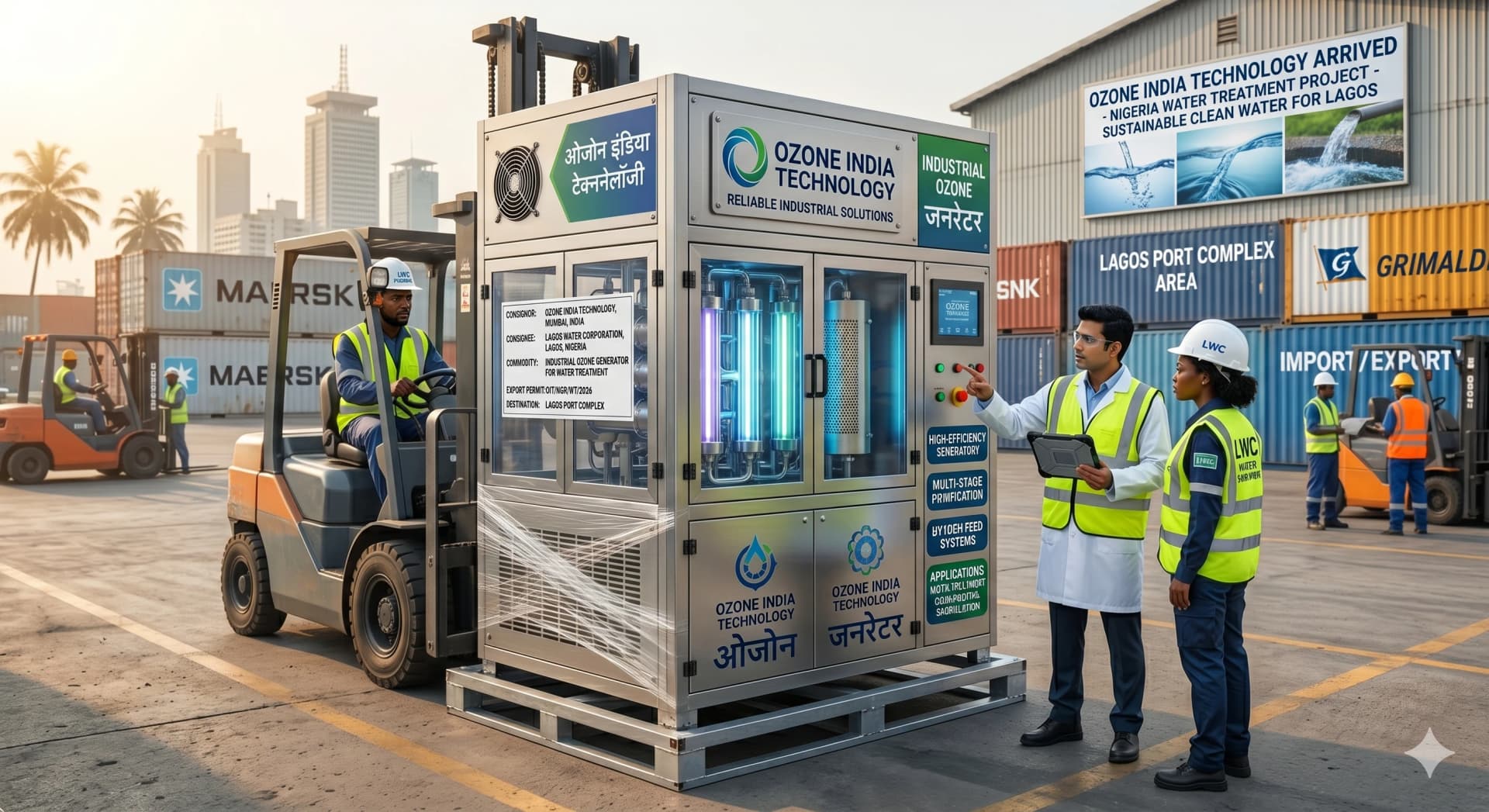
- Sea freight: JNPT Mumbai → Apapa Port Lagos — 18 to 22 days transit; 5 to 14 days customs clearance at Apapa
- Air freight: Delhi IGI → Lagos MMIA — 3 to 5 days; recommended for urgent orders or spare parts
- Total delivery: 8 to 12 weeks sea, 4 to 6 weeks air, from order confirmation
Nigeria's Import Policy Order classifies ozone generators as freely importable under Chapter 84 (Industrial Machinery), with import duty of 10 to 20 percent and 7.5 percent VAT. CE documentation is accepted by Nigerian Customs Service as quality evidence for industrial electrical equipment.
After-Sales Support for Nigerian Installations
Remote technical support is available via WhatsApp video call — no travel, no delay. Spare parts (ozone cells, quartz tubes, venturi injectors, transformer modules) are dispatched from Greater Noida within 48 hours and reach Lagos by DHL air freight in 5 to 7 days. The Ozone India Technology technical team provides free commissioning guidance via video call and ongoing operational support for the life of every ozone generator Nigeria Lagos water treatment system. For the full export product range, visit the Nigeria ozone technology export page or the complete products catalogue.
For food safety applications in Nigeria — ozone washing of fruits and vegetables, cold storage disinfection, and food-grade Nigeria Lagos water treatment — the FAO Food Safety Africa guidelines provide the technical framework for ozone application in African food processing facilities. Buyers evaluating an ozone generator Nigeria system for food processing should also review the food processing application guide for NAFDAC-specific sizing parameters.
Lagos Borehole Water — Before and After Ozone Treatment
NAFDAC Ozone CT Values — Pathogen Inactivation at 0.4 mg/L
Lagos Ozone Generator Market — Applications by Sector (%)
Nigeria Export — Delivery Timeline (Weeks from Order)
Frequently Asked Questions
What ozone dose does NAFDAC require for packaged water disinfection?
NAFDAC Guidelines for Packaged Water (2021) require a minimum residual of 0.4 mg/L ozone at the point of ozonation with at least 4 minutes contact time before bottling. The final packaged product must meet zero total coliform per 100 mL. Every ozone generator Nigeria Lagos water treatment system from Ozone India Technology is sized and validated to achieve these NAFDAC parameters.
Is voltage stabilisation required for ozone generators in Nigeria?
Yes — it is essential, not optional. Nigeria's grid voltage fluctuates between 160V and 265V, and ozone generators in Nigeria require stable 220–240V to maintain consistent ozone output. Every ozone generator Nigeria Lagos water treatment unit from Ozone India Technology ships with AVR specification sheets and wiring guides for Nigerian grid conditions. Installing an undersized or absent AVR is the most common cause of premature ozone generator failure in Nigeria — a problem Ozone India Technology prevents at the specification stage.
Does Nigeria require NAFDAC registration for imported ozone generators?
Ozone generators used in NAFDAC-licensed food or water production facilities may be subject to NAFDAC inspection and must be documented in the facility's production process registration. The CE and ISO documentation package from Ozone India Technology supports NAFDAC facility registration applications. Industrial ozone generators for non-food applications (STP, ETP, cooling towers) do not require NAFDAC product registration. Verify current NAFDAC requirements with a Nigerian regulatory consultant for your specific application.
What after-sales support does Ozone India Technology offer for Nigerian installations?
Remote support via WhatsApp video call within 24 hours of any reported issue. Replacement parts — ozone cell, quartz tube assembly, venturi injector, transformer — dispatched by DHL from Greater Noida within 48 hours, delivered to Lagos in 5 to 7 business days. Two-year warranty on ozone generator cells. Preventive maintenance schedule and spare parts list included with every ozone generator Nigeria Lagos water treatment system.
What is the sea freight transit time from India to Lagos?
JNPT Mumbai to Apapa Port Lagos: 18 to 22 days sea transit. Nigerian customs clearance at Apapa: 5 to 14 days (varies with documentation completeness and HS code classification). Total delivery: 8 to 12 weeks from order confirmation via sea freight. Air freight via Delhi IGI to Lagos MMIA: 3 to 5 days transit, total 4 to 6 weeks from order. Contact Ozone India Technology for current lead times and a shipping quote.
Conclusion: Why Ozone India Technology for Nigeria Lagos Water Treatment
Choosing the right ozone generator Nigeria Lagos water treatment partner matters as much as choosing the right equipment. Ozone India Technology has supplied ozone generators across 15+ countries, holds CE (CE-2621A) and ISO 9001:2015 (UQ-270426AD1) certification, and provides export documentation accepted by NAFDAC, Nigerian Customs, and international food safety auditors. Every ozone generator Nigeria system is factory-tested for 72 hours before dispatch, comes with a two-year cell warranty, and is backed by remote technical support that Nigeria-based buyers can reach on WhatsApp within the same working day.
For Lagos packaged water producers, beverage manufacturers, pharmaceutical companies, and hospitals, an ozone generator for Lagos water treatment is not a capital expenditure — it is a compliance necessity. NAFDAC licensing, WHO water quality targets, and the competitive packaged water market in Nigeria all converge on a single requirement: reliable, validated disinfection that chlorine alone cannot deliver.
Ozone India Technology makes Nigeria Lagos water treatment using ozone straightforward: we size the system from your water quality report, supply CE/ISO documentation for NAFDAC registration, and guide your team through commissioning via video call from Greater Noida to Lagos. The result is a fully operational, NAFDAC-compliant ozone generator Nigeria installation with local technical capability and India-based spare parts support.
To request a free sizing proposal and export quotation for your ozone generator Nigeria Lagos water treatment project, visit the Nigeria export page, call +91 96500 17943, or contact the export team directly. Our team responds to Nigerian enquiries within 4 business hours.