
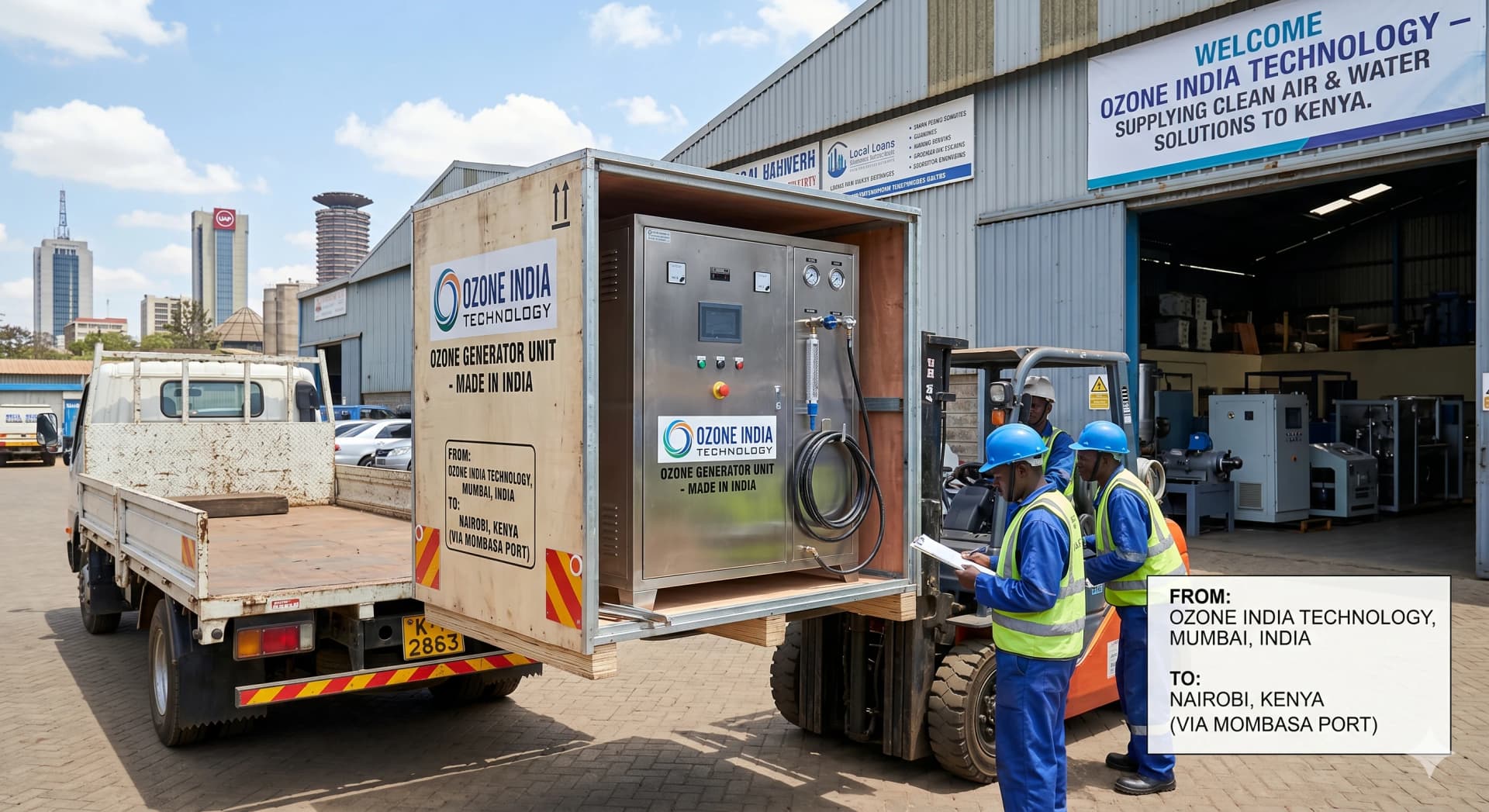
Ozone generator exporter Kenya Nairobi water treatment is a growing demand segment as Kenya's urban and peri-urban water utilities, beverage manufacturers, hospitals, and industrial facilities seek reliable, chemical-free water disinfection alternatives to chlorine — driven by WHO-documented chlorination by-product concerns, Kenya Bureau of Standards compliance requirements, and the practical limitations of chlorine supply chain reliability in East African markets. Ozone India Technology, based in Greater Noida, exports CE and ISO 9001 certified corona discharge ozone generators to Kenya, Uganda, Tanzania, and other East African markets with complete export documentation, CE compliance for KEBS import acceptance, and technical commissioning support.
Water Treatment Challenges in Kenya
WHO/UNICEF Joint Monitoring Programme Water Supply Sanitation Hygiene Report (2023) documents that Kenya's urban water supply coverage, while improving, still faces challenges of water quality consistency, treatment chemical availability, and infrastructure maintenance. Nairobi's water utility and secondary cities including Mombasa, Kisumu, and Nakuru rely on conventional chlorination for drinking water disinfection, but chlorine disinfection presents specific challenges in the Kenyan context.
Source water in Kenya's major water supply systems — the Nairobi River, Ruiru Dam, and groundwater sources — contains significant natural organic matter (NOM) from agricultural runoff and organic soil. When chlorine reacts with NOM, it forms trihalomethanes (THMs) and haloacetic acids (HAAs) — disinfection by-products that WHO Guidelines for Drinking-water Quality classify as probable human carcinogens at concentrations above guideline values of 300 μg/L (total THMs) and 60 μg/L (total HAAs). Source waters with high NOM require high chlorine doses to achieve residual disinfection, increasing DBP formation risk.
Ozone treatment of source water before filtration reduces NOM through oxidation, enabling chlorine disinfection at lower doses and reducing DBP formation. Ozone also provides stronger inactivation of Cryptosporidium and Giardia — waterborne protozoa documented in Kenya's surface water sources that are resistant to chlorine at normal treatment doses. Kenya Bureau of Standards KS EAS 12:2018 adopts WHO drinking water quality guidelines as the reference standard for Kenyan drinking water.
Export Products for the Kenyan Market
Ozone India Technology exports the following product configurations to Kenya:
Small-scale water treatment (0.5 to 5 g/hr): Corona discharge ozone generators for individual household or small community water treatment systems. Suitable for groundwater treatment, borehole water disinfection, and small packaged water operations. Input: 220V 50Hz AC (compatible with Kenya Power supply at 240V 50Hz). Ozone output configured for 0.4 to 1.0 mg/L dissolved ozone dose in 500 to 5,000 LPH flow systems.
Medium-scale industrial and commercial (5 to 50 g/hr): Suitable for hotels, hospitals, food processing facilities, and secondary water utilities. Air-fed or oxygen-fed configurations depending on ozone concentration requirements. HDPE or stainless steel contact tanks with venturi injectors.
Large-scale municipal water treatment (50 to 500 g/hr): High-capacity systems for municipal water treatment plants processing 500 to 5,000 m³/hr. Oxygen-fed systems with on-site oxygen generation (pressure swing adsorption). Complete package: ozone generator + oxygen concentrator + dissolution system + ozone destruction unit for off-gas.
Export Documentation and KEBS Compliance
Ozone India Technology provides complete export documentation for shipments to Kenya including: CE Declaration of Conformity (accepted by Kenya Bureau of Standards for imported electrical equipment), ISO 9001 certificate from accredited certifying body, IEC 60335-1 safety compliance (household and similar electrical appliances), packing list and commercial invoice, country of origin certificate from FIEO (Federation of Indian Export Organisations), and test reports for ozone output, power consumption, and safety.
Kenya Bureau of Standards (KEBS) Product Certification: Electrical equipment imported into Kenya requires KEBS Market Surveillance compliance. CE-certified products from India are accepted under KEBS product conformity assessment procedures. Ozone India Technology advises Kenyan importers on KEBS declaration requirements for each product category.
Applications in the Kenyan Hospital and Food Sector
Kenya's rapidly growing private healthcare sector — including Nairobi Hospital, Aga Khan University Hospital, and a network of county hospitals — faces the same HAI (healthcare-associated infection) challenges as Indian hospitals. Ozone laundry systems for hospital linen disinfection, ozone water treatment for CSSD (Central Sterile Supply Department) instrument reprocessing water, and UV air sterilizers for OT and ICU infection control are all applicable to Kenyan hospital settings.
Kenya's horticulture export sector — supplying cut flowers, vegetables, and processed foods to EU markets — uses ozone wash water treatment for post-harvest decontamination of produce. EU phytosanitary regulations require zero pesticide and microbial contamination in imported produce; ozone wash water treatment is an approved, chemical-residue-free method.
Kenya Water Treatment Market — Ozone Applications by Sector (%)
CE Certified Ozone Systems — Key Acceptance Standards in Africa
Frequently Asked Questions
What voltage and frequency do Kenyan facilities use?
Kenya Power supplies 240V 50Hz single-phase and 415V 50Hz three-phase power — identical to the Indian standard. Ozone India Technology equipment designed for the Indian market (220-240V 50Hz) is directly compatible with Kenyan power supply with no modification.
What is the lead time for export to Nairobi?
Standard production lead time for stocked configurations: 2 to 4 weeks. Custom-configured systems: 4 to 8 weeks. Sea freight from JNPT (Jawaharlal Nehru Port Trust, Mumbai) to Mombasa Port: 14 to 18 days transit. Total delivery to Nairobi: 6 to 10 weeks from order. Air freight available for urgent orders.
Does CE certification satisfy KEBS import requirements for ozone generators?
CE Declaration of Conformity under the Low Voltage Directive (2014/35/EU) and EMC Directive (2014/30/EU) is accepted by KEBS under Kenya's recognition of international standards. Ozone India Technology provides CE documentation in the format required for KEBS product conformity assessment. Kenyan importers are advised to confirm current KEBS requirements with their local customs broker.
Is technical support available in Kenya after installation?
Ozone India Technology provides remote technical support (video call commissioning assistance, WhatsApp technical guidance) for all export installations. For Nairobi-based clients, local authorised service partners provide on-site commissioning and maintenance. Spare parts (UV lamps, ozone cells, venturi injectors) are dispatched from Greater Noida within 48 hours of order.
What warranty applies to exported ozone generators?
Standard warranty: 24 months from date of dispatch for manufacturing defects. Warranty claims are handled by replacement of defective components dispatched to the Kenyan importer. Ozone cells (the consumable component): 12-month warranty at rated output. UV lamps: 9,000-hour performance warranty.