
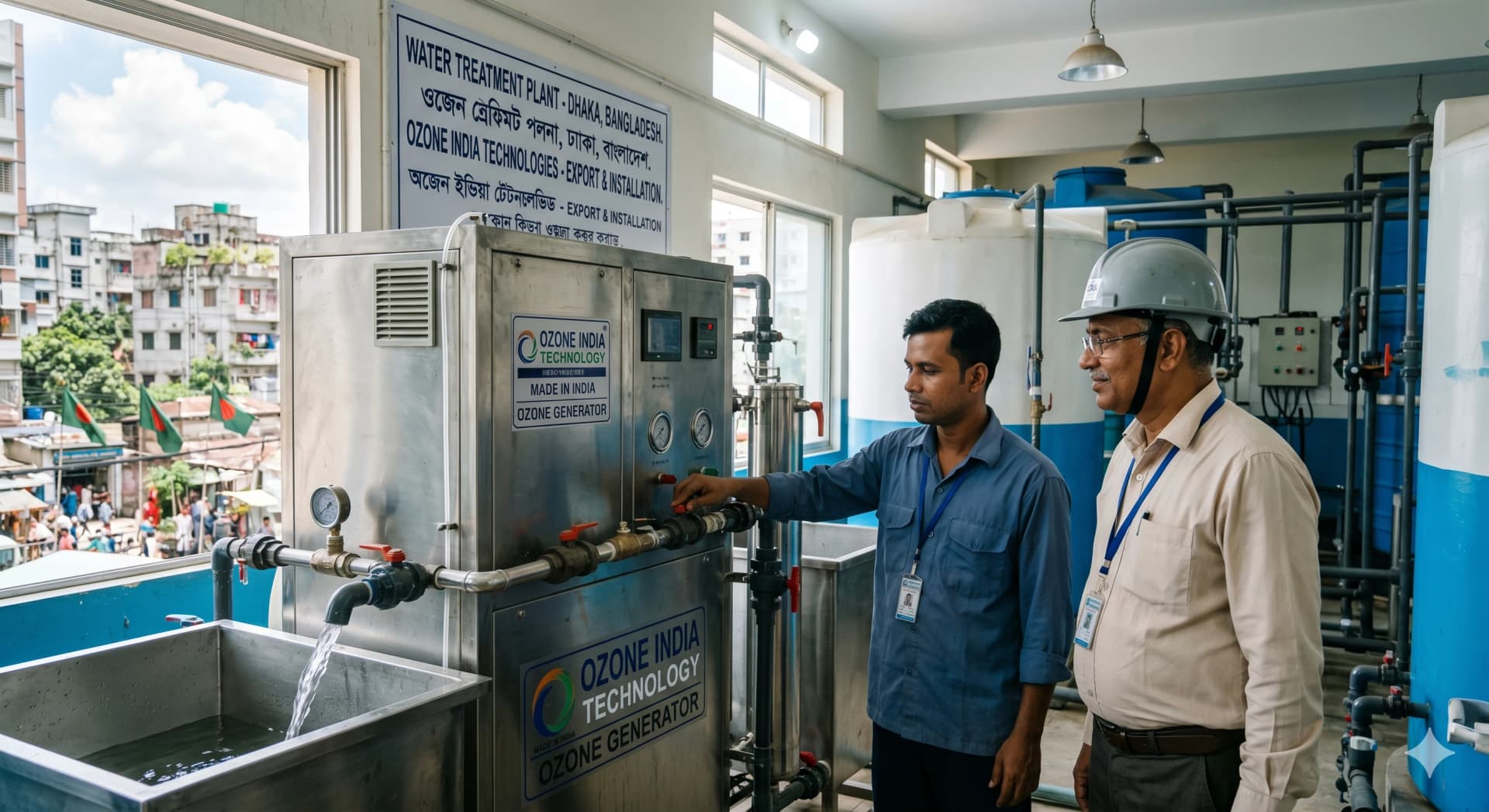
Ozone generator Bangladesh Dhaka water treatment export addresses the specific water quality challenges of the world's most densely populated delta nation — where groundwater arsenic contamination, iron and manganese in tube well water, and microbial contamination of surface water sources combine to make conventional chlorination inadequate as a sole treatment technology. Ozone India Technology, based in Greater Noida, exports CE and ISO 9001 certified ozone generators to Bangladesh, targeting the packaged drinking water sector, pharmaceutical and beverage industries in Dhaka and Chittagong, and hospital water treatment systems that require validated multi-barrier water purification.
Bangladesh Water Quality Context
WHO/UNICEF Joint Monitoring Programme (2023) documents that Bangladesh has achieved near-universal access to improved water sources, yet water quality remains a critical challenge. The Bangladesh arsenic crisis — affecting an estimated 30 to 40 million people who drink groundwater with arsenic concentrations above the WHO guideline value of 10 μg/L — is the world's largest documented case of mass poisoning through a natural chemical in drinking water. Bangladesh Standards and Testing Institution (BSTI) water quality standard adopts the WHO drinking water guidelines as the national reference.
Beyond arsenic, Bangladesh's groundwater from tube wells commonly contains elevated iron (5 to 20 mg/L), manganese (0.5 to 3 mg/L), and ammonia. Surface water from rivers and ponds in the delta is microbiologically contaminated with E. coli, cholera (Vibrio cholerae), and enteric viruses, particularly during monsoon flooding when surface water infiltrates shallow tube wells.
WHO Guidelines for Drinking-water Quality (4th Edition) document ozone as the most effective oxidant for water treatment, providing: oxidation of dissolved iron (Fe²⁺ → Fe³⁺ precipitate) at ozone doses of 0.3 to 0.5 mg/L; oxidation of dissolved manganese (Mn²⁺ → MnO₂ precipitate) at 0.5 to 1.0 mg/L; oxidation of soluble organic arsenic species (As(III) → As(V)) to insoluble forms removable by coagulation-filtration; and disinfection with 3 to 4 log inactivation of bacteria and viruses.
Ozone Treatment for Bangladesh Water Problems
Iron and manganese removal: Bangladesh's tube well water iron and manganese concentrations — significantly above the WHO aesthetic guideline values of 0.3 mg/L and 0.1 mg/L respectively — cause staining, taste problems, and microbial growth in water systems. Conventional aeration followed by sand filtration removes iron but is less effective for manganese. Ozone pre-treatment at 0.5 to 1.0 mg/L oxidises both iron and manganese to insoluble forms, enabling complete removal by subsequent filtration. This is a key technology gap in Bangladesh where simple tube well systems are inadequate.
Arsenic treatment: Ozone oxidises arsenite (As(III)) — the more mobile, more toxic form of arsenic — to arsenate (As(V)), which adsorbs strongly to iron hydroxide floc during coagulation. Combined ozone pre-treatment at 0.5 to 1.5 mg/L, coagulation with ferric chloride or ferric sulphate, and sand filtration achieves arsenic removal from >100 μg/L to below 10 μg/L (WHO guideline). Ozone India Technology designs combined ozone + coagulation + filtration systems for arsenic removal in Bangladeshi community water systems.
Microbial disinfection: Ozone at 0.4 to 1.0 mg/L in the contact tank achieves 4-log inactivation of E. coli, Vibrio cholerae, and rotavirus — the primary microbial pathogens in Bangladesh's surface water. The combination of iron/manganese removal by ozone + filtration + final ozone disinfection provides multi-barrier protection against both chemical and microbiological contamination.
Bangladesh Packaged Drinking Water Sector
Bangladesh's packaged drinking water market, valued at BDT 25,000 crore (approximately INR 18,500 crore) and growing at 8 to 10 percent annually, is dominated by several large brands but includes hundreds of smaller regional manufacturers. BSTI certification under Bangladesh Standard for Packaged Drinking Water requires ozone or UV disinfection as part of the approved production process, creating significant demand for ozone generators in Dhaka, Chittagong, Sylhet, and Rajshahi.
Ozone India Technology's 5 to 20 g/hr corona discharge generators are directly applicable to packaged water operations producing 3,000 to 20,000 litres per hour. The generators are supplied with 220V 50Hz power input compatible with Bangladesh's national grid (220-230V 50Hz) and are designed for the high ambient temperatures (up to 42°C) of the Bangladesh summer.
Export Process and Documentation
Ozone India Technology exports to Bangladesh through the established India-Bangladesh trade corridor. Export shipments proceed via sea freight from Kolkata/Haldia Port to Chittagong Port (2 to 4 days transit) or by road through the Petrapole-Benapole land border crossing under the India-Bangladesh bilateral trade agreement.
Export documentation: CE Declaration of Conformity, ISO 9001 certificate, packing list, commercial invoice, HS code classification for ozone generators under Chapter 84 (Industrial Machinery) for Bangladesh customs, country of origin certificate from EEPC India, and product technical manual in English.
Bangladesh's Import Policy Order lists ozone generators under freely importable items with standard import duty. CE marking is accepted by Bangladesh Standards and Testing Institution as evidence of product quality for electrical equipment.
Bangladesh Water Treatment — Parameter Compliance Before and After Ozone
Dhaka Market — OIT Ozone Applications by Sector (%)
Frequently Asked Questions
What ozone dose is required to treat Bangladesh tube well water for iron and arsenic?
For iron removal: 0.3 to 0.5 mg/L ozone dose per 1 mg/L dissolved iron (Fe²⁺). For arsenic As(III) to As(V) conversion: 0.5 to 1.5 mg/L ozone dose, followed by coagulation-filtration for arsenic removal to below 10 μg/L. Combined treatment system for Bangladesh tube well water: ozone + ferric coagulation + sand filtration + final UV disinfection.
Is Ozone India Technology equipment compatible with Bangladesh power supply?
Bangladesh national grid is 220-230V 50Hz single-phase and 380-415V 50Hz three-phase — compatible with Ozone India Technology equipment designed for Indian 220-240V 50Hz supply. No power supply modifications are required.
What is the import duty on ozone generators in Bangladesh?
Ozone generators classified under HS Code 8543.70.99 (Other electrical machines and apparatus) attract Bangladesh customs duty of 15 to 25 percent plus Value Added Tax (VAT) at 15 percent. Importers should verify current duty rates with a Bangladesh customs broker, as duties may change with annual budget revisions.
Does BSTI require ozone generators to be certified?
BSTI product certification for imported ozone generators is not mandatory under Bangladesh's Import Policy Order for general industrial equipment. CE certification from the exporting country is accepted as quality assurance evidence. BSTI may require testing for specific applications (packaged drinking water plant equipment). Ozone India Technology provides CE and ISO documentation supporting BSTI compliance assessment.
How long does sea freight from India to Bangladesh take?
Sea freight from Kolkata Port to Chittagong Port: 2 to 4 days transit time. Combined with customs clearance: 7 to 14 days from shipment date. Road freight via Petrapole-Benapole: 3 to 5 days including border crossing. Total delivery from order confirmation: 5 to 10 weeks including production lead time.