
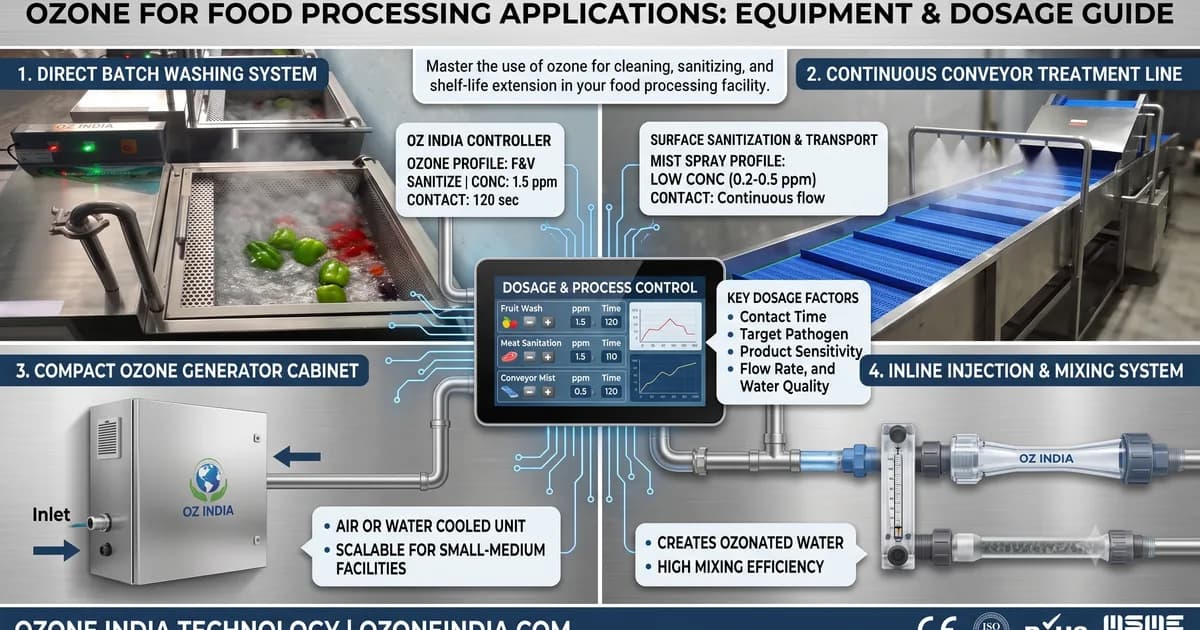
Ozone for food processing has earned GRAS (Generally Recognised As Safe) status from the US FDA for direct food contact applications since 2001, and FSSAI in India similarly recognises ozone as an approved sanitiser for food contact surfaces and produce washing. Despite this regulatory endorsement, many Indian food manufacturers still use chlorine, peracetic acid, or steam as primary disinfectants — unaware of the cost, residue, and compliance advantages that ozone for food processing delivers. This guide covers every major application: fresh produce washing, CIP systems, cold room disinfection, poultry processing, and food packaging sterilisation, with dosage tables and equipment selection criteria for each.
Why Ozone for Food Processing Outperforms Chemical Sanitisers
The core advantage of ozone for food processing over chemical alternatives comes down to three properties: oxidation power, zero residue, and multi-function action.
Ozone's oxidation potential is 2.07 V — more than three times chlorine's 0.94 V. This means ozone destroys Salmonella, E. coli O157:H7, Listeria monocytogenes, Campylobacter, and Cryptosporidium at concentrations that leave no detectable residue after 20–30 minutes (ozone decomposes to oxygen). Chlorine at comparable concentrations forms trihalomethanes and chloramines on food surfaces — regulated contaminants under FSSAI Schedule I that create legal liability for food processors.
The multi-function action of ozone for food processing extends beyond pathogen kill: ozone oxidises ethylene gas (C₂H₄) — the natural ripening hormone emitted by fruits and vegetables — extending shelf life by 30–40%. Ozone eliminates processing odours in plant environments. Ozone destroys biofilms on food contact surfaces that chlorine sanitisers merely suppress. And ozone for food processing requires no neutralisation or disposal step — the sanitiser simply becomes oxygen.
Log Reduction of Key Food Pathogens — Ozone vs Chlorine at Equal Contact Time
Fruit and Vegetable Washing — Dosage and Equipment
Fresh produce washing is the highest-volume application of ozone for food processing in India. Exported vegetables, fresh-cut produce, and packaged salads all require pathogen reduction to meet importing country standards (EU Regulation (EC) No 2073/2005 for microbiological criteria; USFDA FSMA Produce Safety Rule).
Ozone Dosage for Produce Washing
| Produce Type | Dissolved Ozone Dose | Contact Time | Pathogen Reduction |
|---|---|---|---|
| Leafy vegetables | 0.5–1.0 mg/L | 3–5 minutes | 3-log Salmonella |
| Root vegetables | 1.0–2.0 mg/L | 5–10 minutes | 4-log E. coli |
| Soft fruits | 0.3–0.5 mg/L | 2–3 minutes | 3-log mould/yeast |
| Sprouts | 2.0–3.0 mg/L | 5–10 minutes | 5-log E. coli O157:H7 |
| Berries | 0.2–0.4 mg/L | 2 minutes | 2-log Salmonella |
Wash water temperature below 10°C maximises ozone solubility (Henry's law — ozone solubility increases 40% from 20°C to 5°C) while also reducing metabolic rate of surviving bacteria, improving overall hygiene.
Ozone India Technology's ozone fruit and vegetable washing machine is a complete integrated unit combining the ozone generator, dissolution system, washing conveyor, and water recirculation — calibrated at the factory for 1.0–1.5 mg/L dissolved ozone in wash water. The unit processes 200–500 kg/hour of mixed produce and requires only a water connection and 3-phase power supply for installation.
CIP (Clean-In-Place) Disinfection in Food Plants
Ozonated water CIP is the most cost-effective and chemically clean approach to food contact surface disinfection in dairy, beverage, and food ingredient processing. Conventional CIP uses caustic (NaOH), acid (HNO₃/H₃PO₄), and hot water (80°C steam) — consuming large volumes of chemicals, generating waste requiring neutralisation, and requiring 60–90 minute cycle times.
Ozone for food processing CIP replaces the hot water/chemical rinse with ozonated water at 2–3 mg/L, circulated for 15–20 minutes at ambient temperature. The ozone oxidises residual organic matter (proteins, fats, sugars) on tank and pipeline walls, achieving 6-log bacteria reduction without chemical residue. No hot water boiler needed. No chemical disposal. No neutralisation rinse. Post-ozone rinse is potable water only.
Application-Specific CIP Ozone Dosage
| Facility Type | Ozone Dose | Circuit Volume | Ozone Generator Needed |
|---|---|---|---|
| Small dairy (5,000 L/day) | 2 mg/L | 500L | 2–5 g/hr |
| Beverage plant (50,000 L/day) | 2.5 mg/L | 2,000L | 10–15 g/hr |
| Fruit juice processing | 3 mg/L | 5,000L | 25–30 g/hr |
| Large dairy (200,000 L/day) | 2 mg/L | 10,000L | 50–75 g/hr |
The ozone generator 5g/hr light industrial covers small dairy and food processing CIP applications. Larger plants use the ozone generator 10-25g/hr industrial series. All Ozone India Technology ozone generators for food processing CIP include dissolved ozone monitoring output to verify sanitiser concentration in the circuit before and during circulation.
Ozone Dose Required by Food Processing Application (mg/L dissolved ozone)
Cold Storage Ozone Treatment — Shelf Life Extension
Cold room ozone for food processing operates on a fundamentally different principle than wash water applications. In cold storage, ozone is used in gaseous form at very low concentrations (0.05–0.3 ppm in air) to:
- Eliminate surface mould and bacteria on stored produce — 99.99% mould spore kill at 0.1 ppm continuous exposure
- Oxidise ethylene gas (C₂H₄) — delays ripening by 70% at 0.1 ppm ozone, extending shelf life by 30–40%
- Eliminate odours — oxidises volatile organic compounds from decomposing produce before they spread to other stored goods
The ozone concentration in cold storage must remain below the OSHA workplace exposure limit (0.1 ppm TWA) for worker safety. Ozone India Technology ozone ambient air monitors are installed as standard with all cold room ozone systems, providing continuous monitoring with alarm at 0.05 ppm and automatic generator shutdown at 0.1 ppm.
Cold Storage Sizing
Cold room ozone generator capacity (g/hr) = Room volume (m³) × 0.05 mg/m³ × Ventilation factor (3–5×) ÷ 1000
For a 500 m³ cold room with moderate ventilation (4× air changes/hour), a 2g/hr generator operates intermittently (40% duty cycle) to maintain 0.05–0.1 ppm continuously. The ozone generator 2g/hr portable is the most commonly specified unit for cold rooms below 2,000 m³.
Poultry Processing — Pathogen Reduction Without Chemical Residue
Ozone for food processing in poultry plants addresses the most critical food safety challenge in the industry: Salmonella and Campylobacter contamination at the chill stage. The EU and US food safety authorities have consistently documented that chlorinated water chilling reduces Salmonella by only 1–2 log, leaving 10²–10⁴ CFU/g on carcass surfaces. Ozonated water chilling at 1–2 mg/L achieves 5-log Salmonella reduction — leaving no detectable pathogen burden on processed poultry entering the cold chain.
For Indian poultry processors targeting export markets (Gulf, EU), ozone for food processing chill tank treatment achieves the microbiological standards of Regulation (EC) No 853/2004 Annex II without the chemical residue that European importers reject in chlorine-washed poultry.
Air ozonation in poultry processing rooms (at 0.05–0.1 ppm) simultaneously:
- Reduces airborne Salmonella and Campylobacter cross-contamination between carcasses
- Eliminates ammonia and processing odours — improving worker environment and FSSAI compliance
- Controls Listeria in cooler environments where conventional sanitisers are ineffective at 4°C
Packaging and Surface Disinfection
UV conveyor sterilization systems complement ozone for food processing in two specific applications:
-
Packaged food surface sterilisation — UV-C at 254nm sterilises the exterior surface of sealed food packages (bottles, cartons, films) on the production line, achieving 4-log surface kill without moisture, temperature, or chemical effects on packaging materials.
-
Food contact surface sterilisation — UV-C panels installed in conveyor lines and transfer points provide continuous surface disinfection without stopping production.
The combination of ozone (for water and air disinfection) and UV (for surface and packaging sterilisation) provides complete food safety coverage across all contamination pathways in a modern food processing facility.
Shelf Life Extension (%) with Ozone Cold Storage vs Conventional Refrigeration
FSSAI Compliance and Documentation
Ozone for food processing must be implemented with proper documentation to demonstrate FSSAI compliance during audits and export certification inspections. Ozone India Technology supplies:
- Ozone concentration calibration certificates — traceable to NABL accredited standards
- CE certification — EU Machinery Directive compliance for export customers
- ISO 9001:2015 manufacturing certificate — quality management system compliance
- Operating manuals — in English with FSSAI-relevant sections on ozone GRAS status, monitoring requirements, and safety protocols
The FSSAI food safety audit checklist specifically includes sanitiser validation as a Critical Control Point (CCP) under HACCP. Ozone for food processing CCP records include dissolved ozone concentration logs (automatically generated by the ozone monitor), equipment maintenance records, and staff training certificates — all provided by Ozone India Technology as part of commissioning documentation.
Equipment Selection Guide — Ozone for Food Processing
| Application | Ozone Generator | Monitoring | Accessories |
|---|---|---|---|
| Produce washing (<500 kg/hr) | Ozone Fruit Veg Washing Machine | Built-in dissolved monitor | None required |
| CIP system (small plant) | 2–5g/hr | Dissolved ozone monitor | Venturi injector |
| CIP system (large plant) | 10–25g/hr | Dissolved ozone monitor | Static mixer, recirculation pump |
| Cold room (up to 1,000 m³) | 2g/hr | Ambient air monitor | PVDF pipe, timer control |
| Cold room (1,000–5,000 m³) | 5g/hr | Ambient air monitor + dissolved | PVDF pipe |
| Poultry chill tank | 5–10g/hr | Dissolved ozone monitor | Venturi injector, air diffuser |
| Surface spray system | 5g/hr | Dissolved ozone monitor | Recirculation pump, nozzle manifold |
For ozone for food processing applications requiring equipment selection support, contact Ozone India Technology engineering at [email protected] or WhatsApp +91 96500 17943. Our food processing specialists can recommend the correct system configuration for your plant layout, production volumes, and FSSAI compliance requirements.
See also the food processing application page for complete application details, and cold storage ozone treatment for dedicated cold room system information.
Annual Operating Cost Comparison — Ozone vs Chemical Sanitisers (per 1000 m³ processed water)
Conclusion
Ozone for food processing is not a niche technology — it is the most cost-effective, compliant, and food-safe disinfection method available across every food processing application from fresh produce to cold storage to CIP. With FSSAI GRAS recognition, US FDA approval since 2001, and proven performance data across thousands of global food processing installations, ozone for food processing represents the standard of care that India's growing food export industry must adopt to compete in EU, US, and Gulf markets.
Ozone India Technology manufactures CE and ISO 9001:2015 certified ozone generators, fruit and vegetable washing machines, UV conveyor sterilisation systems, and ambient/dissolved ozone monitors — all manufactured in Greater Noida and available across India with installation support. Request a free ozone for food processing consultation and equipment quotation from our engineering team today.
