
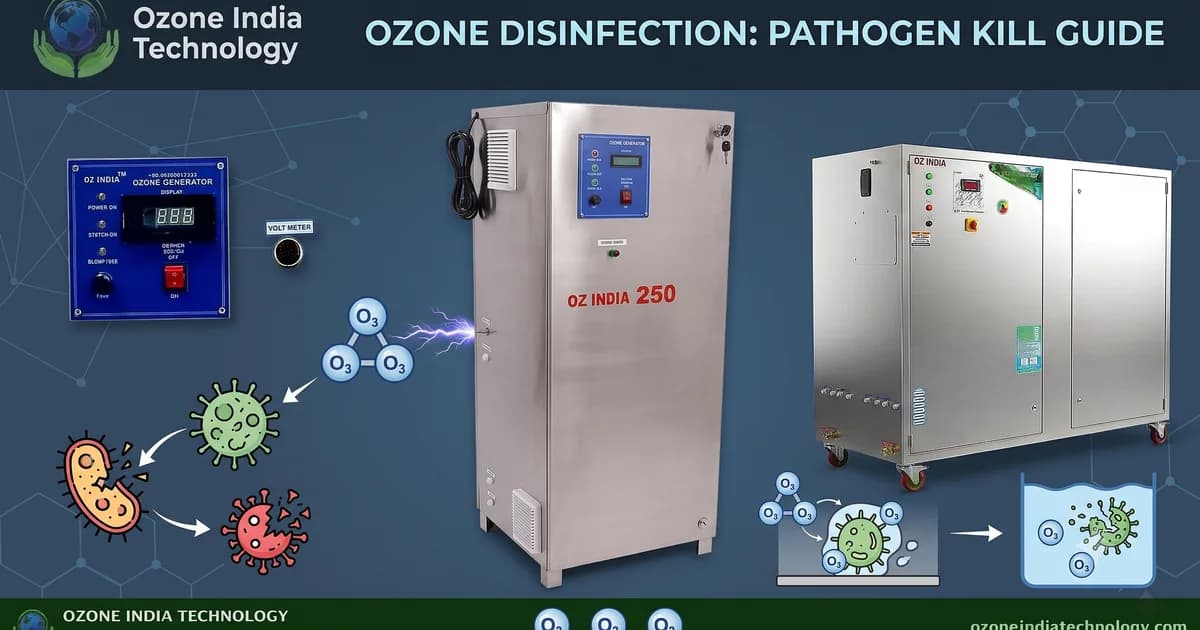
Ozone disinfection is a water and air treatment process that uses dissolved ozone (O₃) to inactivate bacteria, viruses, protozoa, and other pathogens through chemical oxidation — without adding chlorine, bleach, or other disinfectant chemicals that leave residues in water or on food surfaces. Recognised by the World Health Organization (WHO), US Environmental Protection Agency (US EPA), FSSAI, and CPCB as an approved disinfection method, ozone disinfection is used in municipal drinking water plants serving hundreds of millions of people globally, in pharmaceutical purified water systems, in food processing for produce washing and CIP, in swimming pools, and in wastewater reuse treatment. This guide explains what ozone disinfection is, how ozone kills bacteria and viruses at the molecular level, the CT values required for each pathogen class, how it compares with chlorine and UV disinfection, and where it is most effectively applied.
What is Ozone Disinfection?
Ozone disinfection is the application of dissolved ozone (O₃) in water at a sufficient concentration and for a sufficient contact time to achieve a target log inactivation of a target pathogen. The effectiveness of ozone disinfection is quantified by the CT value:
CT (mg·min/L) = Concentration (mg/L) × Time (minutes)
A CT value of 0.5 mg·min/L at 0.1 mg/L dissolved ozone requires 5 minutes of contact time. At 0.5 mg/L dissolved ozone, the same CT is achieved in 1 minute. Different pathogens require different CT values — and ozone's primary advantage over chlorine is its vastly lower CT requirement for resistant protozoa like Cryptosporidium and Giardia.
Ozone disinfection differs from ozone oxidation: disinfection targets pathogens specifically, while oxidation targets organic compounds, colour, taste and odour compounds, and micropollutants. In practice, the same ozone treatment achieves both simultaneously.
How Ozone Kills Bacteria
Ozone kills bacteria through a fundamentally different mechanism than chlorine — and this difference explains why ozone is more effective against many resistant organisms.
Mechanism 1 — Cell wall oxidation: The bacterial cell wall is a complex structure of peptidoglycan (in gram-positive bacteria) or lipopolysaccharide outer membrane (in gram-negative). Ozone is a powerful oxidant (reduction potential +2.07 V) that attacks and ruptures these cell wall structures through electrophilic reactions with double bonds in the organic polymers. Once the cell wall is breached, the cytoplasmic contents leak out and the bacterium cannot maintain osmotic pressure — death is irreversible.
Mechanism 2 — Enzyme inactivation: Even before the cell wall is fully ruptured, ozone oxidises the sulphhydryl (-SH) groups on bacterial enzymes — particularly the respiratory chain enzymes — rendering them non-functional. Bacteria cannot conduct cellular respiration and die.
Mechanism 3 — DNA oxidation: At higher ozone concentrations, ozone and its decomposition product the hydroxyl radical (·OH) attack the purine and pyrimidine bases of bacterial DNA, causing strand breaks that prevent replication. This is a tertiary mechanism that follows cell wall and enzyme damage.
Result: Ozone achieves >4-log (99.99%) inactivation of E. coli, Salmonella, Listeria, Pseudomonas aeruginosa, and most common waterborne pathogenic bacteria at CT values of 0.2–1.0 mg·min/L — achievable at dissolved ozone concentrations of 0.1–0.3 mg/L in 3–10 minutes of contact time.
Ozone CT Values for Pathogen Inactivation vs Chlorine CT (mg·min/L for 3-log kill)
How Ozone Inactivates Viruses
Viruses are structurally simpler than bacteria — they have no cell wall and consist of a protein coat (capsid) surrounding nucleic acid (DNA or RNA). Ozone inactivates viruses through:
Capsid protein oxidation: Ozone attacks the amino acids in the viral capsid, particularly cysteine (sulphhydryl) and tryptophan residues. The capsid loses structural integrity, exposing the nucleic acid to the aqueous environment and making it non-infective.
Nucleic acid damage: Ozone and ·OH radicals directly damage viral RNA and DNA — causing chain breaks and base modifications that prevent viral replication even if the capsid remains partially intact.
Lipid envelope oxidation (for enveloped viruses): Enveloped viruses (influenza, coronavirus, hepatitis B, HIV) have a lipid bilayer envelope surrounding the capsid. Ozone rapidly peroxidises the unsaturated fatty acids in this envelope — the virus loses the ability to fuse with host cell membranes and cannot infect.
Critical point — adenovirus: Most human viruses (rotavirus, hepatitis A, MS2 bacteriophage surrogate) are inactivated by ozone at CT 10–40 mg·min/L. Adenovirus is an exception — it requires CT 40–80 mg·min/L at 254nm UV or high ozone doses. For drinking water applications where adenovirus is a concern (surface water sources), polychromatic medium-pressure UV combined with ozone is the recommended approach.
How Ozone Inactivates Protozoa — The Chlorine-Resistant Pathogens
This is ozone's most significant public health advantage: ozone is the only practical disinfectant for Cryptosporidium parvum in water treatment.
Cryptosporidium parvum causes cryptosporidiosis — severe diarrhoeal disease with high mortality in immunocompromised patients. Its thick-walled oocysts (resistant cysts) resist chlorine even at very high doses for very long contact times (CT 7,200 mg·min/L — not achievable in a water treatment plant). The 1993 Milwaukee Cryptosporidium outbreak infected over 400,000 people from a chlorinated water supply — the water met all chlorine residual standards but Cryptosporidium passed through.
Ozone against Cryptosporidium: CT 5.8 mg·min/L achieves 2-log (99%) inactivation of Cryptosporidium at 20°C (US EPA LT2ESWTR). At 0.5 mg/L dissolved ozone and 12 minutes contact time, the CT requirement is met. This is why the US EPA's Long Term 2 Enhanced Surface Water Treatment Rule (LT2ESWTR) explicitly awards log credits for UV and ozone treatment of Cryptosporidium — no chlorine credit applies.
Giardia lamblia is also chlorine-resistant relative to bacteria, requiring CT 150 mg·min/L with chlorine vs 1.5 mg·min/L with ozone — a 100-fold advantage for ozone.
Log Inactivation Achieved at 5 mg·min/L CT — Ozone vs Chlorine
Ozone Disinfection vs Chlorine vs UV — When to Use Which
| Parameter | Ozone | Chlorine | UV |
|---|---|---|---|
| Cryptosporidium | Effective (CT 5.8) | Not effective (CT 7,200) | Very effective (10 mJ/cm²) |
| Giardia | Effective (CT 1.5) | Moderate (CT 150) | Effective (3.3 mJ/cm²) |
| Bacteria | Excellent | Excellent | Excellent |
| Viruses | Excellent | Good | Good (except adenovirus) |
| Biofilm removal | Excellent | Poor | None |
| Taste/odour removal | Excellent | Worsens (chlorophenols) | None |
| Residual disinfection | Short (ozone decays) | Long-lasting | None |
| Chemical residue on food | None | Detectable | None |
| Disinfection byproducts | Bromate (if Br⁻ present) | THMs, HAAs | None |
Best practice: Municipal water treatment plants worldwide use ozone + UV in sequence: ozone for primary disinfection, Cryptosporidium and Giardia inactivation, and organics removal, followed by UV for final polishing and a small chlorine/chloramine residual for distribution system protection.
Regulatory Recognition of Ozone Disinfection
WHO: WHO Guidelines for Drinking Water Quality (4th edition, 2017) recognise ozone as an approved primary disinfectant for drinking water, with CT values specified for key pathogens.
US EPA: The Surface Water Treatment Rule (SWTR) and Long Term 2 Enhanced Surface Water Treatment Rule (LT2ESWTR) award log inactivation credits for ozone treatment. US FDA recognised ozone as GRAS for food contact under 21 CFR §173.368 in 2001.
CPCB / BIS: BIS IS 10500:2012 (drinking water quality standard) permits ozone as a primary disinfectant. CPCB guidelines for STP treated water reuse (GNSS 2015) recognise ozone disinfection for achieving reuse-grade water quality.
FSSAI: Ozone is approved as a food contact sanitiser under FSSAI Food Safety and Standards Regulations for washing fresh produce, CIP of food processing equipment, and cold storage air disinfection.
Pathogen Inactivation by Disinfectant at Equal CT = 5 mg·min/L (log reduction)
Where Ozone Disinfection is Applied
Drinking water plants: Ozone is the disinfectant of choice for surface water treatment where Cryptosporidium and Giardia are present. Major cities in France, Germany, Netherlands, USA, and increasingly India use ozone as the primary disinfectant for municipal water supply.
Swimming pools: Ozone destroys chloramines (the source of pool smell and eye irritation), inactivates Cryptosporidium that chlorine cannot address, and allows chlorine reduction to 0.5–1.0 mg/L free residual. See our ozone swimming pool guide.
Food processing: Produce washing (0.5–2 mg/L dissolved ozone), seafood processing water treatment, CIP of food contact surfaces. Approved by FSSAI and FDA with no residue concern.
Pharmaceutical water: Ozone storage loop sanitisation for Purified Water (PW) and Water for Injection (WFI) systems. Ozone at 0.1–0.2 mg/L prevents biofilm formation in pharmaceutical water loops — compliant with USP <1231> and WHO GMP.
Wastewater reuse: STP final effluent polishing to achieve CPCB reuse standards — ozone at 2–3 mg/L achieves <100 MPN/100mL faecal coliforms required for unrestricted agricultural reuse.
Conclusion
Ozone disinfection is the most powerful practical disinfection technology available for water treatment — exceeding chlorine in efficacy against resistant protozoa by 100-fold, in speed of action against bacteria and viruses, and in producing no chemical residue on treated water or food. Its primary limitations (no long-lasting residual, bromate formation risk in high-bromide water) are well understood and managed by combining ozone with a small downstream chlorine residual and bromide monitoring where required. Ozone India Technology manufactures CE and ISO 9001:2015 certified ozone generators from 2g/hr to 10kg/hr for the full range of drinking water, wastewater, food safety, and pharmaceutical disinfection applications. For sizing and technical consultation, contact [email protected] or WhatsApp +91 96500 17943. Use our ozone dosage calculator for instant capacity estimates.
