
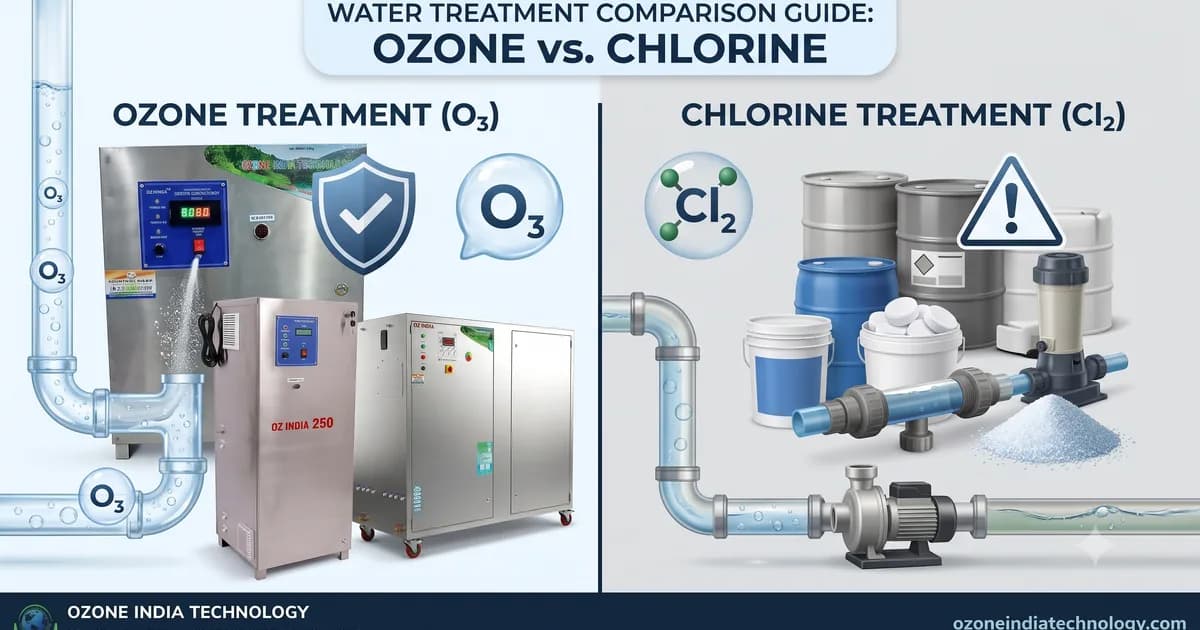
Every industrial water treatment plant in India faces the same decision when commissioning or upgrading disinfection: ozone vs chlorine water treatment. Chlorine — as sodium hypochlorite (liquid bleach) or chlorine gas — has been the default disinfectant for over a century. Ozone has been used in European municipal water treatment since the 1900s and has become the standard for industrial STP, ETP, and WTP in India over the last decade. This guide gives you a direct, data-driven comparison of ozone vs chlorine water treatment across the parameters that matter for industrial plant operators: disinfection efficacy, disinfection byproducts (DBPs), CPCB and BIS compliance, 5-year operating cost, safety requirements, and which technology is right for each application type.
Disinfection Efficacy — Ozone vs Chlorine Water Treatment
Ozone wins the disinfection comparison by a large margin. The key metric is CT value — the product of disinfectant concentration (mg/L) and contact time (minutes) required to achieve a specified log-reduction of a target pathogen.
| Pathogen | Ozone CT for 4-log kill | Chlorine CT for 4-log kill | Ozone advantage |
|---|---|---|---|
| E. coli | 0.02 mg·min/L | 0.08 mg·min/L | 4× faster |
| Cryptosporidium | 5 mg·min/L | >7,200 mg·min/L | Not practical with chlorine |
| Giardia | 0.5 mg·min/L | 15 mg·min/L | 30× faster |
| Norovirus | 1 mg·min/L | 12 mg·min/L | 12× faster |
| Legionella | 0.1 mg·min/L | 0.4 mg·min/L | 4× faster |
For CPCB Class A STP compliance (fecal coliform <100 MPN/100mL from 10⁵ MPN/100mL in secondary effluent), ozone achieves the required 3-log reduction at CT = 1.5 mg·min/L — achievable with 0.3 mg/L dissolved ozone at 5 minutes contact time. The same reduction with chlorine requires 30+ minutes at 2 mg/L — which demands a much larger contact tank and leaves chlorine residual in the discharged effluent.
For Cryptosporidium — a chlorine-resistant protozoan that causes cryptosporidiosis — ozone is the only practical disinfectant. Indian surface water sources increasingly show Cryptosporidium contamination. Ozone at 0.5 mg/L for 10 minutes achieves >3-log Cryptosporidium inactivation; chlorine cannot achieve this at any practical concentration.
CT Value Required for 4-Log Pathogen Inactivation — Ozone vs Chlorine
Disinfection Byproducts — The Critical Regulatory Difference
Ozone vs chlorine water treatment diverges most sharply on disinfection byproducts (DBPs). This is where chlorine's long-term regulatory risk lies.
Chlorine DBPs: When chlorine reacts with natural organic matter (humic acids, fulvic acids) present in all surface water, it forms regulated carcinogenic compounds:
- Trihalomethanes (THMs): Chloroform, bromodichloromethane, dibromochloromethane — classified as Group B2 human carcinogens by US EPA. BIS IS:10500 (2012) limits: 0.1 mg/L total THMs.
- Haloacetic Acids (HAAs): Dichloroacetic acid, trichloroacetic acid — associated with liver tumours in animal studies. WHO guideline: 0.05 mg/L each.
- Chloramines: When chlorine reacts with ammonia in secondary effluent — relevant for STP effluent discharging to rivers used for downstream drinking water abstraction.
Many Indian municipal WTPs treating surface water with chlorine regularly exceed the BIS IS:10500 THM limit of 0.1 mg/L, particularly in the post-monsoon period when river NOM (natural organic matter) is elevated.
Ozone DBPs: Ozone's primary byproducts from oxidation of organic matter are oxygen, carbon dioxide, and simple organic acids (formic acid, acetic acid) that are biodegradable and harmless at water treatment doses. The one significant ozone DBP is bromate (BrO₃⁻) — formed when ozone reacts with naturally occurring bromide ions. WHO guideline for bromate: 0.01 mg/L. Bromate is only a concern in waters with elevated bromide (>0.1 mg/L). Indian groundwater typically has bromide <0.02 mg/L; bromate formation is rarely an issue in Indian ozone installations.
5-Year Operating Cost — Ozone vs Chlorine Water Treatment
For a 1 MLD STP operating continuously:
| Cost Component | Chlorine (NaOCl 10%) | Ozone |
|---|---|---|
| Chemical cost (annual) | ₹9.6–14.4 lakh | Zero |
| Electricity (annual) | ₹0.5 lakh (dosing pump) | ₹4.5–6.5 lakh |
| Maintenance (annual) | ₹1–2 lakh | ₹1.2–1.8 lakh |
| Safety equipment (MSDS, PPE, scrubber) | ₹0.8–1.2 lakh | ₹0.3–0.5 lakh |
| Total annual operating cost | ₹12–18 lakh | ₹6–9 lakh |
| Capital cost | ₹2–4 lakh | ₹15–25 lakh |
| 5-year total cost | ₹62–94 lakh | ₹45–70 lakh |
Ozone vs chlorine water treatment cost advantage: 30–40% lower 5-year total cost at 1 MLD scale. At 5 MLD and above, the advantage increases to 45–55% lower 5-year cost due to economy of scale in ozone generator electricity consumption and reduced per-unit chemical savings.
Annual Operating Cost — Ozone vs Chlorine for STP Treatment (₹ lakh/year)
CPCB and BIS Compliance — Ozone vs Chlorine Water Treatment
Both ozone and chlorine can achieve CPCB and BIS compliance for water and wastewater treatment. The compliance advantages of ozone:
BIS IS:10500 Drinking Water:
- THM compliance: Ozone produces no THMs → automatic compliance. Chlorine requires careful dose control and often carbon filtration post-chlorination to meet 0.1 mg/L THM limit.
- Colour and turbidity: Ozone's oxidation of iron, manganese, and organic colour compounds reduces colour to <5 Hazen units.
- Taste and odour: Ozone oxidises taste and odour compounds (geosmin, 2-methylisoborneol) at 0.2–0.5 mg/L — chlorine amplifies taste complaints at high doses.
CPCB Class A STP Effluent:
- Fecal coliform <100 MPN/100mL: Both ozone and chlorine achieve this. Ozone requires 15–20 minute contact at 0.3 mg/L. Chlorine requires 30+ minutes at 2 mg/L.
- Residual chlorine constraint: CPCB standards require <0.5 mg/L residual chlorine in discharged effluent. High-dose chlorination requires dechlorination step (sodium thiosulfate or sodium bisulphite) adding cost and process complexity. Ozone leaves no residual — no dechlorination required.
Safety Requirements — Ozone vs Chlorine
Chlorine handling involves significant occupational safety risk:
- Sodium hypochlorite (liquid): corrosive, releases chlorine gas if mixed with acids or heated; requires enclosed storage, safety shower, MSDS compliance
- Chlorine gas cylinders: highly toxic at >1 ppm (OSHA IDLH: 10 ppm), requires cylinder storage protocols, scrubber systems, emergency response plans; Factory Act compliance under schedule of hazardous chemicals
Ozone safety requirements are simpler:
- Ozone generator room requires an ambient air monitor (alarm at 0.1 ppm, shutdown at 0.3 ppm OSHA STEL) — Ozone India Technology includes the ozone ambient air monitor as standard
- No chemical storage; no cylinder handling; no spill containment tanks required
- The ozone destructor on the contact chamber vent ensures no ozone emission to the work environment
Payback Period — Ozone Capital Investment vs Chlorine Chemical Savings (years)
Which Technology to Choose — Ozone vs Chlorine Decision Guide
Choose ozone when:
- Treatment scale is >100 m³/day (capital cost justified by chemical savings)
- Source water contains Cryptosporidium, Giardia, or high NOM (THM risk with chlorine)
- BIS IS:10500 THM compliance is a concern (surface water WTP)
- CPCB Class A STP discharge with no dechlorination budget
- Food processing CIP or produce washing (zero chemical residue required)
- ETP colour removal (ozone achieves 80–95% vs 40–60% for chlorine)
- Export market compliance (EU, US, Japan — no chlorine residue tolerance)
Retain chlorine when:
- Long distribution network (>5 km) where residual disinfection is critical — use post-ozone chlorination at 0.2 mg/L for residual maintenance
- Very small systems (<10 m³/day) where ozone capital cost is not recoverable
- Emergency backup — chlorine tablets can maintain disinfection during generator downtime
For most Indian industrial applications above 200 m³/day, ozone vs chlorine water treatment calculates in ozone's favour within 18–36 months. Use the ozone dosage calculator to calculate your specific project payback. For a detailed ozone vs chlorine comparison for your plant, contact Ozone India Technology at [email protected] or WhatsApp +91 96500 17943.
