
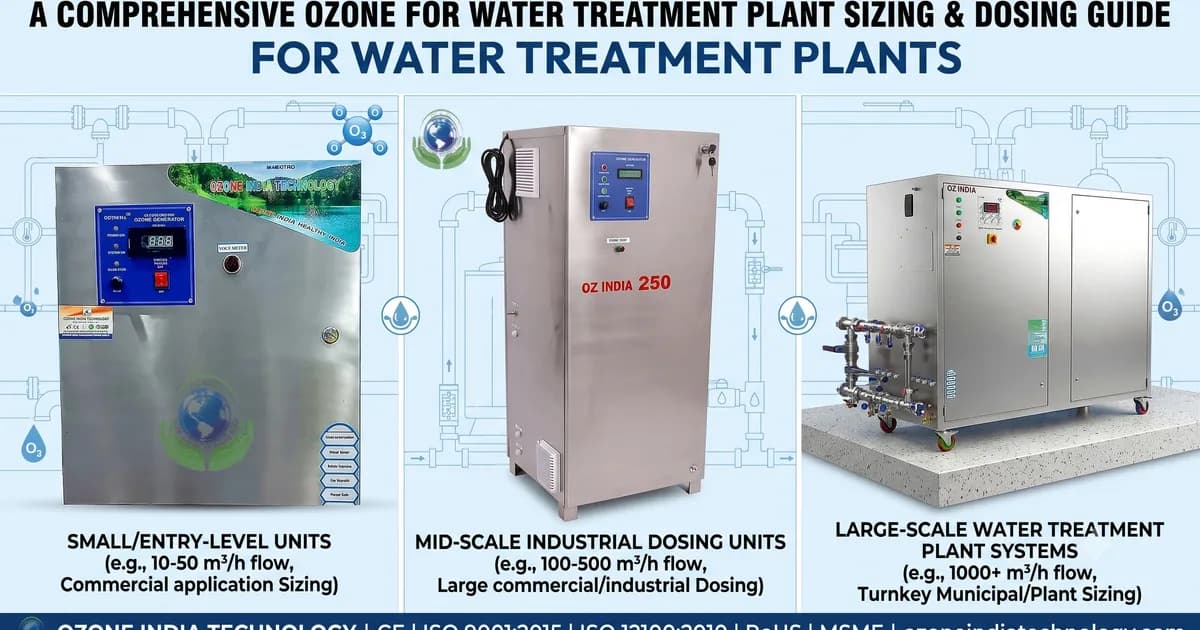
Ozone for water treatment plant design is one of the most technically demanding decisions a plant engineer faces. Unlike chlorination — which has a century of practice behind it — ozone for water treatment plant applications requires precise sizing, contact chamber design, and CT value calculation to achieve consistent regulatory compliance. This guide covers everything an engineer or project manager needs to know: dose selection, generator capacity calculation, contact system design, ozone versus chlorine economics, and Indian regulatory standards.
Why Ozone for Water Treatment Plant Applications Is Growing in India
India's water infrastructure is under pressure from three directions simultaneously: rising raw water contamination, stricter discharge standards, and the failure of chlorination to control Cryptosporidium and Giardia. The Central Pollution Control Board's revised General Standards and IS:10500 Drinking Water Standard together create a compliance requirement that chlorination alone cannot consistently meet.
Ozone for water treatment plant tertiary disinfection achieves 4-log (99.99%) coliform inactivation, eliminates taste and odour compounds at doses as low as 0.5 mg/L, and removes iron and manganese through oxidative precipitation — without forming trihalomethanes (THMs) or haloacetic acids. The WHO Guidelines for Drinking Water Quality (4th Edition) recognises ozone as the most powerful primary disinfectant available for potable water treatment, capable of inactivating Cryptosporidium parvum — the most chlorine-resistant waterborne pathogen — at CT values achievable in standard contact chambers.
India's Smart Cities Mission, Jal Jeevan Mission, and Namami Gange programme collectively mandate advanced water treatment for over 4,700 urban local bodies. Ozone for water treatment plant installations has grown at over 20% per year in India since 2018, driven by NGT enforcement orders, CPCB compliance audits, and the inability of chlorination to meet reuse standards for treated effluent.
Pathogen Log Inactivation at Different Ozone Doses (CT = 30 mg·min/L, pH 7, 20°C)
Understanding Ozone Dose Requirements by Application
The ozone dose for water treatment plant applications is not fixed — it depends on the source water quality, treatment objective, and target discharge or consumption standard. Indian engineers frequently make the error of applying a single "standard" dose from a literature value without accounting for site-specific raw water quality. This leads to either over-dosing (wasted electricity) or under-dosing (non-compliance).
Drinking Water Treatment (IS:10500 / FSSAI IS:14543)
For drinking water, ozone for water treatment plant pre-ozonation targets iron and manganese oxidation. Surface water with dissolved iron above 0.3 mg/L and manganese above 0.05 mg/L requires ozone doses of 0.5–1.0 mg/L. The oxidised precipitates are then removed by filtration. Post-filtration ozonation for disinfection typically uses 0.2–0.4 mg/L with 10–15 minutes contact time, achieving a CT of 2–6 mg·min/L — sufficient for 4-log coliform inactivation and 2-log Giardia inactivation per WHO guidelines.
Packaged drinking water plants under FSSAI IS:14543 require ozone as the terminal disinfectant. The standard mandates zero coliform in finished water, detectable ozone residual at the point of filling, and ozone concentration documentation in quality records. Ozone India Technology has commissioned ozone for water treatment plant systems at 50+ packaged water facilities across India, including plants supplying institutional and municipal customers.
Sewage Treatment Plant Tertiary Treatment (CPCB Class A)
Ozone for water treatment plant in STP tertiary treatment requires 2–5 mg/L to achieve CPCB Class A standards (BOD <10 mg/L, COD <50 mg/L, fecal coliform <100 MPN/100mL) from typical secondary effluent quality. Higher doses of 4–6 mg/L are needed when pharmaceutical compounds, hormones, or recalcitrant industrial co-mingled waste are present.
Effluent Treatment Plant (CPCB CETP Standards)
Ozone for water treatment plant in ETP applications requires 3–8 mg/L for textile dye colour removal, 5–10 mg/L for pharmaceutical API degradation, and 2–4 mg/L for food processing BOD reduction. Ozone contact must follow biological secondary treatment — direct ozone application to high-strength raw industrial effluent is economically prohibitive.
Ozone Generator Sizing: The Engineering Calculation
The fundamental sizing equation for ozone for water treatment plant capacity selection is:
Q (g/hr) = F (m³/hr) × D (mg/L) × SF × 0.001
Where:
- Q = ozone generator capacity in grams per hour
- F = plant design flow rate in cubic metres per hour
- D = ozone dose in milligrams per litre
- SF = safety factor (typically 1.25–1.5 for variable quality raw water)
Worked Example — Municipal WTP, 10 MLD
For a 10 MLD water treatment plant at peak flow (1.25× average) with 1.5 mg/L ozone dose:
- Peak flow = 10 × 1.25 / 24 = 520 m³/hr
- Ozone capacity = 520 × 1.5 × 1.3 × 0.001 = 1,014 g/hr ≈ 1 kg/hr
An ozone generator 1kg/hr from Ozone India Technology in oxygen-fed configuration covers this plant with appropriate margin. For N+1 redundancy, two 600g/hr units (ozone generator 600g/hr) operating in parallel — with one in standby — is the standard municipal design.
Ozone Generator Capacity Required vs WTP Flow Rate (2 mg/L dose, 1.3 safety factor)
For WTPs between 2 MLD and 10 MLD, the ozone generator 75-350g/hr heavy industrial range covers most designs. Plants below 2 MLD typically use the ozone generator 10-25g/hr industrial series.
Contact Chamber Design and CT Value Calculation
A correctly sized ozone generator is necessary but not sufficient for compliant ozone for water treatment plant operation. The contact chamber must achieve the required CT value under the most demanding operating conditions: minimum flow, maximum temperature, and minimum ozone dose.
CT (mg·min/L) = C × T
Where:
- C = residual dissolved ozone concentration at the contact chamber outlet (mg/L)
- T = hydraulic retention time (HRT) of the contact chamber (minutes)
Contact Chamber Sizing
Volume (m³) = Design flow (m³/hr) × HRT (hours) ÷ 60
For a 5 MLD STP at 20-minute HRT: Volume = 208 m³/hr × 20 min ÷ 60 = 69 m³
The existing chlorine contact tank can almost always be repurposed as the ozone contact chamber — eliminating civil construction costs in retrofit ozone for water treatment plant projects. The chamber must be covered (ozone vapour confined) and equipped with an ozone off-gas destructor.
Plug Flow vs Complete Mix
Plug flow contact chambers achieve the design CT at lower ozone doses than complete-mix chambers. Dividing the contact chamber into 4–6 compartments using baffles creates plug flow conditions, reducing ozone consumption by 20–30% for the same disinfection performance. Ozone India Technology supplies baffle designs with each contact chamber proposal — verified by hydraulic CFD modelling for projects above 5 MLD.
Ozone Transfer Systems: Venturi vs Diffuser
Two technologies transfer ozone gas into water in ozone for water treatment plant installations:
Venturi Injectors
Venturi injectors use the Bernoulli principle — water pressure difference creates vacuum that draws ozone gas into the water stream. Transfer efficiency of 85–95%. No moving parts. Low maintenance. Suitable for pressurised pipeline injection upstream of contact chambers. Ozone India Technology ozone Venturi injectors are PVDF-bodied, rated for 0.5–10 bar operating pressure.
Fine Bubble Diffusers
Porous ceramic or PVDF air diffusers create fine bubbles (0.5–2mm diameter) with high surface-to-volume ratio for gas transfer. Installed in the base of ozone contact chambers. Transfer efficiency of 80–90%. Preferred for open-channel contact basins. Ozone India Technology ceramic diffusers are rated for ozone concentrations up to 12% w/w.
Ozone vs Chlorine: Capital and Operating Cost Comparison
The capital cost premium of ozone for water treatment plant installations over chlorination is recovered in 3–5 years through operating cost savings, chemical handling elimination, and reusable effluent revenue.
Annual Operating Cost per MLD — Ozone vs Chlorine Water Treatment
Chlorine cost is increasing 8–12% annually in India due to global chlorine supply constraints. Ozone operating cost depends only on electricity — which, at ₹5–7/kWh for industrial consumers, is more predictable. For STPs with treated water reuse programmes, ozone for water treatment plant tertiary treatment generates revenue of ₹15–30/kL for landscape reuse water — transforming an operating cost into a partial revenue stream.
Monitoring and Control for Regulatory Compliance
Every ozone for water treatment plant system must include:
Dissolved Ozone Monitor
The dissolved ozone monitor with contactor support measures residual ozone at the contact chamber outlet (0–2 mg/L range, ±2% accuracy). The 4–20 mA output feeds back to the ozone generator PLC, maintaining the target residual automatically despite flow and load variations. Data logging for 30 days provides compliance documentation for CPCB inspection.
Ambient Air Safety Monitor
The ozone ambient air monitor detects ozone leakage in the operator zone. Alarm at 0.05 ppm (WHO TWA limit) and automatic generator shutdown at 0.1 ppm (OSHA TWA limit). Required in all enclosed spaces where ozone generators or contact chambers operate.
Off-Gas Destructor
Ozone off-gas from the contact chamber contains 0.5–2% unreacted ozone — far above the 0.1 ppm ambient limit. The catalytic ozone destructor (MnO₂ catalyst, ambient temperature operation) reduces off-gas ozone to <0.1 ppm before venting. Ozone India Technology supplies ozone destructors sized for maximum generator output as standard with all WTP and STP ozone packages.
Use the ozone dosage calculator to generate a site-specific sizing recommendation based on your flow rate, raw water quality, and target standard.
CT Values Required for 4-Log Inactivation of Key Pathogens (pH 7, 20°C)
The CT table above illustrates why ozone for water treatment plant disinfection is essential for Cryptosporidium control: chlorine requires CT of 7,200 mg·min/L (impractical in any WTP), while ozone achieves 2-log inactivation at CT of 12 mg·min/L — achievable with 20-minute contact at 0.6 mg/L residual ozone.
Installation Considerations for Indian WTP Conditions
Power Supply
Ozone generators for WTP applications are sized for 3-phase 415V 50Hz supply. Single-phase 230V generators are available for pilot plants and small (below 5g/hr) installations only. Ozone India Technology recommends a dedicated transformer for ozone generator installations above 25g/hr to prevent voltage fluctuation impact on corona discharge cell performance.
Air Preparation
Air-fed ozone generators require dried compressed air at -60°C pressure dew point. A refrigeration dryer (to -40°C) followed by a desiccant dryer (to -60°C) is standard for Indian climate where ambient humidity can reach 90% in monsoon season. Water ingress into the corona discharge cell causes immediate cell damage — moisture control is the single most important reliability factor for ozone for water treatment plant air-fed systems.
For WTP flows above 5 MLD, oxygen-fed generators using the PSA oxygen generator reduce specific energy consumption from 12–15 kWh/kg ozone to 7–9 kWh/kg — a 40% energy saving that pays for the oxygen generator in 18–24 months at typical Indian electricity rates.
Ozone for Water Treatment Plant: Project Delivery
Ozone India Technology delivers ozone for water treatment plant systems on a turnkey basis from our Greater Noida manufacturing facility:
- Site assessment — raw water quality analysis, flow measurement, existing infrastructure survey
- Engineering proposal — sizing calculations, P&ID, electrical single-line diagram, civil requirements
- Equipment supply — CE-certified ozone generator, air/oxygen preparation, contact system, monitoring instruments
- Installation and commissioning — at your plant location, anywhere in India
- Operator training — 2-day programme covering operation, maintenance, and safety
- Warranty and AMC — 1-year comprehensive warranty, followed by annual maintenance contract options
Contact us at [email protected] or WhatsApp +91 96500 17943 for a free ozone for water treatment plant sizing consultation and techno-commercial proposal within 2 business days.
Conclusion
Ozone for water treatment plant applications in India has moved from a premium technology to the standard for regulatory compliance. The combination of Cryptosporidium control, zero chemical residue, THM-free operation, and reusable effluent quality makes ozone the only technology that simultaneously meets CPCB, NGT, and reuse standards. With total-cost-of-ownership analysis showing payback in 3–5 years, and operating cost 30% below chlorination at current chemical prices, ozone for water treatment plant investment is justified by economics alone — before accounting for the compliance risk eliminated. Ozone India Technology brings 10+ years and 500+ installations of ozone for water treatment plant experience to every project.
