
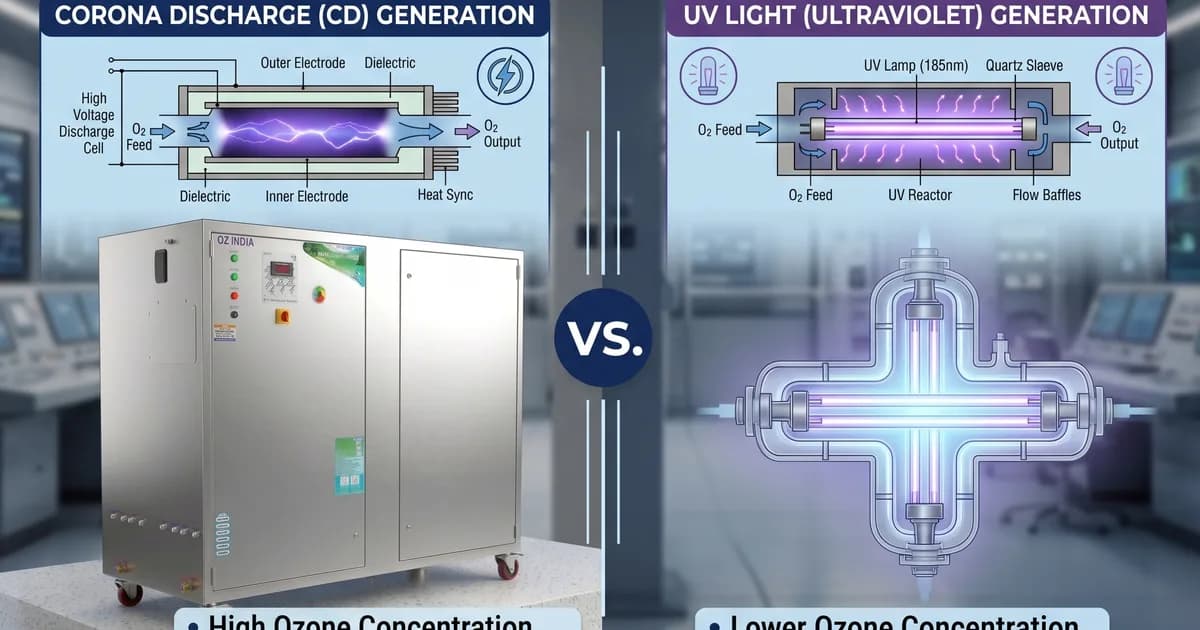
Corona discharge vs UV ozone generator is the most important technology decision for any industrial ozone system purchase. The choice determines ozone output capacity, energy efficiency, operating cost, and application suitability — for the entire life of the system. Ozone India Technology — CE and ISO 9001:2015 certified manufacturer since 2014, serving 150,000+ clients across 15+ countries — has prepared this complete technical comparison to help engineers, procurement managers, and plant operators choose the right technology for their application.
This guide covers:
- How corona discharge and UV ozone generators work
- Output capacity and ozone concentration compared side by side
- Energy efficiency and 10-year operating cost comparison
- Application suitability — STP, ETP, food processing, pharmaceutical, swimming pool
- Selection criteria and sizing table
- CE and ISO certification requirements for industrial procurement
What Is a Corona Discharge Ozone Generator?
A corona discharge ozone generator produces ozone by passing dry air or oxygen through a high-voltage electrical field between two dielectric-coated electrodes. The electrical discharge — named for its visual resemblance to the solar corona — splits O₂ molecules into individual oxygen atoms, which then recombine with remaining O₂ to form O₃.
The technical parameters that define industrial corona discharge performance:
- Ozone concentration: 1–3% by weight from dry air; 3–8% by weight from pure oxygen feed
- Output range: 2g/hr (small commercial) to 10,000g/hr (large municipal plant)
- Feed gas requirement: Dried ambient air to −60°C dew point, or industrial oxygen
- Energy consumption: 8–15 Wh per gram of ozone on dry air feed
- Cell design: Plate cells, cylindrical tube cells, or modular multi-cell arrays
- Operating lifetime: 10,000–30,000 hours on dielectric electrodes
According to the International Ozone Association, over 95% of all industrial-scale ozone installations worldwide use corona discharge technology. This is not coincidence — it reflects the fundamental engineering advantage of corona discharge at any output above 5g/hr.
Ozone India Technology manufactures corona discharge ozone generators in 27 standard capacities from 2g/hr to 10kg/hr. Every unit carries CE certification (CE-2621A) under EU Machinery Directive 2006/42/EC and is manufactured under ISO 9001:2015. View the full range of corona discharge ozone generators.
What Is a UV Ozone Generator?
A UV ozone generator exposes ambient air to 185nm ultraviolet radiation — a specific wavelength that photodissociates O₂ molecules. The freed oxygen atoms then combine with remaining O₂ to form O₃.
Key technical parameters for UV ozone:
- Ozone concentration: 0.05–0.3% by weight — 10 to 30 times lower than corona discharge
- Output per lamp: 0.05–0.5g/hr per 185nm UV lamp
- Maximum practical output: Approximately 3–5g/hr using multiple lamps
- Energy consumption: 30–60 Wh per gram of ozone — 3 to 5 times less efficient than corona discharge
- Feed gas: Ambient air, no drying required at this output level
- Operating lifetime: 8,000–15,000 hours per lamp
UV ozone generators are simple, low-maintenance units suited to residential water treatment, small aquariums, and domestic air purification. For any industrial application requiring more than 5g/hr of ozone, UV ozone technology is not a viable option — the number of lamps required, combined with their power draw and low concentration output, make UV ozone generators physically and economically unsuitable.
Critical distinction: UV-C disinfection systems operating at 254nm — which directly inactivate pathogens through DNA damage — are a completely different technology. This comparison addresses only UV ozone generators (185nm), not UV-C water or air disinfection systems.
Corona Discharge vs UV Ozone Generator: Side-by-Side Comparison
The corona discharge vs UV ozone generator comparison comes down to scale, concentration, and efficiency:
| Parameter | Corona Discharge | UV Ozone |
|---|---|---|
| Output range | 2g/hr – 10,000g/hr | 0.1g/hr – 5g/hr |
| Ozone concentration | 1–8% by weight | 0.05–0.3% by weight |
| Energy efficiency | 8–15 Wh/g O₃ | 30–60 Wh/g O₃ |
| Feed gas | Dry air (−60°C dew point) or O₂ | Ambient air |
| Industrial scale | ✅ 2g/hr to 10kg/hr | ❌ Maximum ~5g/hr |
| Water treatment (STP/ETP) | ✅ Industry standard | ❌ Not suitable above 2 MLD |
| Swimming pool | ✅ 5–50g/hr standard | ⚠️ Only pools < 20,000L |
| Food processing | ✅ 10–100g/hr | ❌ Not viable |
| CE certification | ✅ Industrial CE available | ⚠️ Typically residential grade only |
| Capital cost (10g/hr) | ₹80,000–1,50,000 | Not applicable (20+ lamps needed) |
Energy Efficiency: Why Corona Discharge Wins at Scale
When evaluating corona discharge vs UV ozone generator systems at industrial capacity, energy consumption is the decisive factor.
A corona discharge ozone generator producing 10g/hr consumes approximately 150–200W of electrical power. To achieve the same output from UV lamps, you would need 20–40 lamp assemblies consuming 1,000–2,400W — a 5 to 12 times energy penalty.
At 100g/hr — a typical output for a medium municipal STP or large hotel ETP — a corona discharge unit operates at 1.5–2.0kW total. UV ozone at this output level would be physically impossible to achieve economically; the lamp count would fill an entire plant room.
10-year operating cost comparison at 100g/hr (8,760 hours/year, ₹8/kWh):
| Technology | Power Draw | Annual Cost | 10-Year Cost |
|---|---|---|---|
| Corona discharge | 2kW | ₹1,40,160 | ₹14,01,600 |
| UV ozone (theoretical) | 20kW | ₹14,01,600 | ₹1,40,16,000 |
The 10-year energy saving from a corona discharge ozone generator at 100g/hr is approximately ₹1.26 crore compared to UV technology — more than enough to justify the higher capital investment in corona discharge equipment. This efficiency advantage compounds directly with system size.
Energy Consumption: Corona Discharge vs UV Ozone at Equal Output
Ozone Concentration: Why It Matters for Water Treatment
Ozone concentration in the feed gas directly determines how effectively ozone transfers into water — and this is where the corona discharge ozone generator holds a decisive advantage over UV ozone for water treatment applications.
At 3% ozone concentration (typical dry-air corona discharge output), transfer efficiency into water via venturi injector is 70–85%. When oxygen-fed corona discharge systems produce 6% ozone, transfer efficiency rises to 85–95%.
UV ozone at 0.1–0.3% concentration transfers into water at only 30–50% efficiency. The low concentration creates a significant mass-transfer limitation — ozone cannot overcome the back-pressure at a venturi or diffuser to dissolve into water at adequate rates. For any dissolved ozone application, the WHO Guidelines for Drinking-water Quality establish dissolved ozone residual requirements that only corona discharge systems can reliably achieve at plant scale.
Practical consequence: A UV ozone generator rated at 3g/hr may deliver only 1.5g/hr dissolved ozone into water. A corona discharge system rated at 3g/hr delivers 2.5–2.8g/hr dissolved — nearly double the actual treatment capacity at the same stated rating.
Dissolved Ozone Transfer Efficiency: Corona Discharge vs UV Ozone
Application Suitability: Corona Discharge vs UV Ozone Generator
Sewage Treatment Plants (STP) and Effluent Treatment Plants (ETP)
For STP and ETP applications, the corona discharge ozone generator is the only industrially viable technology. CPCB regulations for STP effluent require BOD below 10mg/L and TSS below 10mg/L — ozone dosing at 5–15mg/L achieves this alongside pathogen elimination.
Municipal STPs processing 2–50 MLD require 10–500g/hr of ozone. Ozone India Technology manufactures the complete range: 10g/hr for 2 MLD plants, 50g/hr for 10 MLD plants, 100g/hr for 20 MLD plants, through to 1kg/hr and 10kg/hr for large municipal installations. Learn more about ozone for sewage treatment.
Swimming Pools
Commercial swimming pools and water parks require 5–50g/hr of ozone depending on pool volume and peak bathing load. CE ISO certified corona discharge ozone generators at 5g/hr, 10g/hr, and 25g/hr are the global standard for hotel, resort, and public pool applications. UV ozone generators are appropriate only for private pools under 20,000 litres.
Food Processing and Cold Storage
Ozone for food processing applications — fruit and vegetable washing, cold room decontamination, slaughterhouse disinfection, and packaged food storage — requires 10–100g/hr at consistent concentration. Only corona discharge technology delivers this output reliably. Ozone concentration from corona discharge ensures effective pathogen reduction — 3-log reduction of E. coli and Salmonella at 1–2mg/L dissolved ozone contact — that UV ozone cannot match at industrial throughput.
Pharmaceutical Purified Water
WHO GMP guidelines for pharmaceutical Purified Water (PW) and Water for Injection (WFI) require ozone sanitisation of storage and distribution loops at 0.05–0.2mg/L dissolved ozone. This requires continuous corona discharge ozone generation at 5–25g/hr with precise output control and real-time dissolved ozone monitoring.
Air Treatment and Odour Control
For room decontamination, cold storage disinfection, and odour control systems, both corona discharge and UV ozone generators are applicable at small scale (under 5g/hr). For large industrial odour control in waste processing facilities, chemical plants, or food manufacturing — requiring 10g/hr or more — corona discharge is the only option.
Ozone Application Market Split — Corona Discharge Systems (%)
Capacity Selection Guide: Matching Technology to Application
| Application | Volume / Throughput | Required Ozone | Recommended System |
|---|---|---|---|
| Residential drinking water | < 500 LPH | < 1g/hr | UV ozone acceptable |
| Small hotel / clinic | 500–2,000 LPH | 2–5g/hr | Corona 2g/hr or 5g/hr |
| Swimming pool (hotel/resort) | 50,000–500,000 L | 5–25g/hr | Corona 5–25g/hr |
| Small STP (housing society) | 1–2 MLD | 5–10g/hr | Corona 10g/hr |
| Medium STP / ETP | 2–10 MLD | 25–50g/hr | Corona 25–50g/hr |
| Large STP / municipal WTP | 10–50 MLD | 100–500g/hr | Corona 100–500g/hr |
| Pharmaceutical PW loop | 500–5,000 LPH | 5–25g/hr | Corona 5–25g/hr |
| Food washing (commercial) | 500–5,000 kg/hr | 25–100g/hr | Corona 25–100g/hr |
| Municipal water plant | > 50 MLD | 500g/hr–10kg/hr | Corona 1kg–10kg/hr |
For applications in the 2–5g/hr range where both technologies are technically possible, the correct choice depends on your budget, required ozone concentration, and whether UV lamp maintenance is acceptable for your operation. Ozone India Technology recommends corona discharge for all applications — the reliability, concentration, and long-term operating economy consistently outperform UV ozone even at the smallest scale.
CE and ISO Certification: What Industrial Procurement Requires
For industrial procurement in India — CPCB compliance for STP/ETP, FSSAI compliance for food processing, NAFDAC for Nigeria, KEBS for Kenya — CE certification is a qualification threshold that UV residential ozone generators do not meet.
Every corona discharge ozone generator from Ozone India Technology ships with:
- CE-2621A — CE Marking under EU Machinery Directive 2006/42/EC and Low Voltage Directive 2014/35/EU
- ISO 9001:2015 — Quality Management System certificate (UQ-270426AD1)
- ISO 12100 — Machinery safety standard certificate
- RoHS Compliance — Restriction of hazardous substances declaration
- Test Report — Factory performance test at rated capacity before dispatch
For government tenders, DPR submissions, and bank-financed projects, CE ISO documentation is mandatory. View our complete certification documentation.
Ozone Generator Capital Cost vs Output Capacity (₹ per g/hr)
Conclusion: Choosing Between Corona Discharge vs UV Ozone Generator
The corona discharge vs UV ozone generator decision simplifies to one question: what is your required output?
For any application above 5g/hr — which includes virtually all industrial, commercial, and municipal ozone applications — corona discharge is the only technology that works. For small residential or micro-commercial applications under 2g/hr, UV ozone offers simplicity with acceptable performance.
Ozone India Technology specialises in CE ISO certified corona discharge ozone generators from 2g/hr to 10kg/hr — the full industrial range. We have supplied corona discharge systems for STP/ETP treatment, municipal water plants, pharmaceutical purified water loops, hotel swimming pools, food processing wash systems, and cold storage odour control across India, Kenya, UAE, Bangladesh, Nigeria, and 10+ additional export markets.
Every corona discharge ozone generator we manufacture is factory-tested for 72 hours before dispatch, carries a 12-month warranty on the corona discharge cell, and is backed by our WhatsApp technical support team for remote commissioning and troubleshooting.
To discuss your specific application and receive a free sizing proposal for a corona discharge ozone generator, contact our technical team, call +91 96500 17943, or WhatsApp the same number. We respond to all technical enquiries within 4 business hours.
