
The sharp chlorine smell and red eyes that swimmers associate with "chlorine pools" are not caused by chlorine itself — they are caused by chloramines, the compounds formed when chlorine reacts with ammonia from swimmer sweat, urine, and body oils. An ozone-treated pool typically has no detectable chlorine smell, crystal-clear water, and zero eye irritation — because ozone destroys chloramines faster than they form. Ozone for swimming pool has been standard in Olympic competition pools (Munich 1972 was the first Olympic ozone-treated pool), hotel pools in Europe, and water parks globally for decades. In India, hotel pools, club pools, and private pools are now adopting ozone as pool operators experience the operating cost advantage (60–70% less chlorine chemical use) and the guest satisfaction improvement of odour-free, non-irritating pool water. This guide covers how ozone pool treatment works, sizing for pool volumes from 25,000 to 2,500,000 litres, and the complete installation approach.
How Ozone Works in a Swimming Pool
Ozone is introduced into pool water in a sidestream configuration — it never enters the pool directly as high-concentration ozone gas. The system works as follows:
Sidestream flow: 15–30% of the pool's total recirculation flow is diverted from the return line through a dedicated ozone contact circuit. For a pool with 50 m³/hr recirculation, 8–15 m³/hr is directed to the ozone sidestream.
Ozone injection: Ozone gas from the generator is injected into the sidestream water at a venturi injector — creating dissolved ozone at 1–4 mg/L in the sidestream water.
Contact chamber: The ozonated sidestream passes through a 30–60 second contact chamber (a SS316L tank with baffles). In the contact chamber:
- Ozone kills bacteria and viruses at >4-log (99.99%) rate — E. coli, Pseudomonas aeruginosa (the cause of swimmer's ear), Cryptosporidium, Giardia
- Ozone oxidises chloramines (combined chlorine) — converting dichloramine and trichloramine (which cause the pool smell and eye irritation) back to free chlorine and nitrogen gas
- Ozone flocculates fine particles and turbidity — no chemical clarifier needed
Return to pool: The treated water leaves the contact chamber with dissolved ozone residual at 0.02–0.05 mg/L — safe for swimmers. Chlorine maintains 0.5–1.0 mg/L free chlorine residual in the pool for continuing disinfection between recirculation cycles.
Pool Water Quality — Ozone vs Conventional Chlorination (mg/L)
Benefits of Ozone for Swimming Pool
No more pool smell: The chlorine odour in poorly managed pools is dichloramine (NH₂Cl₂) and trichloramine (NCl₃) — formed when free chlorine combines with ammonia from swimmers. Ozone destroys these compounds within seconds. Ozone-treated pools smell like fresh water — not chemicals.
No eye and skin irritation: Eye redness and skin dryness are caused by chloramines and high chlorine concentration — not pool water itself. Ozone-treated pools maintain combined chlorine <0.2 mg/L (vs 0.5–1.0 mg/L in conventional pools). The result: swimmers with sensitive eyes and skin can use ozone pools without irritation.
Cryptosporidium protection: Cryptosporidium is resistant to chlorine at normal pool concentrations (CT requirement >7,200 mg·min/L — not achievable in a pool). Ozone inactivates Cryptosporidium at CT = 5 mg·min/L — achievable in the contact chamber. Ozone is the only practical disinfectant for Cryptosporidium in pool water.
60–70% less chlorine: With ozone handling primary disinfection and chloramine destruction, the pool only needs 0.5–1.0 mg/L free chlorine for residual maintenance (vs 1.5–3.0 mg/L without ozone). Chemical spend drops 60–70%. pH adjustment chemical (sodium carbonate/HCl) also reduces because ozone-treated pools have more stable pH.
Better water clarity: Ozone micro-flocculates fine colloidal particles — reducing turbidity without clarifier chemicals. This is why competition pools using ozone achieve <0.1 NTU clarity.
Sizing Ozone Generator for Swimming Pool
Pool ozonation sizing uses the sidestream flow approach:
Formula: Q (g/hr) = Sidestream flow (m³/hr) × Ozone dose (mg/L) × Safety factor ÷ 1000
Sidestream flow = 15–20% of pool recirculation rate Ozone dose in sidestream: 2–4 mg/L (higher for heavily loaded pools) Safety factor: 1.2
Residential pool (50,000 litres, 10 m³/hr recirculation): Sidestream: 2 m³/hr. Q = 2 × 3 × 1.2 ÷ 1000 = 0.0072 kg/hr = 7.2 g/hr → Ozone generator 5g/hr running continuously
Club/hotel pool (200,000 litres, 40 m³/hr recirculation): Sidestream: 8 m³/hr. Q = 8 × 3 × 1.2 ÷ 1000 = 0.029 kg/hr = 29 g/hr → Ozone generator 10-25g/hr at 30g/hr setting
Large aquatic centre (2,500,000 litres, 500 m³/hr recirculation): Sidestream: 100 m³/hr. Q = 100 × 3 × 1.2 ÷ 1000 = 360 g/hr → Ozone generator 75-350g/hr at maximum output or two units
Ozone Generator Capacity for Swimming Pool by Pool Volume (g/hr)
Pool Ozonation System Design
Equipment List for a Complete Pool Ozonation System
- Ozone generator (sized per above)
- Sidestream pump: Draws pool water from the recirculation return line for the ozone sidestream. Stainless steel 316L pump.
- Ozone venturi injector: Injects ozone gas into the sidestream flow. PVDF construction — ozone compatible.
- Contact chamber: SS316L baffled tank. Volume = sidestream flow × contact time (30–60 sec). Example: 8 m³/hr sidestream × 60 sec ÷ 3600 = 0.13 m³ = 130 litre contact chamber.
- Ozone destructor: On the contact chamber off-gas vent — destroys undissolved ozone before venting to the pool plant room.
- Ozone ambient air monitor: In the pool plant room — mandatory for worker safety. Alarm at 0.1 ppm.
- Dissolved ozone monitor at return line: Verifies residual at pool return is <0.05 mg/L before water enters the pool.
- Control system: PLC integrates ozone generator output with pool recirculation flow, dissolved ozone feedback, and ambient monitor safety shutdown.
BIS IS 3552 and WHO Pool Water Standards
BIS IS 3552 (Swimming Pools — Safety Code) and WHO Guidelines for Safe Recreational Water Environments (Volume 2) both set:
- Free chlorine: 1–3 mg/L (with ozone: 0.5–1.0 mg/L is sufficient and BIS-compliant)
- Combined chlorine (chloramines): <0.5 mg/L (with ozone: typically <0.15 mg/L)
- pH: 7.2–7.8
- Turbidity: <0.5 NTU (with ozone: typically <0.2 NTU)
- E. coli: Not detected / <1 MPN/100mL
Ozone-treated pools consistently meet or exceed BIS IS 3552 parameters. The CPCB does not regulate pool water quality directly — state Public Health Engineering Department standards apply.
Annual Chemical Cost — Pool with Ozone vs Conventional Chlorination (₹ lakh/year)
Installation and Commissioning
Pool ozonation retrofits to existing pool systems require:
- Tapping into the pool recirculation return line (before the pool inlet) for the sidestream
- Adding the sidestream pump, venturi, and contact chamber in the pool plant room
- Running a small-bore silicone/PVDF tube from the ozone generator to the venturi
- Connecting the ambient air monitor to the generator control panel (auto-shutoff wiring)
- Commissioning: set target sidestream dissolved ozone (1–3 mg/L at contact chamber outlet), verify pool return dissolved ozone <0.05 mg/L, verify ambient air monitor alarm and shutoff function, adjust chlorine dosing down to 0.5–1.0 mg/L free chlorine target
Commissioning typically takes one day for a club or hotel pool. Ozone India Technology provides commissioning support remotely (video call) or on-site through regional service partners.
Conclusion
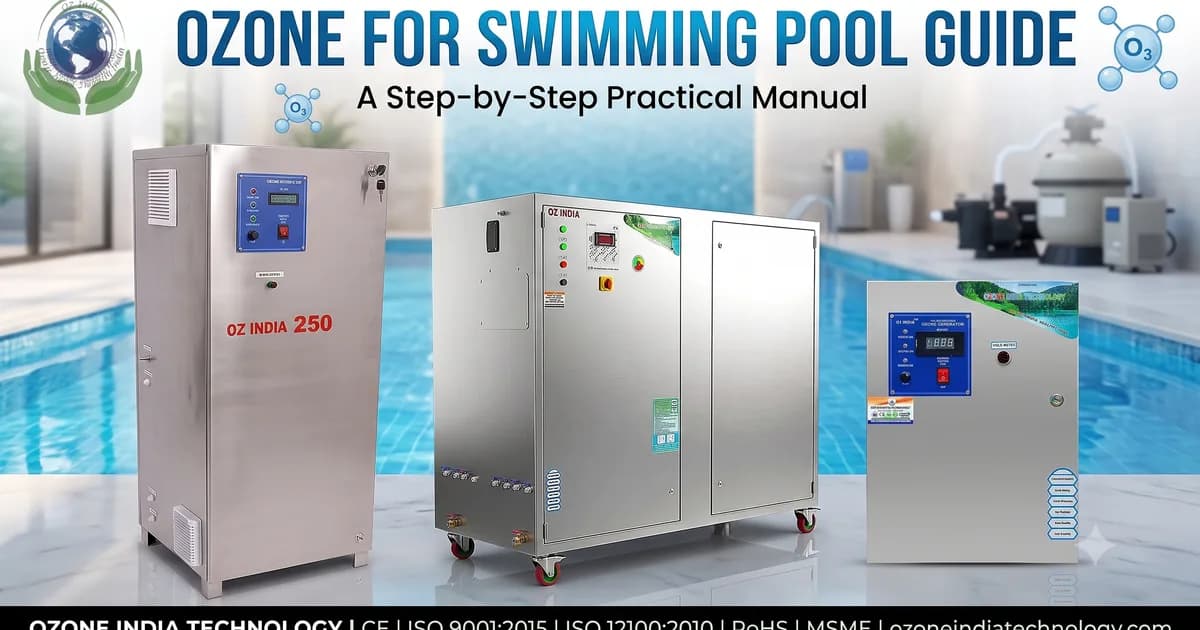
Ozone for swimming pool eliminates the pool smell, eye irritation, and excess chlorine chemical use that define the conventional pool experience — delivering WHO and BIS IS 3552 compliant water quality that pools previously achieved with significantly higher chemical loads. Ozone India Technology's pool ozonation systems — from the 5g/hr unit for residential pools to the 350g/hr system for large aquatic centres — are CE certified, include the ozone destructor and ambient air monitor as standard, and are available with installation support across India and export markets. For a pool ozonation quotation, contact [email protected] or WhatsApp +91 96500 17943 with your pool volume and daily operating hours.
