
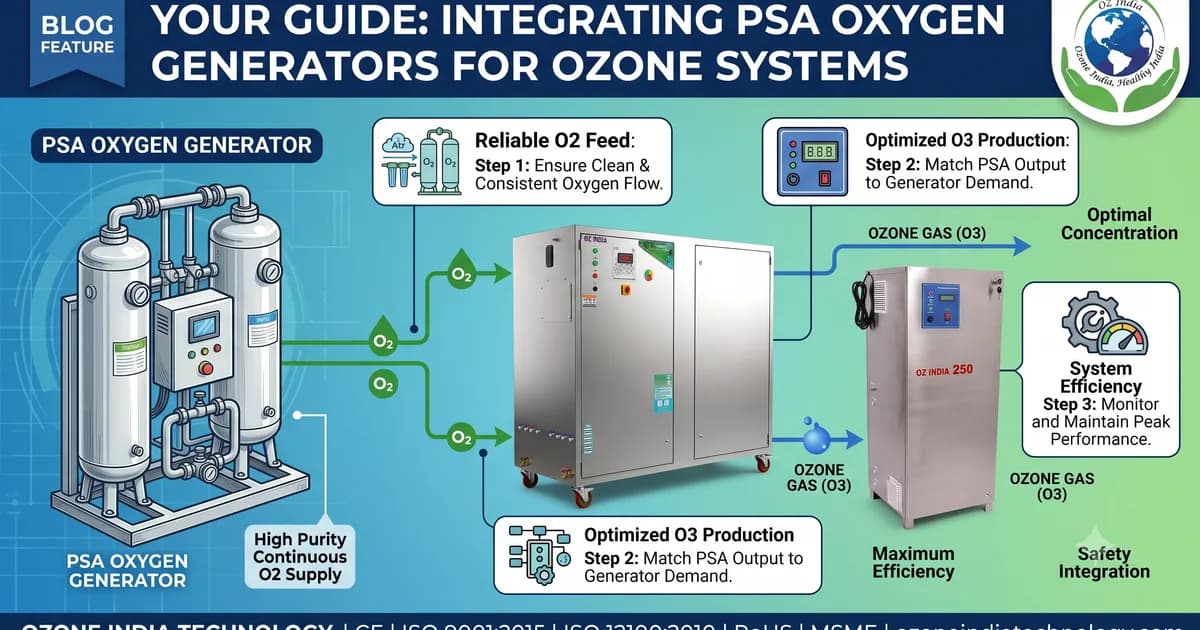
Every industrial ozone generator has a fundamental choice at installation time: feed it dry compressed air (21% oxygen) or feed it pure oxygen from a PSA oxygen generator (93–95% oxygen). This choice determines ozone concentration (2–3% from air vs 8–12% from oxygen), power consumption per gram of ozone produced, contact chamber gas volume, and dissolved ozone transfer efficiency in water. For installations above 50g/hr — large ETP systems, municipal WTPs, pharmaceutical water, and food processing CIP — the PSA oxygen generator for ozone delivers lower operating cost and better performance than air-fed systems. This guide explains how PSA oxygen generation works, the performance advantages of oxygen feed, how to size a PSA unit for your ozone system, and the integration steps.
How PSA Oxygen Generation Works
PSA stands for Pressure Swing Adsorption — a technology that separates oxygen from atmospheric air using zeolite molecular sieve adsorbent:
Adsorption cycle: Compressed air is pushed through a vessel filled with zeolite molecular sieve at elevated pressure (3–5 bar). Zeolite preferentially adsorbs nitrogen (N₂) and argon — letting oxygen (O₂) pass through. The output is 93–95% pure oxygen at the vessel outlet.
Regeneration cycle: When the zeolite becomes saturated with nitrogen, the vessel is depressurised to atmospheric pressure. The adsorbed nitrogen desorbs and vents to atmosphere — regenerating the zeolite for the next adsorption cycle.
Two-vessel design: PSA oxygen generators use two zeolite vessels alternating between adsorption and regeneration phases. This provides continuous oxygen output — one vessel adsorbs while the other regenerates. The switching cycle is typically 30–60 seconds.
The result: a continuous stream of 93–95% oxygen from compressed air, with no chemical consumables, no liquid oxygen storage, and no cryogenic equipment. The zeolite molecular sieve lasts 5–10 years with normal maintenance. The only operating cost is electricity for the air compressor.
Ozone Concentration — Air Feed vs Oxygen Feed (% by weight)
Why Oxygen Feed Doubles Ozone Generator Performance
Mechanism — Why Nitrogen Hurts Air-Fed Ozone Output
Air is 78% nitrogen. In a corona discharge ozone cell fed with air:
- Nitrogen molecules absorb corona discharge energy — energy spent on nitrogen is wasted (produces no ozone)
- Nitrogen reacts with ozone to form nitrogen oxides (NOx — NO, NO₂, N₂O₅): NOx destroys ozone before it reaches the water, reducing net ozone delivery
- Nitrogen oxides in water form nitrous and nitric acid — lowers water pH and can damage stainless steel contact chambers over time
A PSA oxygen generator eliminates all three problems by replacing the 78% nitrogen with 93–95% oxygen:
- Almost all corona energy goes to ozone production
- No nitrogen = no NOx formation = no ozone destruction in the gas phase
- No acidification from NOx dissolution
Performance Improvement Quantified
| Parameter | Air-Fed | O₂-Fed | Improvement |
|---|---|---|---|
| Ozone concentration | 2–3 wt% | 8–12 wt% | 3–4× higher |
| Power per gram ozone (Wh/g) | 12–18 | 8–12 | 30–40% lower |
| Gas volume for same dose | 1.0 (base) | 0.25–0.35 | 65–75% less gas volume |
| NOx formation | Significant | Negligible | Eliminated |
| Contact chamber size needed | Larger | Smaller | 40–60% smaller |
| Dissolved ozone transfer efficiency | 70–85% | 85–95% | Better mass transfer |
Less gas volume for the same ozone mass means the venturi injector handles less gas, the contact chamber needs less headspace, and dissolved ozone concentration at the same generator output is higher — because a higher-concentration gas stream transfers more efficiently into water.
PSA Oxygen Generator Sizing for Ozone Systems
The PSA oxygen generator is sized to supply the ozone generator's full oxygen demand at maximum output:
Oxygen consumption formula: PSA output required (Nm³/hr) = Ozone capacity (g/hr) × ozone concentration factor
At 10 wt% ozone (typical oxygen-fed): 1 gram of ozone requires approximately 0.0015 Nm³ oxygen. PSA output (Nm³/hr) = Ozone generator capacity (g/hr) × 0.0015 × safety factor 1.3
Sizing examples:
| Ozone Generator | Ozone Output | O₂ Required | PSA Unit Size |
|---|---|---|---|
| 50g/hr | 50 g/hr | 0.098 Nm³/hr | PSA-5 (0.5 Nm³/hr) |
| 100g/hr | 100 g/hr | 0.195 Nm³/hr | PSA-10 (1 Nm³/hr) |
| 350g/hr | 350 g/hr | 0.68 Nm³/hr | PSA-30 (2.5 Nm³/hr) |
| 1 kg/hr | 1000 g/hr | 1.95 Nm³/hr | PSA-100 (5 Nm³/hr) |
| 5 kg/hr | 5000 g/hr | 9.75 Nm³/hr | PSA-300 (15 Nm³/hr) |
PSA units are named by their oxygen output in standard litres per minute or Nm³/hr. Always size with 25–30% margin above minimum calculated requirement to allow for zeolite aging and compressor efficiency variation.
Power Consumption per Gram of Ozone — Air Feed vs Oxygen Feed (Wh/g)
PSA Oxygen Generator Integration — Step by Step
Air Compressor Requirement
The PSA oxygen generator requires clean, dry, oil-free compressed air at 3–5 bar as its feed. The air compressor must be:
- Oil-free — oil vapour in the feed air contaminates the zeolite, permanently degrading oxygen purity. Dedicated oil-free screw or scroll compressor.
- Pre-treatment: Compressed air must pass through: (1) refrigerated dryer (dew point ≤+3°C), (2) coalescing filter to remove oil aerosol, (3) particulate filter (1 micron).
- Sizing: Compressor output (Nm³/hr of air) = PSA oxygen output (Nm³/hr) ÷ 0.45 (PSA air-to-oxygen ratio is approximately 2.2:1).
Oxygen Delivery from PSA to Ozone Generator
- Oxygen buffer tank: Install a 50–100 litre oxygen buffer tank between PSA outlet and ozone generator. This dampens the PSA switching cycle (which produces slight output pulses every 30–60 seconds) and ensures stable oxygen pressure to the ozone generator.
- Pressure regulation: Oxygen delivery pressure to ozone generator inlet: 0.5–1.5 bar. Install a stainless steel pressure regulator (oxygen service rated) at the ozone generator inlet.
- Piping material: Stainless steel 316 or clean copper for oxygen lines. Never use PVC or aluminium in oxygen service — potential combustion risk with high-purity oxygen.
- Oxygen service safety: High-purity oxygen is a fire accelerant — ensure all piping connections are leak-free, no oil contamination, no ignition sources near the oxygen line. Oxygen service requires clean, degreased pipework.
Ozone Generator Recalibration for Oxygen Feed
When switching from air to oxygen feed:
- The ozone generator produces 3–4× higher ozone concentration at the same power setting
- Generator power must be reduced to the new target output level
- The dissolved ozone monitor and process control setpoints must be recalibrated
- Ozone India Technology provides commissioning support for all oxygen-feed retrofits
PSA Oxygen Generator Payback Calculation — 100g/hr Ozone System (₹ lakh)
When to Choose Oxygen Feed vs Air Feed
Choose PSA oxygen feed when:
- Ozone generator output is above 50g/hr (capital cost of PSA is justified by electricity saving)
- Plant operates 16–24 hours/day (higher utilisation increases electricity saving per unit time)
- Contact chamber volume is constrained (oxygen feed allows smaller chamber for same dose)
- Pharmaceutical water, food CIP, or export market applications requiring maximum dissolved ozone transfer efficiency
- ETP treating pharmaceutical API or high-COD industrial effluent (requires high dissolved ozone at contact chamber outlet)
Keep air feed when:
- Ozone generator output is below 25g/hr (PSA capital cost not recovered)
- Intermittent operation (8 hours/day or less)
- Small-scale applications: swimming pool, aquaculture sidestream, cold storage
For the ozone generator 75-350g/hr range and above, Ozone India Technology offers factory-configured oxygen-feed models with the oxygen inlet fitting, pressure regulation, and control system pre-configured for PSA oxygen input. The oxygen generator PSA from Ozone India Technology is designed and sized specifically for ozone system integration.
Conclusion
A PSA oxygen generator for ozone systems delivers 3–4× higher ozone concentration, 30–40% lower electricity consumption per gram of ozone, and 65–75% reduction in gas volume at the contact chamber — making oxygen-fed ozone the preferred configuration for all large-scale industrial installations. For a complete PSA + ozone generator package quotation for your ETP, WTP, pharma, or food processing application, contact Ozone India Technology at [email protected] or WhatsApp +91 96500 17943 with your ozone generator capacity and daily operating hours.
