
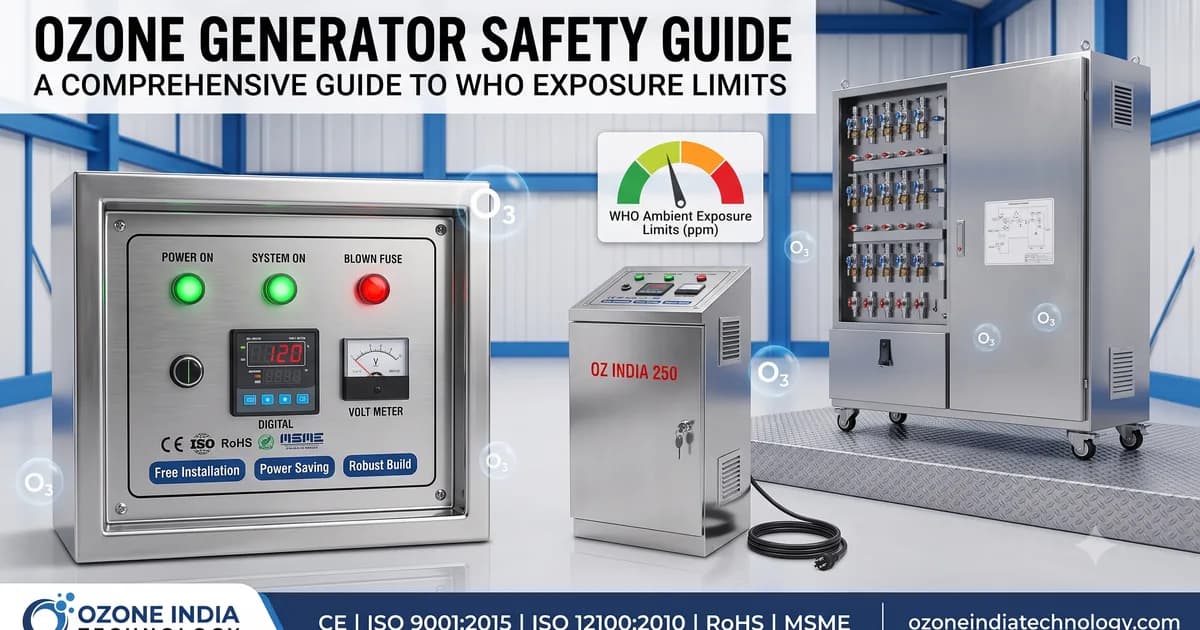
Ozone is one of the strongest oxidants used in industrial water treatment — and that oxidative power is precisely what makes it effective against bacteria, viruses, and chemical pollutants. The same chemistry that destroys pathogens will also irritate respiratory tissue at concentrations above safe limits. Industrial ozone generator installations require a specific, non-negotiable set of safety measures: an ambient air monitor, an ozone destructor on every contact chamber vent, adequate ventilation, and a clear written safety procedure for anyone working near ozone-generating equipment. This guide covers WHO and OSHA exposure limits, health effects at each concentration level, mandatory safety equipment, CE Machinery Directive safety requirements, and how ozone safety compares to the chlorine-based treatment it often replaces.
Ozone Exposure Limits — WHO, OSHA, and NIOSH
Ozone exposure limits are well-established by multiple international bodies. The limits differ by duration:
| Authority | Limit | Duration | Basis |
|---|---|---|---|
| WHO Air Quality Guideline | 0.05 ppm (0.1 mg/m³) | 8-hour mean | Outdoor air quality — respiratory protection |
| OSHA PEL (light work) | 0.1 ppm (0.2 mg/m³) | 8-hour TWA | US occupational exposure |
| OSHA PEL (heavy work) | 0.08 ppm | 8-hour TWA | Increased breathing rate at heavy exertion |
| OSHA STEL | 0.3 ppm | 15-minute | Short-term excursion limit |
| NIOSH REL | 0.1 ppm | 8-hour TWA | US NIOSH recommended limit |
| ACGIH TLV | 0.05 ppm | 8-hour TWA | American Conference of Governmental Industrial Hygienists |
| NIOSH IDLH | 5 ppm | Immediate | Immediately Dangerous to Life and Health |
For industrial ozone generator installations, the working target is: ambient ozone below 0.05 ppm during normal operation, with automatic alarm at 0.1 ppm and automatic generator shutdown at 0.2–0.3 ppm.
Ozone Health Effects by Concentration Level (ppm)
Health Effects at Each Concentration
0.005–0.01 ppm: Odour detection threshold for most people. No health effect. A slight ozone smell in a generator room at this level is normal and harmless.
0.05–0.1 ppm: Mild throat and eye irritation after prolonged exposure (hours). Sensitive individuals (asthmatics) may notice airway tightening. This is the target operating range — acceptable for brief access but not for extended work periods.
0.1–0.3 ppm: Headache, chest tightness, coughing, and reduced lung function after 2+ hours of exposure. Workers should not remain in this zone for extended periods. This is the alarm and evacuation range in ozone generator rooms.
0.3–1.0 ppm: Marked respiratory symptoms within 30–60 minutes — coughing, chest pain, shortness of breath. Equivalent to pulmonary edema risk in sensitive individuals at the high end. OSHA STEL limit — 15-minute maximum exposure.
Above 1 ppm: Severe respiratory damage, pulmonary edema, life-threatening exposure with prolonged contact. Emergency evacuation required. Not a credible operational exposure scenario with proper safety systems in place.
Above 5 ppm (NIOSH IDLH): Immediately dangerous to life and health. Only with full respiratory protection (SCBA — self-contained breathing apparatus).
Mandatory Safety Equipment for Industrial Ozone Generator Installations
1. Ozone Ambient Air Monitor
The ozone ambient air monitor is non-optional in any enclosed space where an industrial ozone generator operates. Required functions:
- Continuous electrochemical sensor measurement of ambient ozone (ppm)
- Audible alarm at 0.1 ppm — signals workers to leave the space
- Relay output at 0.2–0.3 ppm — automatically shuts down the ozone generator
- Display of current ozone level visible from the room entrance
- Data logging for inspection records (CPCB ETP/STP log book requirement)
Installation position: 1.5 metres above floor level, downwind of the ozone generator (ozone is lighter than air — it rises, but drafts and mixing dominate in enclosed rooms). Install at the breathing zone height.
2. Ozone Destructor on Contact Chamber Off-Gas
The contact chamber (ozone bubble diffuser tank) has headspace gas at 500–5,000 ppm ozone — the undissolved fraction of ozone injected into the water. This off-gas must not vent directly to the room or atmosphere.
The ozone destructor is a catalytic cartridge (MnO₂ catalyst or activated carbon impregnated with KMnO₄) installed on the contact chamber vent line. It converts O₃ → O₂ before venting. Outlet ozone from a correctly functioning destructor: <0.1 ppm — safe to vent to atmosphere.
Destructor sizing: Must handle the full off-gas volume at maximum generator output. Ozone India Technology sizes and supplies the destructor as a matched component with every ozone generator installation.
3. Room Ventilation
Ozone generator rooms require minimum ventilation to dilute any ozone that enters the room air from connection points or maintenance activities:
- Minimum: 10 air changes per hour (ACH) for generator rooms
- Do not recirculate ozone generator room air to other building zones
- Dedicated exhaust to atmosphere — not through building HVAC return
Mandatory Safety Equipment — Ozone Generator Installation Checklist
CE Machinery Directive Safety Requirements for Ozone Generators
Under EU Machinery Directive 2006/42/EC (which Ozone India Technology's generators comply with under CE-2621A), ozone generators must include:
Automatic fault shutdown: Generator automatically stops output on: cooling failure, feed gas pressure loss, power supply fault, ozone generator temperature exceedance. Manual reset required after fault — prevents automatic restart into an unsafe condition.
Ozone interlock: Generator automatically shuts down when the ambient air monitor signals high ozone (>0.2 ppm in the room). This interlock must be hardwired — not software-only — so it cannot be bypassed by a software fault.
Electrical safety: IP54 minimum enclosure rating (dust and splash protection). Earthing connection accessible and documented. Lockable isolator for maintenance lockout. No exposed live conductors accessible without tools.
Labelling and documentation: Ozone hazard warning label (GHS oxidising agent symbol + ozone gas hazard) on the enclosure. CE mark and manufacturer identification plate. Emergency stop location marked. Operating manual including safety procedures in English (and local language on request).
PPE for Ozone Generator Maintenance
Workers performing maintenance on ozone generator systems need:
- Half-face respirator with ozone/organic vapour cartridge (Type OV/P100) — for any maintenance where the contact chamber is opened, connections are broken, or the destructor cartridge is replaced
- Safety glasses — ozone is an eye irritant at >0.1 ppm
- Chemical-resistant gloves — when handling components that have been in contact with ozonated water
- No full ozone immersion without SCBA — if an ozone leak is large enough to trigger the IDLH alarm (5 ppm), evacuate and do not re-enter without self-contained breathing apparatus
Ozone vs Chlorine Safety — Operational Comparison
Ozone safety requirements are often compared to the chlorine it replaces:
| Safety Factor | Chlorine Gas (Cl₂) | NaOCl (Liquid Bleach) | Ozone |
|---|---|---|---|
| IDLH | 10 ppm | N/A (liquid) | 5 ppm |
| Storage hazard | High (pressurised cylinder, gas leak) | Medium (corrosive liquid, gas release if acidified) | None — generated on-site |
| Spill containment | Required (bund, sump) | Required | Not required |
| Transport risk | High (hazardous goods regulations) | Medium | None |
| Regulatory (India) | Major Accident Hazard if >100 kg on site | Scheduled chemical handling | Not a scheduled chemical |
| Worker exposure route | Inhalation, skin, eye contact | Skin, eye contact (liquid) | Inhalation only |
| Emergency response plan | Required under Factories Act | Recommended | Not required |
| Ongoing procurement | Required (supplier, transport, storage) | Required | None — generated from electricity |
Ozone's safety advantage in industrial water treatment is that the hazard exists only when the generator is energised — switch it off and the hazard stops within seconds as ozone decays to oxygen. Chlorine stored in cylinders remains hazardous 24 hours a day.
Annual Safety Compliance Cost — Ozone vs Chlorine for 1 MLD STP (₹ lakh/year)
Safe Operating Procedures — Summary Checklist
For the ozone generator room standard operating procedure (SOP):
Before entering the ozone generator room:
- Check ambient air monitor reading at room entrance (must read <0.1 ppm before entry)
- Ensure ventilation is operating (check exhaust fan)
- Do not enter if ozone alarm is active — investigate from outside
During normal operation:
- Do not allow extended work in the generator room — brief checks only
- Keep the room door closed during operation
- Never bypass or defeat the ambient air monitor interlock
During maintenance:
- Switch off ozone generator and lock out isolator before any maintenance
- Allow 15 minutes for residual ozone to disperse before entering for maintenance
- Wear half-face respirator when opening contact chamber or replacing destructor cartridge
Emergency (ozone alarm or smell):
- Evacuate room immediately
- Shut down generator at external emergency stop (if accessible)
- Do not re-enter until ambient monitor confirms <0.05 ppm
- Ventilate for 30 minutes minimum before re-entering
For a site-specific ozone safety procedure template, contact [email protected] or WhatsApp +91 96500 17943.
Conclusion
Ozone generator safety is straightforward when the required systems are in place: ambient air monitor, contact chamber destructor, adequate room ventilation, and CE Machinery Directive-compliant automatic shutoffs. With these in place, ozone is safer to operate than chlorine — no chemical storage, no spill risk, no pressurised cylinder handling. Ozone India Technology supplies every industrial ozone generator with the ambient air monitor and destructor as standard equipment, and provides the CE Declaration of Conformity and operating manual required for Factories Act compliance and export market installation approval.
