
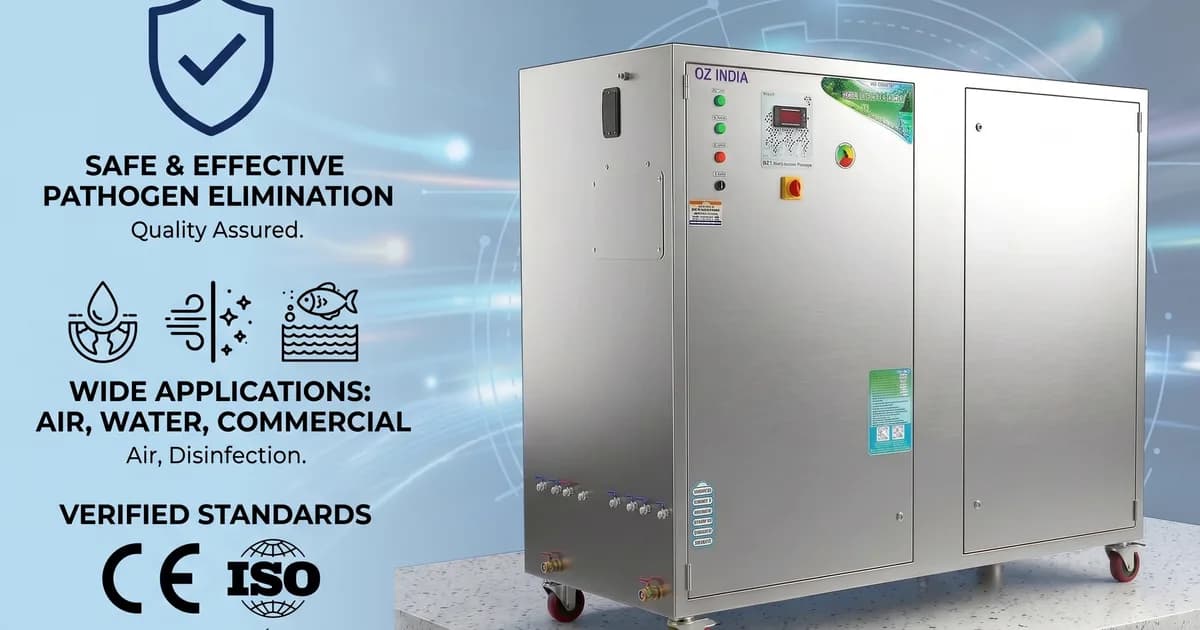
When an industrial buyer in Kenya, UAE, or Germany evaluates ozone generator suppliers from India, the first question is almost always: "Is it CE certified?" The second question is: "Do you have ISO?" These are not box-ticking exercises — CE certification and ISO 9001:2015 registration affect import clearance, insurance liability, facility audits, and the manufacturer's right to place equipment on the EU market. A CE certified ozone generator from India is importable into UAE under Cabinet Resolution No. 43/2009, qualifies for 0% duty under India-UAE CEPA, and passes the vendor qualification process of multinational food, pharma, and water companies. This guide explains exactly what CE and ISO certification mean for industrial ozone generators, what they cover, and why uncertified equipment creates risk that certified equipment does not.
What CE Certification Means for an Ozone Generator
CE marking (Conformité Européenne — European Conformity) is a manufacturer's declaration that the product complies with all applicable EU directives. For an ozone generator, the applicable directives are:
EU Machinery Directive 2006/42/EC — the primary directive. Requires:
- Risk assessment per ISO 12100 covering all hazards: mechanical, electrical, ozone gas exposure
- Safety features: automatic shutoff on fault, ozone leak interlock, emergency stop
- Technical file: design drawings, test results, risk assessment documentation
- CE Declaration of Conformity signed by authorised representative
Low Voltage Directive 2014/35/EU — covers electrical safety of components operating at 50–1000V AC EMC Directive 2014/30/EU — covers electromagnetic compatibility (generator electronics must not interfere with other equipment and must be immune to interference) RoHS Directive 2011/65/EU — restricts hazardous substances (lead, mercury, cadmium, etc.) in electronic components
CE marking does not mean an EU government agency tested the product. For most machinery, CE is a self-declaration by the manufacturer after completing the conformity assessment process. However, the manufacturer is legally liable if the CE-marked product fails to comply with the directives — making a fraudulent CE mark a serious legal and commercial risk.
Ozone Generator Certification Requirements by Export Market
What ISO 9001:2015 Certification Covers
ISO 9001:2015 is a Quality Management System (QMS) standard — it certifies the manufacturing process, not an individual product. An ISO 9001:2015 certified ozone generator manufacturer has:
- Design control: Documented procedures for product design, design review, and design validation. Changes to product specifications go through a controlled change process.
- Incoming inspection: Purchased components (corona discharge cells, transformers, control boards) are inspected against specifications before use in production.
- Production control: Assembly procedures, test procedures, and acceptance criteria are documented. Every unit is built and tested to the same standard.
- Calibration: Test equipment used in production (ozone output meters, voltmeters, leak detectors) is calibrated on schedule.
- Customer complaints: A documented corrective action process for field failures and customer complaints. Root cause analysis, corrective action, and effectiveness verification.
- Management review: Annual review of quality data — defect rates, customer satisfaction, supplier performance — to drive continuous improvement.
ISO 9001 certification is issued by an accredited certification body (UKAS, DAkkS, etc.) after a third-party audit of the manufacturer's QMS. Unlike CE marking, ISO 9001 cannot be self-declared — it requires an independent audit every year.
For industrial buyers, ISO 9001 answers the question: "Will every unit I receive be built to the same quality as the sample?" The answer for an ISO 9001 certified manufacturer is yes — because the process that produces every unit is documented, audited, and controlled.
CE vs ISO: What Each Covers
| CE Marking | ISO 9001:2015 | |
|---|---|---|
| What it certifies | The product meets EU safety directives | The manufacturing process meets quality standards |
| Who assesses | Manufacturer (self-declaration for most machinery) | Third-party accredited certification body |
| Renewal | No expiry — must update for directive changes | Annual surveillance audit, 3-year recertification |
| Legal status | Mandatory for EU market access | Voluntary (but required by many buyers) |
| Covers | Safety, electrical, EMC, RoHS | Quality process, consistency, traceability |
| Customer benefit | Import clearance, safety compliance | Consistent product quality, reliable supply |
Quality Assurance Steps in ISO 9001:2015 Certified Ozone Generator Manufacturing
Why Uncertified Ozone Generators Create Risk
Import risk: UAE, Saudi Arabia, and most GCC countries require CE marking or equivalent for machinery imports. Non-CE ozone generators can be detained at port by customs authorities. ESMA (Emirates Authority for Standardisation and Metrology) requires CE marking for industrial electrical equipment under UAE Cabinet Resolution No. 43/2009. A detained shipment means project delays, storage fees, and re-export costs.
Insurance liability: If an ozone generator causes a fire, explosion, or worker injury and is not CE marked, the buyer's industrial insurance may not cover the claim. Insurance policies for industrial equipment typically require CE or equivalent certification. The equipment operator (factory owner) carries personal liability for injuries caused by non-certified machinery under India's Factories Act and equivalent legislation in most countries.
Vendor qualification: Multinational food companies (Nestlé, Unilever, Pepsi), pharmaceutical manufacturers, and hotel chains require CE and ISO certification as part of their supplier qualification process. Non-certified equipment fails vendor qualification — regardless of price.
Performance risk: A CE-certified ozone generator has been through risk assessment, design review, and documented testing. An uncertified unit has not. The documented testing process catches design defects — dielectric materials that degrade in ozone environments, electrical insulation failures, cooling system inadequacies — before they cause field failures.
Ozone India Technology Certifications
| Certificate | Number | Scope | Issuer |
|---|---|---|---|
| CE | CE-2621A | Full product range 2g/hr–10kg/hr, EU Machinery Directive 2006/42/EC, ISO 12100 | Euro Global |
| ISO 9001:2015 | UQ-270426AD1 | Quality management system — design, manufacture, and service of ozone generators | UK Global |
| ISO 12100 | UQ-27426AD89 | Risk assessment standard for machinery safety | UK Global |
| RoHS | QA-2704A2 | Restriction of hazardous substances compliance | Euro Global |
| MSME/UDYAM | UDYAM-UP-29-0072870 | Government of India MSME registration | Ministry of MSME |
Certified vs Uncertified Ozone Generator — Risk Comparison Score (lower is better)
Using CE Certification for Import — Practical Guide
UAE import: Present the CE Declaration of Conformity (CE-2621A) to Dubai Customs with the commercial invoice. Cite UAE Cabinet Resolution No. 43/2009 exemption from mandatory ESMA product conformity testing. Ozone India Technology provides the CE DoC with every shipment.
India-UAE CEPA duty exemption: Submit Certificate of Origin (Form AI) with the CE DoC. HS Code 8543.70. 0% duty vs standard 5%. Ozone India Technology provides Form AI for all UAE export orders.
Vendor qualification forms: Most multinational vendor questionnaires ask for: "CE certificate or equivalent" + "ISO 9001 certificate" + "latest audit report date." Ozone India Technology provides copies of all certificates and the audit summary letter on request.
ESMA product registration: For ozone generators used in food-contact applications (bottled water, food processing) in UAE, Dubai Municipality may request ESMA product registration. The CE Declaration of Conformity and test report are the primary documents required. Ozone India Technology has supported multiple UAE food facility import registrations.
Conclusion
CE and ISO certified ozone generators from Ozone India Technology (CE-2621A, ISO 9001:2015 UQ-270426AD1) cover the full industrial range from 2g/hr to 10kg/hr — importable into UAE under CEPA at 0% duty, acceptable to multinational vendor qualification programmes, and backed by documented quality management that ensures every unit is built to the same standard. For certificate copies, Declaration of Conformity, or vendor qualification documentation, contact [email protected] or WhatsApp +91 96500 17943.
