
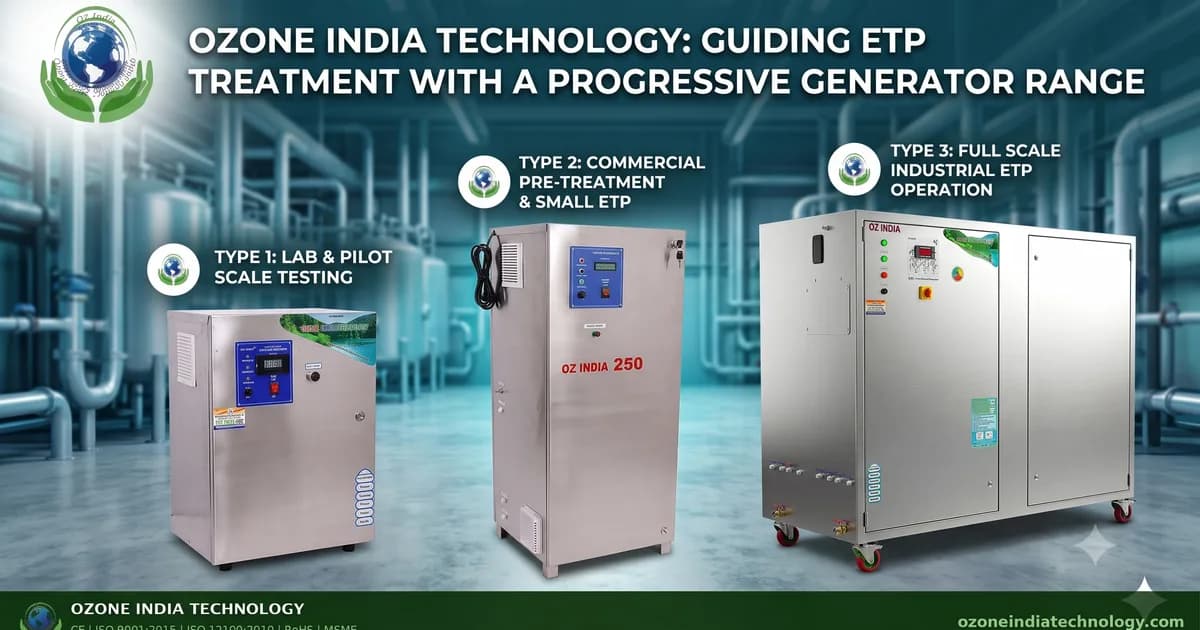
Effluent treatment plants in India face two immovable constraints: CPCB discharge standards that must be met every day, and the rising cost of the chemicals used to meet them. Conventional ETP chemical treatment — sodium hypochlorite, Fenton's reagent (H₂O₂ + FeSO₄), polyelectrolytes — adds up to ₹80–200 per kilolitre of treated effluent in high-load industries like textiles, pharmaceuticals, and food processing. An ozone generator for ETP replaces chemical oxidation with electrochemically produced ozone gas, achieving 80–95% colour removal from reactive dye wastewater, 60–75% COD reduction from secondary effluent, and pharmaceutical API elimination — with no chemical procurement, no sludge from Fenton's iron, and no chlorinated organic byproducts in the treated effluent. This guide covers ozone dosing for textile, pharma, and food ETPs, contact chamber sizing, CPCB compliance verification, and the 5-year cost comparison with conventional treatment.
Why Ozone Generator for ETP Outperforms Chemical Oxidation
The ozone generator for ETP addresses the fundamental problem with chemical oxidants: they introduce new substances into the wastewater. Sodium hypochlorite forms trihalomethanes (THMs) and chlorinated organics that are themselves regulated under CPCB and State Pollution Control Board standards — and are acutely toxic to receiving water ecosystems. Fenton's reagent generates iron sludge requiring costly disposal. Both chemicals require purchase, storage, handling safety systems, and regular supplier replenishment.
Ozone is generated on-site from air or oxygen using a corona discharge ozone generator. It enters the effluent as a dissolved gas, reacts with organic pollutants, and decomposes to oxygen — leaving no chemical residue in the treated effluent. The ozone generator for ETP is the only oxidation technology that simultaneously:
- Removes colour from reactive dye wastewater (>85% colour reduction at 4–8 mg/L dose)
- Reduces COD from biologically-resistant compounds (ozone breaks aromatic ring structures into biodegradable fragments)
- Inactivates pathogens without chlorinated byproducts
- Eliminates pharmaceutical API molecules (emerging contaminants not treated by biological processes)
- Reduces ETP sludge volume by 20–30% through oxidative conditioning
ETP Pollutant Removal — Conventional Chemical vs Ozone Advanced Oxidation
Ozone Dose for ETP by Industry — Dosing Table
The ozone dose required for an ETP depends on the pollutant load and the compliance target. The ozone generator for ETP must be sized for peak influent load — not average load — to maintain CPCB compliance on worst-case production days.
| Industry | ETP Influent COD | Colour (ADMI) | Ozone Dose Required | Contact Time |
|---|---|---|---|---|
| Reactive dye textile | 800–2000 mg/L | 2,000–8,000 | 6–10 mg/L | 25–35 min |
| Textile (post-bio) | 200–400 mg/L | 500–2,000 | 3–6 mg/L | 20–25 min |
| Pharmaceutical (API) | 1000–5000 mg/L | 500–2,000 | 8–15 mg/L | 30–45 min |
| Food processing | 500–1500 mg/L | 200–800 | 4–7 mg/L | 20–30 min |
| Hospital/healthcare | 300–600 mg/L | 100–300 | 3–5 mg/L | 15–20 min |
| Tannery/leather | 2000–6000 mg/L | 3,000–10,000 | 10–20 mg/L | 35–60 min |
Note: Ozone is most cost-effective as a polishing step after biological treatment. Ozone generator for ETP on raw (primary) effluent requires 2–3× the dose compared to secondary effluent polishing.
Sizing the Ozone Generator for ETP — Worked Examples
Example 1: Mid-Scale Textile ETP (500 m³/day)
Given: Garment factory ETP treating 500 m³/day reactive dye wastewater. Secondary effluent after activated sludge: COD 350 mg/L, colour 1,200 ADMI. Target: CPCB General Effluent Standards (COD <250 mg/L, no standard colour but CETP colour compliance required at <200 ADMI for river discharge).
Step 1 — Flow rate: 500 m³/day ÷ 16 operating hours = 31.25 m³/hr
Step 2 — Dose: Secondary effluent, colour target 200 ADMI from 1,200 → 5 mg/L from table above
Step 3 — Generator capacity: Q = 31.25 × 5 × 1.3 ÷ 1000 = 0.20 kg/hr = 200 g/hr
Result: Ozone generator 75-350g/hr at 200g/hr setting.
Example 2: Pharmaceutical ETP (200 m³/day)
Given: API manufacturing facility, ETP treating 200 m³/day. Secondary effluent: COD 800 mg/L (biologically-resistant API fragments), colour 800 ADMI. Target: CPCB Pharma Standards (COD <500 mg/L for CETP inlet, API below detection).
Step 1 — Flow rate: 200 ÷ 16 = 12.5 m³/hr
Step 2 — Dose: Pharma API removal at secondary effluent quality → 8 mg/L
Step 3 — Generator: Q = 12.5 × 8 × 1.3 ÷ 1000 = 0.13 kg/hr = 130 g/hr
Result: Ozone generator 75-350g/hr at 150g/hr provides margin. For this application, oxygen feed is recommended (ozone concentration 8–12% vs 2–3% for air-fed) to minimise gas volume in the contact chamber.
Ozone Generator Capacity Required for ETP by Daily Flow Volume (5 mg/L dose)
ETP Ozone Contact Chamber Design
The ozone generator for ETP requires a contact chamber sized for the required hydraulic retention time (HRT):
Contact chamber volume (m³) = Flow (m³/hr) × HRT (hr)
For the 500 m³/day textile ETP example at 25 minutes HRT: Volume = 31.25 × (25/60) = 13 m³
The contact chamber is typically a serpentine baffled tank (3–4 passes) to prevent short-circuiting. Ozone is introduced at the inlet via a venturi injector. The dissolved ozone monitor at the outlet controls generator output automatically.
Contact chamber materials: All stainless steel 316L, or HDPE/GRP with PVDF lining. Carbon steel and standard PVC corrode rapidly in ozonated water. Ozone India Technology supplies turnkey contact chambers in SS316L for most ETP applications.
Off-gas treatment: The contact chamber must have an ozone destructor on the vent line — ozone that does not dissolve exits the tank as off-gas at 500–5,000 ppm concentration. The ozone destructor reduces this to <0.1 ppm before venting to atmosphere, complying with CPCB Ambient Air Quality Standards.
CPCB Compliance Verification with the Ozone Generator for ETP
The ozone generator for ETP achieves CPCB compliance only when the dissolved ozone monitor confirms sufficient dose delivery. The monitoring protocol:
- Inline dissolved ozone monitor at contact chamber outlet — continuously measures residual dissolved ozone (target 0.1–0.5 mg/L residual at outlet, confirming adequate dose was delivered)
- Quarterly effluent sampling for CPCB parameters: COD, BOD, colour, suspended solids, pH, heavy metals (as applicable to the industry)
- ETP log book — daily recording of ozone generator output (g/hr), contact time, dissolved ozone residual, and influent flow rate. This documentation is reviewed by State PCB inspectors during consent renewal
The ozone dosage calculator at Ozone India Technology calculates required generator output for your specific ETP parameters and compliance target.
5-Year Operating Cost Comparison — ETP Treatment Methods (₹/kilolitre treated)
Integration of Ozone Generator for ETP with Existing Treatment
Most Indian ETPs have existing biological treatment (activated sludge, SBR, MBR) and physical-chemical treatment (coagulation, DAF). The ozone generator for ETP is added as a tertiary polishing stage after secondary clarifier:
Position 1 (most common): Secondary clarifier outlet → Ozone contact chamber → Final clarifier/sand filter → Discharge Position 2 (for ZLD plants): Secondary clarifier → Ozone contact chamber → RO feed tank → RO system → Reuse water
For the ETP retrofit, the ozone generator is typically installed in a 2×2m footprint adjacent to the secondary clarifier. The contact chamber is built in the available space between secondary and tertiary treatment. No shutdown of the existing ETP is required — the ozone system is commissioned as an add-on while the existing process continues.
For technical specifications on the ozone generator for ETP, contact the effluent treatment plant application team at Ozone India Technology. Email [email protected] or WhatsApp +91 96500 17943 with your ETP daily flow, industry type, and current effluent quality for a project-specific quotation.
Conclusion
The ozone generator for ETP is the most cost-effective advanced oxidation technology available to Indian industry for achieving CPCB discharge compliance, eliminating chemical procurement risk, and enabling ZLD-ready treated effluent quality. With 5-year operating costs 40–65% below Fenton's reagent and sodium hypochlorite, and payback periods of 12–24 months at medium ETP scales, the ozone generator for ETP from Ozone India Technology is CE-certified, ISO 9001:2015 quality-assured, and backed by a pan-India service network. Contact us at [email protected] or +91 96500 17943 for a sizing consultation and quotation.
