
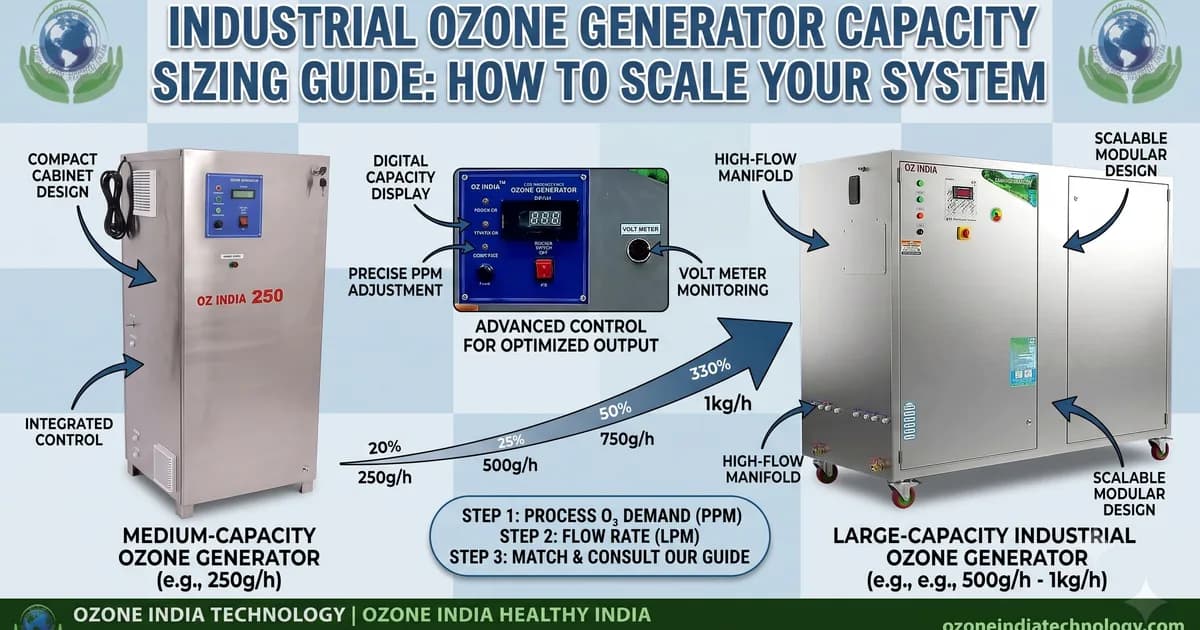
How to size an ozone generator correctly is the foundational engineering question for any ozone water treatment project. Get it wrong — too small — and the system fails to achieve CPCB, WHO, or FSSAI compliance. Get it too large and you waste capital cost and electricity. This guide gives you the complete sizing methodology: the dose selection table by application, the g/hr calculation formula with worked examples, oxygen vs air feed selection, contact chamber volume sizing, and CT value verification.
The Core Sizing Formula
The fundamental answer to how to size an ozone generator is a single equation:
Q (g/hr) = F (m³/hr) × D (mg/L) × SF ÷ 1000
Where:
- Q = ozone generator capacity in grams per hour (g/hr)
- F = design flow rate in cubic metres per hour (m³/hr)
- D = ozone dose in milligrams per litre (mg/L) — from the application dose table below
- SF = safety factor, typically 1.25 for stable source water, 1.5 for variable quality
The ozone dosage calculator at Ozone India Technology performs this calculation automatically — enter your flow, application, and water quality to get a recommended g/hr and product selection.
Ozone Dose Selection by Application
The ozone dose D is the most critical input in how to size an ozone generator correctly. It depends entirely on the application — what you are trying to achieve and in what water quality conditions.
| Application | Typical Ozone Dose | Contact Time | Target Standard |
|---|---|---|---|
| Drinking water (IS:10500) | 0.2–0.5 mg/L | 10–15 min | WHO/BIS zero coliform |
| Packaged water (FSSAI IS:14543) | 0.3–0.5 mg/L | 5–10 min | Zero coliform, detectable O₃ |
| Iron/manganese removal | 0.5–1.0 mg/L | 5 min | Pre-filter oxidation |
| STP tertiary (CPCB Class A) | 2–5 mg/L | 15–20 min | BOD <10, coliform <100 MPN |
| ETP colour removal (textile) | 4–8 mg/L | 20–30 min | CETP colour standard |
| ETP pharma API removal | 5–10 mg/L | 20–30 min | API below detection |
| Cooling tower (Legionella) | 0.1–0.3 mg/L | Continuous | ASHRAE 188 |
| Swimming pool | 0.1–0.5 mg/L | Sidestream | Chloramine elimination |
| Cold storage air | 0.05–0.15 ppm | Continuous | Mould/ethylene control |
| Food processing CIP | 2–3 mg/L | 15–20 min | 6-log bacteria reduction |
Ozone Dose Required by Application (mg/L dissolved ozone)
Worked Examples — How to Size an Ozone Generator
Example 1: Hotel STP, 1 MLD
Given: Hotel STP treating 1 MLD (1,000 m³/day) for landscape reuse. Secondary effluent quality: BOD 30 mg/L, fecal coliform 10⁵ MPN/100mL. Target: CPCB Class A.
Step 1 — Flow rate in m³/hr (peak): Design flow = 1.25 × average = 1,250 m³/day ÷ 24 = 52 m³/hr
Step 2 — Dose selection: Secondary STP effluent, CPCB Class A target → 3 mg/L from dose table
Step 3 — Generator capacity: Q = 52 × 3 × 1.3 ÷ 1000 = 0.20 kg/hr = 200 g/hr
Result: Ozone generator 200g/hr from Ozone India Technology. Alternatively, the 75-350g/hr range system at 200g/hr setting.
Example 2: Municipal WTP, 5 MLD
Given: Municipal water treatment plant, 5 MLD from river source. Iron 2 mg/L, coliform 10⁴ MPN/100mL. Target: IS:10500 drinking water standard.
Step 1 — Flow rate: Peak flow = 5,000 × 1.25 ÷ 24 = 260 m³/hr
Step 2 — Dose selection: River water with iron → dual dose: pre-ozonation 0.8 mg/L (iron oxidation) + post-filtration 0.3 mg/L (disinfection) Design for pre-ozonation (larger): 0.8 mg/L
Step 3 — Generator capacity: Q = 260 × 0.8 × 1.3 ÷ 1000 = 0.27 kg/hr = 270 g/hr
Result: Ozone generator 300g/hr provides capacity with headroom. Oxygen-fed for energy efficiency at this scale.
Example 3: Swimming Pool, 500 m³
Given: Commercial hotel pool, 500 m³ volume, recirculated 6× per day (125 m³/hr turnover).
Step 1 — Ozone demand: Pool ozone requirement: 4g/m³/day × 500 m³ ÷ 24 hr = 83 g/hr ozone demand
Step 2 — Generator sizing (with transfer efficiency): Venturi transfer efficiency 90%: Q = 83 ÷ 0.9 × 1.2 = 111 g/hr
Result: Ozone generator 125g/hr handles this pool with margin.
Ozone Generator Capacity Required for Common WTP Flows (3 mg/L dose, 1.3 SF)
Air-Fed vs Oxygen-Fed: Which Feed Gas to Choose
Knowing how to size an ozone generator also means choosing the right feed gas:
Air-fed generators use atmospheric air, dried to -60°C dew point. They produce ozone at 1-3% concentration by weight. Energy consumption: 12-15 kWh per kg of ozone. Lower capital cost. Recommended for capacities below 25-30g/hr.
Oxygen-fed generators use 90-93% oxygen from a PSA oxygen generator or bulk liquid oxygen. They produce ozone at 5-12% concentration. Energy consumption: 7-9 kWh/kg — 40% lower than air-fed. Higher capital cost (PSA unit) recovered in 18-24 months at Indian electricity rates above ₹6/kWh. Recommended for capacities above 25g/hr and mandatory above 100g/hr for cost-effective operation.
Energy Consumption by Generator Type (kWh per kg ozone)
Contact Chamber Sizing
Once you know how to size an ozone generator in g/hr, the contact chamber must be sized to deliver the required CT value:
Contact chamber volume (m³) = Design flow (m³/hr) × HRT (hr)
For a 5 MLD STP at 20 minutes HRT: V = 208 × 20 ÷ 60 = 69 m³
The existing chlorine contact tank can almost always be repurposed — retrofit ozone into operating STPs without stopping treatment. Ozone India Technology engineers assess each site and provide retrofit drawings that preserve CPCB compliance during the transition.
CT verification: After commissioning, measure residual dissolved ozone at the contact chamber outlet using the dissolved ozone monitor. CT = C × T. If C = 0.3 mg/L at T = 20 min, CT = 6 mg·min/L — more than sufficient for 4-log coliform inactivation (CT required = 0.5-1.0 mg·min/L).
Ozone India Technology Generator Range — Selection Guide
| Capacity | Product | Typical Application |
|---|---|---|
| 2g/hr | Ozone Generator 2g/hr | Hotel rooms, car detailing, small DW |
| 5g/hr | Ozone Generator 5g/hr | Small pools, clinic water, cold room |
| 10g/hr | Ozone Generator 10g/hr | STP 2 MLD, pool 200m³ |
| 25g/hr | Ozone Generator 25g/hr | STP 5 MLD, ETP small textile |
| 50g/hr | Ozone Generator 50g/hr | STP 10 MLD, WTP 5 MLD |
| 100g/hr | Ozone Generator 100g/hr | STP 20 MLD, ETP medium |
| 200g/hr | Ozone Generator 200g/hr | STP 40 MLD, WTP 15 MLD |
| 350g/hr | Ozone Generator 350g/hr | Municipal WTP/STP large |
| 1kg/hr | Ozone Generator 1kg/hr | Municipal grade STP/WTP |
| 10kg/hr | Ozone Generator 10kg/hr | Mega plant, river treatment |
Simple Payback Period for Ozone vs Chlorination at Different Scales
Using the Ozone India Technology Dosage Calculator
The ozone dosage calculator at Ozone India Technology simplifies how to size an ozone generator for your specific project. Enter:
- Application type (STP, ETP, WTP, drinking water, food, pool)
- Design flow rate (MLD or m³/hr)
- Source water quality (if known)
- Target standard (CPCB Class A/B, IS:10500, FSSAI, WHO)
The calculator returns: recommended g/hr capacity, suggested product from the Ozone India Technology range, air vs oxygen feed recommendation, contact chamber volume, and estimated electricity consumption. For complex multi-application systems, contact our engineering team at [email protected] for a custom sizing study with full project proposal.
Conclusion
Knowing how to size an ozone generator correctly — starting with the dose table, applying the Q = F × D × SF ÷ 1000 formula, and verifying CT value in the contact chamber — is the difference between an ozone system that delivers compliant results 24/7 and one that causes non-compliance or wasted expenditure. Ozone India Technology has sized and commissioned ozone systems from 2g/hr to 10kg/hr across 500+ installations in India and 15 export markets. Our engineers are available for free sizing consultations via WhatsApp +91 96500 17943 or email [email protected].
