
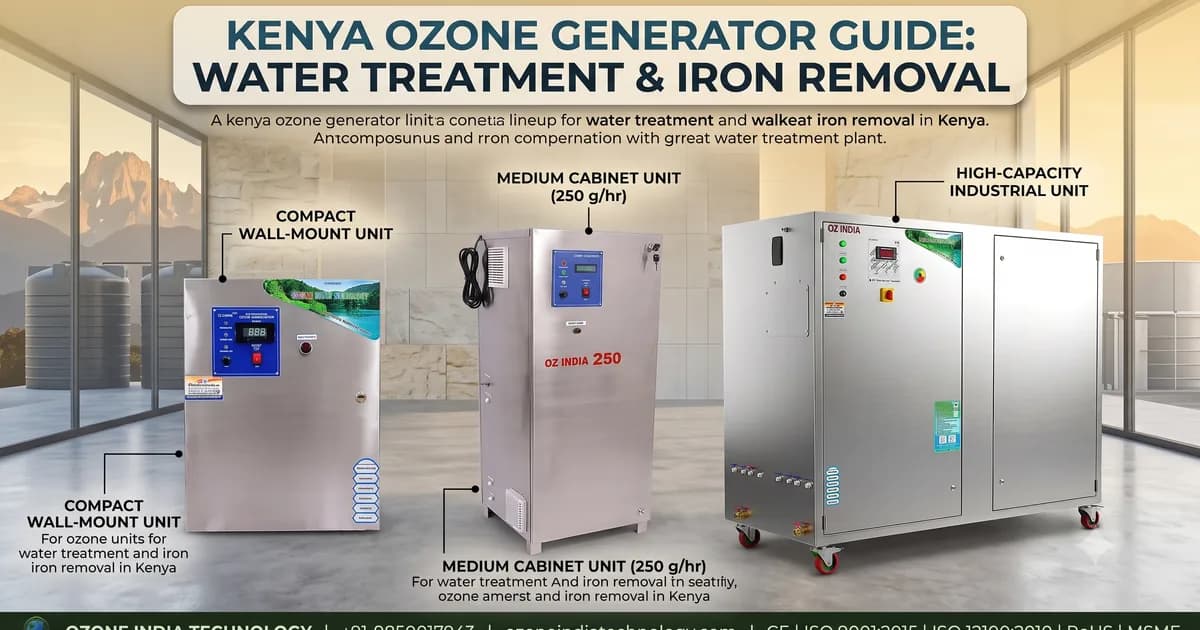
Kenya faces some of the most demanding water treatment challenges in sub-Saharan Africa: borehole groundwater in the Rift Valley region with iron levels of 1–5 mg/L, manganese contamination that stains laundry and plumbing fittings, fluoride concentrations exceeding WHO limits in volcanic regions, and surface water from Lake Victoria tributaries contaminated by agricultural runoff and sewage. An ozone generator for Kenya addresses all of these simultaneously — with a single unit providing iron oxidation, manganese removal, microbiological disinfection, and organic matter reduction that meets KEBS KS EAS 12 drinking water standards. This guide explains ozone generator selection, sizing, applications, and import procedures for Kenya.
Why Kenyan Water Needs Ozone Treatment
The ozone generator for Kenya must address water quality problems that are fundamentally different from European or North American contexts. The Rift Valley borehole water that supplies much of Kenya's rural and peri-urban population contains:
Dissolved iron (Fe²⁺): Commonly 1–5 mg/L in borehole sources. KEBS KS EAS 12 limit: 0.3 mg/L. At concentrations above 0.3 mg/L, water causes red staining, metallic taste, and promotes iron bacteria growth in distribution pipes. Conventional treatment requires aeration towers and sand filters — effective but requires large footprint and regular backwash. An ozone generator for Kenya oxidises dissolved Fe²⁺ to Fe³⁺ (insoluble ferric hydroxide) in seconds at 0.5–1.0 mg/L dose, which is then captured in a downstream sand filter. The ozone generator eliminates the need for chemical coagulants and reduces filter run times by 30%.
Dissolved manganese (Mn²⁺): Present at 0.05–0.5 mg/L in many Kenyan boreholes. KEBS limit: 0.1 mg/L. Manganese oxidation requires higher ozone dose (1.0–2.0 mg/L) and longer contact time (5–10 minutes) than iron. The ozone generator for Kenya must be sized to handle the combined iron and manganese demand plus the residual dose for disinfection.
Fluoride: Geothermal volcanic geology in Kenya's Rift Valley produces groundwater with fluoride levels of 1–20 mg/L — well above the KEBS limit of 1.5 mg/L. While ozone itself does not remove fluoride (fluoride removal requires activated alumina or Nalgonda process), the ozone generator addresses the accompanying bacterial contamination and organic load, reducing the treatment burden on downstream defluoridation units.
Fecal coliform contamination: Both surface water (rivers, dams) and some shallow boreholes in densely populated areas contain fecal coliforms. KEBS KS EAS 12 requires zero total coliform in treated drinking water. The ozone generator for Kenya provides >4-log coliform inactivation at a CT value of 0.5 mg·min/L — achievable with 0.3 mg/L dissolved ozone at 2 minutes contact time.
Common Kenyan Groundwater Contaminants vs KEBS KS EAS 12 Limits (mg/L)
Sizing an Ozone Generator for Kenya — The Formula
Selecting the right ozone generator for Kenya starts with the same calculation used globally:
Q (g/hr) = F (m³/hr) × D (mg/L) × SF ÷ 1000
Where F is the design flow rate, D is the required ozone dose (from the application table below), and SF is a 1.3 safety factor for Kenya applications where borehole water quality varies seasonally.
Ozone Dose Requirements for Kenyan Applications
| Application | Typical Ozone Dose | Contact Time | Generator |
|---|---|---|---|
| Iron oxidation (borehole) | 0.5–1.0 mg/L | 2–5 min | Size for F × 1.0 × 1.3 |
| Iron + manganese removal | 1.0–2.0 mg/L | 5–10 min | Size for F × 2.0 × 1.3 |
| Disinfection only (clean water) | 0.2–0.4 mg/L | 5–10 min | Size for F × 0.4 × 1.3 |
| Surface water treatment (river/dam) | 2.0–4.0 mg/L | 10–15 min | Size for F × 4.0 × 1.3 |
| Produce washing (horticulture export) | 0.3–1.0 mg/L | Batch | 5-25g/hr unit per station |
Worked Example: Nairobi Industrial Zone Water Treatment Plant
Given: Industrial complex in Nairobi requiring treated water, drawing from a borehole at 30 m³/hr. Borehole analysis: iron 2.5 mg/L, manganese 0.2 mg/L, coliform 500 MPN/100mL. Target: KEBS KS EAS 12 drinking water standard.
Step 1 — Combined oxidant demand: Iron oxidation: 2.5 × 0.43 = 1.1 mg/L ozone (0.43 g ozone per g iron) Manganese oxidation: 0.2 × 0.88 = 0.18 mg/L ozone (0.88 g ozone per g manganese) Disinfection residual: 0.3 mg/L Total dose: 1.1 + 0.18 + 0.3 = 1.6 mg/L
Step 2 — Generator capacity: Q = 30 × 1.6 × 1.3 ÷ 1000 = 0.062 kg/hr = 62 g/hr
Result: Ozone generator 75g/hr provides the required capacity with margin for peak demand. Contact chamber: 300L HDPE tank, 10 minutes HRT. Downstream: dual sand filters for iron/manganese removal.
Ozone Generator Capacity Required for Kenyan Water Treatment Applications (g/hr)
Ozone Generator Applications in Kenya
Municipal and Institutional Water Treatment
Kenyan county governments, schools, hospitals, and factories rely on boreholes for water supply. The ozone generator for Kenya in these applications replaces or supplements chlorination. The key advantage over chlorine: ozone produces no trihalomethanes (THMs) or haloacetic acids (HAAs) — the chlorination byproducts that are increasingly scrutinised by KEBS and WHO. Schools and hospitals that have adopted ozone generators in Kenya report consistent WHO-compliant water quality without the chemical procurement and safety challenges of chlorine gas.
A 50-bed hospital in Nairobi processing 10 m³/hr of borehole water uses the ozone generator 25g/hr from Ozone India Technology — treating iron (2 mg/L), providing disinfection, and eliminating the monthly chlorine cylinder supply chain. The contact chamber is a modified JoJo tank (1,000L) with an ozone venturi injector at the inlet.
Kenya Horticultural Export Industry
Kenya is the largest exporter of fresh cut flowers and the third-largest exporter of vegetables to the EU. Growers supplying EU buyers must comply with EU Regulation (EC) 852/2004 food hygiene requirements and GlobalG.A.P. standards, both of which require documented produce washing water quality.
The ozone generator for Kenya in horticulture applications:
- Produce washing water: 0.3–0.5 mg/L dissolved ozone in wash tanks kills E. coli, Salmonella, and Listeria on produce without chemical residue
- Packhouse washdown: 2–3 mg/L ozonated water for surface and equipment sanitisation, replacing chlorine-based sanitisers that leave taste residue on cut flowers
- Cold room air treatment: 0.05–0.1 ppm gaseous ozone in cold storage extends shelf life of vegetables by 30–40% during transit to European ports
EU certification bodies and GlobalG.A.P. auditors specifically accept ozone treatment documentation as evidence of HACCP water control compliance — making the ozone generator for Kenya an investment that directly enables export market access.
Aquaculture and Fisheries
Kenya's fisheries sector — tilapia from Lake Victoria, freshwater fish from inland farms — uses ozone generators for hatchery water treatment. The ozone generator for Kenya in aquaculture:
- Eliminates fish pathogens (Aeromonas, Pseudomonas) from recirculating aquaculture system (RAS) water
- Reduces biological oxygen demand (BOD) in fish pond water without chemical disinfectants that accumulate in fish tissue
- Reduces antibiotic use — ozone disinfection reduces bacterial load to levels where antibiotic treatment is less frequently needed
An ozone generator 5g/hr treats a 200 m³ tilapia hatchery recirculation system, improving fingerling survival rates from 60% to 85% in validated Kenya installations.
Industrial Effluent Treatment
Kenya's growing food processing, flower-packing, and textile sector requires DOE Kenya-compliant effluent treatment. Ozone in ETP applications:
- Colour removal from flower processing wastewater (highly coloured plant pigments)
- COD reduction in food factory effluent
- Pathogen inactivation before discharge to soil disposal or municipal sewer
For ETP colour removal, the ozone generator for Kenya is typically dosed at 4–6 mg/L with 15–20 minutes contact time, achieving 70–80% colour reduction.
Ozone Treatment Performance for Kenya Water Applications (% target parameter reduction)
KEBS Certification and Import Procedure for Kenya
Importing an ozone generator for Kenya involves the following documentation:
Product certification required:
- CE Declaration of Conformity (issued under CE Directive 2006/42/EC for machinery)
- ISO 9001:2015 quality management certificate
- Test report for electrical safety (IEC 60335 or equivalent)
Kenya import procedure:
- KEBS Product Certification Mark (PCM): Industrial equipment above KSh 50,000 requires KEBS inspection on arrival or KEBS-approved pre-shipment inspection. Ozone India Technology provides CE documentation that supports KEBS type approval application
- Kenya Revenue Authority (KRA): Classify under HS Code 8421.21 (Water filtration apparatus) or 8543.70 (Ozone generators) — duty rate 0–10% under COMESA preferential tariff for India
- Import Declaration Form (IDF): Filed online through Kenya Trade Net system
- Pre-Export Verification of Conformity (PVoC): Kenya requires PVoC for certain equipment categories — Ozone India Technology provides the PVOC-compatible technical file
All ozone generators from Ozone India Technology are supplied with CE Declaration of Conformity, ISO 9001 certificate, Bill of Lading support documentation, and packing list format accepted by KRA and KEBS.
Ozone Generator Products Available for Kenya Export
| Product | Capacity | Typical Kenya Application |
|---|---|---|
| Ozone Generator 10-25g/hr | 10–25g/hr | Borehole WTP 5-15 m³/hr, school/clinic water treatment |
| Ozone Generator 30-50g/hr | 30–50g/hr | Industrial borehole 20-40 m³/hr, horticultural produce washing |
| UV Water Treatment System | 100–200,000 LPH | Secondary disinfection after ozone + sand filter |
| Ozone Fruit Vegetable Washing Machine | Batch | Export-grade produce washing for EU market |
| Dissolved Ozone Monitor | 0–20 mg/L | Process control and KEBS compliance documentation |
Ordering and Logistics for Kenya
Ozone India Technology ships ozone generators to Kenya via:
- Sea freight: Greater Noida → Inland Container Depot Delhi → Nhava Sheva (Mumbai) → Mombasa port → Nairobi ICD. Transit time: 25–35 days
- Air freight: For urgent requirements, smaller units (up to 50kg) ship to Jomo Kenyatta International Airport. Transit: 3–5 days
- Payment: LC at sight, TT against documents, or confirmed purchase order for established buyers
For quotation, technical specification, and Kenya import documentation support, contact Ozone India Technology at +91 96500 17943 (WhatsApp) or [email protected]. Reference the Kenya country page for recommended products and the ozone dosage calculator for sizing support.
Conclusion
The ozone generator for Kenya addresses the specific water quality challenges of Kenyan borehole and surface water — iron, manganese, fluoride-adjacent contamination, and fecal coliform — in a single unit that is CE-certified, KEBS-importable, and more cost-effective to operate than chlorination over a 5-year cycle. From a Nairobi hospital borehole to a Meru horticulture packhouse to a Lake Victoria aquaculture farm, Ozone India Technology has the ozone generator capacity and application expertise to support Kenya's water treatment needs. Contact us at [email protected] or WhatsApp +91 96500 17943 for a project consultation and quotation.
