
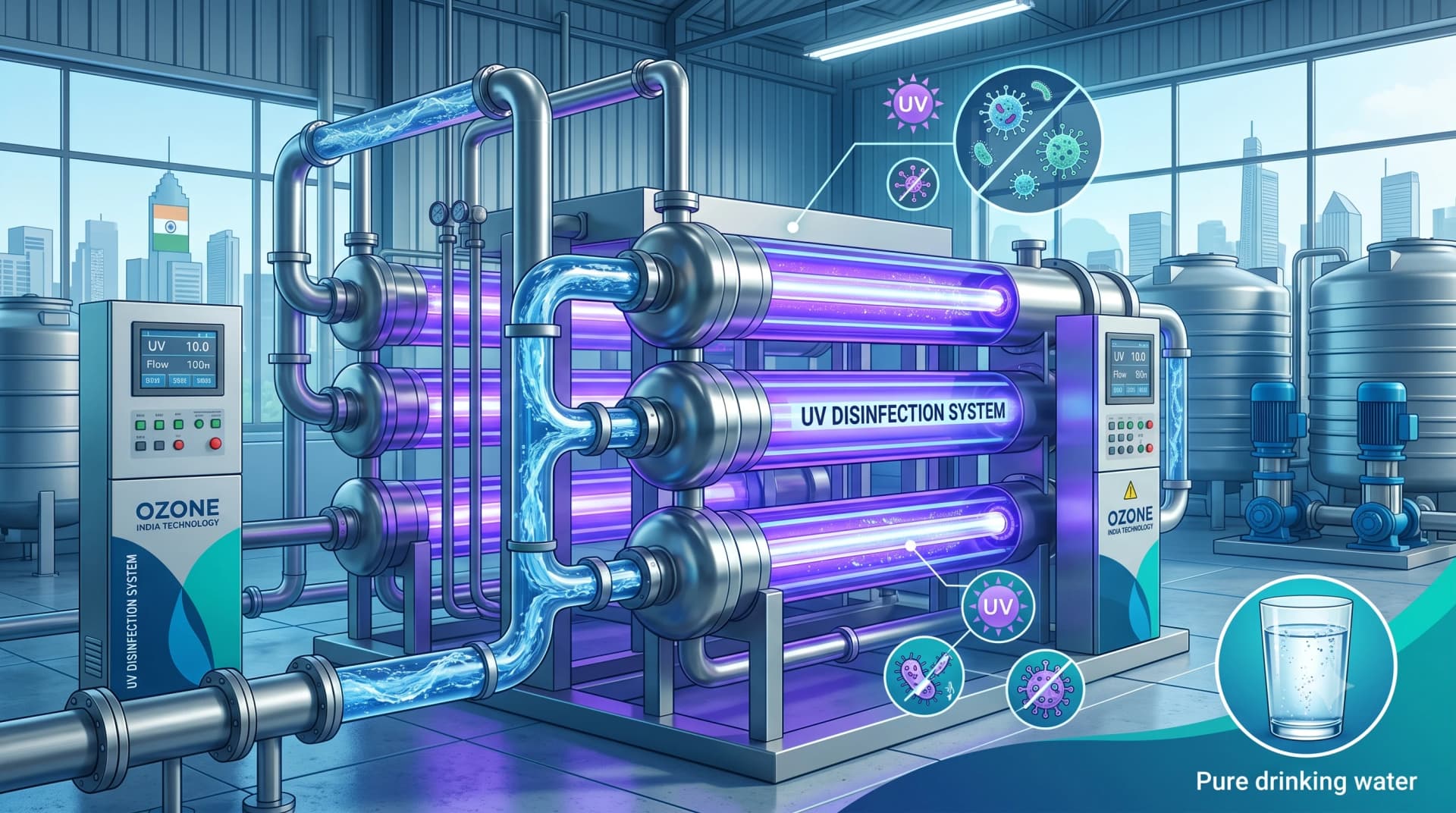
UV disinfection system for drinking water India has become the mandatory final treatment step for packaged water plants, RO systems, and municipal distribution networks as BIS IS 14543, FSSAI, and WHO drinking water guidelines demand validated pathogen inactivation without chemical additives. Alpha UV System, the UV division of Ozone India Technology based in Greater Noida, manufactures CE and ISO 9001 certified 254nm UV-C disinfection systems from 5 LPH for laboratory applications to 50,000 LPH for municipal water supply — with factory-direct pricing and complete compliance documentation for every installation.
How UV Disinfection Works for Drinking Water
Ultraviolet disinfection at 254nm wavelength — the germicidal peak of the UV-C spectrum — damages the DNA and RNA of waterborne microorganisms by inducing the formation of thymine dimers that prevent cellular replication. Unlike chemical disinfection methods, UV treatment does not alter the taste, odour, or chemical composition of the treated water and produces no regulated disinfection byproducts (DBPs) such as trihalomethanes (THMs) or haloacetic acids (HAAs).
The effectiveness of UV disinfection is expressed as UV dose (also called UV fluence), calculated as the product of UV intensity (mW/cm²) and contact time (seconds): Dose (mJ/cm²) = Intensity × Time. According to the WHO Guidelines for Drinking Water Quality 4th Edition (2017, Chapter 9), a minimum UV dose of 40 mJ/cm² is required to achieve a 4-log (99.99%) inactivation of E. coli and most waterborne bacterial pathogens. At 40 mJ/cm², the WHO also confirms 3-log inactivation of enteric viruses and 3-log inactivation of Giardia lamblia cysts.
The US EPA UV Disinfection Guidance Manual (2006, USEPA 815-R-06-007) establishes validated UV dose targets for municipal water treatment: 10 mJ/cm² for 2-log Giardia credit, 40 mJ/cm² for 3-log Cryptosporidium credit, and 186 mJ/cm² for 4-log adenovirus inactivation. For drinking water applications in India, the 40 mJ/cm² dose target is the industry standard adopted by BIS and FSSAI.
BIS IS 14543 and FSSAI Requirements for UV Treatment
BIS IS 14543:2016 Packaged Drinking Water (Other than Packaged Natural Mineral Water) mandates that treated water must meet the microbiological requirements of total coliforms (absent in 100 mL) and faecal coliforms (absent in 100 mL) after the final disinfection step. UV disinfection at validated 40 mJ/cm² dose reliably achieves these standards from municipal source water after primary filtration.
FSSAI Food Safety and Standards (Water, Standards and Licensing) Regulations require packaged water manufacturers to use ozone or UV as the terminal disinfection technology before filling. BIS certification for packaged water requires documented evidence of UV system dosimetry — the UV dose delivered under worst-case flow conditions. Alpha UV System provides complete dosimetry documentation including UV sensor calibration certificates and dose-response validation reports to support BIS licence applications.
Technical Specifications — Alpha UV System Range
Alpha UV System manufactures UV disinfection systems in the following standard configurations for drinking water applications. Each system uses a low-pressure mercury UV lamp operating at 254nm with UV transmittance (UVT) correction for the specific water quality.
The 5 to 500 LPH range covers laboratory water purification, small packaged water units, and residential RO systems. These units feature a single UV lamp in a stainless steel SS 316L reactor, UV sensor for real-time dose monitoring, and automatic lamp-on timer. Flow rates are adjustable by a feed pump controller to maintain the required UV dose at all operating flows.
The 500 LPH to 10,000 LPH range serves mid-scale packaged water plants, hotel water systems, and food processing facilities. Multi-lamp configurations with SS 316L reactors provide UV doses validated to exceed 40 mJ/cm² at rated flow. All systems include a UV intensity sensor, alarm for low-UV output, and automatic shutdown to prevent untreated water from passing through if the UV lamp fails.
The 10,000 to 50,000 LPH range is designed for municipal water treatment, large industrial RO post-treatment, and bottling plant final disinfection. These systems use medium-pressure UV lamps with broader spectral output, providing enhanced inactivation of UV-resistant viruses compared to low-pressure systems. Skid-mounted configurations with PLC control, remote monitoring capability, and SCADA integration are available.
Advantages of UV Over Chlorination for Indian Drinking Water
India's municipal water supplies commonly use chlorine as the primary disinfectant. However, chlorination of water containing naturally occurring organic matter (NOM) — present in surface water sources including Ganga, Yamuna, and most Indian rivers — produces trihalomethanes (THMs) and haloacetic acids (HAAs). The CPCB and Bureau of Indian Standards have set limits for total THMs in drinking water at 0.1 mg/L, but chlorination of NOM-rich source water can generate THM concentrations approaching or exceeding this limit at conventional doses.
UV disinfection produces zero chemical disinfection byproducts. UV at 40 mJ/cm² inactivates Cryptosporidium parvum — which is completely resistant to chlorine at practical doses used in municipal treatment — with a 3-log reduction. The US EPA Groundwater and Drinking Water Program (2006) specifically recommends UV as the preferred technology for Cryptosporidium and Giardia control in surface water treatment.
For packaged water plants using RO membrane filtration as primary treatment, UV post-treatment is preferred over chlorination because residual chlorine can damage the next-stage RO membrane if the product water is further processed, and because consumers increasingly reject chemical taste in premium packaged water.
Installation and Commissioning
Alpha UV System installation for a packaged water plant typically requires one working day. The UV reactor is installed on the product water line after final filtration and before the filling machine. The system is commission-tested by measuring UV transmittance of the product water, setting the flow rate, and verifying that the UV dose delivered exceeds 40 mJ/cm² under worst-case (maximum flow, minimum lamp output) conditions.
All Alpha UV System installations include a UV sensor calibration certificate, dosimetry validation report, operation and maintenance manual, and BIS/FSSAI documentation package. Annual maintenance involves UV lamp replacement (rated lamp life: 9,000 to 12,000 hours), UV sensor recalibration, and reactor inspection.
Why Alpha UV System for Your Drinking Water Project
Manufactured by Ozone India Technology, the CE and ISO 9001 certified ozone and UV manufacturer based in Greater Noida, Alpha UV System combines 11 years of water treatment manufacturing experience with factory-direct pricing that is 30 to 40 percent below imported European UV brands for equivalent technical performance and CE certification. Our IIT Patna-educated engineering team provides free UV system sizing based on your flow rate, water quality (UV transmittance), and target compliance standard.
UV Disinfection — Log Inactivation at 254nm by Pathogen
Disinfection Operating Cost — UV vs Ozone vs Chlorine (₹ per 1,000 Litres)
Frequently Asked Questions
What UV dose is required for drinking water per WHO?
WHO Guidelines for Drinking Water Quality (2017) recommend 40 mJ/cm² for 4-log bacterial inactivation and 3-log viral inactivation in drinking water UV disinfection systems. Alpha UV System validates every unit at 40 mJ/cm² minimum dose under rated flow conditions.
Does UV treatment remove all contaminants from drinking water?
UV disinfection specifically targets biological contaminants — bacteria, viruses, and protozoa — by damaging their DNA. UV does not remove dissolved chemicals, heavy metals, nitrates, or turbidity. For comprehensive drinking water treatment, UV is used as the final disinfection step after filtration and, where required, RO treatment.
Is an Alpha UV system compliant with BIS IS 14543?
Yes. Alpha UV Systems are CE certified and designed to deliver a validated UV dose of 40 mJ/cm² per WHO/EPA standards. Dosimetry documentation and installation reports suitable for BIS IS 14543 licence applications and FSSAI audits are provided with every installation.
What maintenance does a UV system require?
Annual UV lamp replacement (every 9,000 to 12,000 operating hours), UV sensor recalibration, and reactor cleaning. O-ring inspection and replacement as required. Total annual maintenance time: 2 to 4 hours. Genuine spare lamps and sensors are available from our Greater Noida facility.
How does UV system sizing work?
UV system capacity is determined by the water flow rate (LPH) and the UV transmittance (UVT%) of the source water. Lower UVT water (from surface sources or after certain chemical treatments) requires higher UV lamp power to deliver the same dose. Alpha UV System engineers size every unit based on actual UVT measurement of your source water — free sizing consultation available.