
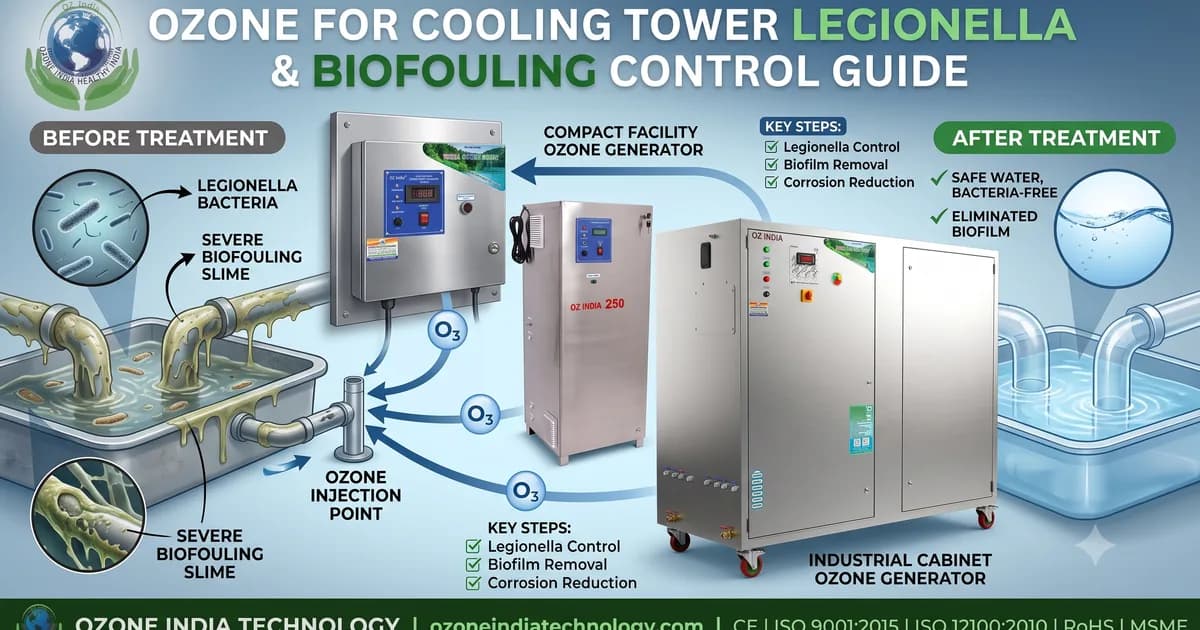
Cooling towers in commercial buildings — hotels, hospitals, data centres, shopping malls, airports — concentrate three water treatment problems that compound each other: biological fouling (Legionella pneumophila in biofilm), scaling (calcium carbonate deposits on heat exchanger surfaces), and corrosion from aggressive biocide chemicals used to control the first two. Conventional cooling tower water treatment uses a cocktail of isothiazolinone biocides, scale inhibitors, and dispersants — added continuously by chemical dosing pumps, procured from specialist vendors, and discharged as blowdown that carries regulated biocide residues to the sewer. Ozone for cooling tower replaces continuous biocide dosing with electrochemically produced ozone gas, eliminates Legionella at >4-log kill in 5 minutes of contact, destroys biofilm that protects Legionella from chlorine treatment, and reduces scale formation by 30–40% — with no chemical procurement, no biocide in blowdown water, and ASHRAE 188 Water Management Program compliance.
Legionella in Cooling Towers — Why It Matters
Legionella pneumophila causes Legionnaires' disease — a severe pneumonia with 5–15% case fatality rate in the general population and 25–40% in immunocompromised patients. Cooling towers are the most common source of community Legionella outbreaks globally. The epidemiology:
- Cooling tower water temperatures of 25–45°C (ambient temperature in India and Middle East) are optimal for Legionella growth
- Legionella enters cooling towers from makeup water (municipal water typically contains low levels of Legionella)
- Legionella proliferates inside biofilm on fill pack surfaces — biofilm protects it from biocides
- Aerosolised drift from cooling towers carries Legionella up to 500 metres downwind — infecting building occupants and neighbours who inhale the contaminated aerosol
ASHRAE Standard 188 (Legionellosis Risk Management for Building Water Systems) is the standard adopted by most large building operators (hospitals under JCI accreditation, international hotels, data centres) for Legionella risk management. ASHRAE 188 requires a documented Water Management Program (WMP) with specific control measures for cooling towers. Ozone treatment of cooling tower water is explicitly recognised in ASHRAE 188 as an effective Legionella control measure.
In India: Ministry of Health has issued guidelines on Legionella control in healthcare facilities. DEWA (Dubai Electricity and Water Authority) and DHA (Dubai Health Authority) require ASHRAE 188-compliant WMPs for cooling towers in Dubai commercial buildings.
Legionella Control — Ozone vs Chemical Biocides (Log Reduction, 5-minute contact)
Why Ozone Beats Chlorine for Cooling Tower Legionella Control
The critical limitation of chlorine for Legionella control in cooling towers is biofilm. Legionella lives inside biofilm — a polysaccharide matrix formed by bacteria on fill pack surfaces, basin walls, and heat exchanger tubes. Biofilm acts as a physical shield: chlorine at 1 mg/L achieves only 0.8-log reduction of Legionella inside biofilm, vs 3.5-log kill of free-floating (planktonic) Legionella. Ozone penetrates biofilm:
Mechanism: Ozone reacts with and degrades the polysaccharide matrix of biofilm through oxidation of the organic polymer chains. Once the matrix is disrupted, Legionella cells are exposed to ozone and killed. Ozone achieves >4-log kill of Legionella in biofilm at 0.1–0.2 mg/L dissolved ozone.
Biofilm elimination cycle: Monthly shock ozone treatment at 0.5 mg/L for 30–60 minutes eliminates established biofilm. Continuous ozone at 0.1 mg/L prevents new biofilm formation. The combination eliminates the Legionella reservoir — something biocide treatment cannot achieve without full mechanical cleaning and chemical descaling.
Ozone for Cooling Tower — System Configuration
Ozone is applied to cooling tower water in a sidestream configuration:
Sidestream setup:
- 5–10% of cooling tower basin circulation flow is drawn by a sidestream pump through an ozone contact loop
- The ozone venturi injector injects ozone gas (from the generator) into the sidestream flow — creating 2–5 mg/L dissolved ozone in the sidestream
- Contact time in the sidestream pipe: 30–60 seconds (longer than a venturi alone — a short pipe loop or small SS316L contact vessel)
- Treated water returns to the basin — dissolved ozone residual in the basin: 0.1–0.2 mg/L
- The dissolved ozone monitor at the basin measures residual and controls generator output automatically
Basin dissolved ozone control:
- Target: 0.1–0.2 mg/L dissolved ozone in the basin water at steady state
- This concentration provides continuous Legionella kill, biofilm prevention, and corrosion inhibition of copper tube heat exchangers (ozone at <0.3 mg/L does not corrode copper — unlike chlorine at equivalent kill concentrations)
- The dissolved ozone monitor maintains this setpoint by modulating generator output
Cooling Tower Ozone System Sizing by Tower Capacity (g/hr generator required)
Sizing Ozone Generator for Cooling Tower
Standard sizing approach:
Step 1 — Basin volume: Approximately 0.15–0.2 m³ per refrigeration ton (RT). 500 RT tower = 75–100 m³ basin.
Step 2 — Sidestream flow: 5% of basin volume per hour = 4–5 m³/hr for a 500 RT tower.
Step 3 — Ozone dose in sidestream: 3 mg/L (to achieve 0.1–0.2 mg/L residual in basin after dilution).
Step 4 — Generator capacity: Q = 4.5 × 3 × 1.3 ÷ 1000 = 0.0175 kg/hr = 17.5 g/hr → 20g/hr unit
Quick reference:
- 100 RT: 5g/hr ozone generator
- 250 RT: 10g/hr
- 500 RT: 20g/hr → Ozone generator 10-25g/hr
- 1,000 RT: 40g/hr → Ozone generator 30-50g/hr
- 3,000 RT: 100g/hr → Ozone generator 75-350g/hr
Scale Reduction and Chemical Savings
Ozone for cooling tower reduces scaling through oxidation of organic fouling and improvement in cycles of concentration (CoC):
Organic fouling reduction: Organic matter in makeup water (humic acids, algae, biofilm precursors) acts as nucleation sites for calcium carbonate scale. Ozone oxidises these organics — reducing scale nucleation sites and allowing higher CoC before scale forms on heat exchanger surfaces.
Increased CoC: Conventional cooling towers operate at 2–4 cycles of concentration before blowdown (to prevent scale). Ozone-treated towers can operate at 4–6 cycles of concentration — reducing makeup water consumption by 20–30% and blowdown volume proportionally.
Chemical reduction: Ozone replaces: isothiazolinones and other biocides (₹1.5–4 lakh/year for a 500 RT tower), chlorine shock treatments (₹0.5–1 lakh/year), and some scale inhibitor requirement (reduced dosage). Scale inhibitor and dispersant may still be used at reduced dose to prevent any residual scaling.
Annual Cooling Tower Chemical Savings with Ozone Treatment (₹ lakh/year, 500 RT tower)
ASHRAE 188 Compliance with Ozone Treatment
A cooling tower Water Management Program (WMP) under ASHRAE 188 requires:
- Control measure identification: Ozone treatment documented as the primary biocidal control measure for Legionella
- Target parameters: Dissolved ozone residual 0.1–0.2 mg/L in basin water; verified by the dissolved ozone monitor
- Monitoring and documentation: Weekly dissolved ozone readings logged; monthly Legionella culture or rapid test (qPCR) from basin water and fill pack swabs
- Response actions: If Legionella detected: increase ozone to shock dose (0.5 mg/L for 60 minutes); inspect and clean fill pack; review makeup water quality
- Corrective action triggers: Basin dissolved ozone <0.05 mg/L for >4 hours = corrective action required (check generator operation, venturi, sidestream pump)
The dissolved ozone monitor's data logger provides the continuous monitoring record required for ASHRAE 188 WMP documentation — downloaded quarterly for review by the facility's Water Management Team. Ozone India Technology provides the WMP documentation template for cooling tower installations on request.
Ozone Safety for Cooling Tower Installations
Cooling tower ozone systems operate in plant rooms with workers present for maintenance. Safety requirements:
- Ozone ambient air monitor in the ozone generator room (not in the cooling tower basin area — ozone decays to oxygen in open basin air within seconds)
- Ozone destructor on the contact vessel off-gas vent (the small contact vessel in the sidestream loop has minor off-gas)
- Standard IP54 or IP65 enclosure for the generator (cooling tower plant rooms have high humidity)
Conclusion
Ozone for cooling tower is the most effective Legionella control technology available — outperforming chlorine in biofilm penetration and kill rate, eliminating the procurement and disposal complexity of isothiazolinone biocides, and delivering ASHRAE 188 Water Management Program compliance with continuous monitoring documentation. Ozone India Technology's cooling tower ozone systems from 5g/hr (100 RT) to 100g/hr+ (3,000 RT) are CE certified, include dissolved ozone monitor and ambient air monitor, and are sized and commissioned by our technical team. For a cooling tower ozonation quotation, contact [email protected] or WhatsApp +91 96500 17943 with your cooling tower RT and basin volume.
