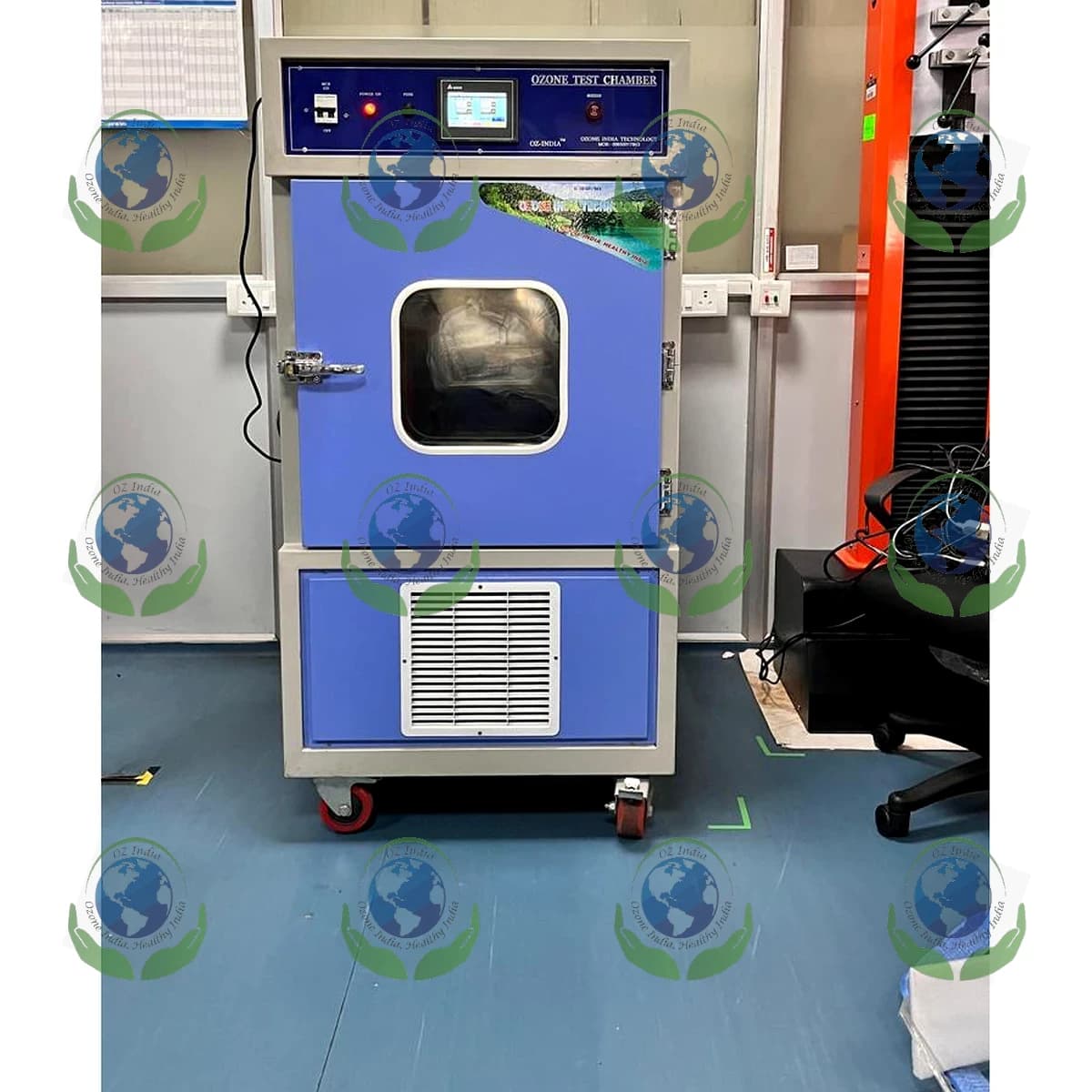
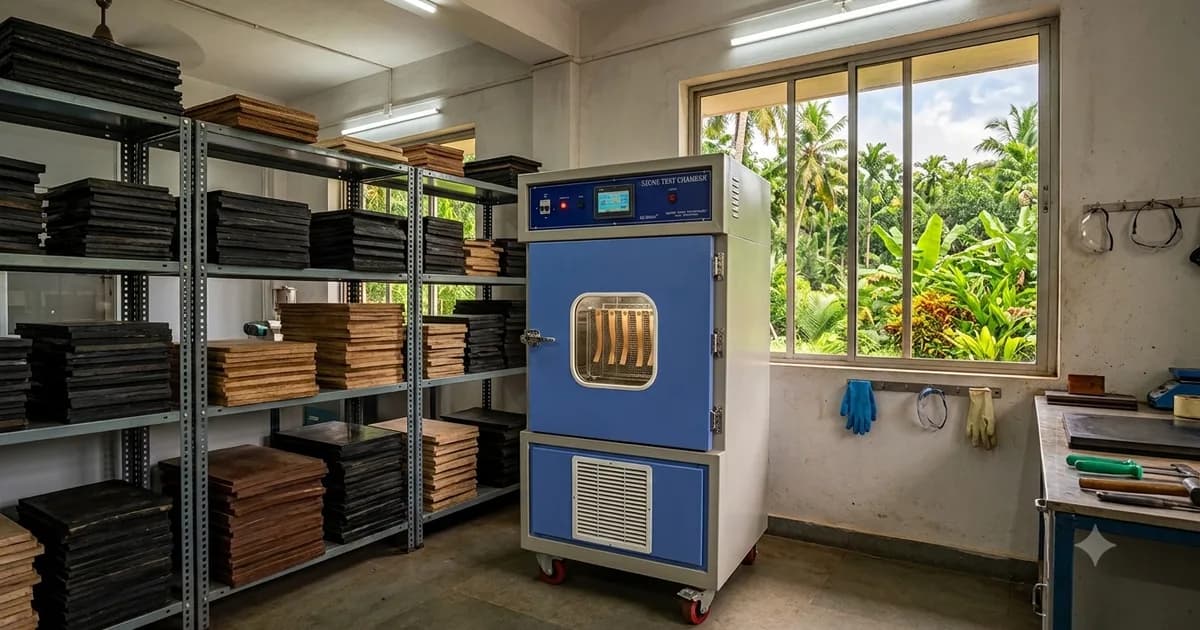
Ozone test chamber for natural rubber testing Kerala is a requirement at the heart of Hevea Rubber Technologies Pvt. Ltd., Kottayam — one of India's most respected natural rubber processing companies. Hevea Rubber Technologies is based in Kottayam, Kerala, in the geographic centre of India's natural rubber belt. When Hevea Rubber Technologies ordered an ozone test chamber (Model OZ-India-OTC) from Ozone India Technology, it was the logical next step for a company whose products must meet the most exacting rubber quality standards in the world. This blog explains why Kerala's rubber industry needs ozone test chambers, how Hevea Rubber Technologies uses this equipment, and what makes natural rubber uniquely vulnerable to ozone.
Kerala and Natural Rubber — The Context for Ozone Testing
Kerala produces over 90% of India's natural rubber (Hevea brasiliensis) output. The state's rubber industry — spanning plantations, processing mills, compounding operations, and finished goods manufacturers — employs over 1.2 million people. The value chain moves from plantation to RSS (Ribbed Smoked Sheet) or TSR (Technically Specified Rubber) grade, through compounding, to finished rubber products.
Natural rubber (NR) is chemically polyisoprene — a double-bonded hydrocarbon polymer that reacts with ozone to form ozonides, which then cleave the polymer chain. This is ozone cracking, and it is particularly aggressive in natural rubber compared to synthetic alternatives. Ozone levels as low as 5–25 ppb (parts per billion) in ambient air can initiate cracking in a strained natural rubber specimen over days to weeks. An ozone test chamber accelerates this to hours.
For Hevea Rubber Technologies, which processes and compounds natural rubber for supply to automotive, industrial, and export markets, every compound must demonstrate acceptable ozone cracking resistance before it can be sold. The ozone test chamber is the instrument that validates this, running IS 3400 Part 20 or ISO 1431-1 tests on compound samples to confirm batch quality.
About Hevea Rubber Technologies Pvt. Ltd.
Hevea Rubber Technologies Pvt. Ltd. is a Kerala-based natural rubber processing and technology company operating from Kottayam, Kerala — a location within easy reach of Kerala's rubber growing districts (Kottayam, Ernakulam, Idukki, and Thrissur).
Hevea is the botanical genus name for the rubber tree (Hevea brasiliensis), making Hevea Rubber Technologies' branding a direct reference to the natural rubber supply chain in which the company operates. The company processes rubber compounds and technologies for customers in automotive, footwear, industrial, and export markets — all sectors that require documented ozone cracking resistance.
The company procured one unit of the Ozone India Technology OZ-India-OTC ozone test chamber, confirming the standard model configuration appropriate for natural rubber compound testing.
Why Natural Rubber Is More Vulnerable to Ozone Than Synthetic Rubber
Understanding ozone vulnerability helps explain why Hevea Rubber Technologies prioritised the ozone test chamber as a quality investment:
| Rubber Type | Ozone Resistance | Mechanism |
|---|---|---|
| Natural Rubber (NR) | Low | High density of C=C double bonds — highly reactive with O₃ |
| Styrene Butadiene Rubber (SBR) | Low-Medium | Also contains C=C bonds, similar ozone reactivity |
| Ethylene Propylene Diene Monomer (EPDM) | High | C=C bonds in side chain only — main chain protected |
| Silicone | Excellent | Inorganic Si-O backbone — essentially ozone-inert |
| Nitrile Rubber (NBR) | Low | C=C double bonds present |
| Neoprene (CR) | Medium-High | Chlorine atom provides partial chain protection |
Natural rubber compounds used in automotive and industrial applications are often modified with antiozonants (chemical protectants like 6PPD/IPPD) to improve ozone resistance. The ozone test chamber validates whether the antiozonant concentration and dispersion are adequate for the specified service conditions. This is an ongoing test requirement at every batch, not a one-time qualification.
IS 3400 Part 20 and Natural Rubber Compound Testing at Hevea
Hevea Rubber Technologies' ozone test chamber is used to run IS 3400 Part 20 (identical to ISO 1431-1) ozone cracking resistance tests. The test protocol:
- Specimen preparation: Rubber strips cut to 150 mm × 10 mm × 2 mm from the compound batch
- Strain application: Specimens mounted on SS-304 jali holders at 20% elongation
- Chamber conditions: Set ozone concentration (typically 50 pphm for IS 3400), temperature 40°C ±2°C, 70% ±10% RH
- Exposure duration: 24 hours to 96 hours depending on specification
- Inspection: Visual examination under 7× magnification for ozone cracks
The Ozone India Technology OZ-India-OTC ozone test chamber maintains all these conditions automatically, with the PID controller and electrochemical sensor ensuring concentration stability ±5% throughout the test duration. The digital LED display and timer allow lab technicians to monitor and record test conditions without manual intervention.
View full technical specifications of the ozone test chamber
Rubber Compound Applications Tested at Hevea Rubber Technologies
The natural rubber compounds processed at Hevea Rubber Technologies serve multiple end-use markets, each with specific ozone resistance requirements:
Automotive Natural Rubber Compounds
Engine mounts, suspension bushings, body mounts, and vibration isolators often use natural rubber compounds for their superior dynamic properties. Automotive OEMs require ozone test chamber data confirming 50 pphm / 40°C / 48-hour performance per IATF 16949 and OEM-specific standards.
Industrial Vibration Dampers
Machinery mounts, anti-vibration pads, and industrial coupling rubber elements are tested in an ozone test chamber to industrial standards — typically IS 3400 or DIN 53509 depending on the buyer's specification.
Footwear and Consumer Rubber
Natural rubber soles and heels require ozone resistance validation for export markets. European CE marking for footwear increasingly references ISO 1431 ozone testing.
Export Grade Rubber Sheets
RSS and compound sheets exported to Malaysia, Singapore, Japan, and Germany must often carry ozone test certificates. The in-house ozone test chamber at Hevea Rubber Technologies enables this documentation without third-party lab dependency.
The Economics of an In-House Ozone Test Chamber for Kerala Rubber Companies
Kerala has over 4,000 rubber product manufacturers — from micro-enterprises to large compound processors. External ozone testing services in Kerala are concentrated in Kochi and Thiruvananthapuram, with typical turnaround times of 5–10 working days. Companies with high batch volumes find that an in-house ozone test chamber eliminates this wait, enabling same-day batch approval and dispatch.
Ozone India Technology provides free ROI analysis for any company considering an in-house ozone test chamber. Call +91 96500 17943 or contact us for a custom analysis.
Natural Rubber Ozone Cracking — Antiozonant Concentration vs Protection Duration
Kerala Rubber Processing Industry — Value Chain Distribution (%)
In-House OTC — Time and Throughput Benefits for Rubber Processors
Ozone Resistance by Rubber Type — Hours to First Crack at 50 pphm
Conclusion — Ozone Test Chamber for Kerala's Natural Rubber Industry
Hevea Rubber Technologies Pvt. Ltd.'s investment in an ozone test chamber from Ozone India Technology represents a quality leadership decision for Kerala's rubber processing industry. By testing every batch in-house using a CE-certified, IS 3400 and ISO 1431-1 compliant instrument, Hevea can guarantee the ozone cracking resistance of their compounds to automotive, industrial, and export customers without dependency on external laboratories.
Natural rubber's inherent ozone vulnerability makes the ozone test chamber not a luxury but a necessity for any company serious about quality. The Ozone India Technology OZ-India-OTC delivers the precision, reliability, and documentation support that Kerala's rubber industry needs to compete in domestic and export markets.
For rubber processing companies, compound manufacturers, or natural rubber product exporters across Kerala, Tamil Nadu, Karnataka, and the rest of India, Ozone India Technology provides certified ozone test chamber solutions with factory-direct pricing and comprehensive commissioning support. Explore our ozone test chamber product page, visit our products catalogue, or reach out to our technical team. Call +91 96500 17943 — we serve Kerala with road freight delivery within 3–4 working days.