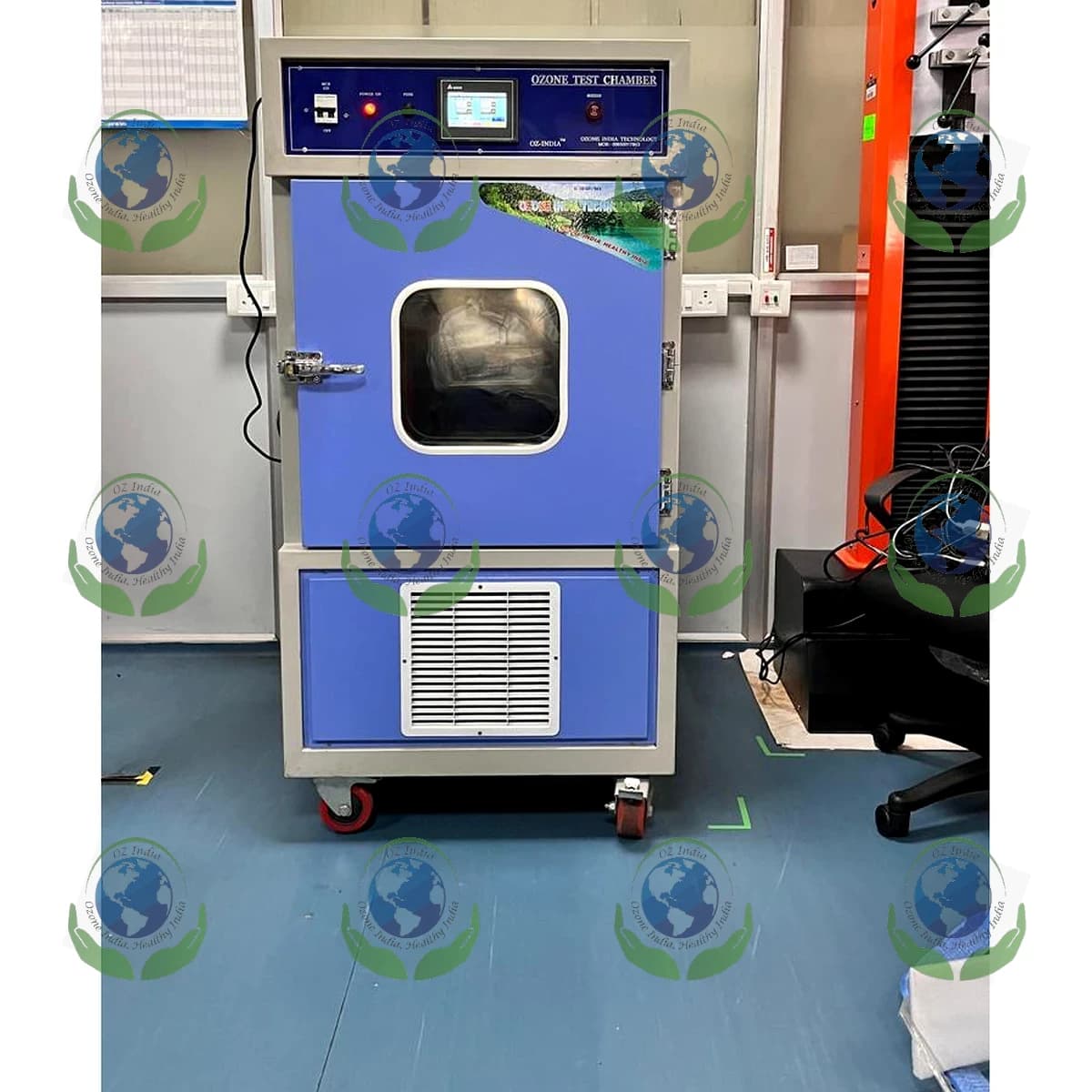
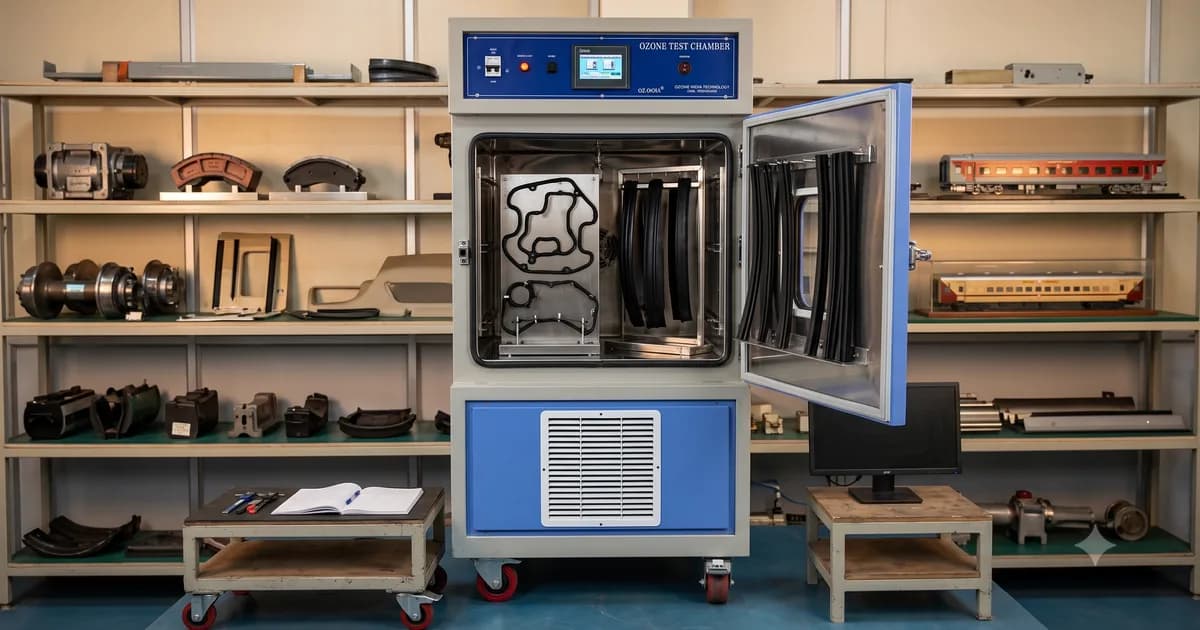
Ozone test chamber for railway rubber component testing is a requirement that Avadh Rail Infra Ltd, Haridwar, Uttarakhand, addressed when they commissioned an ozone testing chamber from Ozone India Technology in March 2024. This blog explains why railway infrastructure companies test rubber seals and polymer components in an ozone test chamber, what standards apply, and how Ozone India Technology delivered a CE-certified solution to the SIDCUL IIE industrial estate at Haridwar.
Why Railway Infrastructure Companies Need an Ozone Test Chamber
Rail is among the most demanding environments for rubber and polymer components. Doors seals, vibration dampers, buffer stops, cable conduits, and gaskets on rolling stock are exposed to ozone concentrations in tunnels, elevated corridors, and electrical switchgear rooms that far exceed ambient urban air. Bureau of Indian Standards IS 3400 Part 20 and ISO 1431-1 require that every rubber compound used in load-bearing or sealing roles on rolling stock must pass an ozone test chamber exposure trial before batch approval.
Avadh Rail Infra Ltd operates in Haridwar, Uttarakhand — within one of India's largest multi-product industrial estates, home to over 400 manufacturing units producing components for railways, power sector, and heavy engineering. The company's quality systems demanded that rubber seals and polymer mouldings pass accelerated ozone ageing tests in a certified ozone test chamber before supply to their end customers.
When a rubber component fails an ozone cracking test, the consequences on rolling stock are severe — gasket failures that allow moisture ingress, door-seal degradation that causes draughts and noise at speed, and vibration-damper cracking that shortens maintenance intervals. Indian Railways' quality specifications reference IS 3400 Part 20 explicitly, making an in-house ozone test chamber a prerequisite for any supplier seeking approved vendor status.
About Avadh Rail Infra Ltd
Avadh Rail Infra Ltd is a manufacturing company based in Haridwar, Uttarakhand, with a facility in the SIDCUL IIE industrial estate. The company manufactures and tests components for rail infrastructure projects, maintaining a quality laboratory that meets the documentation requirements of Indian Railways and railway OEM supply chains.
The ozone test chamber from Ozone India Technology was procured for quality laboratory infrastructure at their Haridwar plant. The scope of supply covered the complete ozone test chamber with associated accessories, installation, and commissioning support.
Standards Compliance for Railway Rubber Testing
Every ozone test chamber used in a railway supplier's QC laboratory must meet specific performance criteria to generate test data that is accepted by auditors:
- IS 3400 Part 20: BIS standard for ozone cracking resistance of vulcanised rubber — the primary Indian standard
- ISO 1431-1: Static strain ozone cracking test — the international equivalent
- ISO 1431-2: Dynamic strain testing for rubber components subject to movement
- AIS-034: ARAI specification for automotive rubber components with overlap to rail applications
- ASTM D1149: US standard followed by export-oriented rail component manufacturers
The Ozone India Technology OZINDIA-OTC meets all these standards. The ozone test chamber maintains ozone concentration stability of ±5% across the set point range of 25 pphm to 500 pphm, temperature uniformity of ±2°C from 15°C to 70°C, and relative humidity control of 55% ±5% RH — parameters required for IS 3400 compliant test results. CE certification (CE-2621A) and ISO 9001:2015 certification (UQ-270426AD1) are supplied with each unit and are accepted by Indian Railways quality auditors.
Technical Specifications of the OZINDIA-OTC Supplied to Avadh Rail Infra
The ozone test chamber supplied to Avadh Rail Infra Ltd at Haridwar is the standard OZINDIA-OTC model with the following specification:
| Parameter | Specification |
|---|---|
| Cabinet | Mild Steel, powder-coated exterior |
| Inner Chamber | SS-304 stainless steel |
| Ozone Concentration | 25–500 pphm, adjustable |
| Temperature Range | 15–70°C, ±2°C uniformity |
| Humidity | 55–75% RH, controlled |
| Test Type | Static strain |
| Ozone Sensor | Electrochemical type |
| Display | 3½ digit LED, 12 mm high |
| Timer | Digital, 1 second to 10 hours |
| Certification | CE, ISO 9001:2015 |
The ozone test chamber is designed for simultaneous testing of multiple rubber specimens on a SS-304 jali specimen holder. Test specimens are stretched to 20% elongation as per IS 3400 Part 20, exposed to the set ozone concentration for the prescribed duration, then inspected visually for cracking under 7× magnification.
How the Ozone Test Chamber Works for Rubber Ageing Testing
An ozone test chamber accelerates real-world ageing by concentrating environmental ozone to levels many times higher than outdoor ambient (typically 25 ppb outdoor vs. 25–500 pphm in the chamber — a 100× to 2000× acceleration factor). This lets quality engineers identify batch failures in hours rather than waiting months for field evidence.
The ozone test chamber generates ozone internally through a corona discharge cell fed by dry, oil-free compressed air. A pump circulates the ozone-air mixture evenly across all specimens. The electrochemical sensor continuously monitors concentration and the PID controller adjusts ozone output to maintain set-point within ±5%. At the end of the test cycle, the ozone is automatically destroyed before the chamber is vented — a safety feature required in all industrial environments.
For Avadh Rail Infra Ltd's railway rubber component testing, the process is: prepare specimens to IS 3400 Part 20 geometry → stretch to specified elongation on the holder → place in the ozone test chamber → set concentration and duration per the applicable specification → run test → inspect. Any compound showing cracking is rejected and the batch fails qualification.
Internal link: View the Ozone Test Chamber product specification
Who Else Uses Ozone Test Chambers in India
The ozone test chamber is a critical instrument across multiple industries in India:
Automotive OEMs and Tier-1 Suppliers
Maruti Suzuki, Tata Motors, Hyundai, Honda, and their Tier-1 rubber suppliers require ozone test chamber data for every rubber compound approval. IATF 16949 supplier qualification mandates ozone cracking resistance testing for all rubber seals, hoses, and dampers.
Cable and Wire Manufacturers
Electrical cable manufacturers test PVC, XLPE, and rubber outer sheaths in an ozone test chamber to verify compliance with IS 1554, IS 694, and IEC 60811-403 — the ozone cracking resistance standard for cable insulation.
NABL and Third-Party Testing Laboratories
NABL accredited laboratories offer commercial ozone test chamber testing services. Multiple companies send specimens to Gurgaon, Pune, Chennai, and Bangalore-based labs rather than investing in in-house equipment — until testing volumes justify the capital expenditure.
Defence and Aerospace
DRDO, HAL, and defence rubber component suppliers test gaskets and seals in an ozone test chamber to MIL-R-6130 and equivalent specifications.
Infrastructure and Construction
Bridge bearing pads, expansion joint seals, and tunnel gaskets are qualified in an ozone test chamber per IS specifications before use in critical civil infrastructure — exactly the use case relevant to rail infrastructure companies like Avadh Rail Infra Ltd.
Selecting the Right Ozone Test Chamber for Railway Applications
Railway rubber component manufacturers typically need the following ozone test chamber configuration:
| Chamber Volume | Specimen Capacity | Typical Application |
|---|---|---|
| 100 litres | 6–8 standard specimens | Small gaskets, O-rings, seals |
| 250 litres | 15–20 specimens | Door seals, vibration dampers |
| 500 litres (INZI-spec) | 30+ specimens | High-throughput QC lab |
| Custom | As required | Walk-in chambers for large components |
For a facility like Avadh Rail Infra's Haridwar Unit-II, the standard OZINDIA-OTC with 100-litre test space is appropriate for incoming quality inspection of rubber batches. Companies with higher testing throughput — testing 50+ batches per week — should consider the 250-litre or 500-litre ozone test chamber variants.
Get a free sizing recommendation from Ozone India Technology
Ozone Cracking Risk — Railway Components vs Ambient Ozone Concentration
IS 3400 Part 20 Key Test Parameters — OZINDIA-OTC Compliance
Ozone Test Chamber Users — India by Industry Sector (%)
In-House OTC — Operational Benefits for Railway Suppliers
Why Avadh Rail Infra Ltd Chose Ozone India Technology
Ozone India Technology was selected for the Avadh Rail Infra Ltd ozone test chamber project based on three factors:
CE and ISO 9001:2015 Certification. Avadh Rail Infra's quality management system requires that test equipment suppliers carry valid CE and ISO certifications. Ozone India Technology's CE-2621A and ISO certificate UQ-270426AD1 were acceptable to the client's quality team without additional audit. See all certifications
Factory-Direct Supply with Approved Documentation. The PO required MTC, MSDS, and PDI reports alongside the equipment — documentation that Ozone India Technology provides as standard with every ozone test chamber supplied. Many equipment traders cannot generate genuine MTC and PDI documentation, but as a manufacturer, Ozone India Technology issues factory-genuine documents for every unit.
Rapid Delivery. The purchase order specified delivery within three days of PO date — an aggressive timeline that Ozone India Technology met from their Greater Noida manufacturing facility, dispatching road freight directly to Haridwar SIDCUL IIE.
Conclusion — Ozone Test Chamber for Railway Rubber Testing
Avadh Rail Infra Ltd's investment in an ozone test chamber at their Haridwar Unit-II plant reflects the broader trend of Indian railway and infrastructure companies building in-house test capability rather than depending on external laboratories. With lead times from external labs often exceeding two weeks, an in-house ozone test chamber eliminates batch hold time and enables real-time QC decisions.
The Ozone India Technology OZINDIA-OTC ozone test chamber provides IS 3400 Part 20, ISO 1431-1, and ASTM D1149 compliant test results from a CE-certified, ISO 9001:2015 manufactured instrument, with full documentation support for vendor qualification audits.
For companies in railway infrastructure, auto components, or cable manufacturing that need a reliable ozone test chamber, Ozone India Technology offers factory-direct supply, same-day quotations, and pan-India installation support. Visit our ozone test chamber product page, browse our complete products range, or contact the team for a free sizing consultation. Call +91 96500 17943 or WhatsApp us today.