
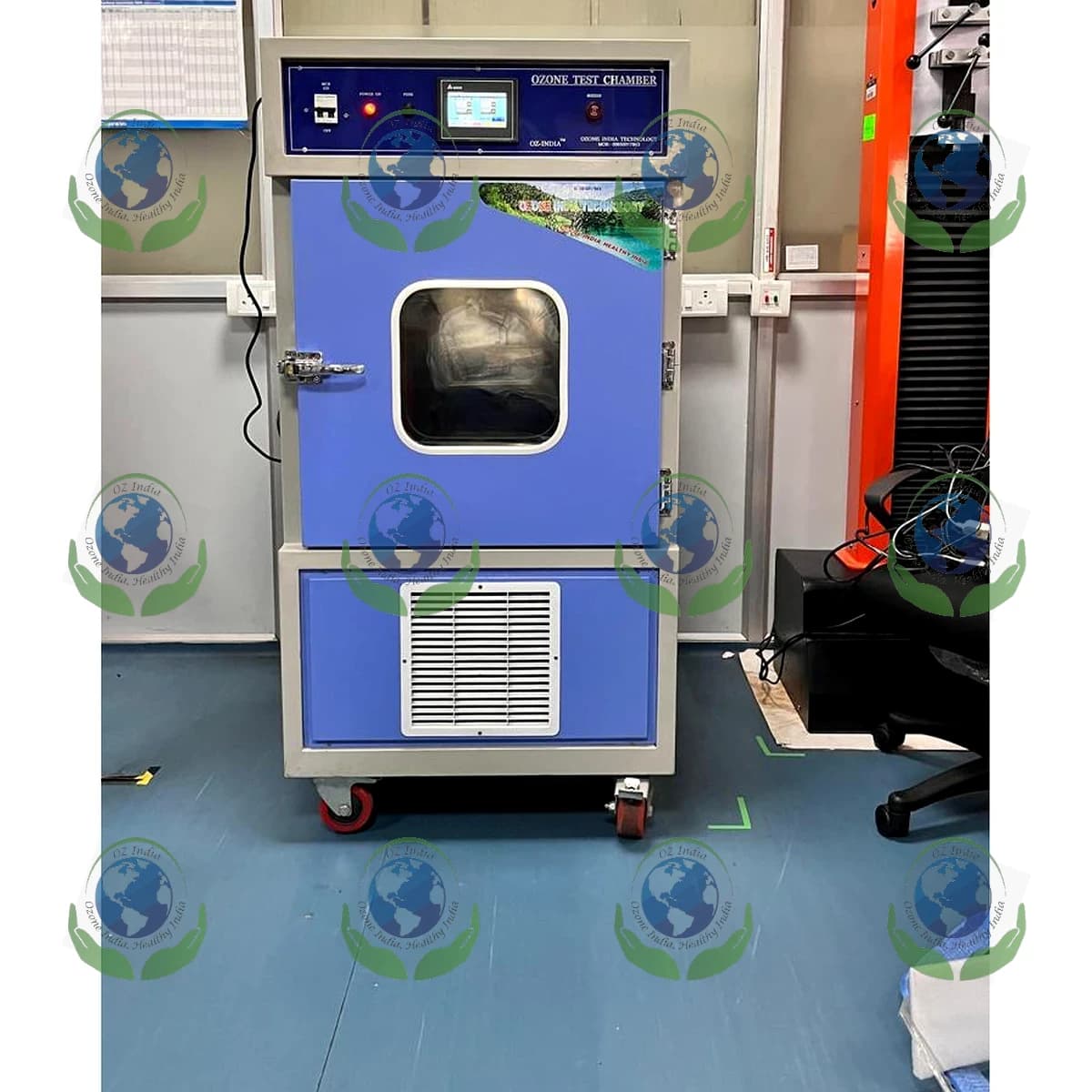
Ozone test chamber for rubber ageing testing India is a mandatory requirement for rubber component manufacturers, cable manufacturers, automotive parts suppliers and polymer product companies across India. Every rubber seal, electric cable and medical tube manufactured in India for safety-critical applications must pass the ozone ageing test before it can be certified, sold or exported. Ozone India Technology, based in Ghaziabad and Noida, manufactures CE certified ozone test chambers for in-house rubber ageing testing that comply with BIS IS 3400 Part 20, ISO 1431-1, ISO 1431-2, ASTM D1149, DIN 53509 and ARAI AIS-034 standards. Our IIT Patna-educated team provides complete technical support for chamber installation, calibration and test protocol development.
What is the Ozone Ageing Test and Why is it Mandatory
Ozone ageing testing — also called ozone exposure testing or ozone cracking test — is a standardised laboratory procedure that evaluates the resistance of rubber compounds, polymer materials and elastomers to degradation caused by atmospheric ozone. Ozone present in the atmosphere attacks the double bonds in unsaturated rubber compounds, causing the rubber surface to develop cracks perpendicular to the direction of stress — a characteristic degradation mode known as ozone cracking.
Ozone cracking is a serious quality and safety failure mode. A rubber seal that cracks due to ozone exposure can cause machinery leakage, coolant system failure, electrical insulation breach or medical device contamination. This is why rubber testing standards worldwide — including Indian BIS standards, ISO standards and automotive industry standards — mandate ozone resistance testing for safety-critical rubber components before they can be used in production.
For an ozone test chamber for rubber ageing testing India to be compliant, it must be capable of maintaining precise ozone concentrations, temperature and humidity conditions as specified in the relevant testing standard. Ozone India Technology designs every test chamber to meet the specific standard requirements of the purchaser.
Indian and International Standards — Ozone Ageing Testing
IS 3400 Part 20 — the Bureau of Indian Standards specification for methods of test for vulcanised rubbers covering resistance to ozone cracking. This is the primary Indian standard for ozone ageing testing and is mandatory for BIS product certification of rubber components.
ISO 1431-1 — the International Standards Organisation specification for vulcanised rubber resistance to ozone cracking under static conditions. Widely referenced by international buyers of Indian rubber components. ISO 1431-2 extends this to dynamic conditions, simulating ozone cracking under repeated mechanical flexing.
ASTM D1149 — the American Society for Testing and Materials standard for rubber deterioration by ozone cracking. Required for products exported to North America. DIN 53509 — the German standard for ozone cracking resistance, referenced by European automotive manufacturers.
AIS-034 — Automotive Industry Standard issued by ARAI for rubber components used in Indian automotive manufacturing. Every Tier 1 and Tier 2 automotive supplier in India must demonstrate ozone resistance compliance for rubber components supplied to OEMs.
Technical Specifications — Ozone India Technology Test Chambers
Ozone India Technology manufactures ozone test chambers in three standard chamber volumes — 100 litres, 250 litres and 500 litres — with custom sizes available for large rubber components or high-throughput QC laboratory requirements.
All Ozone India Technology test chambers feature automatic PID-controlled ozone concentration with accuracy of plus or minus 5 percent of the set point. Temperature control from ambient to 70 degrees Celsius with accuracy of plus or minus 2 degrees Celsius. Humidity control from 30 to 95 percent RH. The ozone generator within the chamber uses UV lamp technology for laboratory-scale chambers and corona discharge for larger industrial chambers.
Ozone concentration range — 25 ppb to 5000 ppb, covering all standard test conditions from atmospheric simulation to accelerated ageing. Chamber construction — SS 304 internal lining for ozone compatibility. Ozone measurement — built-in UV absorption ozone analyser for continuous concentration monitoring. Safety — ozone destructor at exhaust prevents workplace ozone exposure above safe limits. Data logging — digital display and USB data export for test report generation.
Rubber Ozone Ageing Test Standards — Required Ozone Concentration (pphm)
In-House Testing vs External Laboratory — Cost Analysis
Many Indian manufacturers currently send rubber samples to NABL-accredited external testing laboratories for ozone ageing tests. While this avoids capital investment in test equipment, it creates significant hidden costs and risks.
External laboratory turnaround time for ozone ageing tests is typically 5 to 15 working days. During this period, production batches are either held pending test results — creating work-in-progress inventory cost — or released on assumed compliance — creating quality risk.
External laboratory cost for a standard IS 3400 ozone ageing test in India ranges from Rs 1,500 to Rs 5,000 per sample. For a company conducting 200 ozone tests per year, the annual external laboratory cost is Rs 3 lakhs to Rs 10 lakhs — enough to justify an in-house ozone test chamber with payback under 18 months. Batch release time reduced from 10 days to 2 days. Annual laboratory testing cost eliminated. Supply reliability to OEM customers improved significantly.
In-House vs External Lab — Rubber Testing Cost and Turnaround
Case Study — Rubber Gasket Manufacturer in Pune
A rubber gasket manufacturer in Pune supplying to major automotive OEMs was conducting all ozone ageing tests at an external NABL laboratory with a 10-day turnaround. When their automotive client increased testing frequency from quarterly to monthly batch testing under new supplier quality requirements, the external laboratory approach became operationally unworkable.
Ozone India Technology supplied a 250-litre ozone test chamber. Within one week of installation, the manufacturer's QC laboratory was conducting all ozone tests in-house with 48-hour turnaround. Batch release time reduced from 10 days to 2 days. Annual laboratory testing cost of Rs 6 lakhs was eliminated. The chamber paid for itself within 14 months while simultaneously improving supply reliability score with the automotive OEM client.
Why Ozone India Technology for Your Ozone Test Chamber
Ozone India Technology manufactures ozone test chambers using corona discharge ozone generation for stable and precise ozone concentration control — the same technology used in our industrial ozone generators. This means our chambers maintain ozone concentration within plus or minus 5 percent of the set point throughout the test duration, ensuring reproducible and audit-acceptable test results.
All chambers are CE certified, ISO certified and supplied with complete calibration documentation including ozone concentration calibration certificate and temperature calibration certificate — required for NABL-aligned in-house testing laboratories. Our IIT Patna-educated engineering team provides chamber installation support, operator training and test protocol development assistance for all standards including IS 3400, ISO 1431 and AIS-034.
Frequently Asked Questions
What is an ozone test chamber for rubber ageing testing?
An ozone test chamber is a precision laboratory instrument that exposes rubber test specimens to controlled ozone concentrations at controlled temperature and humidity for specified time periods. It evaluates the ozone cracking resistance of rubber compounds per BIS IS 3400, ISO 1431, ASTM D1149 and other standards.
Which standard should I test to — IS 3400 or ISO 1431?
For BIS product certification in India — IS 3400 Part 20. For products exported to international markets — ISO 1431-1 and ISO 1431-2. For products supplied to Indian automotive OEMs — AIS-034 from ARAI. Ozone India Technology chambers are designed to meet all these standards. Our team helps select the correct standard for your specific product and market.
What chamber size do I need?
100 litre chambers are suitable for standard rubber strip and O-ring specimens. 250 litre chambers accommodate larger components and multiple specimen sets simultaneously. 500 litre chambers are used for high-throughput testing or large rubber mouldings. Contact Ozone India Technology for a free chamber size recommendation based on your product dimensions and testing frequency.
Does Ozone India Technology provide NABL-aligned calibration documentation?
Yes. Every ozone test chamber is supplied with ozone concentration calibration certificate and temperature calibration certificate. Calibration documentation is formatted to support NABL-aligned in-house testing laboratory requirements.
What is the payback period for an in-house ozone test chamber?
For a company currently spending Rs 3 to 10 lakhs per year on external laboratory ozone testing, payback period is typically 12 to 18 months. Ozone India Technology provides a free ROI analysis for every enquiry. Call +91 96500 17943.