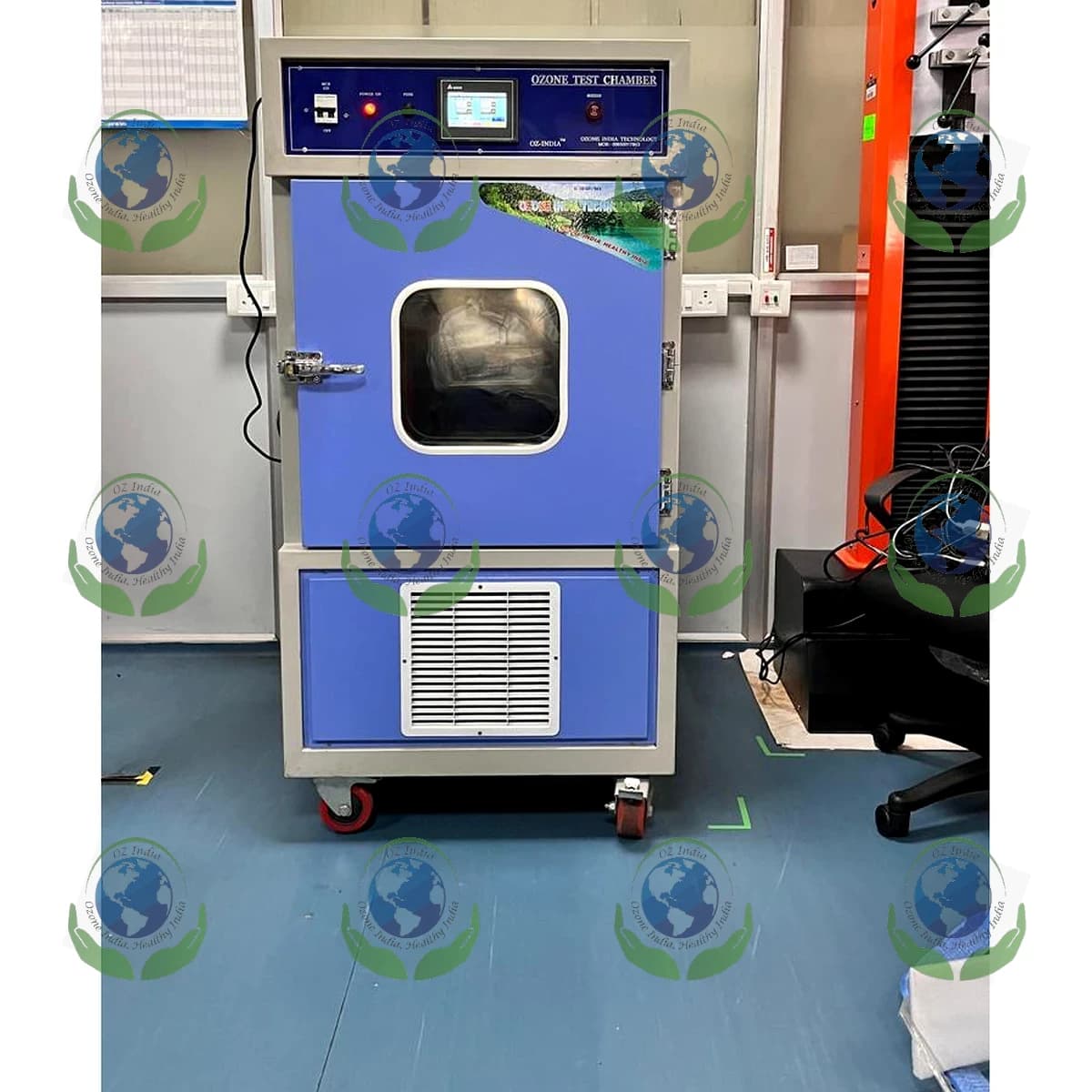
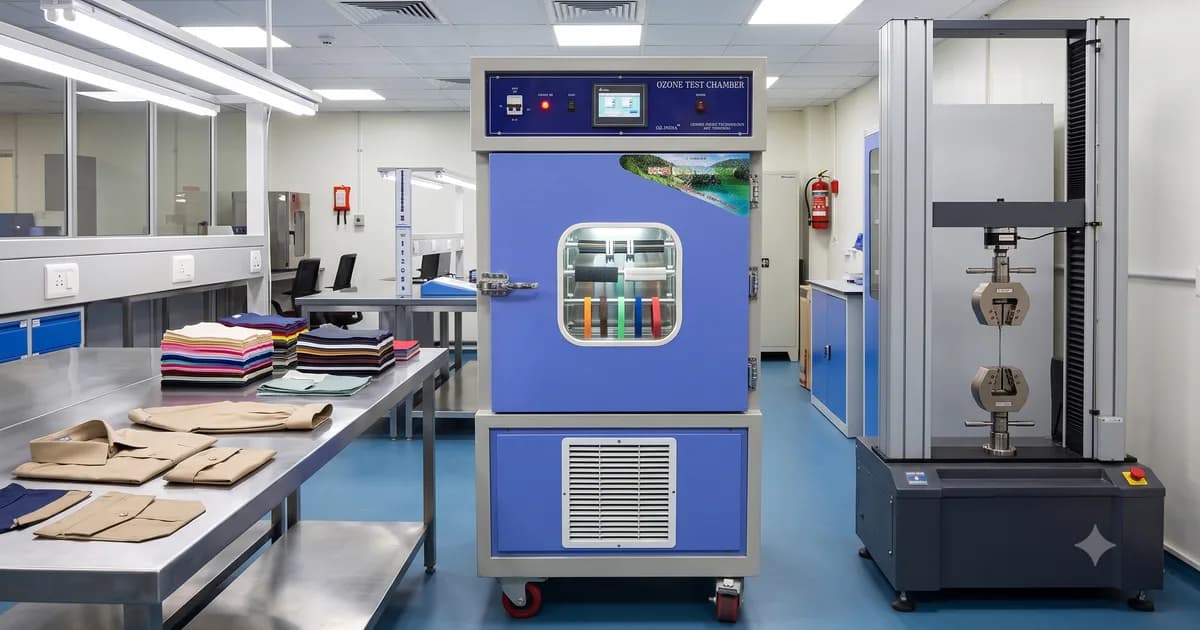
Ozone test chamber for garment and textile export quality testing India is an emerging requirement as India's garment export industry faces increasing buyer scrutiny for chemical safety, material performance, and international quality standards. Gokaldas Exports, one of India's largest garment manufacturers and exporters, based in Bangalore, procured an ozone test chamber from Ozone India Technology — a choice that reflects the growing intersection of textile engineering and rubber/polymer testing in India's apparel export value chain. This blog explains why garment manufacturers need ozone test chambers, which textile and apparel components require ozone cracking resistance testing, and how Ozone India Technology supports India's export-oriented garment industry.
Why Garment and Textile Companies Need an Ozone Test Chamber
When most people think of ozone testing, they think of automotive rubber components or cable insulation. But the ozone test chamber is also essential in the textile and garment export industry for testing:
- Elastic rubber and spandex waistbands in garments — ozone cracking in elastic waistbands causes the band to snap or lose elasticity during retail storage or transit in containers
- Rubber-coated fabric components — waterproof membranes, rubberised undersides on outdoor garments
- Gaskets and seals in garment industry machinery — industrial sewing machine rubber parts, pressing machine seals
- Technical textiles — coated fabrics, rubber-backed floor mats, anti-slip workwear underlayers
- Footwear components — rubber soles, heel pads, toe caps on safety footwear exported with garment orders
The ozone test chamber accelerates ozone exposure to identify rubber or elastomer components that will degrade during storage, transit, or use — preventing product recalls, customer complaints, and brand damage.
About Gokaldas Exports
Gokaldas Exports is one of India's largest and most respected garment manufacturers and exporters, headquartered in Bangalore, Karnataka. The company produces knit and woven garments for major international brands across Europe, the US, and other global markets. With manufacturing facilities across Karnataka, Gokaldas Exports has the scale and quality infrastructure that major international buyers demand.
International garment buyers — H&M, Zara, Tommy Hilfiger, Gap, Marks & Spencer — enforce rigorous RSL (Restricted Substances List) and MRSL (Manufacturing Restricted Substances List) requirements for their suppliers. These requirements increasingly include testing for physical performance of elastic and rubber components in garments, not just chemical safety. The ozone test chamber is the instrument that validates whether elastic waistbands, rubber trim, and rubberised fabric components will maintain their properties during the expected product lifecycle.
Gokaldas Exports' procurement of an ozone test chamber from Ozone India Technology reflects their proactive approach to building comprehensive in-house testing capability — ensuring that products meet buyer specifications before shipment, without dependence on external test laboratories in Mumbai, Bengaluru, or overseas.
Ozone Cracking in Garment Elastic — The Problem Ozone India Technology Solves
Elastic rubber in garments is made from natural rubber latex or synthetic elastomers (spandex/Lycra, which is polyurethane-based). Natural rubber elastic is particularly vulnerable to ozone cracking:
The mechanism: During retail storage or container transit, garments folded in containers or on hangers expose elastic waistbands to air containing ozone at 10–30 ppb ambient. Over weeks or months, this exposure degrades the rubber, causing:
- Surface cracking visible on the elastic
- Loss of elasticity (the rubber becomes brittle)
- Complete snap failure in extreme cases
The ozone test chamber accelerates this long-term ambient exposure to a 24–72 hour laboratory test. At 25–50 pphm ozone (25× to 50× ambient), the chamber replicates 6–12 months of ambient exposure in one to three days.
For a garment manufacturer like Gokaldas Exports shipping to European markets, where garments may sit in retail storage for 6–18 months before sale, verifying that elastic components survive this ozone exposure is critical. Elastic that passes the ozone test chamber test at 25 pphm / 40°C / 48 hours can be expected to maintain its properties through at least 12 months of normal retail storage.
Standards for Textile Ozone Testing
The standards applicable to Gokaldas Exports' ozone test chamber testing include:
- ISO 1431-1: Rubber — ozone cracking resistance in static conditions — applied to elastic rubber components
- AATCC 183: American standard for textile resistance to ozone fading — primarily for colour fastness, but the chamber conditions overlap with rubber cracking tests
- OEKO-TEX Standard 100: Requires that accessories (including elastic bands) meet safety and durability criteria. Ozone cracking resistance testing supports compliance documentation
- IS 3400 Part 20: BIS standard for vulcanised rubber — applicable to natural rubber elastic components
- REACH Regulation (EU): EU buyers require documentation that rubber components in garments do not contain restricted substances and maintain their physical performance. Ozone test chamber data supports the physical performance documentation
The Ozone India Technology ozone test chamber is configured to run all of these test protocols, with CE certification (CE-2621A) and ISO 9001:2015 manufacturing certification (UQ-270426AD1) that is accepted by international textile certification bodies (OEKO-TEX, Bureau Veritas, SGS, Intertek).
Technical Textiles and Industrial Garments — Advanced OTC Applications
Beyond standard apparel elastic, Gokaldas Exports and the broader Karnataka garment manufacturing sector produce technical textiles where ozone test chamber testing is mandatory:
Workwear and PPE with Rubber Components
Safety workwear — high-visibility jackets, chemical protection suits, safety boots — contains rubber seals, boots, and coatings that must pass IS 15768 (Indian Standard for PPE) or EN 340 (European workwear standard) durability requirements. The ozone test chamber tests the rubber components before PPE batch approval.
Outdoor and Sportswear with Rubberised Membranes
Outdoor jackets with PU (polyurethane) membranes and rubber-coated fabrics are tested in the ozone test chamber to verify that the rubber coating maintains adhesion and flexibility after ozone exposure. Delamination after ozone exposure is a warranty failure.
Industrial Aprons and Rubber-Coated Protective Clothing
Industrial protective clothing with natural rubber or chloroprene-coated fabrics for chemical and food processing industries must demonstrate ozone resistance for the expected service life.
Garment Export Quality Labs — The Move Toward In-House Testing
India's top garment exporters are investing in in-house testing laboratories to reduce dependence on third-party labs and compress the product development to export approval timeline. Key instruments in a garment exporter's quality lab:
| Instrument | Purpose |
|---|---|
| Colour fastness tester (Xenon arc) | Colour durability against light |
| Washing fastness tester | Colour durability after laundering |
| Tensile strength tester | Fabric and seam strength |
| Ozone test chamber | Rubber/elastic component ozone resistance |
| Dimensional stability washer | Shrinkage measurement |
| Flammability tester | Fire resistance per buyer requirement |
The ozone test chamber is a natural addition to this quality laboratory lineup for garment exporters whose product range includes elastic waistbands, rubber trim, or technical textile components.
See the ozone test chamber product page for garment laboratory configurations
Ozone Cracking Risk in Garment Components — Ambient vs Test Exposure
India Garment Export Quality Lab — Instrument Priority (%)
Elastic Component Ozone Test — Pass Rate by Rubber Type (%)
Bangalore Garment Exporters — Testing Investment by Category (relative share)
Gokaldas Exports' Quality Infrastructure Investment
Gokaldas Exports has consistently invested in quality infrastructure that matches international buyer expectations. Their procurement of an ozone test chamber from Ozone India Technology is part of a broader quality laboratory expansion that positions the company to meet the most demanding buyer requirements without external laboratory dependency.
The CE-2621A certified, ISO 9001:2015 manufactured ozone test chamber from Ozone India Technology generates test reports that are accepted by international buyers' quality auditors (SGS, Bureau Veritas, Intertek, TÜV) — reports that can be included in buyer-facing quality documentation to demonstrate proactive quality management.
For an export-oriented company like Gokaldas Exports, reducing testing lead time from 7–14 days (external lab) to same-day (in-house ozone test chamber) directly impacts product development cycle time and the speed at which new elastic component suppliers can be qualified.
Conclusion — Ozone Test Chamber for India's Garment Export Leaders
Gokaldas Exports' investment in an ozone test chamber from Ozone India Technology reflects the evolving quality expectations of India's garment export industry. As international buyers tighten their RSL, MRSL, and physical performance requirements for elastic, rubber trim, and technical textile components, in-house ozone test chamber capability gives Bangalore's garment manufacturers the testing speed, cost control, and documentation quality to stay ahead of compliance requirements.
For garment manufacturers, textile exporters, technical textile companies, footwear manufacturers, and workwear suppliers across Karnataka, Tamil Nadu, Maharashtra, and the rest of India who need an ozone test chamber for elastic and rubber component testing, Ozone India Technology provides CE-certified, factory-direct solutions with complete technical documentation. Visit our ozone test chamber product page, browse our full products catalogue, or get in touch with our team for a garment-industry OTC consultation. Call +91 96500 17943 — we understand export quality requirements.