
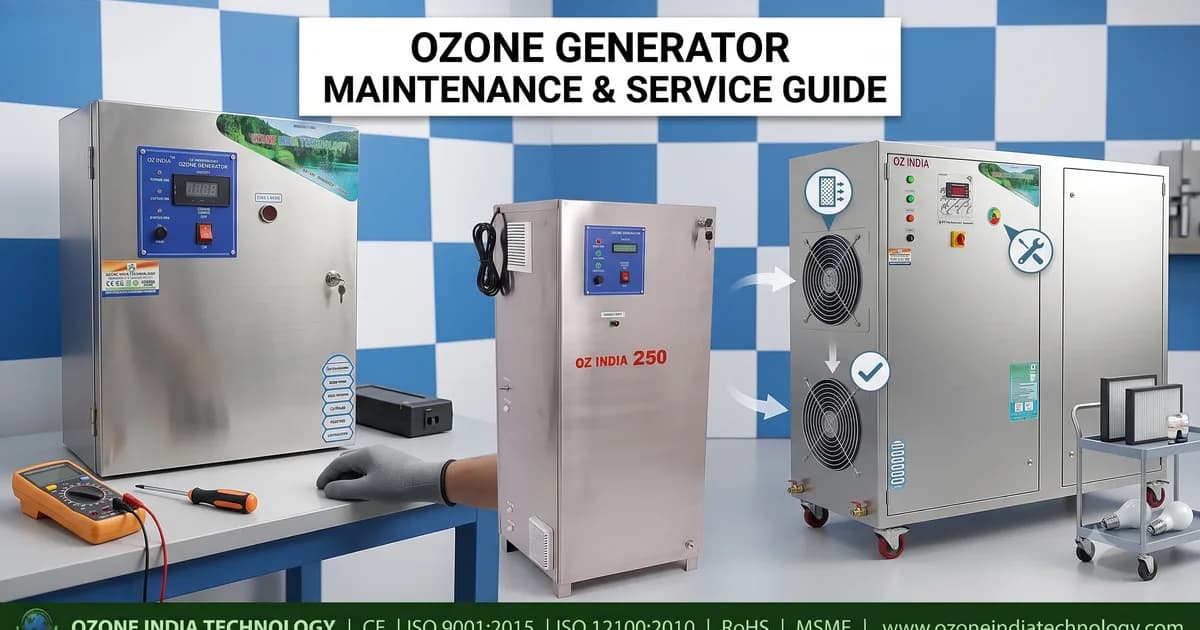
An industrial ozone generator running 16–24 hours per day processes thousands of cubic metres of feed air or oxygen, applies high-voltage corona discharge to produce ozone, and contacts ozonated water in stainless steel contact chambers — all of which require regular preventive maintenance to maintain rated ozone output and prevent unplanned breakdowns during critical treatment operations. The most common cause of reduced ozone generator output in the field is wet or contaminated feed air — a problem that desiccant replacement and air dryer maintenance prevents entirely. The second most common cause is electrode fouling from NOx deposits in air-fed systems. Both are predictable, scheduled maintenance items. This guide covers the complete ozone generator maintenance schedule by interval, the top 5 maintenance problems and their fixes, the spare parts every site should stock, and Ozone India Technology's Annual Maintenance Contract (AMC) programme for assured uptime.
Why Ozone Generator Maintenance Matters for Compliance
An STP, ETP, or WTP operating with a failed or degraded ozone generator is likely non-compliant with CPCB discharge standards or BIS/FSSAI water quality requirements until the generator is repaired. For plants under Consent to Operate from State Pollution Control Boards, unexplained non-compliance events must be reported and can trigger show-cause notices. An AMC or documented preventive maintenance programme demonstrates due diligence to PCB inspectors — essential for consent renewal.
For food processing plants with FSSAI licences or pharma facilities with CDSCO compliance requirements, a documented ozone generator maintenance log is part of the facility's HACCP/GMP records. Equipment malfunction logs must show corrective action timelines.
Maintenance Schedule — By Interval
Daily Checks (2 minutes, operator level)
These checks require no tools and should be part of the STP/ETP daily log:
- Ozone output display: Verify generator shows rated output on the display panel. A 10% drop from baseline indicates early-stage feed air or electrode degradation.
- Feed gas pressure: Air-fed: inlet pressure 0.5–1.5 bar (check compressor/dryer outlet). Oxygen-fed: PSA oxygen outlet pressure 0.8–1.5 bar.
- Cooling airflow: Place hand near generator cooling vents — should feel warm airflow. No airflow = cooling fan failure = imminent overtemperature shutdown.
- Dissolved ozone monitor reading: At contact chamber outlet — confirm residual is in the target range (application-specific). A reading below target with ozone generator showing normal output indicates venturi blockage or reduced water flow.
- Ambient air monitor: Confirm reading <0.05 ppm in the generator room. Any reading above 0.1 ppm triggers investigation.
Monthly Maintenance (15–30 minutes, maintenance technician)
Air inlet filter: Clean or replace the air inlet filter element on the ozone generator housing. Dust and particulate build-up on the filter restricts cooling airflow and, in air-fed systems, reduces the air flow to the corona cell. On-site inspection: hold the filter against a light — if it blocks >50% of visible light area, replace it.
Venturi injector inspection: The ozone venturi injector throat can accumulate mineral scale from the process water. Remove the venturi, hold up to a light, check for partial blockage at the throat. Flush with dilute citric acid (5%, 30 minutes) if scale is present. A partially blocked venturi reduces ozone transfer and increases ozone generator backpressure.
Water connections: Check all PVDF tube connections from generator to venturi for ozone permeation discolouration (PVDF yellows slightly over time — cosmetic) or cracking at fittings. Check SS316L contact chamber connections for corrosion.
Ambient air monitor: Zero-check the ambient monitor (fresh air outside the generator room should read 0.03–0.05 ppm — outdoor background). If the monitor reads significantly above outdoor background in fresh air, the sensor element may be drifting and needs replacement.
Ozone Generator Output Degradation vs Maintenance Neglect (% of rated output)
Quarterly Service (2–4 hours, qualified technician)
Desiccant replacement (air-fed systems): The air dryer desiccant (silica gel or molecular sieve beads) removes moisture from compressed air before it enters the corona cell. Moisture in the corona discharge produces nitric acid (HNO₃) which:
- Etches and corrodes the dielectric tube surface
- Reduces ozone production efficiency by 20–40%
- Produces nitric acid mist that enters the water, lowering pH
Replace desiccant when the humidity indicator turns from blue (dry) to pink (saturated). At minimum, replace quarterly regardless of indicator colour. Saturated desiccant is the leading cause of reduced ozone output.
Corona cell inspection (visual): With the generator powered off and locked out, remove the corona cell access panel. Inspect the dielectric tube surface — should be smooth and uniform. Look for:
- White or yellow deposits (NOx buildup) — clean with dry cloth, check desiccant condition
- Brown or black deposits (carbon) — indicates oil contamination from compressor; clean and inspect air treatment chain
- Cracks or chips in the dielectric — replace dielectric assembly
Dissolved ozone monitor calibration: Calibrate the dissolved ozone monitor quarterly using the Indigo Colorimetric Method (spectrophotometric reference): collect a sample at the contact chamber outlet, add Indigo reagent, measure absorbance at 600nm, calculate dissolved ozone concentration, compare to monitor reading. Adjust monitor calibration if >10% deviation.
All safety interlock testing: Test the ambient monitor auto-shutoff by simulating an alarm (cover sensor or use calibration gas). Generator should shut down within 30 seconds of alarm signal. Test the generator fault alarm — disconnect feed gas pressure switch, confirm generator shuts down and alarm activates. Document test results in the maintenance log.
Annual Overhaul (full day, OEM service engineer)
Corona discharge cell replacement or reconditioning: The dielectric tube and electrode assembly in the corona cell degraded at a rate determined by operating hours and feed gas quality. After 8,000–12,000 operating hours (approximately 2–3 years of 12-hour/day operation), the dielectric may need replacement to restore full ozone output. Signs of end-of-life dielectric: ozone output consistently below 80% of rated even after desiccant replacement and cleaning.
Transformer and power electronics inspection: High-voltage transformer windings, capacitors, and IGBT switching elements are inspected for deterioration. Capacitors in ozone generator power supplies have a 10–15 year rated life — replacement before failure prevents unscheduled downtime.
Full recalibration: Dissolved ozone monitor calibration (factory-level); ambient air monitor sensor element replacement; ozone output measurement at rated conditions documented in service report.
Ozone destructor catalyst inspection: The ozone destructor catalytic cartridge (MnO₂) has a service life of 12–24 months depending on ozone throughput. Measure outlet ozone from the destructor with a portable ozone monitor. If outlet reads >0.1 ppm, the catalyst is spent — replace the cartridge.
Maintenance Cost vs Breakdown Cost Comparison — 1 MLD STP Ozone System (₹/year)
Top 5 Maintenance Problems and Fixes
1. Reduced ozone output (most common) Cause: Saturated desiccant — wet feed air enters corona cell. Fix: Replace desiccant immediately. Run generator for 2 hours after replacement — output should recover to >90% of rated. If output does not recover, inspect corona cell for acid deposits (see quarterly service above).
2. Generator overtemperature shutdown Cause: Blocked cooling air filter; ambient temperature >42°C in generator room; cooling fan failure. Fix: Replace or clean air inlet filter. Check cooling fan operation (should be audible and warm airflow at vent). For ambient temperature: add room ventilation or AC — the generator rated ambient temperature is typically 5–40°C; above 40°C, output derates automatically.
3. Venturi injector cavitation / no dissolved ozone despite ozone generator running Cause: Venturi throat blocked with mineral scale; water flow below minimum venturi operating flow; ozone gas backpressure preventing injection. Fix: Remove and inspect venturi — citric acid clean. Check process water pump pressure and flow. Check PVDF tube from generator to venturi for kinks or blockage.
4. Dissolved ozone monitor reading zero despite dosing Cause: DO sensor membrane fouled or dried out; membrane perforated; electrolyte depleted. Fix: Replace sensor membrane and electrolyte kit (takes 30 minutes). Calibrate after replacement. If readings remain erratic, replace the sensor element.
5. Arcing/sparking noise from corona cell Cause: Moisture in corona cell (wet desiccant); cracked dielectric; oil contamination from compressor. Fix: Emergency: shut down generator immediately — arcing damages dielectric rapidly. Replace desiccant; inspect oil filter on air compressor; if dielectric is cracked, contact Ozone India Technology for replacement cell assembly.
Recommended On-Site Spare Parts
Keep these items in the plant store room — delivery time for emergency orders is 2–5 days from Greater Noida:
| Spare Part | Replacement Interval | Qty to Stock |
|---|---|---|
| Air inlet filter element | 1–3 months | 3 units |
| Desiccant (5 kg bag) | Quarterly | 2 bags |
| DO sensor membrane + electrolyte kit | 3–6 months | 2 kits |
| Ambient monitor sensor element | 12–18 months | 1 unit |
| Venturi injector | 12–24 months | 1 unit |
| Ozone-resistant PVDF tubing (1m) | As needed | 2 metres |
| Ozone destructor catalyst cartridge | 12–18 months | 1 unit |
Spare Parts Replacement Frequency for Industrial Ozone Generator (months)
Ozone India Technology Annual Maintenance Contract (AMC)
The AMC programme covers all Ozone India Technology ozone generators installed in India:
AMC Standard Coverage:
- 2 preventive maintenance visits per year (quarterly inspection checklist, desiccant replacement, calibration)
- Labour for all scheduled visits included
- Priority 48-hour response to breakdown calls
- 10% discount on spare parts
- DO monitor and ambient monitor recalibration once per year
- Written service report after each visit (for CPCB/PCB inspection documentation)
AMC Pricing:
- 2–25g/hr units: ₹15,000–20,000/year
- 30–100g/hr units: ₹22,000–35,000/year
- 100g/hr+ units: ₹35,000–60,000/year
- Pricing varies by unit capacity and site location
AMC Advantage: Scheduled AMC visits prevent the top 3 maintenance failures (wet desiccant, blocked filter, venturi scale) before they cause downtime. Plants on AMC have 85–90% lower unplanned downtime than plants maintaining generators without a scheduled programme.
To request an AMC quotation or schedule a service visit, contact [email protected] or WhatsApp +91 96500 17943 with your generator model, installation date, and site location.
Conclusion
Ozone generator maintenance is straightforward: replace the desiccant quarterly, clean the filter monthly, calibrate the monitors quarterly, and schedule an annual service for the corona cell and power electronics. With this programme in place, industrial ozone generators from Ozone India Technology deliver 90–95% of rated output consistently over a 10–15 year operational life, and provide the continuous compliance documentation required by CPCB, FSSAI, and facility auditors. For maintenance support, spare parts, or AMC enquiry, contact us at [email protected] or +91 96500 17943.
