
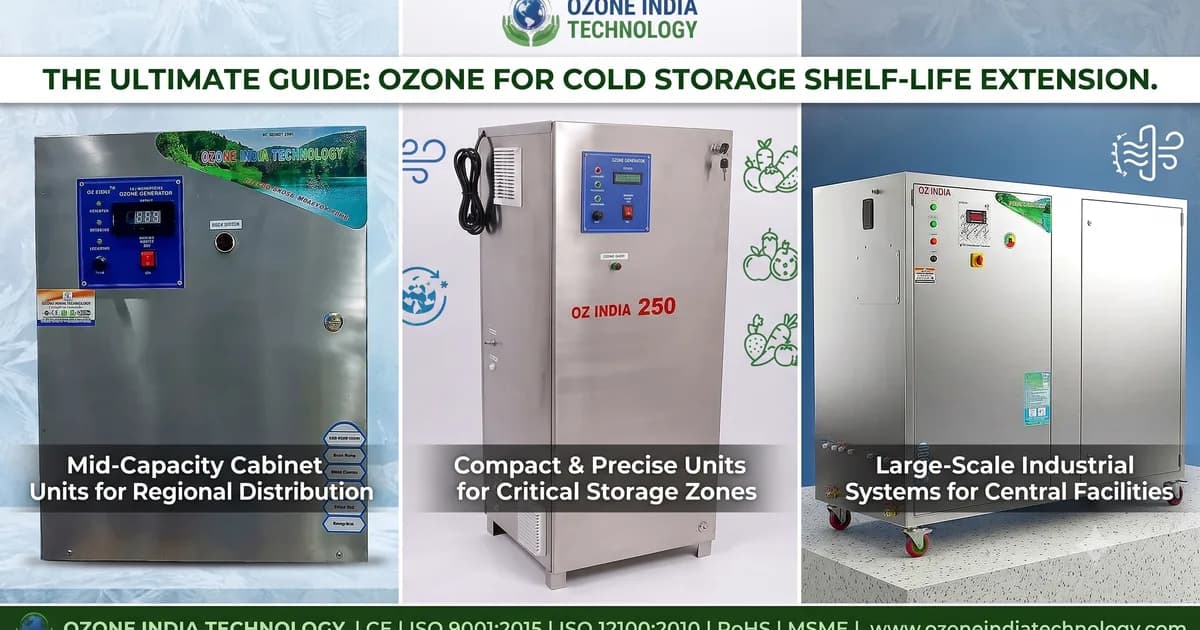
Cold storage facilities in India lose 15–25% of stored produce to post-harvest mould, ethylene-driven ripening, and bacterial spoilage — even in well-maintained refrigerated warehouses. Ozone for cold storage addresses all three simultaneously: gaseous ozone at 0.05–0.3 ppm continuously oxidises airborne mould spores, breaks down ethylene gas (C₂H₄) that accelerates ripening, and eliminates the bacterial biofilm that builds up on cold room walls, floors, and pallets. The result is 30–60% extended shelf life for grapes, apples, pomegranates, onions, potatoes, and cut flowers — with zero chemical residue in the stored product, FSSAI compliance, and operating costs lower than fumigation alternatives. This guide covers the mechanism, safe concentrations by commodity, sizing, payback calculation, and regulatory compliance for ozone cold storage installations.
How Ozone for Cold Storage Extends Shelf Life
Ozone is a triatomic oxygen molecule (O₃) that is unstable and reverts to O₂ in 20–30 minutes at cold storage temperatures (0–8°C). This instability is the key to its cold storage effectiveness — it continuously reacts with and destroys the organic molecules responsible for post-harvest loss:
1. Mould spore inactivation: Botrytis cinerea (grey mould) in grapes, Penicillium expansum in apples, Alternaria in tomatoes — all are inactivated by gaseous ozone at 0.1 ppm within 30 minutes of exposure. Conventional cold room fumigation with SO₂ (sulphur dioxide) for grapes leaves residues that require EU maximum residue level (MRL) compliance; ozone leaves no residue.
2. Ethylene oxidation: Ethylene gas produced by ripening fruit triggers autocatalytic ripening — one ripe apple accelerates ripening in the entire cold room. Ozone at 0.1–0.2 ppm continuously oxidises ethylene (C₂H₄ + O₃ → CO₂ + H₂O + O₂), maintaining the cold room ethylene concentration below the critical 0.05 ppm threshold. For apples: without ethylene control, shelf life in standard cold storage is 3–4 months; with ozone, 6–8 months.
3. Bacterial biofilm elimination: Pseudomonas, Listeria, and Erwinia form biofilm on cold room surfaces, packaging materials, and pallets. Standard cold room washing (quaternary ammonium compounds) removes visible contamination but leaves biofilm. Ozone at 0.2–0.3 ppm during unloaded room sanitation cycles (before restocking) kills biofilm to >3-log reduction in 30 minutes of exposure.
4. Odour elimination: Dimethyl disulfide (DMDS) in onion/garlic stores, ethanol in apple stores, and ammonia from refrigeration leaks are oxidised by ozone — maintaining a fresh-smell environment that indicates lower microbial load.
Shelf Life Extension with Ozone Treatment vs Standard Cold Storage (days to rejection quality)
Safe Gaseous Ozone Concentration by Commodity
Ozone for cold storage requires careful concentration management — the same oxidative chemistry that kills mould can bleach pigments in sensitive produce and cause surface oxidative damage (russeting in apples, bleaching in green vegetables) at excessive concentrations. Safe continuous exposure concentrations:
| Commodity | Safe Continuous O₃ (ppm) | Sensitive Tissues | Application Mode |
|---|---|---|---|
| Grapes | 0.1–0.2 | Berry skin, SO₂-sensitive varieties | Continuous low-level |
| Apples | 0.05–0.15 | Skin russeting at >0.3 ppm | Continuous |
| Pomegranate | 0.1–0.3 | Seeds (protected by arils) | Continuous |
| Onion/Garlic | 0.2–0.5 | Outer dry skin only | Continuous high-level |
| Potato | 0.1–0.3 | Minimal sensitivity | Continuous |
| Tomato (green) | 0.05–0.1 | Skin colour | Intermittent |
| Cut flowers | 0.05–0.15 | Petal pigments | Low-level continuous |
| Mushrooms | 0.05–0.1 | Gill browning | Very low, intermittent |
Unloaded sanitation cycles (no produce in room): 1–3 ppm ozone for 30–60 minutes achieves complete surface sanitisation. Room must be unoccupied and ventilated before restocking.
The ozone ambient air monitor in the cold room monitors ozone concentration continuously, triggers an alarm at 0.1 ppm (OSHA STEL above which workers must leave), and activates an automatic generator shutoff at 0.3 ppm. The ozone destructor on the cold room exhaust prevents ozone from entering adjacent areas when the room is opened.
Ozone Cold Storage System Design
Generator and Distribution Configuration
Ozone for cold storage is distributed as gaseous ozone directly into the cold room air — not dissolved in water (which would wet produce) and not applied as a spray. The system:
- Generator: Ozone generator 2g/hr for rooms up to 500 m³; 5g/hr generator for 500–2,000 m³ rooms; larger units for multi-chamber operations
- Distribution: PVDF or silicone tubing from the generator to a distribution manifold above the produce stack. Small-bore diffusers (ozone-resistant PVDF or ceramic) distribute ozone gas uniformly without creating concentrated streams that contact produce directly
- Recirculation fan: The cold room's existing evaporator fans distribute ozone through the room volume — no additional fan required
- Controls: A timer or ozone monitor feedback loop maintains the target concentration — generator runs for 15–30 minutes per hour to maintain steady-state at the target ppm
Sizing Calculation
Ozone for cold storage is sized by room volume (not flow rate, since it is a gaseous application):
Required ozone output (g/hr) = Room volume (m³) × Target concentration (mg/m³) × Decay factor ÷ 1000
At 5°C, ozone half-life in cold room air is ~60 minutes (slower decay than ambient temperature). Target maintenance dose:
- 0.1 ppm = 0.2 mg/m³ (at 1 atm, 5°C)
- Decay factor for continuous maintenance: 2.0 (supply twice the steady-state target to account for continuous decay and reaction with produce surfaces)
Example — 1,000 m³ apple cold room: Q = 1,000 m³ × 0.2 mg/m³ × 2.0 ÷ 1000 = 0.4 g/hr continuous → or 4 g/hr for 6 minutes every hour
Result: Ozone generator 2g/hr on a timer cycle (6 min/hr) for a 1,000 m³ apple store.
Example — 5,000 m³ onion/potato warehouse: Target: 0.3 ppm = 0.6 mg/m³ Q = 5,000 × 0.6 × 2.0 ÷ 1000 = 6 g/hr continuous → or ozone generator 5g/hr running 72 minutes/hour
Mould Reduction in Cold Storage — Ozone vs Conventional Fumigation (log-reduction in viable mould count)
Payback Calculation — Ozone for Cold Storage
For a 2,000 m³ grape cold store (100 MT capacity):
Without ozone:
- Rejection rate: 15–20% (15–20 MT per storage cycle)
- SO₂ fumigation pads: ₹2–3 lakh/season
- Revenue loss from rejections: ₹50,000/MT × 17 MT average = ₹8.5 lakh/season
- Total loss: ₹10.5–11.5 lakh/season
With ozone:
- Rejection rate: 3–5% (3–5 MT)
- Ozone operating cost: electricity ~₹0.5 lakh/season + zero fumigation chemicals
- Revenue loss from rejections: ₹50,000 × 4 MT = ₹2 lakh/season
- Total loss: ₹2.5 lakh/season
Net saving: ₹8–9 lakh/season. Ozone system capital cost: ₹1.5–3 lakh (generator + monitor + tubing + installation). Payback: 3–6 months (within first season).
For onion and potato storage (lower per-kg value but very high volumes), payback is 6–12 months at similar capital cost but driven by reduced weight loss (ozone reduces dehydration by 1–2%) and lower fungal rot.
Ethylene Reduction with Gaseous Ozone in Cold Storage (% reduction from initial ethylene level)
FSSAI and Export Market Compliance
FSSAI (Food Safety and Standards Authority of India)
FSSAI Food Safety and Standards (Food Products Standards and Food Additives) Regulations, 2011 — Schedule IX, permitted processing aids: ozone (O₃) is listed as a permitted processing aid for food contact applications in India. This means ozone-treated produce, cold store rooms, and food processing surfaces are FSSAI-compliant without additional approval.
FSSAI does not set a maximum residue level (MRL) for ozone in stored produce because ozone has zero residual — it decomposes to oxygen before produce reaches the consumer. No declaration is required on food labels for ozone-treated storage.
EU Export — MRL Compliance
The EU sets ozone as GRAS (Generally Recognised As Safe) at the concentrations used in cold storage. EU Regulation 1107/2009 covers plant protection products; ozone in cold storage is classified as a physical/non-chemical treatment and is not subject to pesticide MRL requirements. Indian exporters to EU (grapes to Germany, UK, Netherlands; pomegranate to UK; onion to Germany) can use ozone-treated cold storage without MRL declaration.
For GLOBALGAP certification (required by many EU retail buyers): ozone use in cold storage is a permitted post-harvest treatment. The ozone ambient air monitor calibration certificate and ozone treatment log (dates, concentrations, produce stored) form part of the GLOBALGAP post-harvest documentation.
US Market — FDA GRAS
US FDA GRAS Notice GRN 000115 (2001) recognises ozone as GRAS for use in food production, including storage atmospheres. Indian exporters to US (spices, vegetables, pomegranate arils) using ozone cold storage are compliant with FDA food safety requirements.
Cold Storage Ozone Dose Guide by Commodity
Recommended Continuous Ozone Concentration by Cold Storage Commodity (ppm)
Conclusion
Ozone for cold storage from Ozone India Technology delivers measurable shelf life extension, mould control, and ethylene reduction for Indian horticulture — from 500 m³ grape cold rooms in Nashik to 10,000 m³ onion warehouses in Lasalgaon — with FSSAI compliance, EU export GRAS status, and payback in 3–12 months depending on commodity value. Our ozone cold storage systems include the generator, ambient air monitor, ozone destructor, PVDF distribution tubing, and timer controller as a complete package. For a cold storage sizing consultation and project quotation, contact Ozone India Technology at [email protected] or WhatsApp +91 96500 17943 with your room volume, commodity, and storage duration.
