
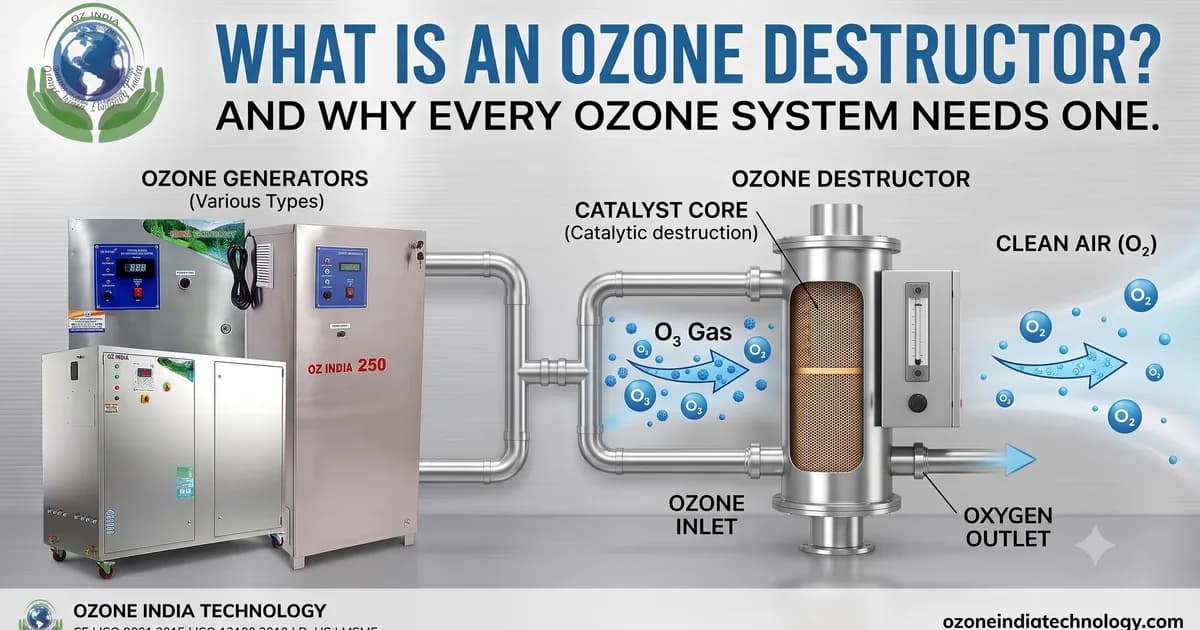
An ozone destructor is one of the most important — and most frequently omitted — components in an industrial ozone system. Every ozone generator produces off-gas containing significant quantities of unreacted ozone. Without a functioning ozone destructor, that off-gas creates a serious safety hazard and a regulatory violation. This guide explains what an ozone destructor is, how catalytic and thermal ozone destructors work, how to size an ozone destructor for your system, and why no ozone installation should ever be operated without one.
What is an Ozone Destructor?
An ozone destructor — also called an ozone off-gas destructor, ozone tail gas destructor, or ozone decomposer — is a device that converts excess ozone (O₃) in the off-gas stream from an ozone contact system back into ordinary oxygen (O₂) before the gas is vented to atmosphere:
2O₃ → 3O₂ (decomposition reaction)
The off-gas from an ozone contact chamber — the gas that bubbles out of the water after ozone transfer — contains 0.5–2% ozone by weight. This equates to 5,000–20,000 ppm gaseous ozone. The OSHA permissible exposure limit (PEL) for ozone in the workplace is 0.1 ppm (8-hour TWA) and 0.3 ppm (15-minute STEL). The off-gas without an ozone destructor exceeds the OSHA limit by 50,000–200,000 times. Releasing it to atmosphere is a safety emergency and a regulatory violation under the Indian Environment Protection Act and CPCB Ambient Air Quality Standards.
Ozone Concentration Comparison — Off-Gas vs Safety Limits (ppm)
Types of Ozone Destructors
Catalytic Ozone Destructor (Standard)
A catalytic ozone destructor uses a catalyst bed to decompose ozone at ambient temperature. The most commonly used catalyst is manganese dioxide (MnO₂), sometimes mixed with copper oxide (CuO) for higher activity. The off-gas passes through the catalyst bed at a controlled superficial velocity, and the catalytic surface accelerates the ozone decomposition reaction without consuming heat energy.
How it works: MnO₂ acts as an electron donor/acceptor surface, facilitating the dissociation of ozone molecules into oxygen radicals which recombine to form stable O₂. The reaction is exothermic — the catalyst bed may reach 40–60°C during operation — but requires no external heat input. Outlet ozone concentration: <0.1 ppm, typically 0.01–0.05 ppm.
Advantages:
- No electricity consumed for heating (small fan motor only)
- Compact — sized by the off-gas flow rate
- Low maintenance — annual catalyst replacement
- Reliable for all system sizes from 2g/hr to 350g/hr ozone output
The Ozone India Technology ozone destructor is the catalytic type, supplied as standard with all STP, ETP, WTP, and food processing ozone packages. The MnO₂ catalyst cartridge is available ex-stock from Greater Noida for annual replacement — no special handling or disposal required.
Thermal Ozone Destructor (For High Concentrations)
A thermal ozone destructor heats the off-gas to 300–350°C, at which temperature ozone spontaneously decomposes without a catalyst. Used for high-concentration oxygen-fed systems above 1kg/hr output where the off-gas ozone concentration may exceed 10,000 ppm.
Advantages: No catalyst to replace; handles very high ozone concentrations reliably.
Disadvantages: Significant electrical heating energy (3–5 kWh per kg of ozone destructor capacity); larger footprint; thermal insulation required; start-up time of 15–30 minutes before reaching operating temperature.
Thermal-Catalytic Combined Destructor
A combination type that pre-heats the off-gas to 60–100°C before passing through a catalyst bed. The elevated temperature significantly increases catalyst activity, achieving outlet concentrations below 0.01 ppm even at very high inlet concentrations. Used in pharmaceutical water treatment and food processing applications where near-zero outlet ozone is required.
Ozone Destructor Efficiency by Type (% ozone reduction from 10,000 ppm inlet)
Where to Install the Ozone Destructor
The ozone destructor must be installed on the off-gas vent line from the ozone contact chamber, after any moisture separator or condensate trap. The installation points:
- Ozone contact chamber vent — the primary source of high-concentration off-gas
- Ozone generator off-gas — air/oxygen purge gas from the generator cell during shutdown contains residual ozone
- Storage tanks — any tank that receives ozonated water has a headspace vent that requires ozone destructor protection
Do not vent any off-gas from an ozone system to the atmosphere without first passing through a functioning ozone destructor. Even short-duration venting during startup or testing must go through the destructor. The ozone ambient air monitor in the equipment room provides the verification that the destructor is functioning — if the ambient reading rises above 0.05 ppm, the destructor requires inspection.
How to Size an Ozone Destructor
An ozone destructor is sized for the total off-gas flow rate from all contact chambers and generators, with a 1.2× safety margin:
Destructor capacity (Nm³/hr) = Generator air/oxygen flow rate (Nm³/hr) × (1 - transfer efficiency) × 1.2
For a 100g/hr air-fed ozone generator with 90% ozone transfer efficiency in the contact chamber:
- Generator air flow: approximately 10 Nm³/hr
- Untransferred ozone fraction: 10%
- Off-gas flow: 10 × 0.1 × 1.2 = 1.2 Nm³/hr destructor capacity
Ozone India Technology provides destructor sizing with every ozone generator quotation — sized specifically for the generator model, feed gas type, and contact system design.
Off-Gas Ozone Concentration vs Ozone Transfer Efficiency (100g/hr generator)
Maintenance of the Ozone Destructor
Catalyst activity declines over time as MnO₂ surfaces become saturated with oxidation products and the catalyst structure changes. Signs of declining destructor performance:
- Measurable ozone at the outlet (check with an ambient air monitor at the destructor vent)
- Elevated temperature of the outlet gas (indicates excessive ozone load passing through)
- Discolouration or visible deterioration of catalyst bed
Maintenance schedule:
- Monthly: Visual inspection, check vent temperature
- Quarterly: Measure outlet ozone concentration at the destructor vent
- Annually: Replace MnO₂ catalyst cartridge
Catalyst poisoning from oil mist is the most common failure cause in Indian installations — oil from the air compressor must be removed by coalescing filter before entering the ozone generator and destructor. Ozone India Technology standard packages include a coalescing oil filter and desiccant dryer upstream of the ozone generator.
Regulatory and Safety Requirements
Under Indian regulations, operating an ozone system that vents off-gas directly to atmosphere violates:
- CPCB Ambient Air Quality Standards — ozone is a regulated air pollutant
- Factories Act 1948 — employers must protect workers from toxic substances
- Environment Protection Act 1986 — prohibits emission of hazardous substances above prescribed limits
- OSHA Equivalent Standards — State Pollution Control Board ambient ozone limits align with OSHA 0.1 ppm TWA
All ozone systems supplied by Ozone India Technology include a correctly sized ozone destructor as standard. No separately quoted system from Ozone India Technology is supplied without an ozone destructor. Customers who wish to purchase an ozone generator alone are advised of the mandatory requirement for an ozone destructor and supplied with specifications.
The sewage treatment plant and effluent treatment plant applications pages provide additional information on complete ozone system design including destructor integration.
Conclusion
An ozone destructor is not optional — it is a mandatory safety device for every ozone system operating with a contact chamber that generates off-gas. The catalytic ozone destructor from Ozone India Technology provides compliant, low-maintenance off-gas treatment for all system sizes from 2g/hr to 350g/hr, with annual catalyst replacement as the only maintenance requirement. Do not commission an ozone contact system without verifying that the ozone destructor is correctly installed, sized, and functioning. For ozone destructor specifications, sizing assistance, or replacement catalyst cartridges, contact Ozone India Technology at [email protected] or WhatsApp +91 96500 17943.
