
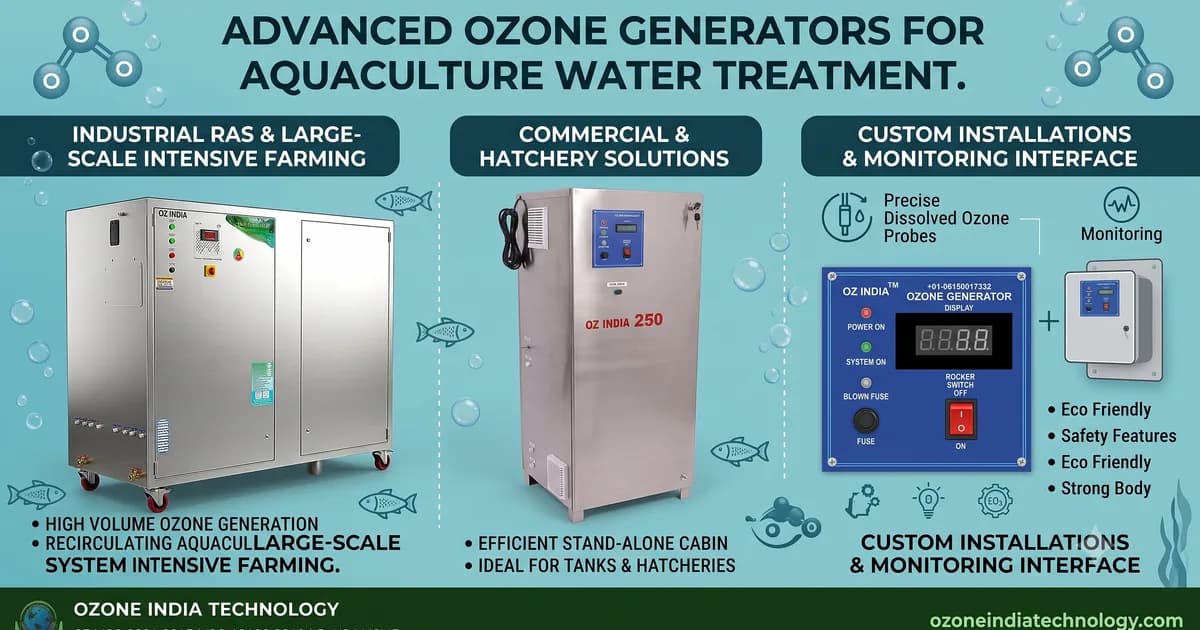
Aquaculture in India — covering shrimp farming in Andhra Pradesh, tilapia and catla hatcheries in West Bengal and Odisha, and ornamental fish export from Kerala — faces a structural problem: intensive fish production in recirculating aquaculture systems (RAS) or earthen ponds concentrates ammonia, pathogenic bacteria, and parasites at densities that kill stock without active water treatment. An ozone generator for aquaculture is now the standard water treatment technology in MPEDA-certified export farms and EU-compliant shrimp facilities. Ozone at 0.01–0.2 mg/L dissolved ozone eliminates Aeromonas, Vibrio, and WSSV viral pathogens from fish water without the antibiotic residues that trigger EU and US import rejections. This guide covers safe ozone doses by species, sizing for RAS and pond systems, and India export compliance.
Why Ozone Generator for Aquaculture Outperforms Antibiotics and UV
The ozone generator for aquaculture replaces three conventional inputs:
Antibiotics (oxytetracycline, amoxicillin, florfenicol): MPEDA prohibited antibiotic list covers the most common prophylactics used in Indian shrimp farming. EU Regulation 2019/6 bans antibiotic growth promoters. US FDA Aquaculture Program tests imports for antibiotic residues. Any detection = shipment rejection. Ozone eliminates the bacterial load that drives antibiotic use — Vibrio harveyi in shrimp ponds, Aeromonas hydrophila in tilapia, Flavobacterium in trout — without antibiotic residue.
Formalin: Used for external parasite treatment (Trichodina, Dactylogyrus) in hatcheries. Formalin is classified as a carcinogen (Group 1, IARC). EU and US prohibit formalin residues in food fish. Ozone treats external parasites at the larval stage without chemical residue in fish tissue.
Potassium permanganate (KMnO₄): Used for pond disinfection. Leaves manganese residue in pond sediment; creates ZDHC-reportable discharge issues in farm effluent. Ozone disinfects pond water without manganese residue.
Pathogen Log-Reduction — Ozone vs UV in Aquaculture Water (0.5 mg/L dose, 5 min)
Safe Dissolved Ozone Dose by Aquaculture Species
The critical constraint in the ozone generator for aquaculture is the toxicity of dissolved ozone to fish and shrimp. The same oxidative chemistry that kills pathogens damages gill tissue at excessive dose. Safe dissolved ozone at the point of fish contact:
| Species | Safe Dissolved Ozone (mg/L) | Lethal Dose (mg/L) | Recommended System Dose |
|---|---|---|---|
| Vannamei shrimp (post-larvae) | <0.05 | >0.2 | 0.01–0.03 mg/L |
| Vannamei shrimp (grow-out) | <0.1 | >0.4 | 0.02–0.05 mg/L |
| Tilapia (fingerling) | <0.1 | >0.3 | 0.02–0.08 mg/L |
| Tilapia (grow-out) | <0.2 | >0.6 | 0.05–0.15 mg/L |
| Atlantic salmon | <0.1 | >0.3 | 0.02–0.08 mg/L |
| Catla/Rohu/Indian carp | <0.15 | >0.5 | 0.05–0.12 mg/L |
| Ornamental fish | <0.03 | >0.1 | 0.005–0.02 mg/L |
Important: The ozone generator for aquaculture doses ozone into the water before it enters the fish tank — the ozone reacts with ammonia, pathogens, and organic matter during a reaction/contact period (typically 30–120 seconds in a sidestream reactor), and dissolved ozone residual drops to safe levels before the treated water reaches fish. The dissolved ozone monitor at the tank inlet continuously verifies that residual is below the safe threshold for the species.
Safe Dissolved Ozone Levels by Aquaculture Species (mg/L maximum at fish contact)
Ozone Generator for Aquaculture — Applications by System Type
Recirculating Aquaculture Systems (RAS)
RAS is the fastest-growing aquaculture segment in India for high-value species (salmon, trout, ornamentals for export). In RAS, 90–99% of water is recirculated — ammonia, nitrite, and pathogens concentrate without active treatment. The ozone generator for aquaculture in RAS:
- Micro-flocculation: Ozone at 0.05–0.1 mg/L causes fine suspended particles (fish mucus, uneaten feed) to aggregate into settleable flocs — improving mechanical filter efficiency and reducing turbidity to <1 NTU
- Pathogen control: Ozone eliminates bacteria, fungi, and protozoa in the recirculating stream before they concentrate to infectious dose
- Nitrite oxidation: Ozone converts toxic nitrite (NO₂⁻) to nitrate (NO₃⁻) — nitrite toxicity to fish at >0.1 mg/L (as N) is eliminated
- Colour and odour removal: Ozone oxidises yellow humic compounds and geosmin (earthy odour in recirculated water) — essential for premium fish quality in export RAS
A 50 m³/hr RAS treating tilapia or salmon requires ozone at 0.5–1.0 mg/L in the sidestream (ozone applied to 10–20% of flow via a venturi injector, then mixed back) — the fish-side dissolved ozone remains <0.1 mg/L after the reaction period.
Shrimp Hatchery Water Treatment
In L. vannamei hatchery nauplii and PL stages, Vibrio harveyi is the primary cause of mass mortality. Traditional treatment: formalin baths (banned) or antibiotic prophylaxis (causes resistance and import rejection). Ozone hatchery treatment:
- Treat incoming seawater to 4-log Vibrio inactivation before introducing broodstock or larvae
- Ozone dose for incoming seawater: 1–2 mg/L, 10-minute contact, then allow residual to decay to <0.01 mg/L before use
- Zero antibiotic record for MPEDA-certified hatcheries — meets EU and US import programme requirements
Pond Shrimp Farming — Pathogen Load Reduction
For semi-intensive and intensive pond farming (vannamei, monodon), ozone generator for aquaculture is used in:
- Water inlet treatment: Ozone treats incoming canal/river water before pond filling — eliminates wild Vibrio and parasite cysts
- Pond circulation sidestream: A small fraction of pond water (5–10%) is drawn through an ozone contact loop and returned — maintains low ambient pathogen count in the pond
Sizing the Ozone Generator for Aquaculture
RAS Sizing Example — 50,000 Fish Tilapia System
Given: RAS producing 50,000 tilapia (300g average). System water volume: 200 m³. Recirculation rate: 200 m³/hr (full turnover each hour). Sidestream flow (15% of total): 30 m³/hr.
Step 1 — Flow rate: Sidestream: 30 m³/hr
Step 2 — Dose in sidestream: To achieve 0.05 mg/L dissolved ozone at the tank inlet, apply 0.5 mg/L ozone to the 15% sidestream (ozone decays from 0.5 to <0.05 mg/L in the 30-second mixing/reaction pipe before fish contact).
Step 3 — Generator capacity: Q = 30 m³/hr × 0.5 mg/L × 1.3 ÷ 1000 = 0.0195 kg/hr = 19.5 g/hr
Result: Ozone generator 10-25g/hr at 20g/hr setting. The dissolved ozone monitor monitors residual at the fish tank inlet and automatically reduces generator output if residual approaches 0.1 mg/L.
Shrimp Hatchery Sizing — 500 m³/day Water Treatment
Given: Vannamei hatchery treating incoming seawater and recirculated water. Incoming seawater: 100 m³/day. Recirculation flow: 20 m³/hr (hatchery tank volume 50 m³, 40% hourly turnover).
Incoming seawater (batch treatment): 100 m³/day ÷ 6 hours treatment window = 16.7 m³/hr. Dose: 2 mg/L. Q = 16.7 × 2 × 1.3 ÷ 1000 = 0.043 kg/hr = 43 g/hr
Recirculation sidestream (10% of 20 m³/hr = 2 m³/hr): Q = 2 × 0.5 × 1.3 ÷ 1000 = 0.0013 kg/hr = 1.3 g/hr
Result: A single ozone generator 30-50g/hr handles both batch seawater treatment and recirculation, with programmable output switching between modes.
Fish Survival Rate Improvement — With vs Without Ozone Treatment (% survival to harvest)
Contact Chamber and Injector Design for Aquaculture
Venturi Injector Configuration
The ozone venturi injector for aquaculture sidestream systems:
- Installed on the sidestream pump outlet (positive pressure side)
- Creates a vacuum that draws ozone gas from the generator into the water stream
- Gas-liquid mixing: 20–40% ozone transfer efficiency in a simple venturi; 80–95% with a downstream static mixer or bubble diffuser
- For RAS: PVDF venturi + PVDF pipe rated for 0.3 mg/L dissolved ozone exposure. Silicone tubing from generator to venturi — do not use PVC in aquaculture ozone systems (ozone degrades PVC, releasing plasticisers into fish water)
Dissolved Ozone Monitoring — Critical for Fish Safety
The dissolved ozone monitor is non-optional in aquaculture ozone systems. It:
- Monitors dissolved ozone continuously at the tank inlet (not the sidestream — at the point of fish contact)
- Triggers generator shutoff if dissolved ozone exceeds the safe threshold (set at 0.07 mg/L for tilapia, 0.04 mg/L for vannamei)
- Logs dissolved ozone over time — provides the continuous treatment record required for MPEDA and EU HACCP documentation
Without a dissolved ozone monitor, an ozone generator malfunction (generator stuck at high output or venturi blockage causing ozone to bypass contact time) can deliver lethal dissolved ozone to the fish tank in minutes.
Antibiotic Use Reduction in RAS After Ozone Installation (% reduction in treatment events)
MPEDA and EU Export Compliance
MPEDA Aquaculture Certification
The Marine Products Export Development Authority (MPEDA) certification for export shrimp farms requires:
- Zero detection of banned antibiotics (chloramphenicol, nitrofurans, malachite green, oxytetracycline above 100 ppb)
- Traceability records from hatchery to harvest
- Water quality log: daily DO, pH, salinity, temperature, ammonia
- Ozone treatment log: ozone generator run hours, dissolved ozone monitor readings, species and life stage at time of treatment
MPEDA inspectors review ozone treatment as a positive factor in certification because it reduces antibiotic dependency and demonstrates investment in biosecurity.
EU Regulation on Aquaculture Products (EC 853/2004, 854/2004)
EU imports of farmed shrimp and fish require HACCP plans that address microbiological hazards. Vibrio in shrimp at harvest is a HACCP critical control point. Ozone treatment of inlet water and recirculation stream is documented in the HACCP plan as a CCP for Vibrio control — with dissolved ozone monitoring data as the verification record.
The ozone generator for aquaculture at MPEDA/EU-certified Indian farms is typically supplied with:
- CE Declaration of Conformity (CE-2621A from Ozone India Technology)
- ISO 9001:2015 quality certificate
- Ozone output test report (mg/hr at rated conditions)
- Dissolved ozone monitor calibration certificate
For shrimp farms in Andhra Pradesh and West Bengal exporting to EU and US, the ozone installation record forms part of the farm's traceability documentation submitted to the importer.
Conclusion
The ozone generator for aquaculture from Ozone India Technology — from the 2g/hr portable unit for small ornamental fish hatcheries to the 50g/hr system for large vannamei shrimp operations — delivers pathogen control without antibiotic residue, improved survival rates, and the MPEDA/EU compliance documentation that Indian export farms require. For aquaculture sizing consultation and project quotation, contact us at [email protected] or WhatsApp +91 96500 17943 with your species, system type, and daily water volume.
