
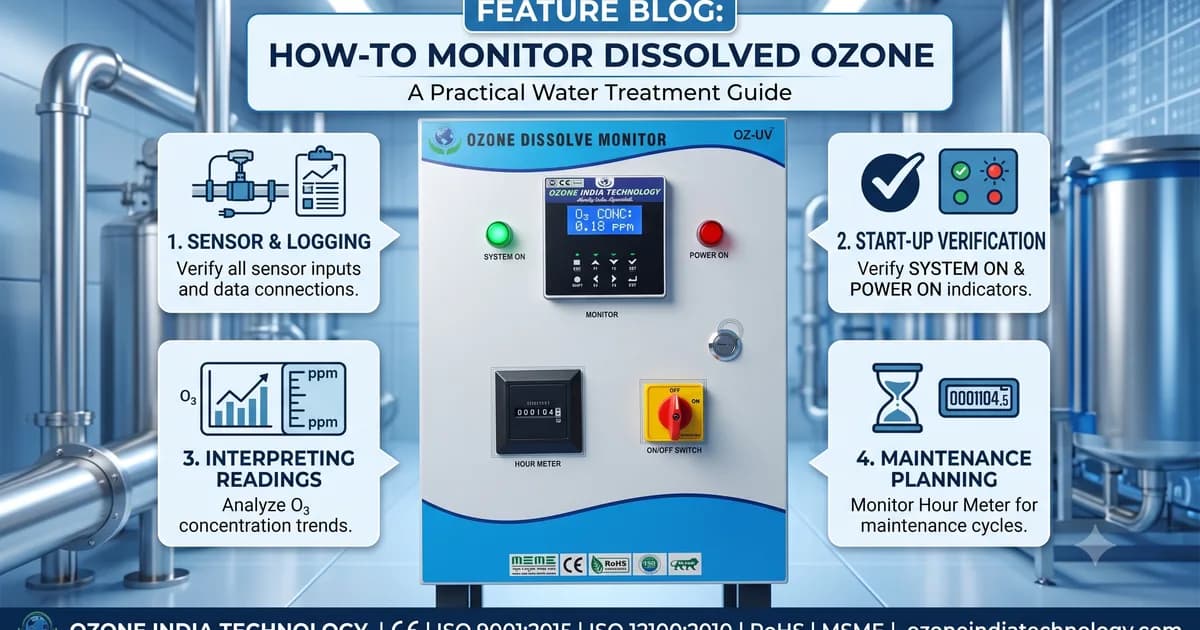
Monitoring dissolved ozone in water treatment is not optional — it is the only way to verify that your ozone system is delivering the required CT value for pathogen inactivation, maintaining CPCB or FSSAI compliance, and avoiding over-dosing that wastes electricity and degrades water quality. This guide covers how dissolved ozone monitoring works, what a dissolved ozone monitor measures, how to interpret dissolved ozone readings in STPs, WTPs, and food processing systems, and how to select and install a dissolved ozone monitor for your ozone treatment plant.
Why Dissolved Ozone Monitoring Is Critical
Dissolved ozone monitoring is the control point for every ozone water treatment system. Without real-time measurement of dissolved ozone concentration at the contact chamber outlet, the operator has no confirmation that:
- Sufficient ozone is being transferred to the water (verifying ozone generator output alone is not enough — transfer efficiency varies)
- The required CT value (ozone concentration × contact time) is being achieved for the target pathogen inactivation
- Ozone concentration is not so high that it damages downstream membranes, process equipment, or residual monitoring sensors
The dissolved ozone monitor measures actual dissolved ozone in the treated water — the parameter that directly correlates with disinfection efficacy. An ozone generator can be running at full output while the dissolved ozone concentration in the contact chamber remains zero, if the venturi injector is blocked or the water flow is excessive. Only the dissolved ozone monitor reveals this failure.
For CPCB Class A sewage treatment plant discharge (BOD <10 mg/L, fecal coliform <100 MPN/100mL), the ozone CT value required is 0.5–1.0 mg·min/L. If your dissolved ozone monitor reads 0.3 mg/L at the outlet of a 20-minute contact time, your CT = 6 mg·min/L — well above the required level. If it reads 0.05 mg/L, your CT = 1.0 mg·min/L — just at the threshold. The dissolved ozone monitor is the compliance instrument.
Dissolved Ozone Concentration Required by Application (mg/L at Contact Chamber Outlet)
How a Dissolved Ozone Monitor Works
The dissolved ozone monitor operates on one of two measurement principles: electrochemical (amperometric) or optical (UV absorption). Both are used in industrial water treatment, with different strengths.
Electrochemical (Amperometric) Dissolved Ozone Monitor
The amperometric dissolved ozone monitor uses a Clark-type membrane electrode submerged in the water stream. The electrode consists of a cathode (gold or platinum) and an anode (silver/silver chloride), separated from the water by a gas-permeable membrane. Ozone dissolved in the water diffuses through the membrane and is reduced at the cathode surface, generating an electrical current proportional to the dissolved ozone concentration.
Measurement principle: O₃ + 2H⁺ + 2e⁻ → O₂ + H₂O (at cathode). The resulting microampere current is converted to a dissolved ozone concentration reading in mg/L or ppb.
Advantages:
- Direct measurement of dissolved ozone
- Low instrument cost
- Well-suited for continuous monitoring in pipelines and channels
- Dissolved ozone monitor readings are stable in the 0.01–2.0 mg/L range typical of water treatment applications
Limitations:
- Membrane requires periodic replacement (every 3–6 months)
- Requires regular electrolyte replenishment
- Sensitive to interfering oxidants (chlorine, chloramine) — compensated in modern instruments
- Flow-dependence: requires minimum flow across the membrane for accurate dissolved ozone readings
UV Absorption Dissolved Ozone Monitor
The UV absorption dissolved ozone monitor uses the strong absorption of ozone at 254nm wavelength. A UV light source (low-pressure mercury lamp or UV LED) illuminates the water sample. Dissolved ozone absorbs UV radiation in proportion to its concentration. The transmitted light intensity is measured by a photodetector and converted to dissolved ozone concentration using Beer-Lambert law.
Advantages:
- No membrane, no electrolyte — true flow-through measurement
- Highly accurate dissolved ozone monitor readings across wide concentration range (0.001–20 mg/L)
- No interference from other oxidants
- Minimal maintenance — clean optical windows quarterly
Limitation: Higher instrument cost; dissolved ozone monitor readings can be affected by turbidity or UV-absorbing compounds (humic acids, iron) — requires sample filtration in complex water matrices.
Dissolved Ozone Monitor Technology Comparison
Where to Install the Dissolved Ozone Monitor
The dissolved ozone monitor placement determines what information you obtain from the measurement. The three critical measurement points are:
1. Contact Chamber Outlet (Primary Installation Point)
Install the dissolved ozone monitor at the outlet of the ozone contact chamber — the point where treated water exits before distribution or discharge. This reading tells you the residual dissolved ozone concentration after the full contact time. This is the CT verification point: dissolved ozone (mg/L) at this location × hydraulic retention time (minutes) = CT value.
For a sewage treatment plant operating at 20 minutes HRT, if the dissolved ozone monitor reads 0.3 mg/L at the outlet, CT = 6 mg·min/L. This exceeds the requirement for 4-log coliform inactivation.
2. Mid-Chamber (Dose Control Point)
In large systems (>5 MLD), install a second dissolved ozone monitor at the mid-point of the contact chamber. This dissolved ozone monitor reading drives the ozone generator output via a PID control loop: if mid-chamber dissolved ozone is above the setpoint, the generator reduces output; if below, it increases output. This provides automatic dose control and energy savings of 15–25% versus constant-rate ozone generation.
3. Final Distribution Point (Decay Monitoring)
For drinking water treatment plants distributing treated water through a pipeline network, a third dissolved ozone monitor at the furthest distribution point verifies that ozone residual is maintained or safely decayed to zero before customer contact. WHO guidelines recommend <0.05 mg/L dissolved ozone at the tap — the dissolved ozone monitor at the distribution endpoint confirms this.
Dissolved Ozone Monitor Installation Requirements
The dissolved ozone monitor from Ozone India Technology is a flow-through inline instrument. Installation requirements:
Pipe connection: 1/2" or 3/4" NPT/BSP sidestream tap from the main treatment pipeline. The sidestream is controlled by a manual valve to maintain 0.5–2.0 L/min sample flow through the dissolved ozone monitor cell.
Materials compatibility: All wetted parts of the dissolved ozone monitor must be ozone-resistant — stainless steel 316L, PVDF, or PTFE. Do not use brass, copper, or standard PVC pipe for ozone sample lines. Use ozone PVDF pipe for sample line connections.
Temperature: Dissolved ozone solubility decreases with temperature. The dissolved ozone monitor reading at 30°C is lower than at 20°C for the same ozone transfer rate. The Ozone India Technology dissolved ozone monitor includes automatic temperature compensation — the reading is normalised to 20°C equivalent.
Pressure: Maximum 6 bar. Install after a pressure reduction valve if system pressure exceeds this.
Position: Do not install the dissolved ozone monitor in a dead-leg or low-flow zone. Install on the main flow line or a representative sidestream with continuous flow.
Dissolved Ozone Decay at Different Water Temperatures (initial 1.0 mg/L, minutes)
Interpreting Dissolved Ozone Monitor Readings
Understanding what your dissolved ozone monitor reading means operationally is as important as installing the instrument correctly.
Reading = 0 mg/L at contact chamber outlet:
- Ozone generator is off or faulted
- Ozone transfer system (venturi injector or diffuser) is blocked
- Water flow rate is too high for the ozone dose — check flow against design parameters
- Ozone is being consumed entirely by organic load before reaching the outlet — BOD/COD of influent may have increased
Reading too high (above setpoint by >50%):
- Ozone generator output is excessive for current flow rate
- Water quality has improved (lower BOD/COD) — the same ozone dose now leaves more residual
- Reduce ozone generator output to maintain target residual
Reading fluctuating rapidly:
- Unstable water flow — check pump operation
- Air entrainment in the sample line — inspect sidestream connection
- Electrode fouling — clean or replace membrane (amperometric type)
Seasonal variation: In Indian water treatment plants, dissolved ozone monitor readings will show natural variation with water temperature. In summer (35°C+), ozone solubility decreases and ozone decay accelerates — the generator may need to increase output by 10–15% to maintain the same dissolved ozone residual at the outlet compared to winter operation. The dissolved ozone monitor provides the feedback signal for this seasonal adjustment.
Dissolved Ozone Monitor for Food Processing and FSSAI Compliance
In food processing applications, dissolved ozone monitoring takes on additional compliance significance. FSSAI guidelines for ozone use in food processing require:
- Produce wash water: dissolved ozone maintained at 0.3–1.0 mg/L during washing cycle
- CIP (Clean-In-Place): 1.5–2.0 mg/L dissolved ozone for 15–20 minutes contact
- Potable water: dissolved ozone at point of use ≤0.05 mg/L (FSSAI IS:14543)
The dissolved ozone monitor in food processing installations typically operates with automatic control: when dissolved ozone drops below the low setpoint, the ozone generator increases output; when it reaches the high setpoint, the generator reduces. This closed-loop control maintains dissolved ozone within the FSSAI-required range automatically, providing documentation for food safety audits.
For swimming pool applications, the dissolved ozone monitor measures dissolved ozone in the sidestream return line. Pool operators target 0.05–0.1 mg/L dissolved ozone at the pool return (residual after the contact system) — high enough for effective sanitation, low enough to avoid bather irritation. The ozone dosage calculator at Ozone India Technology helps determine the ozone generator output required to maintain target dissolved ozone in pool applications.
The Complete Ozone Monitoring System
The dissolved ozone monitor addresses one half of the ozone monitoring requirement: measuring dissolved ozone in the treated water. The other half is measuring ozone in the surrounding air — the worker safety dimension.
A complete ozone monitoring installation includes:
-
Dissolved ozone monitor — inline measurement of dissolved ozone in the treatment water, at the contact chamber outlet and optionally mid-chamber for dose control
-
Ambient air monitor — wall-mounted electrochemical gas-phase sensor measuring airborne ozone concentration in the equipment room. Continuous display, audible alarm at 0.1 ppm (OSHA PEL), automatic shutdown signal to the ozone generator at 0.3 ppm STEL
-
Ozone destructor — installed on the contact chamber off-gas vent, converting unreacted ozone in the headspace gas to oxygen before venting. The ambient air monitor verifies that the ozone destructor is functioning correctly — a rising ambient reading indicates destructor inspection is required
This three-component monitoring system — dissolved ozone monitor + ambient air monitor + ozone destructor — is the complete safety and compliance instrumentation package for any industrial ozone system, from a 5g/hr drinking water unit to a 350g/hr STP tertiary treatment installation. Ozone India Technology supplies all three components as a coordinated package, sized and configured together.
Dissolved Ozone Monitor Specifications — Ozone India Technology
The Ozone India Technology dissolved ozone monitor provides:
| Parameter | Specification |
|---|---|
| Measurement range | 0.00 – 20.00 mg/L |
| Resolution | 0.01 mg/L |
| Accuracy | ±2% full scale |
| Temperature compensation | Automatic (0–50°C) |
| Output | 4–20mA, RS485 Modbus, relay contacts |
| Display | 4-line LCD, real-time dissolved ozone and temperature |
| Alarms | High/low dissolved ozone setpoints, configurable |
| Power supply | 85–265V AC, 50/60Hz |
| Enclosure | IP65 weatherproof |
| Sample flow | 0.5–2.0 L/min |
| Pressure rating | 6 bar maximum |
| Wetted materials | SS316L, PVDF, PTFE |
| Electrode life | 12–18 months (amperometric type) |
The dissolved ozone monitor integrates with SCADA systems via Modbus RS485, allowing dissolved ozone readings to be logged, trended, and alarmed from a central control room. For ozone generator auto-control, the 4–20mA output connects directly to the ozone generator's remote control input — dissolved ozone below setpoint increases generator output, above setpoint reduces it.
The dissolved ozone monitor is available from Ozone India Technology at Greater Noida, with applications support for STP, WTP, ETP, swimming pool, food processing, and pharmaceutical water treatment. For dissolved ozone monitor specifications, quotation, or installation support, contact the Ozone India Technology engineering team at [email protected] or WhatsApp +91 96500 17943.
For dissolved ozone monitor sizing and contact chamber design for your specific flow rate and compliance target, use the ozone dosage calculator or contact the sewage treatment plant or water treatment plant application specialists directly.
Conclusion
A dissolved ozone monitor is not a convenience — it is the instrument that proves your ozone treatment system is working. Without a dissolved ozone monitor, you cannot verify CT compliance, cannot document disinfection efficacy for CPCB or FSSAI audits, and cannot efficiently control ozone generator output. Properly installed at the contact chamber outlet and integrated with an ambient air monitor and ozone destructor, the dissolved ozone monitor from Ozone India Technology completes the ozone measurement and safety package for any industrial water treatment application. Contact Ozone India Technology at +91 96500 17943 or WhatsApp for dissolved ozone monitor specifications and project support.
