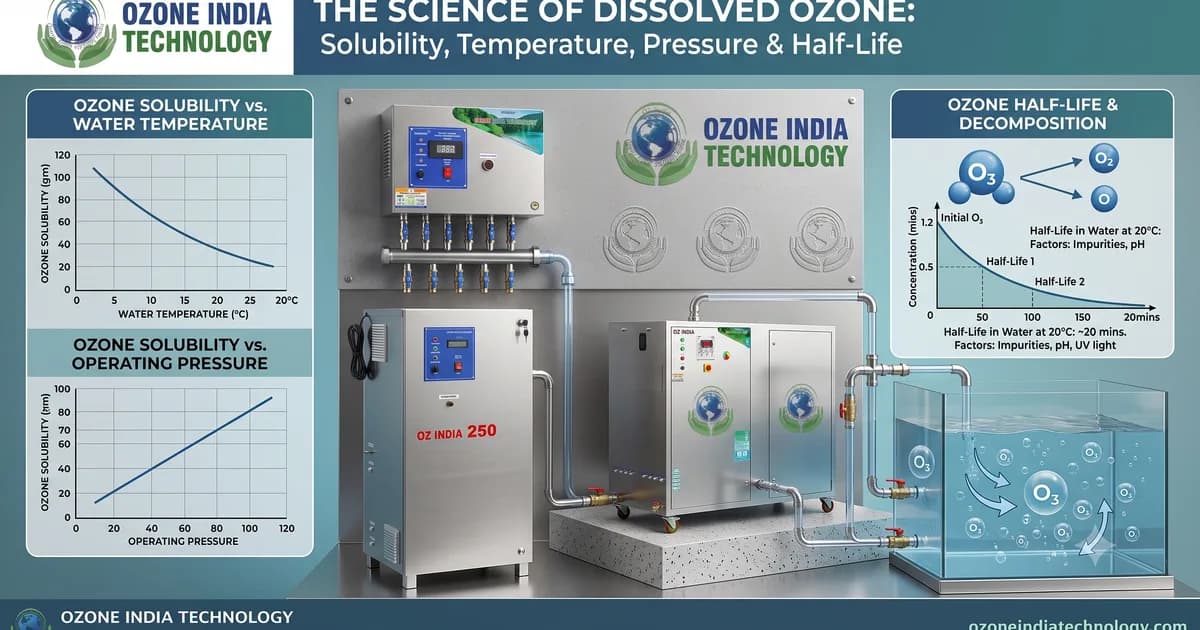
Ozone is a sparingly soluble gas in water — its solubility is 13 times higher than oxygen and 25 times lower than chlorine at equivalent conditions. Understanding ozone solubility in water, and how temperature, pH, and water quality affect both solubility and ozone half-life in solution, is fundamental to designing ozone water treatment systems that actually achieve the required dissolved ozone residual. An ozone generator that produces 100g/hr is worthless if the system design allows ozone to off-gas before reacting with the target pathogens or organic compounds. This guide covers ozone solubility as a function of temperature and pressure, ozone half-life in water, the effect of pH and water composition on ozone stability, and the practical design implications for ozone dosage systems.
Ozone Solubility — Henry's Law and Temperature
Ozone solubility in water follows Henry's Law: the mass of gas dissolved in a liquid at constant temperature is proportional to the partial pressure of that gas above the liquid. For ozone:
C (mg/L) = KH × P_O3*
Where C* is the equilibrium dissolved ozone concentration, KH is Henry's constant for ozone, and P_O3 is the partial pressure of ozone in the gas phase.
Practical implication: If the ozone generator produces gas at 3 wt% ozone concentration and the venturi injector operates at 2 bar water pressure, the maximum dissolved ozone achievable at equilibrium is approximately 30–40 mg/L at 20°C. In practice, contact time and mixing efficiency limit actual dissolved ozone to 5–15 mg/L — well below the theoretical maximum. This means temperature and pressure set the upper limit; system design determines how close to that limit the installation operates.
Ozone Solubility in Water vs Temperature (mg/L at 1 atm, 100% ozone gas)
Key design insight from the solubility table:
- Ozone solubility drops by approximately 50% for every 10°C temperature rise
- A swimming pool at 28°C has significantly lower maximum dissolved ozone than a cold-water STP at 18°C — the pool ozone generator must produce proportionally more ozone
- Cold storage ozone systems (for air ozonation, not water) benefit from the low temperature — higher ambient ozone levels are achievable at equivalent generator output
Ozone Half-Life in Water — Stability and Decay
Unlike ozone in air (half-life 30 minutes at 25°C), ozone dissolved in water decomposes much faster through reaction with water molecules, hydroxyl ions, and dissolved organic compounds. This decay is the primary design constraint for contact chamber sizing.
Ozone decomposition in water follows pseudo-first-order kinetics: t½ = ln(2) ÷ k_d
Where k_d is the ozone decomposition rate constant, which depends on temperature, pH, and water composition.
Clean demineralised water (pH 7, 20°C): Half-life 20–30 minutes Typical surface water (organic load, pH 7.5, 20°C): Half-life 5–15 minutes Wastewater/ETP water (high organic load, pH 7–8): Half-life 1–5 minutes
This means: in wastewater treatment, ozone reacts and disappears within minutes of injection. The contact chamber must provide at least 2–3 half-lives of contact time to achieve the target dissolved ozone residual and CT value.
Ozone Half-Life in Water by Water Type and Temperature (minutes)
Effect of pH on Ozone Decomposition
pH is the most important water chemistry parameter affecting ozone stability. As pH increases above 7, the hydroxide ion (OH⁻) concentration increases, catalysing ozone decomposition through an OH radical chain reaction:
O₃ + OH⁻ → HO₂• + O₂•⁻ (initiation) O₃ + HO₂• → ·OH + 2O₂ (propagation)
This chain reaction is self-amplifying — once started, ·OH radicals rapidly consume ozone.
Practical consequences:
- At pH 6–7: Ozone is relatively stable; direct ozone reactions dominate; CT values from literature (measured at pH 6–7) are applicable
- At pH 7.5–8: Ozone half-life is 30–50% shorter than at pH 7; ·OH radicals contribute significantly to pathogen inactivation
- At pH 8.5+: Ozone decomposes rapidly; direct ozone CT targets may be difficult to achieve; ·OH radical reactions dominate (AOP regime)
- At pH 4–6: Ozone is most stable; used in specialised applications (pharmaceutical, semiconductor)
For STP/ETP design: Measure the pH of your process water before ozone system sizing. High-pH wastewater (ETP from alkaline textile process, pH 9–11 before neutralisation) will require 2–3× the ozone dose to achieve the same CT as neutral-pH water — neutralise first if possible.
Ozone Demand — The "Immediate Ozone Demand" Effect
Natural water and wastewater contain organic compounds, Fe²⁺, Mn²⁺, NO₂⁻, and other reducing agents that react with ozone instantly — before any pathogen inactivation occurs. This is called the "immediate ozone demand" or "instantaneous ozone demand":
Applied dose = Immediate demand + CT dose + Residual
For a heavily loaded STP secondary effluent with 10 mg/L COD:
- Immediate demand: 2–5 mg/L ozone consumed in first 30 seconds
- CT dose for 3-log E. coli: 0.3 mg/L × 5 min = 1.5 mg·min/L CT
- Residual at outlet: 0.1–0.2 mg/L
- Total applied dose needed: 5–8 mg/L — much higher than the CT value alone suggests
This is why ETP applications require 5–10 mg/L ozone dose (generator sized at ETP dose × flow) while the CT value for pathogen inactivation might only require 2 mg/L dissolved ozone.
Ozone Dose Breakdown for STP Secondary Effluent Treatment (mg/L)
Maximising Ozone Transfer and Dissolved Ozone in Practice
Given that ozone decomposes quickly in water, especially at elevated temperature and high pH, the system design must maximise transfer efficiency and minimise the time between injection and reaction:
- Higher ozone concentration in gas phase: Use oxygen feed (8–12 wt%) rather than air feed (2–3 wt%) — higher gas-phase partial pressure drives more ozone into solution per m³ of gas injected
- Venturi injector at maximum pressure: Higher water pressure at the venturi inlet increases dissolved ozone driving force. Operate at 2–4 bar for best results
- Shorter gas path to water: Minimise PVDF tube length from generator to venturi (ozone decomposes in gas at elevated temperature — keep runs short, use insulated tubing in hot climates)
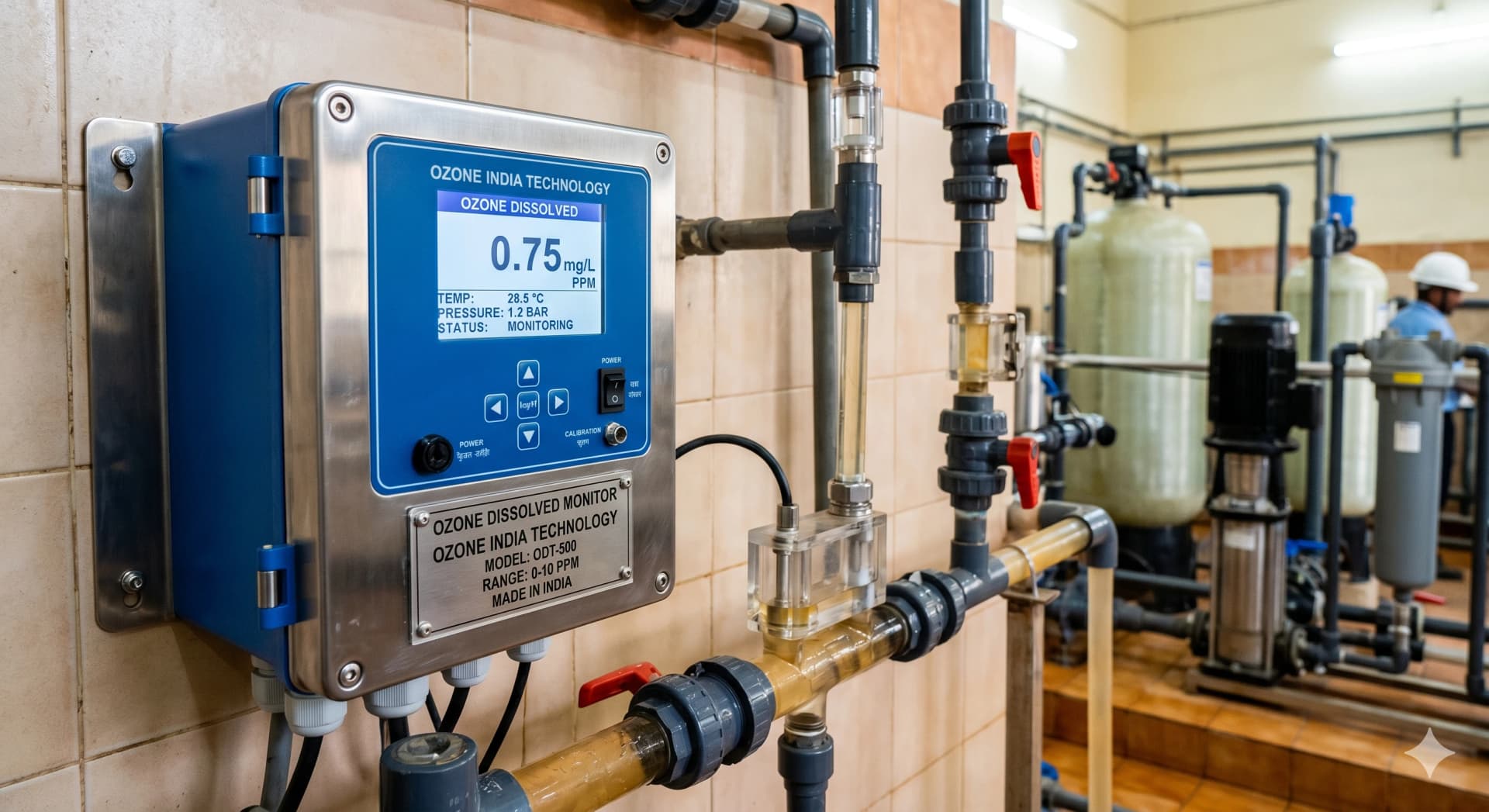
- Measure at the right point: The dissolved ozone monitor should be installed at the contact chamber outlet (not the generator outlet) — this is the actual dissolved ozone the process water receives
Application of Solubility and Half-Life to System Design
For a drinking water plant treating 100 m³/hr at 25°C, pH 7.5, moderate organic load:
- Solubility limit: At 25°C and pH 7.5, ozone solubility is ~250 mg/L — not the constraint
- Half-life: ~10 minutes at pH 7.5, 25°C
- Target CT: 0.5 mg·min/L for 3-log Giardia inactivation (US EPA LT2)
- Contact chamber volume needed: For 0.2 mg/L residual × 2.5 min effective contact time = CT 0.5 mg·min/L; chamber volume = 100 m³/hr × 2.5 min ÷ 60 = 4.2 m³
- Applied dose: 1.5 mg/L (immediate demand 0.8 + CT dose 0.5 + residual 0.2 = 1.5 mg/L)
- Generator required: 100 m³/hr × 1.5 mg/L × 1.3 safety factor ÷ 0.9 transfer efficiency = 216 g/hr → 250g/hr unit
For sizing your specific application, use the Ozone Dosage Calculator or contact Ozone India Technology for a free technical sizing consultation.
Conclusion
Ozone solubility in water is strongly temperature-dependent — halving for every 10°C rise — while ozone half-life in water is determined by pH, temperature, and organic load. For design purposes: size the generator for the applied dose (immediate demand + CT dose + residual), not the CT value alone; size the contact chamber for 2–3 half-lives at your process water temperature; and use a dissolved ozone monitor to verify actual dissolved ozone rather than relying on generator output alone. Ozone India Technology's CE-certified ozone generators from 2g/hr to 10kg/hr are supplied with full technical documentation and sizing support. Contact [email protected] or WhatsApp +91 96500 17943.