
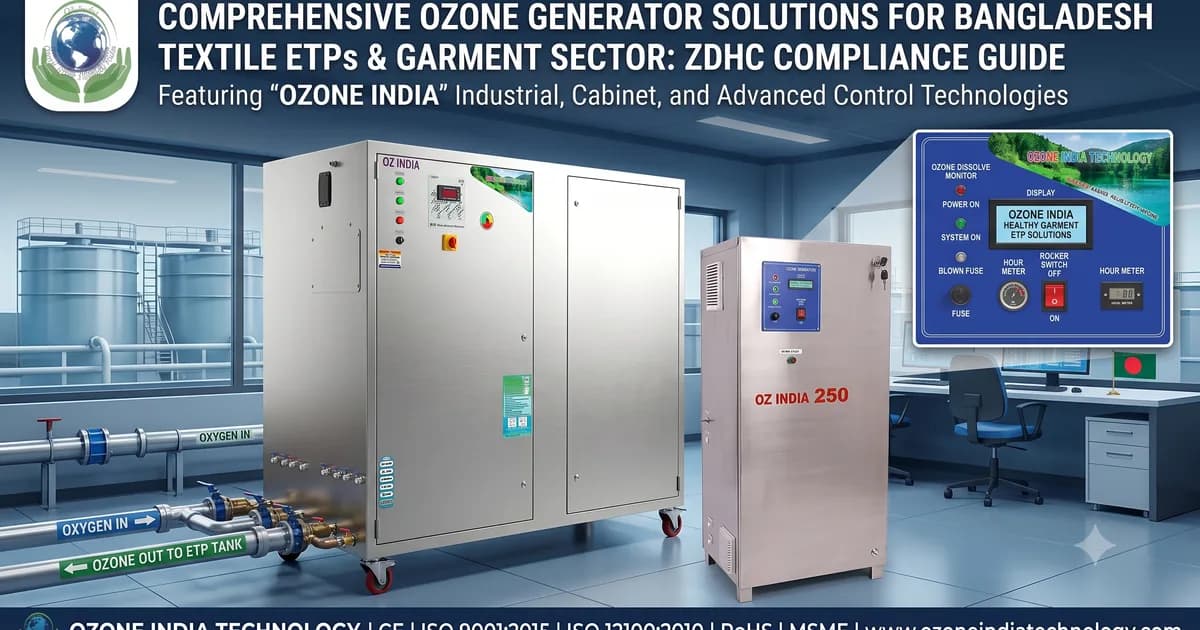
Bangladesh's garment and textile industry — the world's second-largest — supplies H&M, Zara, PVH, Gap, and Primark through factories concentrated in Dhaka, Gazipur, Narayanganj, and Chittagong. Every factory supplying these brands is required to demonstrate ZDHC Roadmap to Zero compliance: proof that manufacturing processes do not use or discharge substances on the ZDHC Manufacturing Restricted Substances List (MRSL). Potassium permanganate — the standard chemical used in denim stone wash and bleaching operations — is a ZDHC-scrutinised substance due to its persistent manganese contamination of wastewater. An ozone generator for Bangladesh replaces potassium permanganate in denim finishing, reduces textile ETP COD and colour to meet DOE Bangladesh discharge standards, and enables GOTS and ZDHC certification that opens doors to premium brand approvals. This guide covers ozone generator applications across the full Bangladesh garment value chain.
The ZDHC Problem for Bangladesh Garment Factories
The ozone generator for Bangladesh addresses a specific and urgent compliance challenge. The ZDHC Roadmap to Zero programme — mandatory for suppliers to over 150 global brands — restricts several chemicals commonly used in Bangladesh textile wet processing:
Potassium permanganate (KMnO₄): Used as a bleaching spray in denim stone wash finishing to create stone-washed and bleached appearances. ZDHC MRSL v3.1 classifies potassium permanganate as a "Discharges to Environment" substance requiring strict wastewater controls. Manganese residues in ETP discharge above 2 mg/L trigger ZDHC non-compliance findings. Bangladesh garment factories facing ZDHC audits from H&M, Inditex, and PVH are specifically asked to demonstrate potassium permanganate elimination from their denim finishing process.
Reactive dyes and auxiliary chemicals: Unfixed reactive dyes in textile wastewater contribute to COD and intense colour that is difficult to treat by biological processes alone. DOE Bangladesh discharge standards require BOD <30 mg/L, COD <200 mg/L, and suspended solids <100 mg/L — targets that conventional biological ETPs struggle to achieve consistently without chemical polishing.
The ozone generator for Bangladesh addresses both problems: eliminating potassium permanganate from denim finishing, and providing the advanced oxidation needed for ETP colour and COD polishing to meet DOE standards.
ETP Performance — Conventional vs Ozone Advanced Oxidation Treatment (Bangladesh Textile)
Ozone Generator for Denim Finishing in Bangladesh
The ozone denim machine is the ozone generator for Bangladesh in its most transformative application. Bangladesh is the world's largest producer of denim garments — Gazipur and Narayanganj host the highest concentration of denim washing units outside India. The conventional denim wet process uses:
- Pumice stone (causing silica dust accumulation in garments and occupational silicosis risk for workers)
- Potassium permanganate spray (ZDHC-restricted, creates manganese in ETP)
- Sodium hypochlorite bleach (creates chlorinated organic compounds in ETP)
- Hot water (80–90°C) for enzyme wash (high energy consumption)
The ozone denim machine — a sealed rotating drum with an integrated ozone generator — replaces the entire chemical finishing sequence:
- Stone wash equivalent: 70–80 ppm ozone, 25–30 minutes → matches pumice stone abrasion visually
- Snow wash / bleached: 90–100 ppm ozone, 45–60 minutes → replaces potassium permanganate + hypochlorite
- Vintage fade: 50–60 ppm ozone, 10–15 minutes → premium "naturally worn" appearance
For a Bangladesh denim washing unit processing 2,000 garments per day, eliminating potassium permanganate saves approximately ₹6.2 lakh per year in chemical costs alone. With water savings of 70% (ozone denim process uses 7 litres/garment vs 30 litres in conventional stone wash), the total annual saving exceeds ₹25 lakh at Bangladesh electricity and water rates — with 9–12 month payback on the ozone denim machine investment.
GOTS (Global Organic Textile Standard) permits ozone as a processing aid in textile finishing, as it leaves zero chemical residue in garments. ZDHC-audited factories using the ozone denim machine can present the elimination of KMnO₄ as a corrective action, moving the factory from ZDHC non-compliance to MRSL compliance.
Sizing an Ozone Generator for Bangladesh Textile ETP
For Bangladesh textile ETP colour and COD polishing, the ozone generator for Bangladesh is sized for the ETP discharge flow:
Q (g/hr) = F (m³/hr) × D (mg/L) × SF ÷ 1000
| ETP Scale | Daily Flow | Ozone Dose | Generator Required |
|---|---|---|---|
| Small (5-line) | 50 m³/day | 5 mg/L | 15g/hr |
| Medium (20-line) | 200 m³/day | 6 mg/L | 63g/hr |
| Large (50-line) | 500 m³/day | 6 mg/L | 156g/hr |
| CETP | 2,000 m³/day | 5 mg/L | 520g/hr |
For a medium Bangladesh ETP treating 200 m³/day from 20 sewing lines:
- Flow rate: 200 ÷ 16 operating hours = 12.5 m³/hr
- Dose for DOE colour compliance: 6 mg/L
- Q = 12.5 × 6 × 1.3 ÷ 1000 = 0.098 kg/hr = 98g/hr
- Product: Ozone generator 75-350g/hr at 100g/hr setting
The ozone generator for Bangladesh ETP is installed as a tertiary treatment stage after the biological system — treating settled secondary effluent. Ozone is introduced via a venturi injector into a serpentine contact tank (20 minutes HRT). The dissolved ozone monitor at the outlet controls ozone generator output automatically, maintaining the target dose without manual adjustment.
Ozone Generator Capacity Required for Bangladesh Textile ETP by Factory Size (g/hr)
Drinking Water Treatment for Bangladesh Factory Townships
Many of Bangladesh's large garment factories operate integrated townships housing thousands of workers. Ozone generator for Bangladesh in township water treatment:
- Dhaka groundwater: Arsenic contamination is a known issue in shallow tube wells. While ozone does not directly remove arsenic, it oxidises arsenite (As³⁺) to arsenate (As⁵⁺) which is then removed by iron-based coagulation, reducing arsenic to below BSTI BDS 1520 limits of 0.05 mg/L
- Iron and manganese: Deep tube wells in northern Bangladesh (Rangpur, Bogra) have iron above BSTI limits. Ozone oxidation + sand filtration achieves BSTI-compliant water
- Bacteriological safety: Fecal coliform contamination in shallow tube wells is addressed by the ozone generator disinfection at 0.3–0.5 mg/L, achieving zero total coliform per BSTI BDS 1520
For a factory township with 5,000 workers requiring 10 litres/person/day = 50 m³/day drinking water treatment, the ozone generator 10-25g/hr handles the requirement with 2 minutes contact time at 0.4 mg/L dose.
ZDHC Audit Documentation — What the Ozone Generator Provides
When a Bangladesh factory undergoes a ZDHC Production Restricted Substances Audit (PRSA), the auditor checks for evidence that MRSL-restricted substances are not used. For the ozone denim machine:
- Process documentation: Operation logs from the ozone denim machine showing cycle parameters (ozone concentration, cycle time) — no chemical inputs recorded
- Chemical inventory: Absence of potassium permanganate from chemical store inventory
- ETP analysis: Manganese in ETP discharge below 2 mg/L (manganese from ozone process: zero, versus 2–5 mg/L from KMnO₄ spray processes)
- Wastewater lab reports: Monthly DOE Bangladesh-format ETP analysis reports showing COD, BOD, colour, and suspended solids within limits
Ozone India Technology provides a complete technical dossier for ZDHC audit support, including CE Declaration of Conformity, ozone decomposition chemistry data sheet (demonstrating ozone → oxygen with zero chemical residue), and sample ETP monitoring protocol.
Annual Cost Savings from Ozone Generator — Bangladesh Denim Unit 2000 Garments/Day
Ozone Generator Import Procedure for Bangladesh
Importing an ozone generator for Bangladesh involves:
HS Classification: Industrial ozone generators classify under Bangladesh HS Code 8543.70 (Electrical machines with individual functions). Import duty under SAFTA India–Bangladesh: 0–5% (preferential rate for CE-certified equipment from India).
BSTI Type Approval: For industrial equipment, BSTI approval is obtained post-import through the importer. Ozone India Technology provides CE Declaration of Conformity and test report package that supports BSTI type approval application.
Documentation Package (provided by Ozone India Technology):
- Commercial Invoice with HS Code
- Packing List
- CE Declaration of Conformity (CE-2621A)
- ISO 9001:2015 Certificate
- Bill of Lading / Airway Bill
- Certificate of Origin (India, for SAFTA duty preference)
Delivery: Benapole Land Port (road from Kolkata: 3–5 days) or Chittagong Port (sea from Nhava Sheva: 18–25 days). For Dhaka garment district buyers, Benapole road transit is faster and cost-effective for units up to 500kg.
The ozone dosage calculator on the Ozone India Technology website provides a Bangladesh-specific sizing calculation for textile ETP and drinking water applications. For a detailed project proposal and quotation, contact the Ozone India Technology export team at [email protected] or WhatsApp +91 96500 17943.
Conclusion
The ozone generator for Bangladesh is the definitive solution to the garment industry's twin challenges: eliminating ZDHC-restricted potassium permanganate from denim finishing via the ozone denim machine, and achieving DOE Bangladesh ETP compliance with ozone advanced oxidation treatment. With GOTS certification compatible, ZDHC MRSL compliant, CE-certified equipment available for direct export from Greater Noida to Dhaka and Chittagong within 3–7 days, Ozone India Technology is Bangladesh's preferred ozone generator supplier for garment ETP, denim finishing, and factory township water treatment. Contact us at +91 96500 17943 or [email protected] for Bangladesh project consultation.
