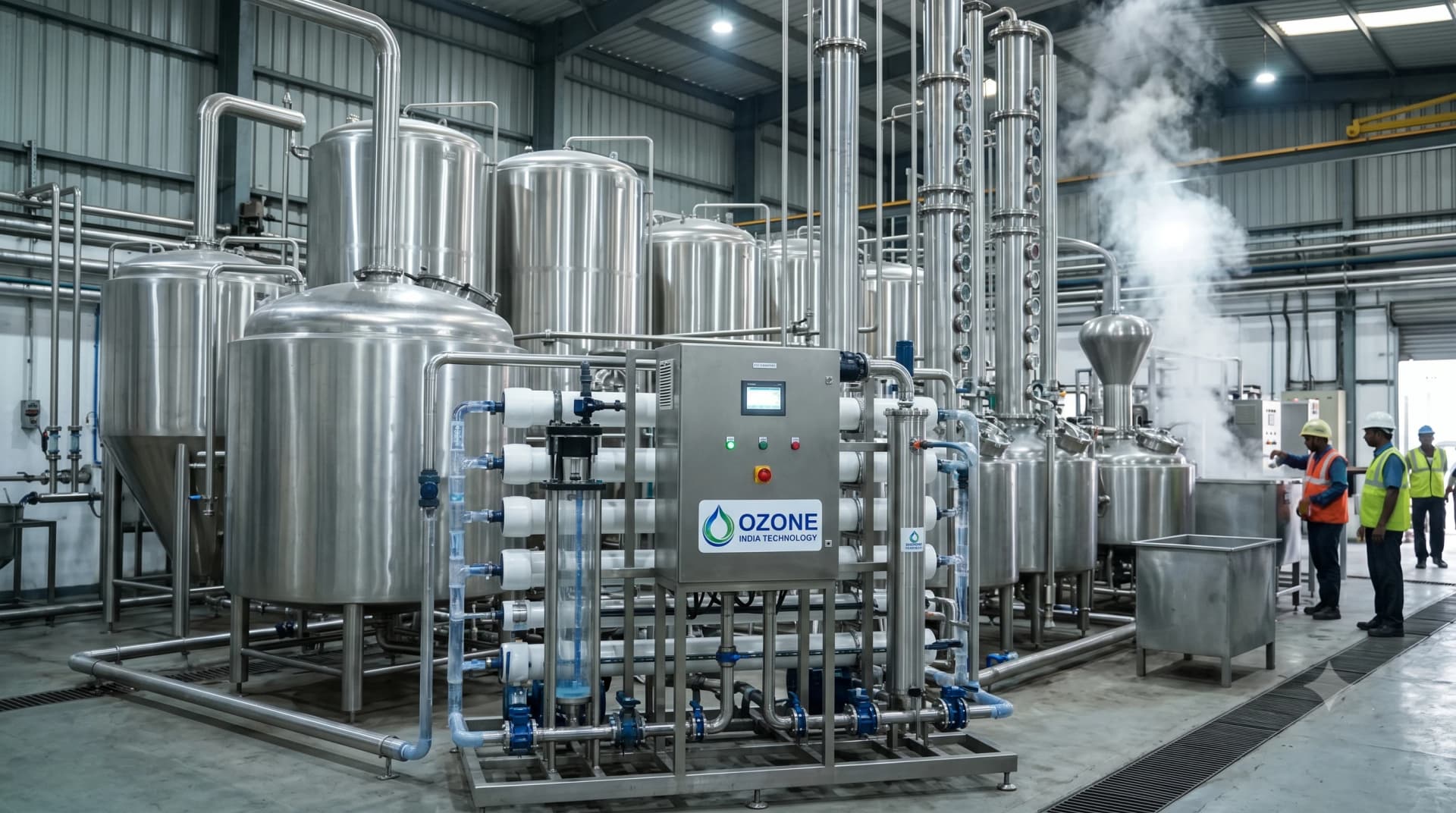
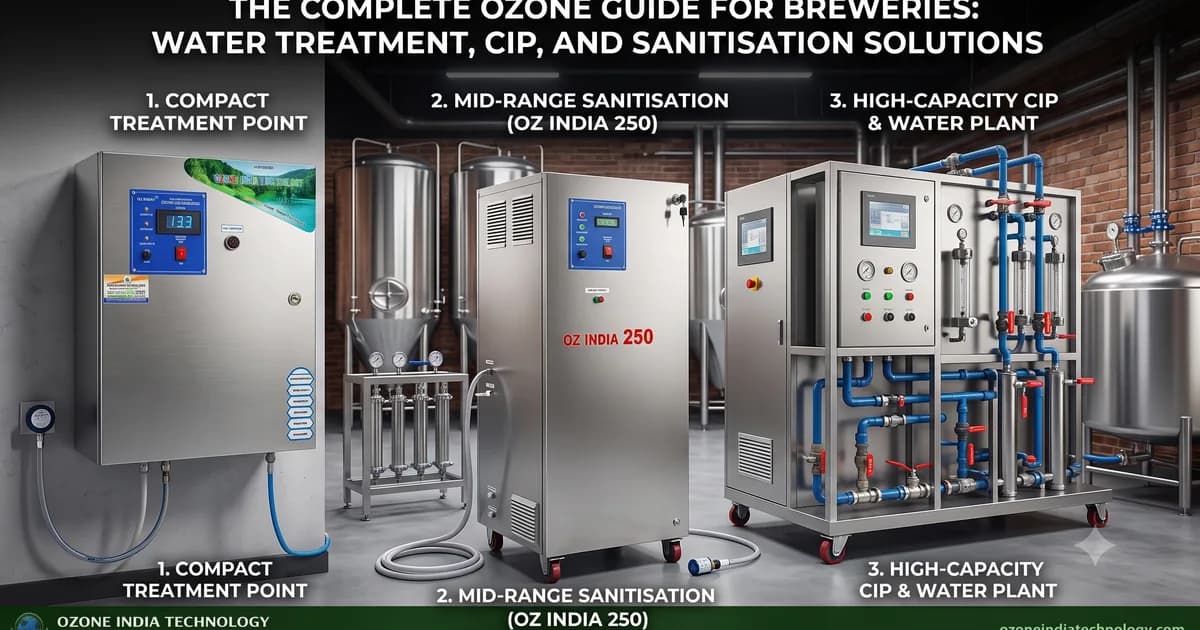
Brewing is one of the most water-intensive manufacturing processes — a typical brewery uses 3–10 litres of water per litre of beer produced for process water, cleaning-in-place (CIP), and cooling. Water quality directly determines beer quality: off-flavours, haze, and microbial contamination in the brewery trace back to process water quality in over 60% of quality incidents, according to ASBC (American Society of Brewing Chemists) survey data. Ozone for brewery water treatment addresses three distinct problems simultaneously: microbiological control of process water and packaging lines without chemical residue, CIP sanitisation without hot water or caustic chemical use, and brewery effluent treatment (beer rinse water, yeast effluent) to meet CPCB or State Pollution Control Board discharge limits. This guide covers each application in detail with ozone dose data, sizing examples, HACCP compliance, and cost comparisons.
Why Breweries Need Advanced Water Treatment
Process water quality: Brewing water (liquor) chemistry directly affects beer flavour, yeast health, and hop utilisation. Beyond chemistry, process water must be free of chlorine (which forms chlorophenol compounds — a major off-flavour precursor even at 0.1 mg/L), free of biofilm-forming bacteria (Pseudomonas, Lactobacillus, Pediococcus — brewery spoilage organisms), and within specified mineral ion ranges. Municipal supply water typically contains 0.2–0.5 mg/L chlorine residual — this must be removed before use in the brew house.
Packaging line contamination: Bottle fillers, cappers, can seamers, and keg fillers are prime sites for biofilm formation by Lactobacillus and wild yeast. Chemical sanitisers (peracetic acid, iodophor) must be rinsed away before filling — adding water consumption and creating a rinse water effluent stream. Ozone eliminates the rinse step because it decomposes to oxygen within minutes.
Brewery effluent: Beer rinse water (contains 0.3–1.5% alcohol, sugars, and yeast), CIP effluent (caustic and acid solutions), and yeast slurry disposal create a high-COD effluent stream (COD typically 1,500–10,000 mg/L) that must be treated before discharge to municipal sewer or CPCB-regulated waterway.
Application 1 — Process Water Treatment and Chlorine Removal
Municipal water entering a brewery contains chloramine (more common than free chlorine in Indian municipal water — chloramine does not evaporate and cannot be removed by boiling or UV). Chloramine at 0.5 mg/L in brewing water produces chloroanisoles in beer — musty off-flavours detectable at parts per trillion.
Ozone for dechlorination and sterilisation:
- Ozone at 0.5–1 mg/L reacts with and destroys chloramine within 30 seconds of contact
- Simultaneously achieves >4-log bacterial reduction in the process water
- Ozone decomposes to oxygen within 5–10 minutes at brewing water temperatures (8–15°C) — no ozone residual enters the brew kettle
System design: Install a 10–25g/hr ozone generator on the brewery incoming water line, injecting via venturi injector into a 200–500L stainless steel contact tank (5–10 minutes contact time at typical brewery inlet flow). A dissolved ozone monitor at the tank outlet verifies ozone residual above 0.1 mg/L; a carbon filter or UV lamp downstream destroys residual ozone before the brew kettle if required.
Ozone Dose Required for Brewery Applications (mg/L dissolved ozone)
Application 2 — CIP (Cleaning-in-Place) with Ozone
Conventional CIP in a brewery uses a 3-step sequence: hot caustic (NaOH, 75–85°C, 30 min), acid rinse (HNO₃ or H₃PO₄, 10 min), and hot water/peracetic acid sanitisation (65–80°C). This consumes significant thermal energy, generates chemical effluent, and requires a cool-down period before the next production cycle.
Ozone CIP replaces the hot sanitisation step with cold ozone water:
- Mix cold water with ozone to 1–3 mg/L dissolved ozone
- Circulate through the CIP circuit (tanks, pipework, heat exchangers) for 10–20 minutes
- Drain — no hot water rinse needed, no peracetic acid
Ozone CIP achieves: >5-log reduction of Lactobacillus, Pediococcus, Saccharomyces, and Brettanomyces in biofilm within 15 minutes at 1–2 mg/L dissolved ozone (ASBC validated). Ozone also removes biofilm exopolysaccharide matrix — the physical biofilm structure — which peracetic acid and caustic CIP cannot do at ambient temperature.
Energy and cost saving for a 10,000 HL/year microbrewery:
- Conventional CIP thermal energy: ₹4–8 lakh/year (heating water to 75–85°C)
- Peracetic acid and caustic chemical cost: ₹2–4 lakh/year
- Ozone CIP system cost: ₹3–5 lakh capital, ₹0.5 lakh/year operating electricity
- Payback period: 18–30 months
Annual Cost Comparison: Conventional CIP vs Ozone CIP (₹ lakh, 10,000 HL/year brewery)
Application 3 — Packaging Line and Keg Sanitisation
The filling hall is the highest-risk microbial contamination zone in a brewery. Ozone water at 1–2 mg/L is applied to:
Bottle and can rinser: Replace final hot water rinse with ozone water (1 mg/L, 10–20 second contact on rotating bottle rinser). Achieves >4-log reduction of Lactobacillus and wild yeast on bottle interior surface. Since ozone decomposes to oxygen within minutes, no ozone flavour carryover occurs in the beer.
Keg sanitisation: Purge kegs with ozone water (2 mg/L, 5-minute contact) before filling — eliminates the hot water and steam keg sterilisation that consumes significant energy in traditional keg operations. Especially effective against Brettanomyces (wine/specialty beer bacteria) that is resistant to heat but sensitive to ozone.
Conveyor and surface sanitation: Ozone water at 0.5–1 mg/L applied by fogging to filling hall conveyors, tables, and walls during breaks. Eliminates ambient microbial load without chemical residue that would require rinsing before next production.
Application 4 — Brewery Effluent Treatment (ETP)
Brewery effluent is characterised by:
- High COD (1,500–10,000 mg/L) from beer, yeast, and sugars
- High BOD5 (typically 60–70% of COD)
- Variable pH (3.5–10 depending on CIP stage)
- High suspended solids from yeast and hops
CPCB Schedule VI discharge limits for brewery effluent to inland waters: COD <250 mg/L, BOD <30 mg/L, pH 6.5–9.
Ozone ETP for brewery: Ozone is most effective as a polishing step after biological treatment (MBBR or activated sludge) has reduced COD to 300–800 mg/L:
- Ozone at 5–10 mg/L dose oxidises residual COD by 40–60%
- Eliminates colour from caramel malt and hop compounds
- Disinfects final effluent before discharge
- Ozone generator sized: ETP flow × dose ÷ transfer efficiency
For a 10,000 HL/year brewery generating 15 m³/day ETP effluent at 500 mg/L post-biological COD:
- Target COD reduction: 500 → 200 mg/L (requires ~8 mg/L ozone dose)
- Generator size: 15 m³/day ÷ 24 hr × 8 mg/L × 1.3 × 1000 ÷ 0.90 = 7.2 g/hr → 10g/hr unit
COD Reduction by Ozone Dose in Brewery ETP Effluent (post-biological treatment)
HACCP Compliance for Ozone in Brewery
Under FSSAI Schedule 4 (GMP for food businesses) and FSSC 22000 (food safety system certification), a brewery implementing ozone as a CCP (Critical Control Point) for process water or packaging line sanitation must document:
- Hazard identification: Microbial contamination of process water or packaging surfaces (L. acetotolerans, S. cerevisiae var. diastaticus, Brettanomyces bruxellensis)
- Critical limit: Dissolved ozone ≥0.5 mg/L at outlet of contact tank / rinser (verified by dissolved ozone monitor)
- Monitoring: Continuous dissolved ozone monitor reading, logged at minimum every 15 minutes
- Corrective action: If dissolved ozone drops below critical limit for >5 minutes, hold affected production batch and investigate generator/venturi
- Verification: Monthly Bioluminescence (ATP) swab testing of rinsed surfaces; quarterly microbiological water quality testing
Ozone India Technology provides the HACCP CCP documentation template for ozone-using breweries on request.
Conclusion
Ozone for brewery water treatment delivers three benefits simultaneously: chloramine-free, microbe-free process water that protects beer quality; cold CIP sanitisation that eliminates thermal energy and peracetic acid costs; and ETP polishing that achieves CPCB discharge compliance. For a 10,000 HL/year craft or regional brewery, the complete ozone system — process water treatment, packaging line rinse water, and ETP polish — can be implemented with a single 25g/hr industrial ozone generator and appropriate system components. Contact [email protected] or WhatsApp +91 96500 17943 for a free brewery water audit and ozone system proposal. Also see our guides for ozone in food processing and the ozone dosage calculator for sizing your specific flow rates.