
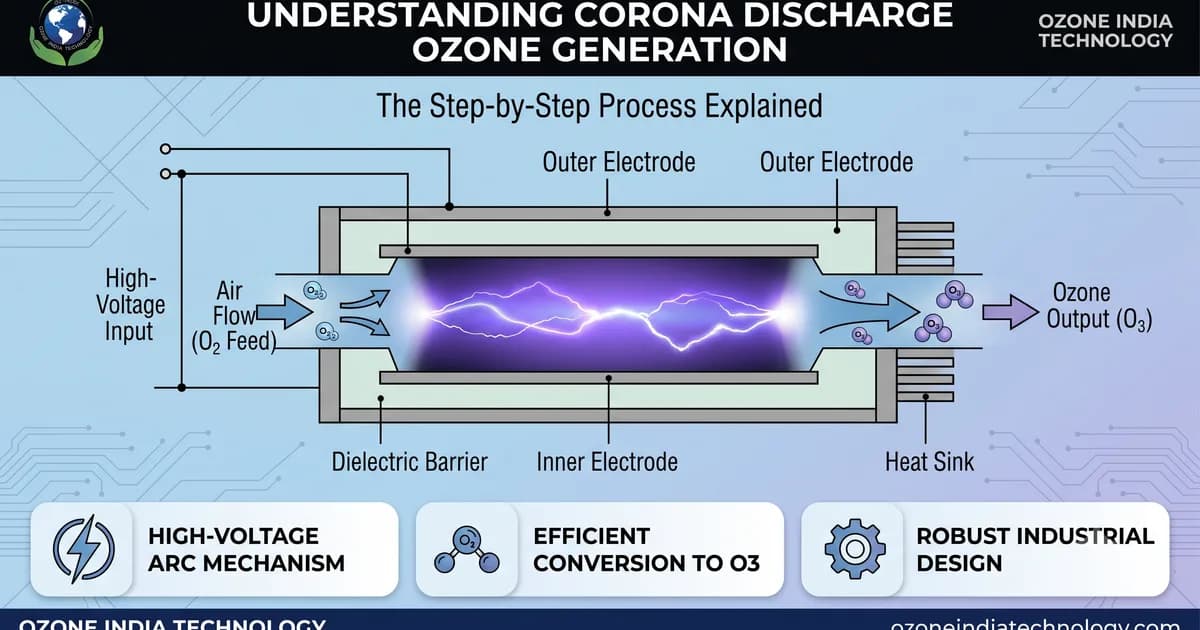
An ozone generator is an electrochemical device that converts oxygen molecules (O₂) in a feed gas into ozone molecules (O₃) by applying high-voltage electrical energy across a narrow gap between two electrodes. The process — corona discharge — is the same natural mechanism that produces the characteristic smell after a lightning storm, replicated in a controlled industrial environment to generate ozone at precise concentrations and flow rates for water treatment, air disinfection, food safety, and industrial process applications. Understanding how an ozone generator works is essential for specifying the correct unit, integrating it into a water treatment system, and troubleshooting performance issues. This guide covers the corona discharge mechanism, feed gas options (air vs oxygen), ozone concentration by weight percent, power electronics, alternative generation methods, and how ozone is transferred into water.
The Corona Discharge Mechanism
The term "corona discharge" refers to a plasma discharge that occurs when a sufficiently strong electric field ionises the surrounding gas without causing a full arc or spark. Inside an ozone generator, two electrodes are separated by a dielectric barrier (a non-conducting material, typically borosilicate glass or ceramic) and a narrow discharge gap (0.5–2 mm). When high-voltage alternating current (3,000–20,000 V at 500–3,000 Hz) is applied across the electrodes, the gas in the discharge gap becomes ionised — forming a cold plasma in which:
- High-energy electrons (3–5 eV) are produced in the plasma
- These electrons collide with O₂ molecules and split them into two oxygen radicals: O₂ + e⁻ → 2O• + e⁻
- Each oxygen radical (O•) immediately combines with an intact O₂ molecule to form ozone: O• + O₂ → O₃
The net reaction: 3O₂ → 2O₃ (ΔG = +143 kJ/mol) — an endothermic reaction requiring continuous electrical energy input. This is why ozone generators consume electricity proportional to ozone output.
Dielectric barrier discharge (DBD): Modern industrial ozone generators use dielectric barrier discharge (DBD) — one or both electrodes are covered with the dielectric material. The dielectric prevents arc formation and distributes the discharge evenly across the electrode surface, producing uniform ozone rather than concentrated arcs that would burn the dielectric and cause efficiency loss.
Corona Discharge vs UV vs Electrolytic Ozone Generation Efficiency (g O₃ / kWh)
Feed Gas: Air vs Oxygen — The Key Choice
The feed gas composition is the single most important factor determining ozone output concentration and energy efficiency.
Air-fed generators: Atmospheric air (21% O₂, 78% N₂, trace gases) passes through an air dryer to remove moisture (dewpoint below -60°C), then through the corona discharge cell. The nitrogen in air partially converts to nitrogen oxides (NOₓ) in the discharge, which react with moisture to form nitric acid — corrosive to the dielectric and reducing ozone yield. Air-fed systems produce ozone at 1–3 wt% concentration.
Oxygen-fed generators: Pure oxygen (93–95% from PSA generator or >99.5% from cylinder) is fed to the corona cell. With no nitrogen present, there is no NOₓ formation, and nearly all electrical energy converts oxygen to ozone. Oxygen-fed systems produce 8–12 wt% ozone concentration from the same electrode area and electrical input.
Why concentration matters: Higher ozone concentration in the gas phase means more ozone mass per unit volume of gas delivered to the water. This improves venturi injector transfer efficiency (more ozone dissolves per pass), allows smaller contact chambers, and reduces off-gas destructor load.
Ozone Concentration by Feed Gas Type (wt%)
Ozone Generator Power Electronics
The corona discharge requires high-frequency, high-voltage AC power that standard 50 Hz mains electricity cannot provide directly. The power supply chain inside an ozone generator:
- Rectifier: Converts mains AC (230V/415V, 50 Hz) to DC
- IGBT inverter: Converts DC to high-frequency AC (500–3,000 Hz) using insulated-gate bipolar transistors
- High-voltage transformer: Steps up frequency to operating voltage (3,000–20,000 V)
- Corona cell: High-voltage AC applied across electrodes through the dielectric
The high-frequency AC (rather than mains 50 Hz) is essential — at 50 Hz, the corona plasma is too intermittent and power transfer to the gas is inefficient. At 500–3,000 Hz, the plasma is continuous and ozone yield per watt of electrical input is maximised.
Power consumption: Industrial corona discharge ozone generators consume approximately 6–12 Wh per gram of ozone (oxygen feed) or 12–18 Wh per gram (air feed). A 100g/hr oxygen-fed generator consumes approximately 800 W–1.2 kW at rated output.
Feed Gas Preparation — The Most Critical System Component
The corona discharge cell is extremely sensitive to moisture. Water vapour in the feed gas:
- Reacts with oxygen radicals to produce hydroxyl radicals (·OH) instead of ozone
- Reacts with NOₓ (in air-fed systems) to produce corrosive nitric acid (HNO₃)
- Causes dielectric surface etching, reducing ozone yield by 20–40% within weeks
Air dryer requirement: Feed air dewpoint must be below -50°C to -70°C before entering the corona cell. Ozone India Technology generators include a desiccant dryer (silica gel or molecular sieve) with automatic regeneration cycle. Saturated desiccant is the leading cause of reduced ozone output in the field.
Effect of Feed Air Dewpoint on Ozone Output (% of rated, 100g/hr unit)
How Ozone is Transferred into Water
Generating ozone in the gas phase is only the first step — the ozone must dissolve into the process water to carry out disinfection and oxidation. The transfer methods used with Ozone India Technology generators:
Venturi injector (most common): Process water flows through a venturi, creating a low-pressure zone that draws ozone gas into the water stream. Transfer efficiency: 85–95%. The ozone venturi injector is the most reliable and low-maintenance transfer method for flow rates from 0.1 to 100 m³/hr.
Fine bubble diffuser: Ozone gas is introduced through a sintered PVDF or ceramic diffuser plate submerged in the water. Creates fine bubbles (1–3 mm) with high surface area for dissolution. Transfer efficiency: 80–90%. Used in large contact tanks and swimming pool contact chambers.
Static mixer: After venturi injection, a static mixer installed inline enhances dissolution by creating turbulent flow that breaks larger bubbles and improves contact time. Used in combination with venturi for demanding applications.
Contact chamber: All methods require adequate contact time — typically 5–20 minutes for drinking water or STP disinfection. The contact chamber (SS316L baffled tank) provides this time and ensures the dissolved ozone target is met at the chamber outlet.
Alternative Ozone Generation Technologies
UV photolysis (185nm): Short-wave UV at 185nm splits O₂ to produce ozone. Very low efficiency (3 g/kWh vs 60–120 g/kWh for corona discharge) — used only for ultra-pure water applications where trace ozone levels (0.001–0.1 mg/L) are needed without a corona generator's complexity. Not suitable for industrial water treatment doses.
Electrolytic (PEM cell): Water electrolysis using a proton exchange membrane (PEM) produces ozone at the anode at 6–14 wt% concentration. Compact, produces ozone from water with no feed gas system. Suitable for small-volume, high-purity applications (semiconductor wash water, laboratory). High capital cost and short electrode life make it uneconomical for industrial ozone doses above 5–10 g/hr.
Cold plasma / DBD in pure oxygen: The same dielectric barrier discharge process described above, but engineered with pure oxygen feed for maximum efficiency. This is the technology in all Ozone India Technology large-scale generators above 50g/hr.
Ozone Generator Technologies — Maximum Practical Output Capacity (g/hr per unit)
Ozone Generator Selection Guide
For applications requiring up to 10g/hr (small STP, residential pool, cold storage, food wash): Air-fed corona discharge with built-in air dryer is sufficient and lowest cost. Use the 2g/hr portable or 5g/hr light industrial units.
For 10–50g/hr (hotel STP, pharmaceutical water, medium pool, cooling tower): Air-fed or oxygen-fed depending on application. The 10–25g/hr industrial and 30–50g/hr heavy industrial units.
For 75g/hr+ (large STP, municipal WTP, large ETP): Oxygen feed is strongly recommended for efficiency. The 75–350g/hr large scale range with paired PSA oxygen generator.
For 400g/hr+ (major city WTP, Namami Gange STP): Contact Ozone India Technology for a site survey and engineered solution.
Conclusion
The corona discharge ozone generator is a mature, proven electrochemical technology operating on the same principle as natural ozone formation — electrical discharge splitting oxygen molecules to reform as ozone. The key design choices — electrode geometry, dielectric material, discharge frequency, and feed gas quality — determine output concentration, energy efficiency, and dielectric lifespan. For industrial water treatment, corona discharge with oxygen feed delivers the best combination of ozone yield, efficiency, and scalability from 2g/hr to 10kg/hr in a single product family. Ozone India Technology's CE-ISO certified corona discharge generators span this full range. For sizing guidance, use our ozone dosage calculator or contact [email protected] for a free technical consultation.
