
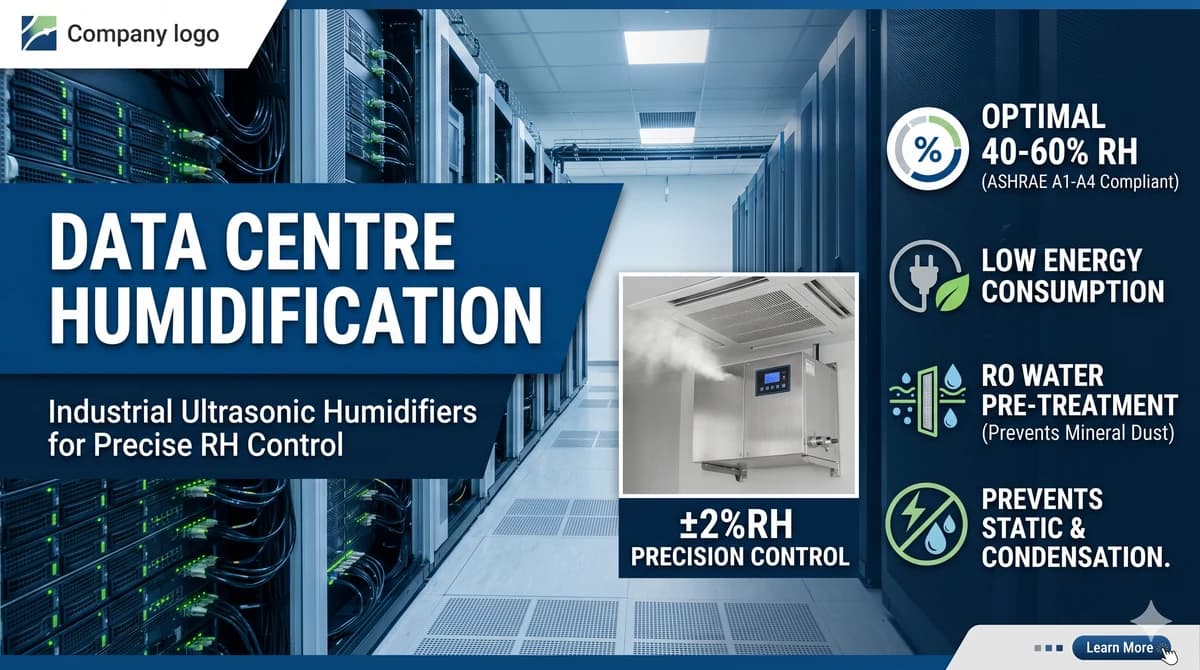
Ultrasonic Humidifier in Data Centre
ASHRAE 90.4-recommended precision humidification for data centres — ESD prevention, 40–60% RH control
THE NEED
Why Data Centre?
ASHRAE 90.4
recommends 40–60% RH for data centre environments
15,000V
ESD discharge at <30% RH — destroys server components
₹50L+
server hardware loss risk per ESD event
±3% RH
OZ India humidifier accuracy for precision control
Zero
minerals deposited — ultrasonic uses pure water
50%
less energy vs steam humidification
OVERVIEW
What is Data Centre?
Modern data centres are among the most humidity-sensitive built environments on earth — a seemingly narrow problem with consequences measured in server downtime, data loss, and billions of rupees in infrastructure investment. The industrial humidifier for data centre applications exists to solve a precisely defined engineering problem: maintaining the relative humidity (RH) within the ASHRAE-recommended operating envelope of 40–60% RH throughout the entire white space, preventing the two catastrophic failure modes that flank this envelope on either side. Below 40% RH, electrostatic discharge (ESD) events generate voltage spikes of 5,000–35,000 volts — sufficient to destroy sensitive CMOS components, corrupt memory, and cause server failures that appear as random, inexplicable hardware faults. Above 60% RH, condensation risk on cold surfaces near cooling coils, and corrosion of PCB traces from hygroscopic salt deposition, create a different category of long-term reliability failure. The industrial humidifier for data centre is the first line of defence against the low-humidity ESD failure mode — an engineering imperative documented in ASHRAE (2021) Thermal Guidelines for Data Processing Environments, 5th edition.
India's data centre industry is growing at one of the fastest rates in the world, with the top seven markets — Mumbai, Delhi NCR (Noida/Gurugram), Hyderabad, Chennai, Pune, Kolkata, and Bengaluru — adding over 1,200 MW of capacity between 2023 and 2028 according to industry analysts. The climate of these cities creates a profoundly asymmetric humidity challenge. Mumbai and Chennai are hyper-humid — monsoon RH regularly exceeds 90%, making condensation control (dehumidification) the dominant challenge. Noida, Hyderabad, and Delhi NCR face opposite conditions from October to March, when the continental dry season drops outdoor RH to 15–30% — and despite data centres operating at positive pressure with HVAC, infiltration and fresh air intake during economiser operation can drive white-space RH below 30%, triggering ESD conditions. The industrial humidifier for data centre addresses this dry-season vulnerability — and OZ India Technology's ultrasonic humidifier is particularly suited to the Indian operational context where water quality varies widely between cities.
The ASHRAE 2021 Thermal Guidelines for Data Processing Environments define four server environment classes (A1–A4) with increasingly wide allowable temperature and humidity ranges as equipment robustness increases. Most enterprise data centres and colocation facilities in India operate to Class A1 or A2 standards, which specify a recommended operating envelope of 18–27°C dry-bulb, 5.5°C dew point minimum, 60% RH maximum — with an allowed but not recommended range that extends to 80% RH maximum and 8% RH minimum for A2 class. The industrial humidifier for data centre must maintain conditions within the narrower recommended envelope (40–60% RH) to support premium uptime SLAs, satisfy colocation tenant lease agreements, and comply with Uptime Institute Tier Standard requirements (Tier III and Tier IV facilities require continuous environmental monitoring with alarm setpoints within the ASHRAE recommended range). TIA-942-B similarly references ASHRAE recommended operating conditions as the design target for data centre HVAC systems.
Electrostatic discharge is the primary damage mechanism that the industrial humidifier for data centre is designed to prevent, and its physics merits understanding. When a person walking on a low-humidity raised floor accumulates static charge — possible because low-humidity air is a poor charge dissipator — and then touches a server chassis or PCB without proper ESD protection, the resulting discharge can exceed 15,000 volts in a 10–20% RH environment. This discharge destroys ESD-sensitive devices (junction damage in MOSFET gates, threshold voltage shifts in memory cells) either immediately (hard failures, system crashes) or as latent damage that causes field failures weeks later. Sullivan et al. (2010) in Pacific Northwest National Laboratory research on data centre energy efficiency documented that ESD-related component failures were significantly reduced in facilities maintaining RH above 40%, consistent with the ASHRAE 2021 recommended minimum. An industrial humidifier for data centre maintaining 45–55% RH throughout the white space is therefore not a comfort measure — it is a reliability and business continuity measure with direct impact on server MTBF and data centre SLA performance.
India's major data centre operators — Reliance JIO InfraConnect, NTT Ltd. (Navi Mumbai), Sify Technologies, NICSI (National Informatics Centre Services, operator of government data centres), CtrlS, and Yotta Infrastructure — each face the seasonal humidity challenge in their respective microenvironments. NTT's Navi Mumbai campus faces high ambient humidity requiring precision control to prevent condensation on cooling coils while maintaining the ASHRAE minimum dew point. Government data centres operated by NIC in New Delhi face the opposite challenge in January–February when outdoor humidity drops to 15–20% and humidification must compensate. The industrial humidifier for data centre in each of these facilities must integrate with the HVAC system (CRAC/CRAH units and precision air conditioning), respond to humidity sensor signals from distributed sensors in the white space, and operate continuously without generating particulate contamination that could settle on circuit boards. OZ India's ultrasonic industrial humidifier for data centre is designed specifically for these requirements — producing pure water vapour from RO/demineralised water input, with no white dust and no heat addition to the already thermally challenged data centre environment.
THE SCIENCE
How Ozone & UV Work in Data Centre
The ultrasonic industrial humidifier for data centre generates humidity by converting liquid water into a fine aerosol mist using piezoelectric transducers vibrating at 1.7 MHz — a frequency that creates ultrasonic pressure waves in the water that eject micrometre-sized droplets (1–5 μm mass median diameter) from the water surface without any heating. These droplets, once ejected, evaporate within 30–100 cm of the humidifier outlet in the data centre's circulating air stream — a key distinction from steam humidifiers that require a 1.5–2 metre evaporation distance. The rapid, room-temperature evaporation eliminates the risk of moisture condensation on nearby server equipment — a risk that exists with steam humidifiers whose visible steam plume can cause localised condensation on cold surfaces if the humidifier is improperly located. The industrial humidifier for data centre from OZ India uses 316L stainless steel transducer tanks with food-grade silicone seals, ensuring zero metallic contamination of the humidified air.
The white dust problem is the most important water quality consideration for the industrial humidifier for data centre using ultrasonic technology. Ultrasonic humidifiers atomise water — including all dissolved minerals — into aerosol droplets. When these droplets evaporate, the dissolved calcium carbonate, magnesium sulphate, and other minerals are deposited as white powder ('white dust') on surfaces including server PCBs, cooling fans, and optical connectors. This mineral deposition causes PCB track resistance changes, fan bearing wear, and optical signal attenuation — all potentially leading to server failures. The solution is unambiguous: ultrasonic industrial humidifiers for data centre must use demineralised or RO-purified water with TDS below 5 ppm, as specified in OZ India's installation requirements. OZ India humidifier packages include an inline demineralised water system ensuring compliant water quality at the humidifier inlet at all times — the single most important operational safeguard in ultrasonic humidification.
The humidity distribution system in a data centre using an industrial humidifier for data centre typically involves either ducted distribution (humidifier installed in the HVAC air handling unit return plenum, with humidified air distributed through the existing supply air ductwork) or direct-room installation (floor-standing humidifiers located in the white space, distributing mist directly into the room air). Ducted installation is preferred in large data centres with centralised HVAC because it ensures uniform distribution — the industrial humidifier for data centre operates as a component of the air handling unit (AHU), with the humidified air mixed with supply air before distribution through perforated floor tiles or ceiling diffusers. Direct-room installation is used in smaller data centres or for spot humidification in specific aisles identified as humidity-deficient by sensor mapping. OZ India ultrasonic humidifiers are available in both duct-mount and free-standing configurations, with outputs from 3 kg/hr (room models) to 30 kg/hr (large AHU duct units).
Control integration is essential in the industrial humidifier for data centre — the humidifier must respond to the data centre's building management system (BMS) or data centre infrastructure management (DCIM) system rather than operating as an isolated device. OZ India ultrasonic humidifiers provide Modbus RTU and BACnet/IP communication protocols standard, allowing the BMS to read real-time humidity output, water consumption, transducer status, and fault conditions. The humidity set-point is commanded from the BMS, which integrates signals from multiple distributed humidity sensors (typically one sensor per 50 m² of white space) to maintain area-wide humidity within the ASHRAE recommended operating envelope. During economiser mode (when outdoor air is admitted to reduce cooling energy per Tschudi & Xu (2003) data centre energy benchmarking methodology), the BMS increases industrial humidifier for data centre output to compensate for the dry outdoor air — a dynamic load that requires rapid response from the humidifier control system. OZ India humidifiers achieve full output within 30 seconds of set-point change, satisfying the response time requirements of dynamic BMS humidity control.
Power Usage Effectiveness (PUE) — the ratio of total facility energy to IT equipment energy — is the primary efficiency metric in data centre operations, and the industrial humidifier for data centre contributes to PUE in both directions. Ultrasonic humidifiers consume only 30–50 W of electrical energy per kg/hr of humidity output (compared to 600–700 W/kg for electric steam humidifiers), making them the most energy-efficient humidification technology available. For a 10 kg/hr humidification requirement, an ultrasonic industrial humidifier for data centre consumes 300–500 W versus 6,000–7,000 W for electric steam — a saving of 5–6 kW that directly improves PUE. The absence of heat addition from the ultrasonic process (versus steam humidifiers that raise supply air temperature by 2–4°C, increasing cooling load) provides a further PUE benefit. For India's NIC government data centres operating under MeitY energy efficiency mandates, and for commercial colocation facilities competing on PUE as a customer acquisition differentiator, the industrial humidifier for data centre from OZ India provides a meaningful PUE improvement versus steam alternatives.
THE SOLUTION
Ozone India Technology Solution
OZ India Technology's industrial humidifier for data centre range is purpose-designed for the demanding continuous-operation requirements of IT infrastructure environments, where equipment downtime for maintenance is unacceptable and ESD-related server failures have direct financial consequences. The OZ India ultrasonic humidifier series uses individually addressable 316L stainless steel transducer modules — a modular design where output scales linearly with the number of active modules and individual module failure reduces output partially rather than causing total humidification failure. This modular redundancy is particularly important for data centres operating to Uptime Institute Tier III or Tier IV standards, where N+1 or 2N redundancy of all critical systems (including humidification) is required by the Tier Standard Topology. Available output configurations range from 3 kg/hr (small server room, <100 m²) to 30 kg/hr (large enterprise data centre, >2000 m²), with multiple units deployable in parallel for unlimited scaling.
The OZ India industrial humidifier for data centre package includes an integrated demineralised water system with a multi-stage RO membrane, mixed-bed ion exchange polishing, and a TDS monitor with high-TDS alarm to prevent white dust conditions. Water quality is continuously monitored and automatically shut off if TDS exceeds 5 ppm — the critical threshold above which mineral deposition risk becomes unacceptable for data centre applications. The RO system is sized to produce demineralised water at 1.5× the humidifier's maximum consumption rate, providing adequate buffer during peak demand. OZ India also supplies a water management manifold with motorised drain valve that automatically purges residual water from the transducer tank during extended humidifier shutdowns — preventing biofilm formation in standing water, which would otherwise contaminate the humidified air with Legionella-risk aerosols.
The control and monitoring system of the OZ India industrial humidifier for data centre is designed for DCIM integration. The humidifier controller provides Modbus RTU (RS-485) and BACnet/IP communication, exposing all operational parameters — output percentage, water consumption, transducer module status, TDS reading, tank water level, and active alarms — as readable registers to the BMS or DCIM platform. Set-point commands from the BMS override the local HMI, allowing centralised humidity management from the data centre's control room. Alarm outputs include dry contacts for integration with facility alarm systems. OZ India provides a full register map and integration guide for major BMS platforms (Schneider EcoStruxure, Honeywell EBI, Johnson Controls Metasys) to minimise integration engineering time. The local HMI logs 12 months of operational data with USB export — supporting energy audits and PUE reporting.
OZ India provides application engineering support for industrial humidifier for data centre projects, including humidity distribution modelling to identify optimal humidifier placement and verify uniform coverage across the white space. For data centres with hot-aisle/cold-aisle containment, the industrial humidifier for data centre must be installed in the return air path (hot aisle or above-ceiling return plenum) to ensure humidified air mixes with return air before re-entering the cooling coils — preventing condensation on the coils' cold surfaces. OZ India engineers review floor layouts, CRAH unit specifications, and cooling airflow patterns before recommending humidifier location, quantity, and output capacity. Post-installation, OZ India conducts a humidity mapping survey with portable data loggers to verify uniform distribution and confirm compliance with ASHRAE 2021 recommended operating conditions across all measurement points.
PERFORMANCE
Without vs With OZ India Treatment
| Parameter | Without Treatment | With OZ India System |
|---|---|---|
| Humidification technology | Electric steam: 600–700 W/kg — high energy, heat addition | Industrial humidifier for data centre: ultrasonic, 30–50 W/kg, no heat addition |
| ESD events at low RH (<30%) | Static discharge 5,000–15,000 V — server and memory failures | RH maintained 45–55% — ESD events eliminated |
| ASHRAE 2021 compliance | Non-compliant <40% RH — risk of warranty void on server hardware | 40–60% RH maintained — full ASHRAE A1/A2 compliance |
| White dust contamination | Tap water in ultrasonic: mineral deposits on PCBs and fans | RO demineralised water system integrated — TDS <5 ppm, zero white dust |
| BMS/DCIM integration | Stand-alone humidifier — no BMS feedback, manual control | Modbus RTU + BACnet/IP — full BMS automation and DCIM monitoring |
| PUE impact (1 MW IT load, 10 kg/hr) | Electric steam adds 6–7 kW — PUE increases by 0.006–0.007 | Ultrasonic adds 0.3–0.5 kW — negligible PUE impact |
| Uptime Institute Tier III compliance | Single unit — no redundancy, violation of Tier III continuous maintenance | Modular design — per-module maintenance without system shutdown |
| Annual operating cost (10 kg/hr continuous) | Electric steam: ~₹3.5 lakh/yr electricity (₹7/kWh) | Industrial humidifier for data centre: ~₹0.21 lakh/yr electricity |
PERFORMANCE DATA
Technical Performance Data
Reference data for ozone treatment system design and validation — applicable to Data Centre applications. All data per standard water treatment engineering practice (AWWA, WHO, CPCB guidelines).
Pathogen Log Inactivation at 3 mg/L Ozone (CT = 45 mg·min/L)
BOD Reduction (%) vs Ozone Dose — Typical STP/ETP Secondary Effluent
E. coli Log Inactivation vs Contact Time at 3 mg/L Ozone
System Sizing Guide — Plant Flow Rate vs Ozone Generator Capacity
RECOMMENDED EQUIPMENT
Products for Data Centre
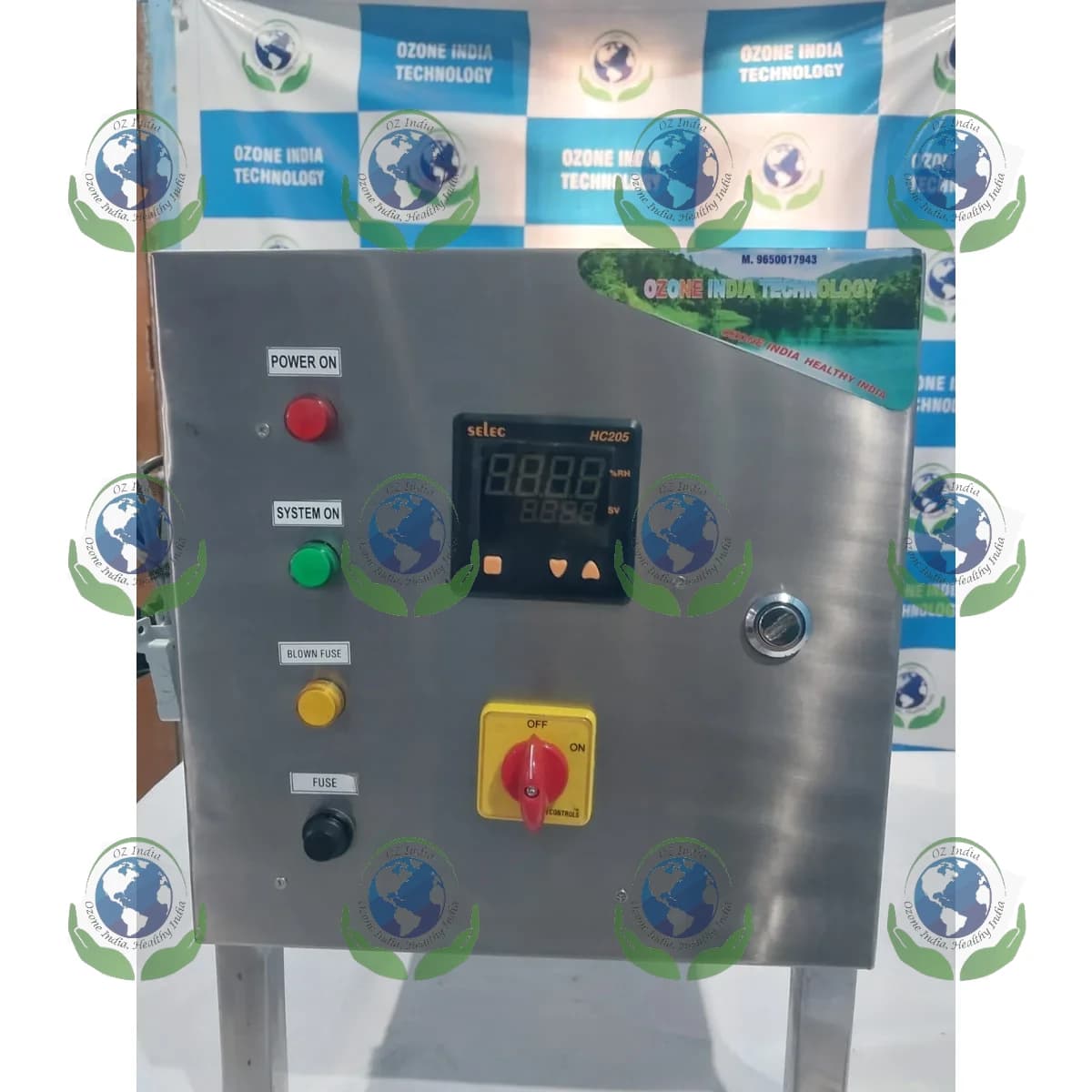
Ultrasonic Humidifier Industrial
Industrial piezoelectric ultrasonic humidifier 1-100 kg per hour for textile mills pharmaceutical and data centres
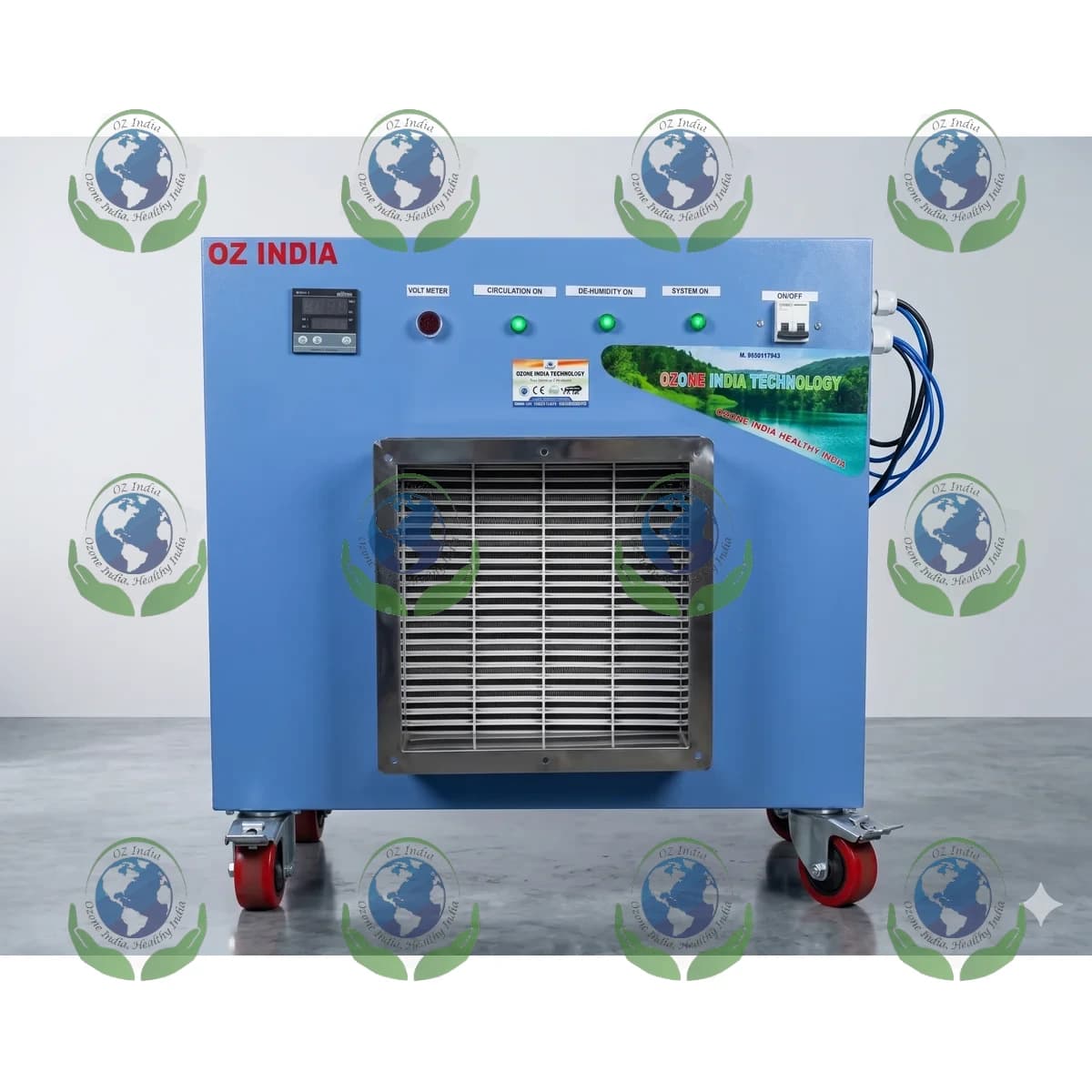
Industrial Dehumidifier
Industrial dehumidifier for pharmaceutical cold storage museum archive and humidity-sensitive process control
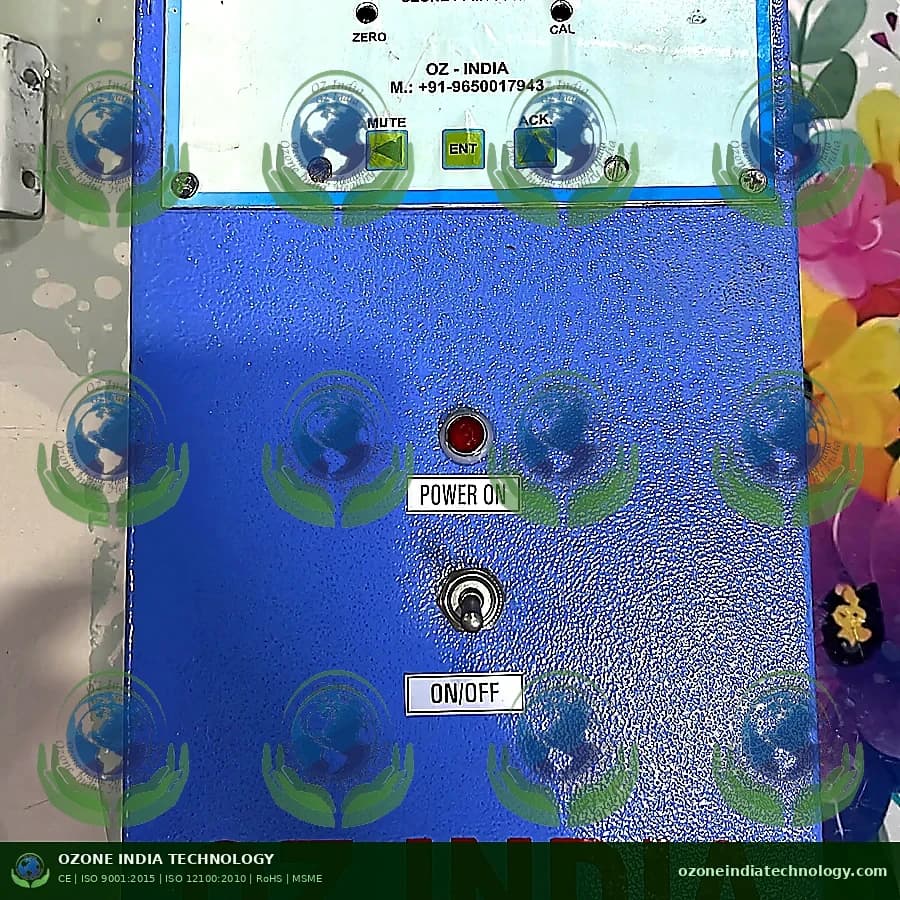
Ozone Ambient Air Monitor
Real-time ozone air monitoring with Delta PLC, HMI touchscreen & USB data logging
SIZING GUIDE
Installation & Sizing Guide
Sizing the industrial humidifier for data centre requires calculating the moisture deficit between the minimum acceptable white-space humidity (40% RH, per ASHRAE 2021 recommended range) and the anticipated lowest incoming air humidity during the dry season — multiplied by the air volume flow rate through the data centre HVAC system. The calculation uses the psychrometric chart: at 22°C supply air temperature, 40% RH corresponds to a moisture content of 6.6 g/kg dry air; at 20% RH (dry-season outdoor air), the moisture content is 3.3 g/kg. The industrial humidifier for data centre must therefore add 3.3 g/kg of moisture to the incoming air. With a data centre HVAC system handling 50,000 m³/hr of air (approximately 1 MW IT load at N+2 cooling), the humidification requirement is 3.3 g/kg × 50,000 m³/hr ÷ 850 m³/kg ≈ 194 kg/hr. This calculation assumes 100% outdoor air (economiser mode); in recirculating mode, the calculation uses infiltration and fresh air intake rates only, typically 10–20% of total HVAC flow.
The number of ultrasonic industrial humidifier for data centre units required is determined by dividing the total calculated humidification load by the output of each individual unit, adding a redundancy factor. For the 194 kg/hr example above, using OZ India 30 kg/hr floor-standing units requires 7 units for the base load plus 2 additional units for N+2 redundancy — a total of 9 units. For ducted AHU integration, units are installed in multiple AHU return plenums distributed across the data centre, ensuring that failure of one AHU does not eliminate all humidification. The industrial humidifier for data centre placement must also respect the ASHRAE evaporation distance requirement: the air velocity in the duct must be sufficient to fully evaporate the aerosol droplets before the air reaches a cold surface (cooling coil or supply air grille) — OZ India provides duct velocity and evaporation distance calculations as part of every project engineering package.
Water supply infrastructure for the industrial humidifier for data centre is a significant design consideration that is often under-estimated. An industrial humidifier for data centre consuming 10 kg/hr of water requires 240 litres/day of demineralised water input, plus the RO system reject water (typically 1.5–2× the permeate volume) — meaning the total data centre water supply for humidification alone may be 600–720 litres/day for a modest installation. For large installations with 100+ kg/hr humidification, water supply planning must address incoming mains pressure, pipe sizing, and storage tank capacity to ensure uninterrupted water supply during periods of simultaneous humidifier start-up. OZ India provides a water supply schematic and pressure calculation for each industrial humidifier for data centre project, coordinating with the facility plumbing design.
The industrial humidifier for data centre maintenance schedule is a critical operational planning consideration for data centre facility managers. OZ India ultrasonic humidifiers require: weekly RO filter inspection (automated TDS monitoring handles this in practice); monthly transducer tank drain and inspection for mineral deposits (even with demineralised water, trace minerals can accumulate over time); quarterly RO membrane performance check and pre-filter replacement; and annual transducer module replacement (OZ India's 1.7 MHz piezoelectric transducers have a rated life of 8,000–10,000 operating hours, approximately 12–14 months at continuous operation). All maintenance procedures can be performed on individual modular units without shutting down the entire industrial humidifier for data centre system — the modular design allows one module to be serviced while the remainder maintain humidification, consistent with Uptime Institute Tier III continuous maintenance requirements.
CASE STUDY
ESD Failure Reduction at Government Data Centre, Noida (NIC-class Facility)
A government data centre campus in Noida — operating servers supporting e-governance applications with mandated 99.9% uptime — experienced a recurring pattern of unexplained server failures and memory errors between November and February each year, the dry season when outdoor relative humidity drops to 15–20% in the Delhi NCR region. The facility's HVAC system ran in partial economiser mode during these months, admitting dry outdoor air that pulled white-space RH below 25% despite the facility's standard air conditioning. Root cause analysis by OZ India Technology identified ESD as the primary failure mechanism: field engineers measured static charges of 8,000–12,000 volts on personnel touching servers in the server room, correlating directly with low-humidity periods.
OZ India Technology supplied and commissioned six OZ India 10 kg/hr ultrasonic industrial humidifiers for data centre integration, installed in the return air plenums above each CRAH unit row. Each industrial humidifier for data centre was integrated via Modbus to the facility's BMS, with distributed capacitive RH sensors at five locations in the white space providing feedback for closed-loop humidity control. The demineralised water system with inline TDS monitoring was installed alongside, with water quality verification logs maintained for facility audit. Post-commissioning RH measurements confirmed 45–52% RH uniformity across all five sensor locations throughout the dry season — within the ASHRAE 2021 recommended operating envelope.
Server failure rates in the subsequent dry season (November–February) dropped by 78% compared to the previous three-year average for the same period. Memory error event frequency (tracked through the server management system) fell by 82%. The facility manager calculated that the reduction in hardware replacement costs and server downtime (valued at ₹85,000 per hour of affected e-governance service disruption) recovered the full cost of the industrial humidifier for data centre installation within 14 months. The OZ India industrial humidifier for data centre system has operated continuously for three dry seasons without transducer failure, with only scheduled preventive maintenance required.
FAQ
Frequently Asked Questions
What relative humidity range should an industrial humidifier for data centre maintain?+
ASHRAE (2021) Thermal Guidelines for Data Processing Environments recommends a relative humidity operating envelope of 40–60% RH for Class A1 and A2 data centres — the classes applicable to enterprise and colocation facilities. The lower limit of 40% RH is set to prevent ESD events: below 40% RH, static charge accumulates on personnel and equipment surfaces, generating discharges of 5,000–15,000 volts that destroy ESD-sensitive semiconductor components. The upper limit of 60% RH prevents condensation on cold surfaces and limits corrosion risk from hygroscopic salt films on PCBs. The industrial humidifier for data centre from OZ India is configured to maintain a set-point of 45–50% RH — providing comfortable margins from both limits — with BMS-controlled output modulation responding to distributed RH sensor feedback.
Why is the white dust problem critical for ultrasonic industrial humidifiers used in data centres?+
Ultrasonic humidifiers atomise water into micrometre-sized droplets that carry all dissolved minerals with them. When these droplets evaporate in the data centre air, calcium carbonate, magnesium sulphate, and other minerals are deposited as white crystalline powder on every surface — including server PCBs, cooling fan bearings, and fibre optic connectors. On PCBs, mineral deposits increase track resistance, cause intermittent short circuits, and accelerate electrochemical corrosion. In cooling fans, mineral deposits cause bearing wear and vibration. The solution is absolute: the industrial humidifier for data centre must be supplied with demineralised or RO-purified water with TDS below 5 ppm. OZ India includes an integrated RO demineralisation system with continuous TDS monitoring in every data centre humidifier package, eliminating the white dust risk entirely.
What is the energy consumption of an ultrasonic industrial humidifier for data centre versus steam humidification?+
Ultrasonic industrial humidifiers for data centre use approximately 30–50 W of electrical energy per kg/hr of humidification output — entirely for the piezoelectric transducers and fan. Electric steam humidifiers consume 600–700 W per kg/hr, because they must heat water from ambient temperature (25°C) to boiling point (100°C) and then fully evaporate it. For a 10 kg/hr humidification requirement, the ultrasonic industrial humidifier for data centre consumes 300–500 W versus 6,000–7,000 W for steam — a saving of 5.5–6.5 kW that improves PUE by 0.006–0.008 for a 1 MW IT load data centre. At ₹7/kWh electricity cost, this energy saving amounts to ₹3.3–3.9 lakh per year for continuous operation — a significant portion of the humidifier's capital cost recovered annually in energy savings.
How should the industrial humidifier for data centre be integrated with the BMS/DCIM system?+
The OZ India industrial humidifier for data centre provides Modbus RTU (RS-485) and BACnet/IP communication interfaces as standard, exposing approximately 40 data registers including: real-time humidity output (%), water consumption rate (litres/hr), transducer module status (per module), TDS reading (ppm), tank water level, active alarms, and accumulated operating hours. The BMS reads these registers at 1-minute polling intervals and commands the humidity set-point via a writable register. Distributed RH sensors (OZ India recommends one sensor per 50 m² of white space, at mid-rack height) feed the BMS, which calculates an area-weighted average RH and adjusts the industrial humidifier for data centre output accordingly. OZ India provides a full Modbus register map and BACnet device profile document with every humidifier order.
Can the industrial humidifier for data centre be used in hot-aisle/cold-aisle containment configurations?+
Yes — in hot-aisle/cold-aisle containment configurations, the industrial humidifier for data centre should be installed in the hot-aisle return air path (hot aisle corridor, ceiling plenum above the hot aisle, or AHU return plenum) rather than in the cold aisle. Hot aisle return air is warm (30–45°C) and therefore has a lower relative humidity than the cold aisle supply air — it accepts additional moisture without condensation risk. The humidified return air then passes through the CRAH/CAHU cooling coils, where humidity is distributed evenly to the supply air before delivery to the cold aisles. Installing the industrial humidifier for data centre in the cold aisle is not recommended because cold-aisle air temperature (18–22°C) provides less evaporation capacity, and the humidifier output may not fully evaporate before reaching cold CRAC coil surfaces, causing condensation and water damage.
What maintenance does the industrial humidifier for data centre require?+
OZ India recommends the following maintenance schedule for the industrial humidifier for data centre: Weekly — verify TDS reading on the water supply (automated monitoring with alarm handles this); Monthly — drain and inspect the transducer tank for mineral deposits, check fan operation, verify BMS communication; Quarterly — replace RO pre-filter cartridge, check RO membrane TDS rejection, clean ultrasonic transducer surfaces with citric acid solution per OZ India maintenance procedure; Annually — replace ultrasonic transducer modules (rated 8,000–10,000 hours ≈ 12 months continuous), replace RO membrane if TDS rejection below 95%, recalibrate RH sensors against portable NABL-traceable reference. OZ India's modular design allows individual module replacement without taking the entire industrial humidifier for data centre offline — supporting Tier III continuous maintenance requirements.
How many industrial humidifiers for data centre are required for a 1 MW IT load facility?+
A 1 MW IT load data centre typically has an HVAC system handling 50,000–70,000 m³/hr of air (depending on cooling approach and server thermal envelope). In the worst-case dry-season scenario for a Delhi NCR or Noida facility (outdoor RH 15%, indoor set-point 45% RH), the industrial humidifier for data centre must add approximately 3–4 g/kg moisture to the incoming air, corresponding to a total humidification requirement of 180–280 kg/hr. Using OZ India 30 kg/hr ultrasonic units in AHU duct-mount configuration, 6–10 units provide the base load plus N+1 redundancy. For a Mumbai facility with high outdoor humidity, the dry-season humidification requirement may be near zero; instead, the challenge is precision humidity control near the 60% upper limit. OZ India provides site-specific psychrometric calculations for each data centre project before specifying industrial humidifier for data centre capacity.
RELATED
Related Applications

Textile Mill Humidification
Ultrasonic humidification for spinning, weaving, and finishing — 65–75% RH for zero yarn breakage
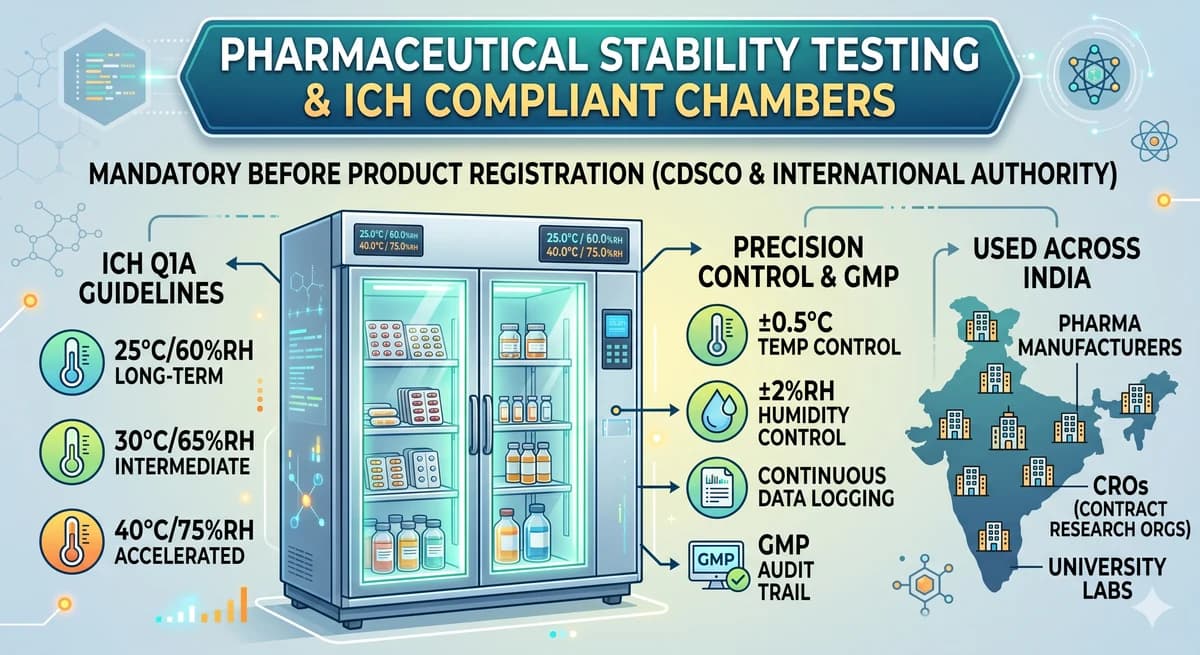
Pharmaceutical Stability Testing
ICH Q1A compliant stability chambers for Zone I–IV drug testing — CDSCO approved manufacturer
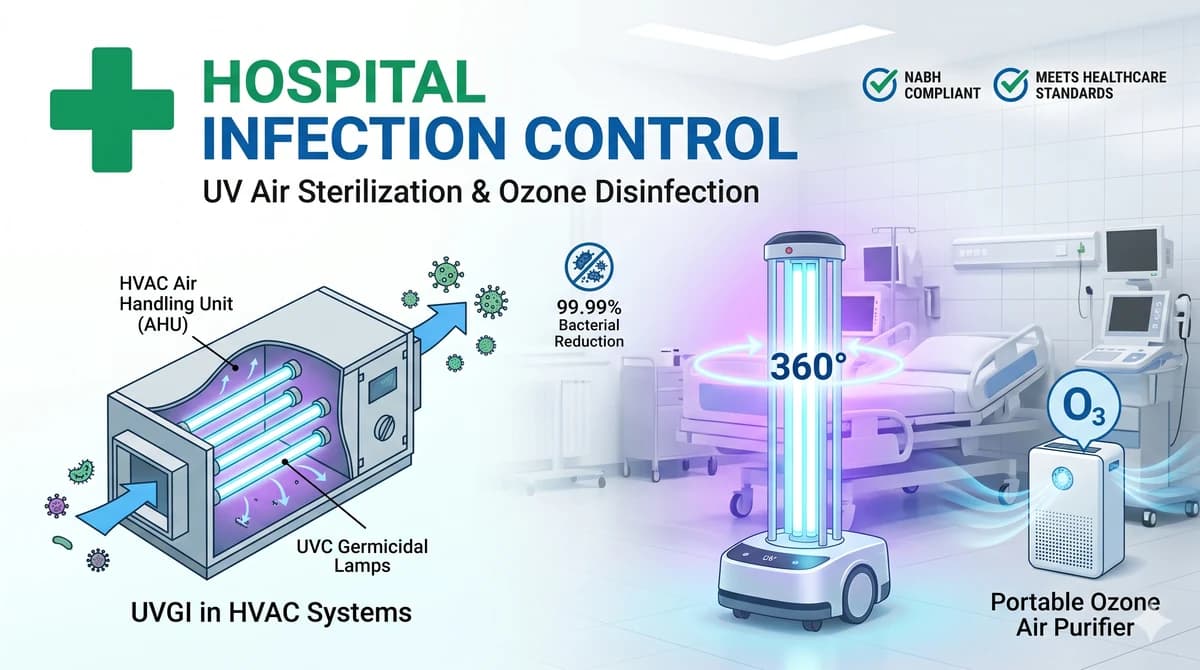
Hospital and Healthcare
NABH-aligned UV and ozone disinfection for hospital air, water, surfaces, and instrument sterilization
Have a question about Data Centre?
Talk to our engineers — free technical consultation
WhatsApp Us Now