
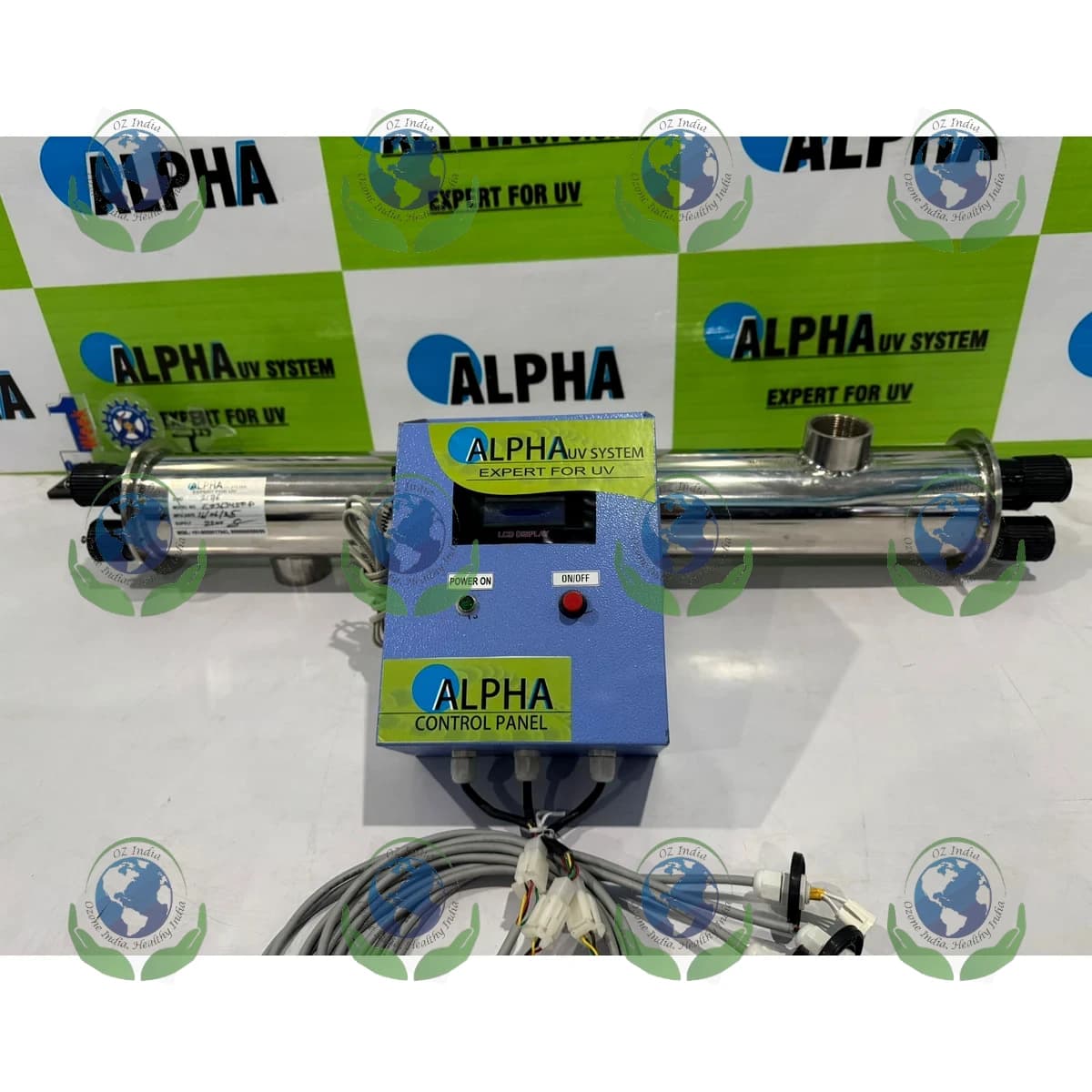
UV water treatment for pharmaceutical industries in India is a mandatory technology under Indian Pharmacopoeia 2022, CDSCO Schedule M, and WHO GMP Technical Report Series 970. Every pharmaceutical manufacturer in India — whether producing oral solids, parenterals, APIs, or ayurvedic formulations — must include a validated UV disinfection step in the purified water treatment train. UV water treatment for pharmaceutical industries works at two distinct levels: primary disinfection of RO permeate at 254 nm before it enters the purified water storage tank, and TOC reduction using medium-pressure UV at 185 nm for facilities where reverse osmosis alone cannot achieve the Indian Pharmacopoeia TOC limit of ≤ 500 μg/L. This guide covers both functions in full technical detail for Indian pharmaceutical engineers and QA teams.
Regulatory Framework — Why UV Is Mandatory in Pharma Water Systems
The Indian Pharmacopoeia (IP) 2022 specifies Purified Water (PW) as the standard for pharmaceutical manufacturing, requiring TOC ≤ 500 μg/L, conductivity ≤ 4.3 μS/cm at 20°C, and a microbial action limit of 100 CFU/mL. Water for Injection (WFI) requires TOC ≤ 500 μg/L, conductivity ≤ 1.1 μS/cm, and a microbial action limit of 10 CFU/mL. Achieving and maintaining these limits requires UV water treatment for pharmaceutical industries as a post-RO disinfection barrier — reverse osmosis reduces microbial counts by 4 to 6 log but does not sterilise water, and biofilm formation in distribution loops can rapidly breach the IP 2022 action limits without continuous sanitisation.
CDSCO Schedule M (Drugs and Cosmetics Act 1940, amended 2018) requires every pharmaceutical water system to be qualified before use and monitored continuously during production. CDSCO inspectors specifically review UV system documentation during GMP inspections — the most common observations include: expired UV lamps still in use, no UV intensity monitoring, missing IQ/OQ/PQ protocols, and incorrect lamp replacement with an unvalidated model. UV water treatment for pharmaceutical industries must be approached as a validated, documented process, not a utility item.
WHO GMP Technical Report Series 970 (2012), Annex 2, specifies that pharmaceutical water purification systems must include continuously recirculating distribution loops with validated sanitisation. UV disinfection at the loop inlet or on the return line is the WHO-accepted method for maintaining microbiological compliance without chemical residuals.
Where UV Fits in the Pharmaceutical Water Treatment Train
UV water treatment for pharmaceutical industries in India is positioned at two specific points in the treatment sequence. Understanding the correct placement prevents both under-treatment (UV placed incorrectly gives no compliance value) and over-treatment (specifying medium-pressure UV where low-pressure UV is sufficient wastes capital).
Standard pharmaceutical water treatment sequence for an Indian facility:
Incoming supply (municipal or borewell) → Multimedia filter → Softener (ion exchange) → Activated carbon filter (chlorine removal) → 5-micron cartridge filter → Reverse osmosis (single or double-pass) → Low-pressure UV at 254 nm (primary disinfection, 40–120 mJ/cm²) → Purified Water storage tank → Distribution loop with ozone or hot-water sanitisation → UV at point-of-use or on return line (residual ozone destruction) → Point-of-use outlets.
The first UV system — between RO and the PW storage tank — inactivates any bacteria and viruses that passed through the RO membrane. The second UV position — on the distribution loop return or at each point-of-use outlet — destroys dissolved ozone residual (if ozone loop sanitisation is used) to ensure zero ozone contamination at the point of dispensing.
UV water treatment for pharmaceutical industries without the correct placement in this sequence provides no regulatory value. A UV system installed before the RO membrane, for example, disinfects water that will be filtered again by RO — providing no net microbiological improvement to the PW.
UV Dose Requirements for Pharmaceutical Water Systems
Low-pressure UV at 254 nm — disinfection function
Low-pressure mercury UV lamps emit 85 to 95% of output at 254 nm, the peak germicidal wavelength. UV water treatment for pharmaceutical industries using LP UV achieves the following log inactivation in RO permeate water (UVT typically 95 to 99%):
| Organism | UV Dose for 4-log Inactivation | Regulatory Significance |
|---|---|---|
| E. coli, Pseudomonas aeruginosa | 20–30 mJ/cm² | IP 2022 bioburden organisms |
| Burkholderia cepacia, Ralstonia | 40–60 mJ/cm² | Notorious pharma water contaminants |
| MS2 phage (virus indicator) | 80–100 mJ/cm² | Conservative viral safety |
| Bacillus subtilis spores | 80–200 mJ/cm² | Most resistant common organism |
Source: US EPA UV Disinfection Guidance Manual, 2006.
For IP 2022 Purified Water compliance, design UV water treatment for pharmaceutical industries at 40 mJ/cm² minimum at end-of-lamp-life (approximately 9,000 hours). Calculate this at the minimum UVT of your actual RO permeate — measure UVT at 254 nm on a spectrophotometer before specifying the UV system. Most Indian pharmaceutical facilities specify 80 mJ/cm² to provide a 2× safety margin above the validated minimum, which is the conservative but defensible design practice for CDSCO Schedule M.
Medium-pressure UV at 185 nm — TOC reduction function
Medium-pressure UV lamps emit across a broad spectrum including 185 nm. At 185 nm, UV photons photolyse water molecules and dissolved organics, generating hydroxyl radicals (OH•) that oxidise dissolved organic carbon to CO₂ and water. UV water treatment for pharmaceutical industries using medium-pressure UV achieves the following TOC reduction:
| Initial TOC (μg/L) | UV Dose (mJ/cm²) | Final TOC (μg/L) |
|---|---|---|
| 150 | 500 | 80–120 |
| 100 | 600 | 40–70 |
| 75 | 800 | 20–40 |
| 50 | 1000 | 10–25 |
Based on typical Indian pharmaceutical RO permeate quality.
Before specifying medium-pressure UV, measure actual TOC on your RO permeate. If double-pass RO already achieves TOC below 200 μg/L, the IP 2022 limit of 500 μg/L is met without medium-pressure UV. Reserve medium-pressure UV for facilities where single-pass RO leaves TOC above 200 μg/L, or where the facility targets TOC below 50 μg/L for high-purity API or biotechnology applications.
UV Dose Required by Application — Pharmaceutical Water India
Pharma-Grade UV System Specifications — What CDSCO Requires
UV water treatment for pharmaceutical industries in India must use pharmaceutical-grade UV systems that differ substantially from food-grade or municipal water UV systems. The following specifications are mandatory for CDSCO Schedule M compliance:
Chamber material: SS316L electropolished to surface roughness Ra ≤ 0.8 μm. SS316L (containing 2–3% molybdenum) provides superior corrosion resistance in pharmaceutical water environments and can be electropolished to the smooth finish that prevents microbial adhesion and biofilm formation. SS304 is not acceptable for pharmaceutical water contact in UV systems — CDSCO inspectors specifically check mill certificates for SS316L compliance. Standard industrial UV systems typically use SS304 — do not accept these for pharmaceutical applications.
Quartz sleeve: High-purity fused silica (synthetic quartz, SiO₂ purity ≥ 99.9%). Fused silica transmits 185 nm UV for medium-pressure TOC reduction and provides 10 to 15% higher 254 nm transmittance than borosilicate glass, delivering proportionally higher germicidal dose. Never accept borosilicate glass sleeves in UV water treatment for pharmaceutical industries — borosilicate completely blocks 185 nm UV and significantly underperforms at 254 nm.
Seals and O-rings: EPDM or Viton (FKM) pharmaceutical-grade elastomers listed in USP Class VI plastics. Standard nitrile rubber O-rings are not acceptable — they degrade in high-purity water and can introduce organic contaminants that increase TOC.
Connections: Sanitary hygienic fittings — Tri-clamp (ISO 2852), DIN 11851, or RJT (BS 4825). Threaded NPT or BSP connections create crevices where bacteria accumulate and cannot be adequately cleaned by CIP procedures. Every CDSCO Schedule M audit of a pharmaceutical water system will check connection type — threaded connections on pharmaceutical water UV systems generate observations.
UV intensity monitoring: Real-time UV sensor embedded in the chamber wall, 4–20 mA analogue output to SCADA or control panel. UV intensity monitoring is the single most critical feature for CDSCO compliance — without it, you cannot demonstrate ongoing UV dose delivery during production. A lamp that is glowing visually may be delivering only 60% of its initial UV output after 7,000 hours; only a UV intensity sensor detects this in real time.
Lamp hours counter and alarm: Digital display showing accumulated lamp-on hours, with an alarm at 8,000 hours (for standard 9,000-hour rated lamps) to prompt replacement before UV output degrades below the validated minimum.
PLC control panel: Local HMI display, lamp failure alarm, UV intensity low alarm, flow interlock (shuts off water if UV lamp fails), and RS485 or Ethernet output for SCADA integration.
Microbial Count — Before and After UV in Pharma Purified Water System
DQ/IQ/OQ/PQ Validation — CDSCO Schedule M Framework
UV water treatment for pharmaceutical industries in India must be fully qualified before use in production. CDSCO Schedule M requires four qualification phases:
Design Qualification (DQ): Document that the UV system design meets the specified User Requirements Specification (URS). DQ package includes: system specifications with material certifications (SS316L mill certificate, quartz sleeve compliance certificate), manufacturer CE certificate, ISO 9001 certificate, UV dose test report at rated flow and minimum UVT, P&ID drawing, and instrument list with calibration requirements.
Installation Qualification (IQ): Verify the UV system was installed as specified in the DQ. IQ documentation includes: as-installed dimensional verification, utility connection checks (supply voltage, earthing resistance), instrument calibration certificates (UV intensity sensor, flow meter), and confirmation that the installed model matches the DQ specification. Record the initial UV intensity sensor reading as the baseline for future comparison.
Operational Qualification (OQ): Verify the UV system operates within specified parameters. OQ tests include: UV intensity vs setpoint accuracy (±10% of nominal), flow rate vs UV dose curve (confirm minimum dose at maximum rated flow), alarm function tests (simulate sensor fault — does alarm trigger?), lamp failure interlock test (simulate lamp failure — does flow interlock shut off?), and automatic wiper operation test if fitted.
Performance Qualification (PQ): Demonstrate that UV water treatment for pharmaceutical industries at your specific facility consistently achieves IP 2022 limits under production conditions. PQ requires three consecutive runs. For each run: collect water samples before and after UV for total viable count (TVC) and IP 2022 TOC analysis. Document UV intensity, flow rate, lamp hours, and water temperature for each run. All three runs must meet IP 2022 action limits to constitute a passing PQ.
Ozone India Technology provides complete DQ/IQ/OQ/PQ protocol templates aligned with CDSCO Schedule M and WHO GMP TRS 970 with every pharmaceutical UV system supplied. Our technical team witnesses OQ and PQ tests on request.
Common CDSCO Inspection Observations for Pharma UV Systems
No UV intensity monitoring: The single most frequent observation during CDSCO GMP inspections of pharmaceutical water systems. A UV lamp that appears normal may deliver only 60 to 70% of its initial dose after extended use. Without a real-time UV sensor, there is no evidence that the validated UV dose was actually delivered during any production batch.
Expired lamps still in operation: Lamp hour counter not monitored, or lamp replacement deferred beyond the 9,000-hour rated life. UV output at 9,000 hours is approximately 70% of initial — for a system validated at 40 mJ/cm² at end-of-lamp-life, the actual dose delivered during operation beyond rated life falls below the validated minimum.
Incorrect lamp replacement: Replacing an expired lamp with a physically similar lamp of a different model from a different manufacturer. The UV output spectrum and intensity can differ by 20 to 40% between lamp models even at the same wattage. Lamp substitution without re-validating the UV dose is a GMP deviation. UV water treatment for pharmaceutical industries requires OEM-specified replacement lamps only.
Missing IQ records for the UV sensor calibration: The UV intensity sensor must be calibrated annually against a traceable standard and the calibration certificate retained. An uncalibrated UV sensor can read 15 to 30% higher than the actual UV intensity — providing false assurance of dose compliance.
Ozone India Technology — Pharmaceutical UV Water Systems
Ozone India Technology manufactures CE and ISO 9001 certified UV water treatment systems for pharmaceutical industries at our Greater Noida, India facility. Our pharmaceutical UV systems are built to full Schedule M specification: SS316L electropolished chambers, fused silica quartz sleeves, Tri-clamp sanitary connections, real-time UV intensity monitoring with 4–20 mA SCADA output, PLC control panel with data logger, and optional automatic quartz wiper for facilities in hard-water areas.
We supply complete CDSCO Schedule M-aligned DQ/IQ/OQ/PQ documentation packages with every pharmaceutical UV water treatment system — not as an optional extra, but as standard. Reference installations at pharmaceutical manufacturers in Baddi (HP), Hyderabad, Ahmedabad, Haridwar, and Delhi NCR. Factory-direct pricing is 30 to 40 percent below imported equivalent systems, with replacement lamps available from stock for all UV water treatment systems supplied by Ozone India Technology.
For a free UV water treatment specification, pharmaceutical water flow rate sizing, and quotation, contact Ozone India Technology at +91 96500 17943 or WhatsApp 919650017943. Technical response within 2 hours on working days.
Frequently Asked Questions
What UV dose is required for IP 2022 Purified Water compliance in pharmaceutical industries in India?
IP 2022 specifies a microbial action limit of 100 CFU/mL for Purified Water — not a specific UV dose. For UV water treatment in pharmaceutical industries, 40 mJ/cm² at 254 nm (end-of-lamp-life, minimum UVT) provides greater than 4-log inactivation of the bacteria relevant to pharmaceutical water (E. coli, Pseudomonas, Burkholderia). Standard design practice for Indian pharma facilities under CDSCO Schedule M is 80 mJ/cm² to provide a validated 2× safety margin. Confirm by measuring your actual RO permeate UVT at 254 nm and performing OQ dose verification.
Can medium-pressure UV achieve the IP 2022 TOC limit of 500 μg/L without double-pass RO?
Yes, in most cases. Medium-pressure UV at 185 nm achieves TOC reduction from 150 μg/L to below 100 μg/L at a dose of 500 mJ/cm², and from 75 μg/L to below 30 μg/L at 800 mJ/cm². However, measure your actual single-pass RO permeate TOC before specifying medium-pressure UV — if it is already below 300 μg/L, the IP 2022 limit of 500 μg/L is achievable with single-pass RO alone, and medium-pressure UV capital cost may not be justified. Medium-pressure UV for UV water treatment in pharmaceutical industries makes most sense when TOC below 50 μg/L is required for API or biotech applications.
What is the difference between pharma-grade and food-grade UV systems for pharmaceutical water treatment in India?
Pharma-grade UV systems for pharmaceutical industries have SS316L electropolished chambers (not SS304), fused silica sleeves (not borosilicate), sanitary Tri-clamp connections (not threaded), real-time UV intensity monitoring with SCADA output, and complete CDSCO Schedule M DQ/IQ/OQ/PQ documentation. Food-grade UV systems have SS304 chambers, borosilicate sleeves, and threaded connections with no validation documentation. Using a food-grade UV system for pharmaceutical water treatment will result in CDSCO observations during GMP inspection — it cannot meet Schedule M material or documentation requirements.
How often must UV lamps be replaced in a pharmaceutical water UV system under CDSCO Schedule M?
Standard low-pressure mercury UV lamps have a rated life of 9,000 hours. For a pharmaceutical facility operating 24 hours per day, this is approximately 12 months. Replace lamps at 8,000 hours if a UV intensity monitor is installed and the reading remains above 85% of the baseline, or at 9,000 hours unconditionally if no intensity monitor is fitted. Document every lamp replacement in the UV system logbook with the old lamp serial number and hours, the new lamp model, manufacturer, and serial number, and the post-replacement UV intensity baseline reading. Lamp replacement without this documentation record is a CDSCO Schedule M deviation.