
Introduction
Ozone water for drinking is used across India by bottled water plants, RO system manufacturers, hospitals, and households. The question most people ask first is: is ozonated water safe to drink?
The short answer: yes — when ozone concentration is properly controlled. The longer answer requires understanding how ozone behaves in water, what residual concentrations are safe, and what Indian standards say.
What Is Ozonated Water?
Ozonated water is water that has been treated with ozone (O₃) — a molecule made of three oxygen atoms. Ozone is a powerful oxidant and disinfectant: it destroys bacteria, viruses, fungi, and protozoa at concentrations far lower than chlorine, and it leaves no chemical residue after decomposing back to oxygen.
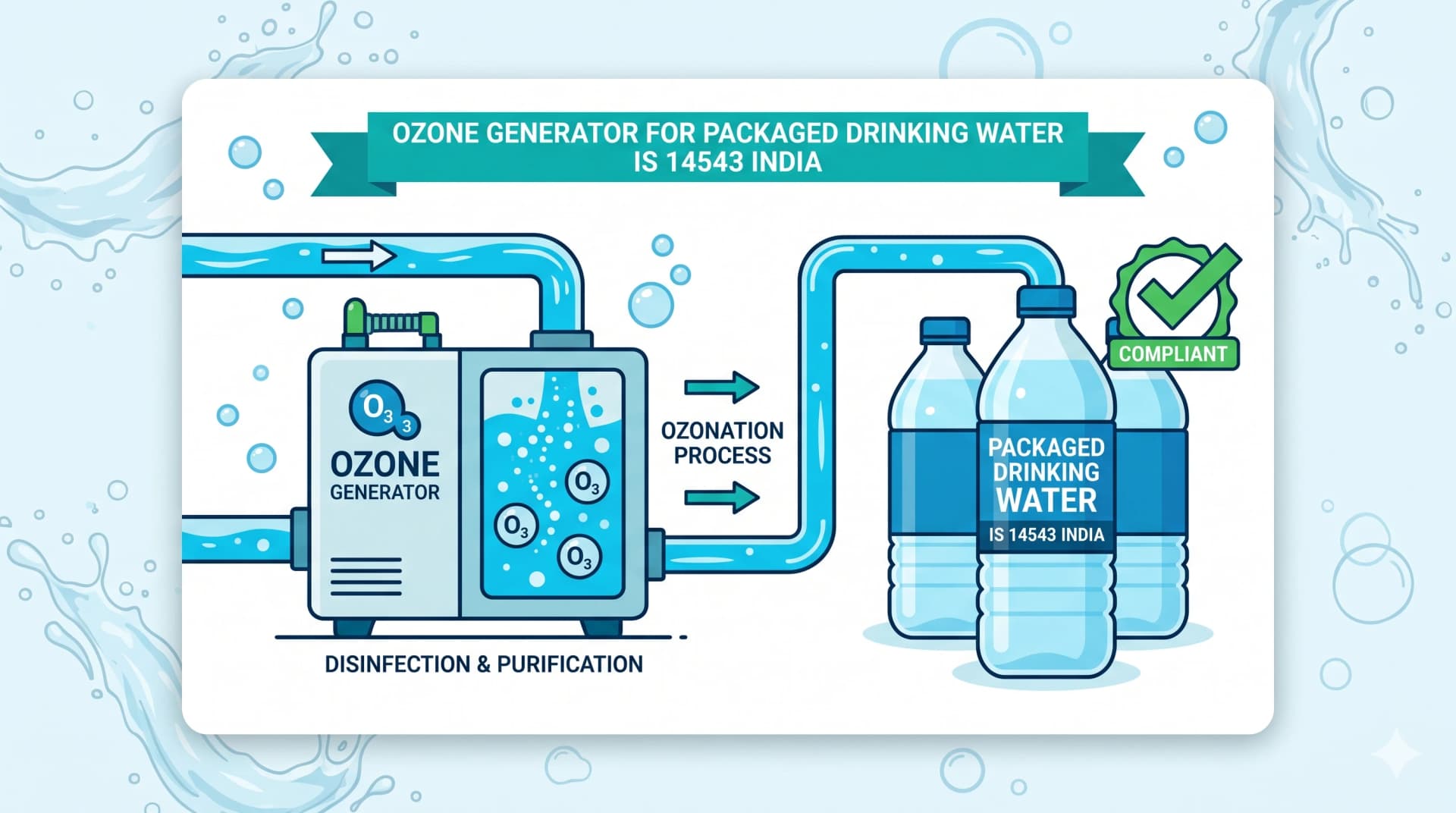
In water treatment, ozone is generated on-site using an ozone generator, then dissolved into water through a venturi injector, bubble diffuser, or static mixer. Contact time of 4–10 minutes at 0.4–1.0 mg/L is sufficient to achieve 4-log (99.99%) inactivation of most pathogens.
Is Ozone Water Safe for Drinking?
Pathogen Inactivation by Ozone Dose (CT Values) in Drinking Water
WHO Guidelines
The World Health Organization's Guidelines for Drinking Water Quality (4th edition) sets a health-based guideline value for ozone in drinking water of 0.05 mg/L (50 μg/L) residual at the point of consumption. This is a conservative safety limit — ozone naturally decomposes in water within minutes to hours depending on temperature and pH.
BIS IS:10500 Standard
Indian standard IS:10500 (Drinking Water Specification) does not set a specific ozone limit but permits ozone as an acceptable disinfectant, consistent with WHO guidelines. Bottled water manufacturers under FSSAI regulations use ozone treatment as an approved disinfection method.
FSSAI Regulations
FSSAI Food Safety and Standards (Water and Beverages) Regulations permit ozone treatment of water for human consumption. Packaged drinking water manufacturers routinely use ozone (0.2–0.4 mg/L dissolved dose, 3–5 min contact) followed by a contact tank and filtration.
Ozone vs. Chlorine for Drinking Water
| Parameter | Ozone | Chlorine |
|---|---|---|
| Disinfection power | 3,000× stronger | Baseline |
| Residual in water | Decomposes to O₂ | Persists (0.2–0.5 ppm) |
| Taste/odour | None | Chlorine taste |
| Disinfection by-products | Minimal (bromate possible if bromide >50 μg/L) | THMs, HAAs |
| Cryptosporidium kill | Effective | NOT effective |
| On-site generation | Required | Chlorine storage/dosing |
| Cost (capital) | Higher | Lower |
| Cost (recurring) | Electricity only | Chemical procurement |
For packaged drinking water, ozone is preferred because it leaves no chlorine taste or residual chemical — the treated water returns to normal oxygen after ozone decomposition.
Can You Drink Ozonated Water at Home?
Home ozone water purifiers (typically 200–500mg/hr output) are sold across India for countertop and under-sink installation. These units dissolve ozone into drinking water to inactivate bacteria and viruses that may have passed through the RO membrane or entered from post-RO contamination.
Safe residual range for consumption: Water with ozone residual below 0.05 mg/L (per WHO guidance) is safe for consumption. At the ozone doses used in home purifiers (0.1–0.3 mg/L contact dose), natural decomposition in the water over 10–30 minutes reduces residual well below the safety threshold before drinking.
Who should be cautious: People with G6PD deficiency should consult a physician before consuming ozone-treated water. Ozone can generate reactive oxygen species during decomposition — at safe drinking water doses, this is not a concern for the general population.
Ozone for Fruit and Vegetable Washing
Beyond drinking water, ozone water is widely used in India for washing fruits, vegetables, and salad items before consumption. Ozone at 0.5–3 mg/L concentration effectively:
- Removes pesticide residues (organophosphates, carbamates) by oxidation
- Inactivates surface pathogens (Salmonella, E. coli, Listeria)
- Extends shelf life by reducing surface microbial load
Ozone India Technology's Ozone Fruit & Vegetable Washing Machine is specifically designed for this application — used by supermarkets, food processing units, hotel kitchens, and catering operations across India.
Ozone Water Treatment — Efficacy for Food Safety Applications
Common Questions About Ozone Drinking Water
Does ozonated water taste different? No. Ozone has no taste or odour in water at the concentrations used for disinfection. Some users report slightly fresher-tasting water compared to chlorinated municipal supply.
How long does ozone last in water? Ozone half-life in water is 20–30 minutes at 20°C and pH 7. At 30°C (typical Indian summer), half-life drops to 8–12 minutes. This means water ozonated and then stored for 1 hour has negligible ozone residual — it has converted back to oxygen.
Can ozone replace a water filter? No. Ozone is a disinfectant, not a filter. It does not remove heavy metals, suspended solids, or dissolved chemicals. Ozone treatment is complementary to filtration (sand filter, carbon filter, RO membrane) — not a replacement.
Is ozone safe for babies and children? WHO drinking water guidelines at 0.05 mg/L residual apply to all populations including infants. Properly dosed ozone-treated water is safe for children and infants at these concentrations.
Ozone India Technology — Water Treatment Solutions
Ozone India Technology supplies ozone generators for drinking water, packaged water plants, RO system integration, and food safety applications. All products are CE and ISO 9001:2015 certified.
- Capacity: 2g/hr for home/small commercial → 10kg/hr for municipal plants
- Complete systems: Generator + contact tank + venturi + ozone destructor + dissolved ozone monitor
- FSSAI food-grade construction for food and beverage applications
Contact: +91 96500 17943 | WhatsApp
Conclusion
Ozone water for drinking is safe when concentration is controlled within WHO and BIS guidelines. Ozone is more effective than chlorine against all major waterborne pathogens, leaves no chemical residue, and improves taste compared to chlorine-treated water. For bottled water plants, home purifiers, and institutional drinking water systems in India, ozone treatment is a proven, FSSAI-accepted technology.