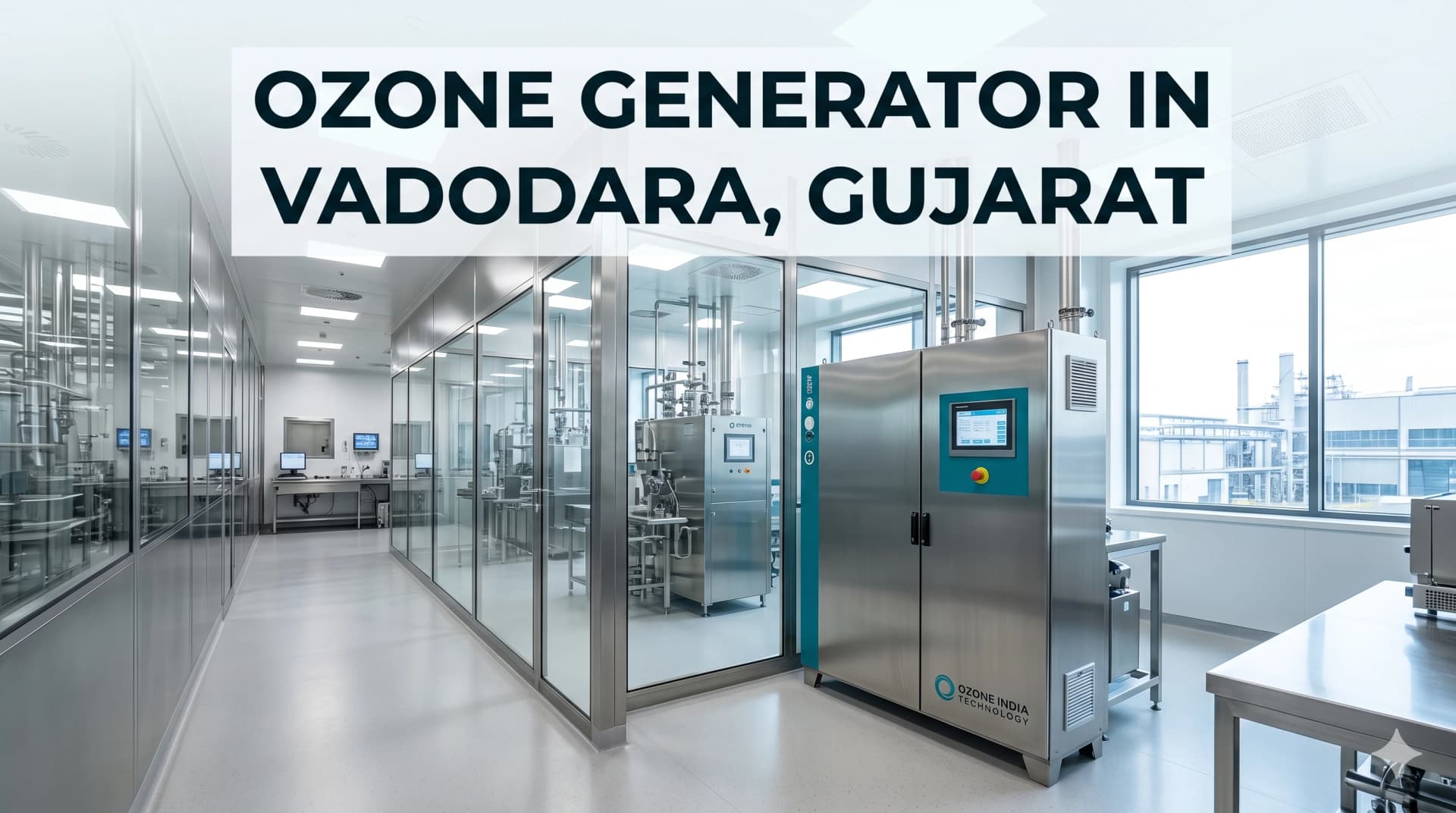
Ozone Generator in Vadodara, Gujarat — also known as Baroda — addresses the complex water treatment landscape of Gujarat's third-largest industrial city, where a globally significant petrochemical and fertilizer complex, a major pharmaceutical cluster and a critically endangered crocodile population in the urban Vishwamitri River create a unique convergence of industrial compliance pressure and ecological sensitivity. The GPCB (Gujarat Pollution Control Board) enforces some of India's most stringent effluent standards in Vadodara's GIDC Makarpura and Halol estates, and the High Court of Gujarat has issued specific orders protecting the Vishwamitri River and its critically endangered mugger crocodile population. Ozone India Technology — India's CE-certified, ISO 9001:2015 manufacturer of industrial ozone generators — supplies factory-direct ozone systems to Vadodara with same-week delivery and full GPCB compliance documentation. Contact our team at +91 96500 17943.
Water and Industrial Challenges in Vadodara
Vadodara — Gujarat's heritage city and cultural capital — sits at the intersection of Rajasthan, Maharashtra and Gujarat on the Vishwamitri River, a 163 km river that flows through the heart of the city and is one of India's most industrially impacted urban rivers. GPCB monitoring data shows Vishwamitri receiving effluent from GIDC Makarpura (1,200-plus units including chemicals, textiles, engineering), GSFC (Gujarat State Fertilizer and Chemicals Corporation) and IPCL (Indian Petrochemicals Corporation Ltd — now Reliance Industries) — collectively contributing a BOD load that renders the lower river hypoxic (dissolved oxygen below 2 mg/L) during non-monsoon months.
The Vishwamitri River hosts an estimated 250 to 300 wild mugger crocodiles (Crocodylus palustris) — one of the densest urban crocodile populations in Asia. Gujarat High Court has directed GPCB and Vadodara Municipal Corporation to maintain Vishwamitri water quality adequate for crocodile and fish survival (DO above 4 mg/L, BOD below 6 mg/L per Wildlife Protection Act provisions). This creates unusually stringent river quality mandates for Vadodara's industries and STPs.
GSFC (Gujarat State Fertilizer Corporation) at Nandesari, Vadodara's IOCL petroleum refinery and the Vadodara-based Reliance Industries petrochemical complex collectively process hundreds of thousands of tonnes of chemicals annually, generating petrochemical wastewater streams containing ammonia, phenol, BTEX compounds, oil and solids. GPCB requires these units to maintain CEQMS (Continuous Effluent Quality Monitoring System) and demonstrate compliance with strict industrial effluent standards.
The pharmaceutical sector in GIDC Makarpura includes Sun Pharmaceutical's Vadodara plant, Alembic Pharmaceuticals (headquarters and primary manufacturing), and Zydus Lifesciences (secondary manufacturing). All require WHO GMP purified water for API synthesis. Alembic's export-oriented API manufacturing additionally meets US FDA cGMP standards, requiring purified water systems at USP-grade quality levels.
How Ozone Technology Addresses Vadodara's Challenges
For Vishwamitri River compliance, ozone tertiary treatment at STPs and CETPs discharging to the Vishwamitri achieves the High Court-mandated parameters of BOD below 6 mg/L and dissolved oxygen preservation — critical for mugger crocodile habitat maintenance. Ozone-treated STP effluent also carries a small dissolved oxygen bonus as ozone decomposes, slightly raising DO in the contact chamber effluent.
For GSFC and IOCL petrochemical effluent, ozone-AOP at 15 to 25 mg/L destroys phenol (>99 percent removal at 10 mg/L dose), ammonia oxidation (>70 percent at 20 mg/L dose), and BTEX compounds — enabling compliance with GPCB's special conditions for Nandesari and Vadodara industrial zones that are more stringent than CPCB General Standards.
For Alembic Pharmaceuticals and Sun Pharma purified water, ozone at 0.05 to 0.2 mg/L in purified water loops achieves continuous USP-grade compliance, eliminating chemical sanitisation costs and Schedule M bioburden failures.
Vishwamitri River Industrial Load by GIDC Zone — COD Contribution (tonnes/day)
Key Applications in Vadodara
Petrochemical ETP — GSFC Nandesari and Reliance
GSFC and Reliance Vadodara petrochemical effluent containing phenol, ammonia and BTEX requires ozone-AOP for GPCB compliance. Ozone India Technology supplies 100 to 350 g/hr large-scale industrial ozone generators for petrochemical ETP tertiary treatment.
Pharmaceutical Purified Water — Alembic and Sun Pharma Makarpura
WHO GMP and US FDA cGMP purified water requirements for Vadodara's pharmaceutical anchor companies. Ozone India Technology supplies 2 to 10 g/hr pharma-grade ozone systems with USP and Schedule M compliance documentation.
Vishwamitri River STP Compliance — VMC Sewage Treatment Plants
Vadodara Municipal Corporation's STPs discharging to Vishwamitri need ozone tertiary polishing for Gujarat High Court-mandated BOD below 6 mg/L standard. Ozone India Technology provides large-scale STP ozone systems with dissolved ozone monitoring and GPCB-compatible data logging.
CETP Post-Treatment — GIDC Makarpura Common ETP
GIDC Makarpura's Common ETP serving 1,200-plus mixed industrial units needs ozone colour and COD polishing to meet GPCB consent conditions. Ozone India Technology supplies 50 to 150 g/hr CETP ozone systems for GIDC Makarpura applications.
Why Indian-Manufactured Ozone Technology Suits India
GPCB is known as one of India's most active enforcement bodies — Vadodara industries benefit from our team's deep experience with GPCB compliance documentation, consent conditions and audit formats. Same-week delivery from Ghaziabad (850 km via NH-48 or train). CE-2621A, ISO 9001 accepted by GPCB and Gujarat High Court-appointed monitoring committees. Factory-direct pricing 30 to 40 percent below European alternatives.
Compliance and Standards in Vadodara
GPCB Vadodara Regional Office enforces enhanced standards for Makarpura and Nandesari industrial zones, including special conditions for phenol (below 1 mg/L), cyanide (below 0.2 mg/L), and oil/grease (below 10 mg/L) discharge. Gujarat High Court monitoring requires Vishwamitri River compliance with Wildlife Protection Act ecological standards. GPCB OCEMS is mandatory for all Red Category units in Vadodara.
Vadodara Petrochemical ETP — Phenol and Ammonia Removal by Technology (mg/L)
Frequently Asked Questions
How does GPCB enforce effluent standards for Vishwamitri River protection?
GPCB Vadodara enforces consent conditions with OCEMS for all Red Category units, quarterly third-party analysis and Gujarat High Court-mandated river monitoring. Non-compliance triggers closure orders and criminal prosecution under the Environment Protection Act, with the High Court's wildlife protection angle adding urgency.
What size ozone system does the GIDC Makarpura CETP need?
Makarpura CETP treating 5,000 KLD of mixed industrial effluent requires 150 to 200 g/hr ozone at 3 to 5 mg/L applied dose for colour and COD polishing after secondary biological treatment. Contact us for a free sizing based on your CETP inlet quality data.
Does Alembic Pharmaceuticals use ozone for purified water?
We cannot confirm specific client details. However, Alembic's US FDA-regulated API manufacturing requires USP purified water (TOC < 500 ppb, conductivity < 1.3 µS/cm, bioburden < 100 CFU/mL). Ozone sanitisation is the most reliable technology for maintaining these parameters continuously in Indian pharma plants.
Can ozone treat GSFC fertilizer plant ammonia in effluent?
Ozone at 20 to 25 mg/L oxidises ammonia to nitrate through nitrosation and nitrification precursor reactions. Combined with biological nitrification, ozone pre-oxidation achieves GPCB ammonia below 50 mg/L from fertilizer plant effluent. Contact us for GSFC-specific application sizing.
How to Get an Ozone System for Vadodara
Contact us:
- Phone / WhatsApp: +91 96500 17943
- Email: [email protected]
Same-week delivery to Vadodara. Free GPCB-aligned application assessment and quotation within 2 hours.