
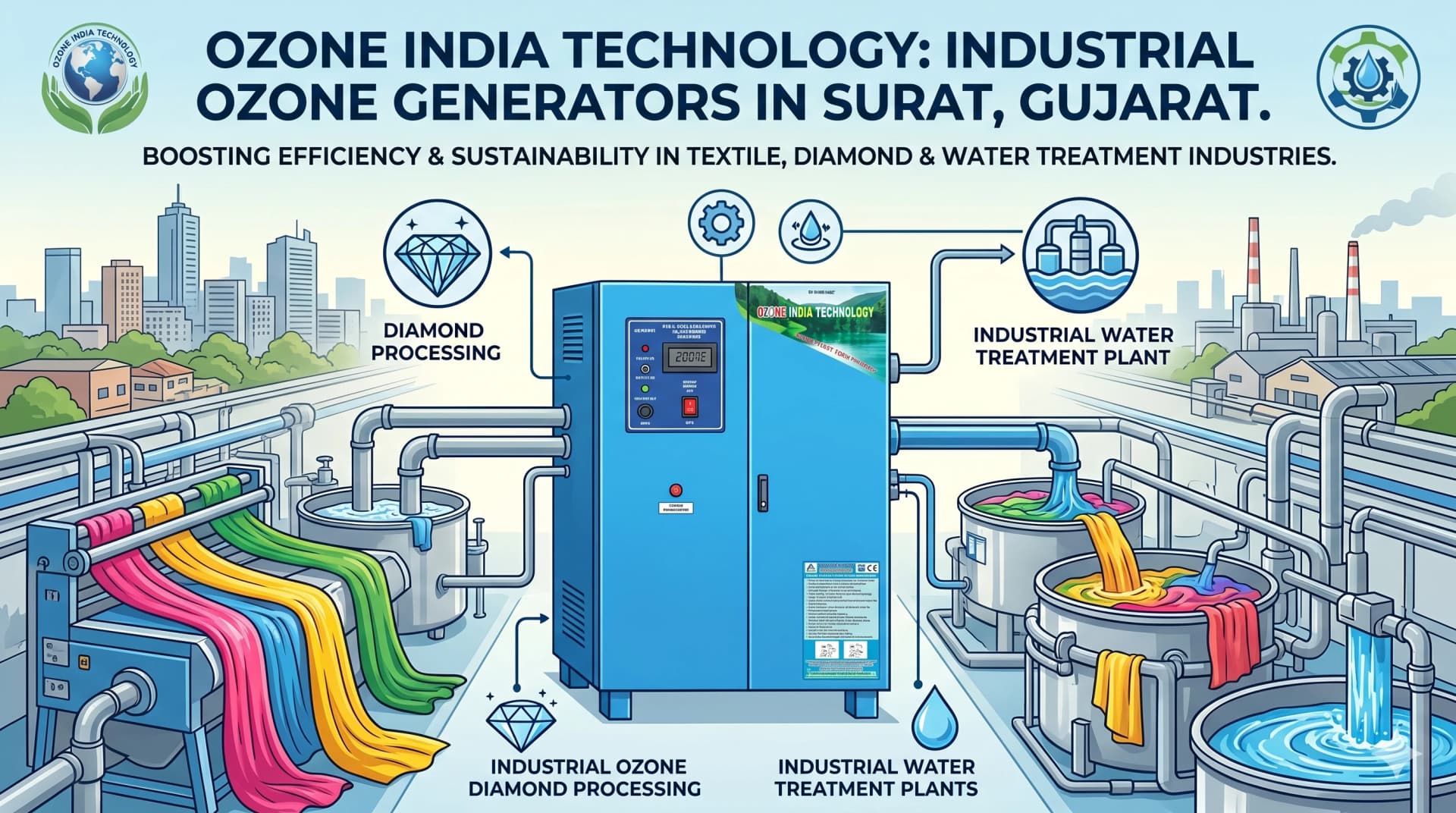
Ozone Generator in Surat, Gujarat addresses the most pressing water treatment challenge in India's textile capital — the removal of synthetic dye colour from effluent that biological treatment alone cannot achieve, at a scale demanded by Surat's massive man-made fibre and synthetic textile industry. Surat handles 95 percent of India's diamond cutting and polishing and is the world's largest synthetic textile market, generating effluent streams that range from highly coloured dye discharge to cooling water scaling in diamond polishing units. Ozone India Technology — India's CE-certified, ISO 9001:2015 manufacturer of industrial ozone generators — supplies factory-direct ozone systems to Surat with GPCB-aligned compliance documentation, same-week delivery from Ghaziabad and expert application support for the specific effluent characteristics of Surat's textile and diamond industries. Call +91 96500 17943 for a free consultation and quotation.
Water and Industrial Challenges in Surat
Surat — Gujarat's second-largest city with a population of 7.2 million — is home to the world's largest man-made fibre and synthetic textile cluster. The Sachin GIDC (one of Gujarat's largest), Pandesara GIDC and Udhna industrial areas house over 10,000 textile power loom and dyeing units. Collectively, these units discharge approximately 350 million litres of textile dyeing effluent per day — a volume that places Surat's Common ETP (CETP) network under severe treatment capacity stress.
GPCB has designated Surat-Sachin as a "critically polluted cluster" under CPCB's Comprehensive Environmental Pollution Index (CEPI), triggering restrictions on new industrial units and mandatory ETP upgrades for existing dyeing units. The Tapi River, which flows through Surat and empties into the Arabian Sea at Hazira, receives treated and partially treated CETP effluent. GPCB river monitoring data at Surat consistently shows Tapi BOD values of 6 to 8 mg/L — technically meeting discharge norms — but colour values that periodically exceed acceptable limits during peak dyeing cycles.
The synthetic textile sector in Surat uses disperse dyes, acid dyes and reactive dyes extensively. Unlike cotton textile indigo dyes, many synthetic dyes are resistant to both biological treatment and coagulation at doses economically feasible for industrial CETPs. Reactive dyes specifically — widely used for bright colours on polyester-cotton blends — contain chromophore groups (azo linkages, anthraquinone structures) that survive conventional CETP treatment at 30 to 60 percent of input concentration, creating visible colour in CETP effluent that triggers GPCB non-compliance notices.
Surat's diamond industry — which processes 9 out of every 10 rough diamonds in the world at 5,000-plus polishing facilities in Varachha, Katargam and Sarthana — requires clean cooling water for bruting (shaping) and polishing machines. Diamond polishing generates fine dust containing silica and diamond particulates that foul cooling water and can contaminate polishing equipment if water is recycled without proper treatment. Ozone treatment of recycled cooling water prevents biofouling and maintains water clarity, enabling 80 to 90 percent water recycling — important as Surat's groundwater extraction has caused local aquifer depletion.
Hazira Port — Gujarat's busiest liquid cargo port adjacent to Surat — hosts ONGC gas processing, IOCL refinery, Reliance Industries petrochemical plants and L&T's heavy engineering facility, all requiring industrial water treatment and ETP for petrochemical effluent.
How Ozone Technology Addresses Surat's Challenges
For Surat's textile dyeing CETP effluent, ozone at 15 to 25 mg/L applied dose reduces ADMI colour from 150 to 400 ADMI (CETP secondary output) to below 10 ADMI (GPCB "colour absent" standard) in 15 to 20 minutes contact time. Unlike coagulation (which adds chemical sludge disposal costs) or activated carbon (which requires regular regeneration), ozone converts colour-causing dye chromophores to colourless carboxylic acid fragments that are readily biodegradable — improving effluent quality without adding secondary waste streams.
For diamond industry cooling water recycling, ozone at 0.3 to 0.5 mg/L dissolved residual prevents biofilm formation on cooling surfaces, controls algae growth and maintains water turbidity below 1 NTU — enabling safe continuous water recycling. Our dissolved ozone monitors maintain precise dosing to avoid ozone over-treatment that could affect diamond surface finish.
For Hazira petrochemical effluent, ozone combined with hydrogen peroxide (AOP — Advanced Oxidation Process) achieves 85 to 90 percent reduction of petroleum hydrocarbons, BTEX compounds and phenols at 20 to 30 mg/L applied dose — enabling GPCB compliance for coastal discharge near Surat's sensitive marine environment.
Surat Synthetic Textile CETP — Colour Removal Before and After Ozone (ADMI units)
Key Applications in Surat
Textile Dyeing CETP Post-Treatment — Sachin and Pandesara GIDC
CETP operators at Sachin and Pandesara face GPCB pressure to achieve colour-absent discharge consistently. Ozone post-treatment after the secondary clarifier is the established pathway. Ozone India Technology supplies 30 to 200 g/hr corona discharge generators for CETP-scale ozone polishing. CE-certified systems with GPCB operational data logging, dissolved ozone monitoring and automatic dosing control. Factory-direct pricing 30 to 40 percent below European equivalents with same-week delivery to Surat from Ghaziabad.
Diamond Polishing Cooling Water Recycling — Varachha and Katargam
5,000-plus Surat diamond polishing units collectively consume enormous volumes of cooling water for CNC lathes, bruting wheels and polishing discs. Ozone treatment at 0.3 to 0.5 mg/L enables 80 to 90 percent water recycling by preventing biofouling and algae growth in cooling loops. Ozone India Technology supplies compact 2 to 5 g/hr ozone systems for individual diamond unit cooling water loops — payback period typically 6 to 12 months through water cost savings.
Hazira Petrochemical ETP — ONGC and Reliance
Hazira's petrochemical zone requires ETP treatment for phenol, BTEX, COD and oil from refinery and gas plant operations. Ozone-AOP (ozone + H₂O₂) at 20 to 30 mg/L removes refractory hydrocarbons that biological treatment cannot achieve to GPCB coastal discharge standards. Ozone India Technology supplies 100 to 350 g/hr large-scale ozone systems for industrial ETP tertiary treatment in the Hazira industrial zone.
Municipal Drinking Water — Surat Municipal Corporation
Surat Municipal Corporation (SMC) supplies water to 7.2 million residents primarily from Ukai Dam and Kim River sources. Seasonal turbidity spikes during monsoon (turbidity exceeding 5,000 NTU) stress conventional alum coagulation treatment. Ozone pre-treatment at 1 to 3 mg/L before coagulation aids micro-flocculation, reducing alum dose requirements by 20 to 30 percent and improving colour and taste. SMC is evaluating advanced oxidation for emerging contaminant removal following CPCB guidelines.
Why Indian-Manufactured Ozone Technology Suits India
Factory-direct supply from our Ghaziabad facility means same-week delivery to Surat by road freight — a critical advantage for industries facing GPCB show-cause notices and urgent compliance deadlines. Our engineering team can be on-site in Surat within 48 hours for application assessment, installation support and GPCB documentation preparation. Our CE-certified systems are accepted by all Gujarat regulatory bodies without additional approvals.
Our 11 years of application experience in Gujarat's textile sector — including CETP post-treatment installations in Bhiwandi (Maharashtra), Tiruppur (Tamil Nadu) and Bhilwara (Rajasthan) — gives our team specific knowledge of the dye compositions and CETP effluent characteristics common to Surat's Sachin cluster. Free application-specific sizing calculations are provided based on your CETP or unit effluent quality data.
Compliance and Standards in Surat
GPCB's Surat regional office enforces CPCB ETP guidelines and Gujarat's own enhanced standards for critically polluted cluster areas. Additional requirements for Surat include: Online CETP monitoring data to GPCB OCEMS (Online Continuous Effluent Monitoring System), quarterly third-party lab analysis, and consent-to-operate renewal linked to ETP performance compliance.
Ozone India Technology provides: CE-2621A certificate, ISO 9001:2015 certificate, ozone output calibration certificate (NABL-aligned), dissolved ozone monitor calibration certificate, and GPCB-formatted operational log templates with every CETP installation.
Diamond Industry Cooling Water Quality — Recycling Rate by Treatment Technology (%)
Frequently Asked Questions
What ozone capacity does a 2,000 KLD synthetic textile CETP in Sachin need?
A 2,000 KLD CETP treating synthetic textile dye effluent with ADMI colour of 300 requires ozone at 3 to 5 mg/L applied dose — approximately 100 to 150 g/hr of ozone generation for a 30-minute contact time system. Contact Ozone India Technology for a free sizing calculation based on your specific CETP inlet quality data.
How quickly can Ozone India Technology deliver and install in Surat?
Standard systems up to 100 g/hr are in stock at our Ghaziabad facility. Delivery to Surat is 2 to 3 days by road freight. Installation is completed in 2 to 3 working days without shutting down existing CETP operations. GPCB compliance documentation is ready within 24 hours of commissioning.
Can ozone remove disperse dyes used in Surat's polyester textile dyeing?
Yes. Disperse dyes used for polyester dyeing respond well to ozone oxidation at 10 to 20 mg/L, with 80 to 90 percent colour removal achieved in 15 minutes. Reactive dyes require slightly higher doses (20 to 25 mg/L). Sulfur dyes used in dark navy and black fabric require combined ozone-coagulation treatment. Ozone India Technology can advise on the optimal treatment sequence for your specific dye mix.
Is there a risk of ozone toxicity to workers in the CETP or diamond unit?
At the concentrations used in closed-vessel contact systems, ozone does not escape to work areas during normal operation. All Ozone India Technology systems include gas-phase ozone destruction (catalytic ozone destructor) on the exhaust gas outlet, maintaining ambient ozone below WHO occupational limit of 0.1 mg/m³ in the work area. Ambient ozone monitors are recommended for enclosed CETP buildings and are available as system accessories.
How to Get an Ozone System for Surat
Looking for ozone technology solutions in Surat, Gujarat? Ozone India Technology provides same-week delivery, on-site installation support and GPCB compliance documentation.
Contact us:
- Phone / WhatsApp: +91 96500 17943
- Email: [email protected]
Free application assessment, sizing calculations and factory-direct quotation within 2 hours.