
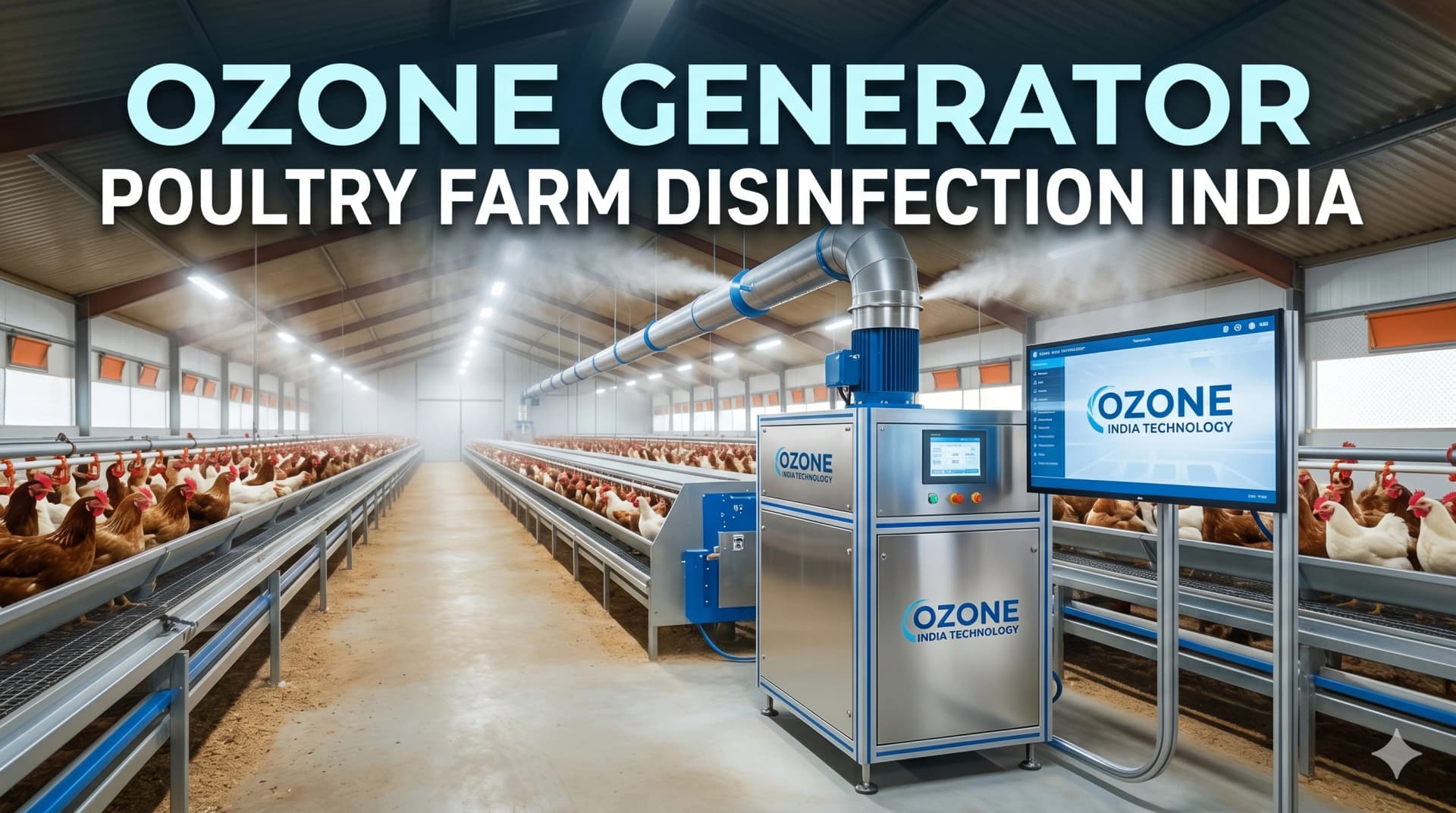
Ozone generator poultry farm disinfection India is proving essential for broiler and layer operations across Andhra Pradesh, Telangana, Maharashtra, and Punjab as India's poultry sector transitions toward antibiotic-free production in response to WHO guidelines on antimicrobial resistance and FSSAI's zero-tolerance approach to antibiotic residues in poultry meat and eggs. Ozone India Technology, based in Greater Noida, manufactures CE and ISO 9001 certified ozone generators for poultry house air disinfection, drinking water treatment, and litter and equipment sanitisation — providing an integrated biosecurity solution that reduces Salmonella, Campylobacter, and Newcastle disease virus load in poultry houses without chemical residue.
Poultry Biosecurity and the Role of Ozone
FAO Animal Production and Health Guidelines No. 10 (2011) — Biosecurity for Highly Pathogenic Avian Influenza (HPAI) — identifies house air and water disinfection as two of the five critical control points in poultry biosecurity management. Gaseous ozone at 0.5 to 1.0 ppm in the poultry house atmosphere reduces airborne bacterial and viral pathogen load while simultaneously oxidising ammonia — the primary air quality concern in confined poultry operations.
Ammonia (NH₃) is produced by bacterial decomposition of uric acid in poultry litter at concentrations of 25 to 100 ppm in poorly ventilated houses. Chronic ammonia exposure above 25 ppm damages the respiratory epithelium of broilers, increasing susceptibility to respiratory diseases including Newcastle Disease, Marek's Disease, and Infectious Bronchitis. Ozone at 0.5 to 1.0 ppm oxidises ammonia through the reaction O₃ + NH₃ → NO₂ + H₂O, reducing in-house ammonia concentration by 20 to 40 percent and improving respiratory health metrics in broiler flocks.
Drinking Water Disinfection for Poultry
Poultry drinking water lines — nipple drinkers, bell drinkers, and open water troughs — accumulate biofilm of Salmonella, E. coli, Campylobacter, and other enteric pathogens that are directly ingested by birds and transmitted through the flock. WHO Guidelines on Use of Medically Important Antimicrobials in Food Animals (2017) require that antibiotic use in poultry be minimised through alternative biosecurity measures, of which water line disinfection is specifically cited as a practical intervention.
Ozone at 0.05 to 0.1 mg/L in poultry drinking water — generated by a small ozone generator and injected into the water supply through a venturi injector — reduces drinking water bacterial count from typical uncontrolled values of 10⁴ to 10⁶ CFU/mL to below 100 CFU/mL (the FSSAI guideline for potable water). At the same time, ozone oxidises biofilm in the water lines — the primary reservoir of drinking water pathogens — eliminating the source of continuous recontamination.
FSSAI Food Safety and Standards (Food Products Standards and Food Additives) Regulations 2011 set maximum residue limits for antibiotics in poultry products. India's export-oriented poultry processors (supplying to UAE, Saudi Arabia, and Japan under APEDA and MPEDA certification) must demonstrate antibiotic-free production practices. Ozone-treated drinking water is a documented, chemical-residue-free alternative to antibiotic supplementation for water-line biosecurity.
House Air Disinfection and Litter Management
Ozone India Technology ozone generators for poultry house air disinfection are sized based on house volume and target ozone concentration. A standard broiler house of 20m × 100m × 3m clear height (6,000 m³) requires a 20 to 30 g/hr ozone generator to maintain 0.5 ppm ozone concentration with continuous ventilation at the recommended ACH (air changes per hour) for the ambient temperature.
Ozone is distributed through perforated HDPE distribution pipes suspended above the birds at 2.5 to 3.0m height. The ozone concentration at bird level (0 to 0.5m) is typically 30 to 40 percent of the distribution line concentration due to dilution by ventilation airflow, placing it well below the OSHA 8-hour TWA limit of 0.1 ppm for occupational exposure during normal house management activities.
Litter treatment with ozone between flocks — applying gaseous ozone to the house before cleanout, or spraying the litter with ozonated water — reduces Eimeria (coccidiosis) oocyst count and Salmonella contamination in the litter, reducing the disease pressure carried forward to the next flock.
Poultry Disease Incidence — Ozone vs Conventional House Management (%)
Poultry Litter Ammonia — Before and After Ozone Air Treatment (ppm)
Frequently Asked Questions
What ozone concentration is safe for broiler chickens?
Published research on ozone tolerance in broiler chickens indicates a no-observed-adverse-effect level (NOAEL) of 0.5 to 1.0 ppm for 24-hour continuous exposure. At 0.5 ppm, no adverse effects on growth rate, feed conversion ratio, or mortality are observed. Above 1.5 ppm, respiratory effects may occur. Ozone India Technology poultry systems are designed to maintain 0.3 to 0.7 ppm at bird level.
Does ozone in poultry drinking water leave residues in meat or eggs?
No. Ozone decomposes to oxygen within minutes of injection into water. By the time water travels through the distribution lines to the nipple drinkers, dissolved ozone concentration is effectively zero. There is no ozone residue in poultry meat or eggs from ozone-treated drinking water.
How does ozone reduce ammonia in a poultry house?
Ozone at 0.5 to 1.0 ppm oxidises ammonia through direct oxidation and hydroxyl radical reactions. The reaction products are nitrogen dioxide (NO₂) and water. NO₂ further reacts with water vapour to form nitrous acid and is ventilated from the house. Net ammonia reduction: 20 to 40 percent at 0.5 to 1.0 ppm ozone concentration.
Can ozone be used during cleanout between flocks?
Yes. Gaseous ozone at 5 to 10 ppm is highly effective for fumigation between flocks when the house is empty of birds. At these concentrations, ozone penetrates all surfaces, litter materials, and equipment, achieving a broad-spectrum disinfection that is difficult to achieve with chemical fumigants. Human entry during high-concentration fumigation requires appropriate PPE (half-face respirator with OV cartridge).
What is the payback period for a poultry farm ozone system?
For a 50,000-bird broiler house, reduction in mortality (from 5% to 2.5% through improved air quality and water biosecurity), reduction in antibiotic treatment costs (Rs 8,000 to Rs 15,000 per flock), and improved feed conversion ratio typically provide payback within 3 to 6 flock cycles (3 to 4 months).