
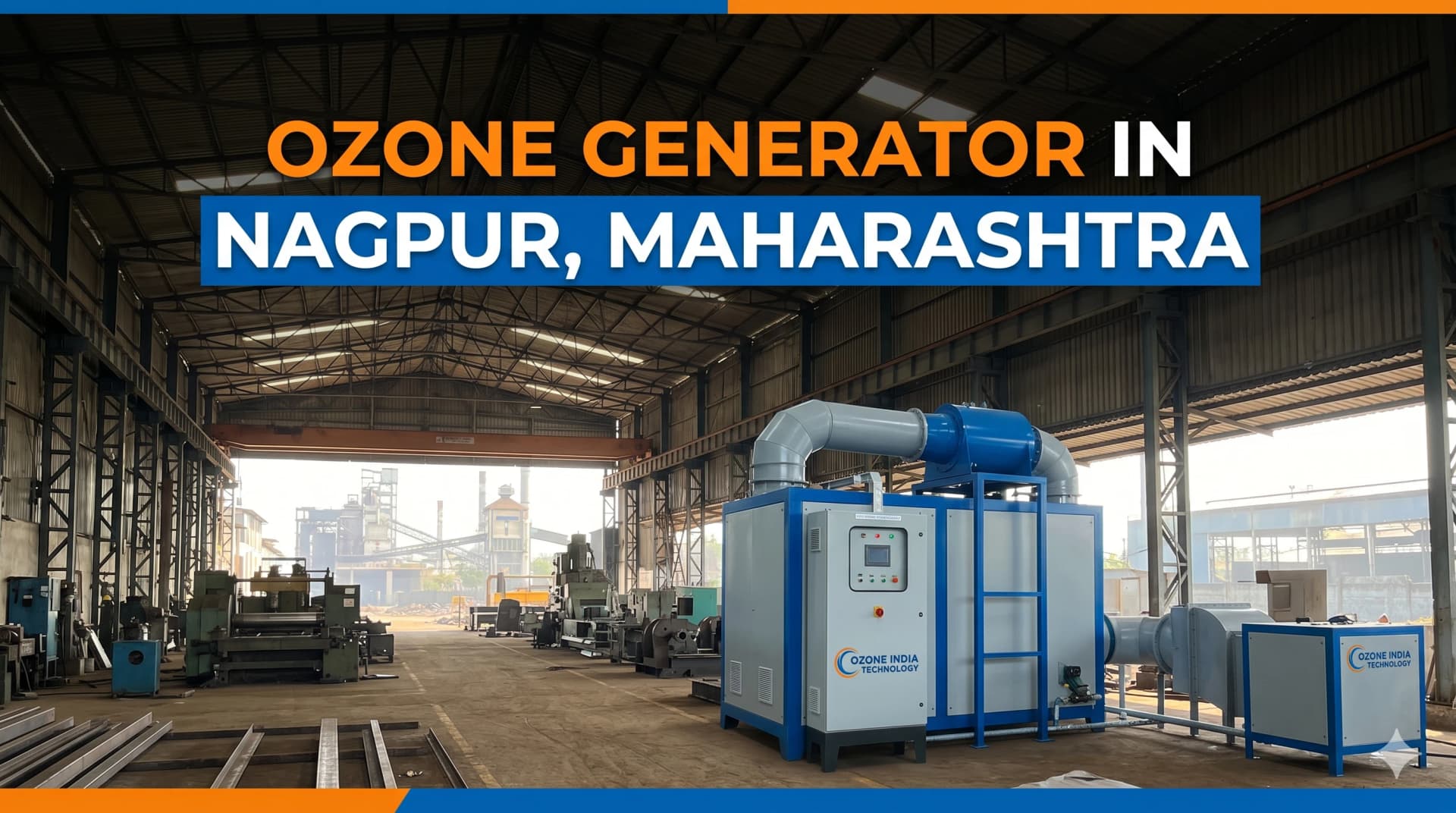
Ozone Generator in Nagpur, Maharashtra addresses the specific industrial and municipal water challenges of Central India's largest city — a rapidly growing urban hub where orange and citrus processing, coal mining effluent, expanding pharmaceutical manufacturing and a severely polluted urban river create diverse demand for advanced water treatment technology. Nagpur's MPCB (Maharashtra Pollution Control Board) Vidarbha regional office has intensified enforcement on the MIDC Butibori industrial cluster (one of Central India's largest integrated industrial zones) and on Nagpur Municipal Corporation's STPs, which discharge to the ecologically sensitive Nag River system. Ozone India Technology — India's CE-certified, ISO 9001:2015 manufacturer of industrial ozone generators — supplies factory-direct ozone systems to Nagpur from our Greater Noida facility with 24 to 36 hour delivery and complete MPCB compliance documentation. Contact our team at +91 96500 17943 for a free application consultation.
Water and Industrial Challenges in Nagpur
Nagpur — Maharashtra's second capital and the geographic centre of India — hosts a diverse industrial ecosystem across the MIDC Butibori (3,500 acres, 400-plus industries), MIDC Hingna (food, engineering, chemical) and MIDC Kalmeshwar zones. The city's 2.9 million population relies on the Kanhan River, Pench Reservoir and Gorewada Lake for water supply — all under pressure from upstream mining and downstream urban effluent.
The Nag River — Nagpur's historic namesake waterway flowing through the urban core — has been declared biologically dead along most of its 30 km urban stretch. Nagpur Municipal Corporation's STPs treat only 60 percent of the city's 400 MLD sewage generation, with 160 MLD of untreated sewage discharging to the Nag River. MPCB and the National Green Tribunal (NGT) have issued show-cause notices to NMC for Nag River non-compliance, with fines and compliance timelines binding the municipal body to STP upgrade with tertiary treatment.
Nagpur is India's "Orange Capital" — Vidarbha region produces 12 to 15 lakh tonnes of oranges annually. Nagpur orange processing (juice extraction, concentrate, essential oil distillation) generates high-BOD organic effluent from citrus peel, seed and pulp processing. FSSAI requires food-grade process water for orange juice production, and Nagpur's orange exporters seeking EU certification require HACCP-compliant wash water. Ozone at 0.5 to 1.5 mg/L eliminates Listeria, Penicillium and Aspergillus moulds that cause post-harvest citrus losses.
MIDC Butibori — Nagpur's primary industrial zone — hosts pharmaceutical (Emcure Pharmaceuticals, Zim Laboratories), automobile (Mahindra), electronics, food and chemical units. MPCB classifies pharmaceutical units in Butibori as Red Category, requiring OCEMS (Online Continuous Effluent Monitoring System) and quarterly third-party audits. WHO GMP pharma water requirements and MPCB ETP standards create simultaneous demand for ozone in pharmaceutical applications.
How Ozone Technology Addresses Nagpur's Challenges
For Nagpur's STP tertiary treatment, ozone at 5 to 8 mg/L achieves BOD below 10 mg/L, TSS below 10 mg/L and coliform below 100 MPN/100 mL in STP secondary effluent — meeting NGT Nag River standards. For NMC's SCADA-controlled STPs at Bhandewadi and Narsala, ozone can be integrated with minimal civil work as a polishing step after the secondary clarifier, with full data logging for NGT compliance reporting.
For orange and citrus processing, ozone at 1 to 2 mg/L dissolved in wash water eliminates surface moulds, bacteria and yeast that cause premature spoilage. Ozone also destroys pesticide residues (chlorpyrifos, thiamethoxam) on citrus surfaces at 70 to 80 percent removal — improving food safety and enabling FSSAI and EU MRL compliance for export. Post-wash storage life extends by 3 to 5 days with ozone treatment — a direct commercial benefit for Nagpur's orange exporters.
For Butibori MIDC pharma water, ozone at 0.05 to 0.2 mg/L in purified water loops achieves WHO GMP bioburden below 100 CFU/mL continuously, eliminating daily chemical sanitisation and associated Schedule M audit risks.
Nag River Water Quality at Nagpur — Key Parameters vs MPCB Standards (mg/L)
Key Applications in Nagpur
Municipal STP Tertiary Treatment — Bhandewadi and Narsala STP
NMC's six STPs need tertiary ozone treatment to meet NGT Nag River parameters. Ozone India Technology supplies 75 to 200 g/hr large-scale STP ozone systems. Our team has experience with MPCB and NGT compliance documentation formats specific to Maharashtra's Nag-Wardha river system monitoring points.
Orange and Citrus Processing — Vidarbha Orange Belt
Vidarbha's 12 to 15 lakh tonne annual orange crop requires post-harvest treatment and juice processing water that meets FSSAI standards. Ozone India Technology supplies 2 to 10 g/hr food-grade ozone systems for Nagpur's citrus processing units — for produce washing, juice equipment sanitation and effluent treatment. Our systems comply with FSSAI Regulation 2.3.3 on food processing water quality.
Pharmaceutical Water — MIDC Butibori
Butibori's pharmaceutical units require WHO GMP purified water for API synthesis, oral dosage form manufacturing and injection water preparation. Ozone India Technology supplies 2 to 10 g/hr pharmaceutical-grade ozone sanitisation systems, with complete Schedule M compliance documentation. Same-week delivery to Nagpur from Ghaziabad.
Hospital Infection Control — AIIMS Nagpur and Government Medical College
AIIMS Nagpur — one of India's newest All India Institutes of Medical Sciences — requires pharmaceutical-grade purified water and CSSD sterile water as per NABH accreditation standards. Ozone India Technology supplies hospital ozone systems designed for AIIMS Nagpur's infrastructure standards, with 24-hour response time for technical support.
Why Indian-Manufactured Ozone Technology Suits India
Our Ghaziabad facility is 1,100 km from Nagpur — 14 to 16 hours by road or overnight by train (Nagpur-Ghaziabad-Delhi route). In-stock systems are delivered in 24 to 36 hours. All CE-2621A and ISO 9001:2015 certifications accepted by MPCB and AIIMS NABH. Factory-direct pricing 30 to 40 percent below European alternatives. Vidarbha's summer temperatures (reaching 47°C) are within our systems' 45°C rated operating range.
Compliance and Standards in Nagpur
MPCB Vidarbha Regional Office enforces standards under Maharashtra PCB norms and CPCB schedules. NGT orders on Nag River require NMC to achieve BOD ≤ 10 mg/L, TSS ≤ 10 mg/L, coliform ≤ 100 MPN/100 mL in STP discharge. OCEMS is mandatory for Red Category MIDC units. FSSAI FSS Act 2006 governs food processing water. CDSCO Schedule M under D&C Act governs pharmaceutical water.
Orange/Citrus Processing Wash Water — Pathogen Reduction by Treatment Method (log CFU/g)
Frequently Asked Questions
What capacity ozone generator does a Nagpur orange juice processing unit need?
A citrus juice processing unit handling 10 tonnes of oranges per day with 50 m³/day process water needs a 2 to 5 g/hr ozone system maintaining 0.5 to 1.5 mg/L dissolved ozone. For the entire wash tank (2,000 to 5,000 litres), a 10 g/hr system with 20-minute turnover maintains adequate dissolved ozone concentration continuously.
How does MPCB enforce ETP standards in MIDC Butibori?
MPCB Butibori enforcement involves quarterly laboratory sampling, OCEMS data review for Red Category units, and periodic joint inspection with CPCB teams under CPCB's Critically Polluted Areas monitoring. Non-compliance triggers show-cause notices, fines of Rs 25,000 to Rs 1 lakh per day, and potential closure orders. Ozone post-treatment is the most reliable pathway to consistent MPCB compliance.
Can ozone treat mine water from Wardha Valley coal mines near Nagpur?
Yes. Coalmine drainage (CMD) typically contains iron (5 to 50 mg/L), manganese (1 to 5 mg/L), acidity (pH 4 to 6) and suspended solids. Ozone at 5 to 10 mg/L oxidises ferrous iron (Fe²⁺) to ferric iron (Fe³⁺) that precipitates as iron hydroxide, and oxidises Mn²⁺ to MnO₂ that precipitates similarly — achieving CPCB mine water discharge standards. Combined with lime neutralisation and settling, ozone enables Wardha coal mine water to meet pH 6.5 to 8.5 and iron below 3 mg/L discharge requirements.
Does Ozone India Technology offer service support in Nagpur?
Yes. Technical support is available via WhatsApp +91 96500 17943 with 2-hour response on working days. On-site visits are available within 48 to 72 hours from our Ghaziabad team. Spare parts are couriered same-day with next-day arrival in Nagpur.
How to Get an Ozone System for Nagpur
Ozone India Technology delivers to Nagpur in 24 to 36 hours with full MPCB compliance documentation and expert application support for Maharashtra's Vidarbha region.
Contact us:
- Phone / WhatsApp: +91 96500 17943
- Email: [email protected]
Free consultation and factory-direct quotation within 2 hours.