
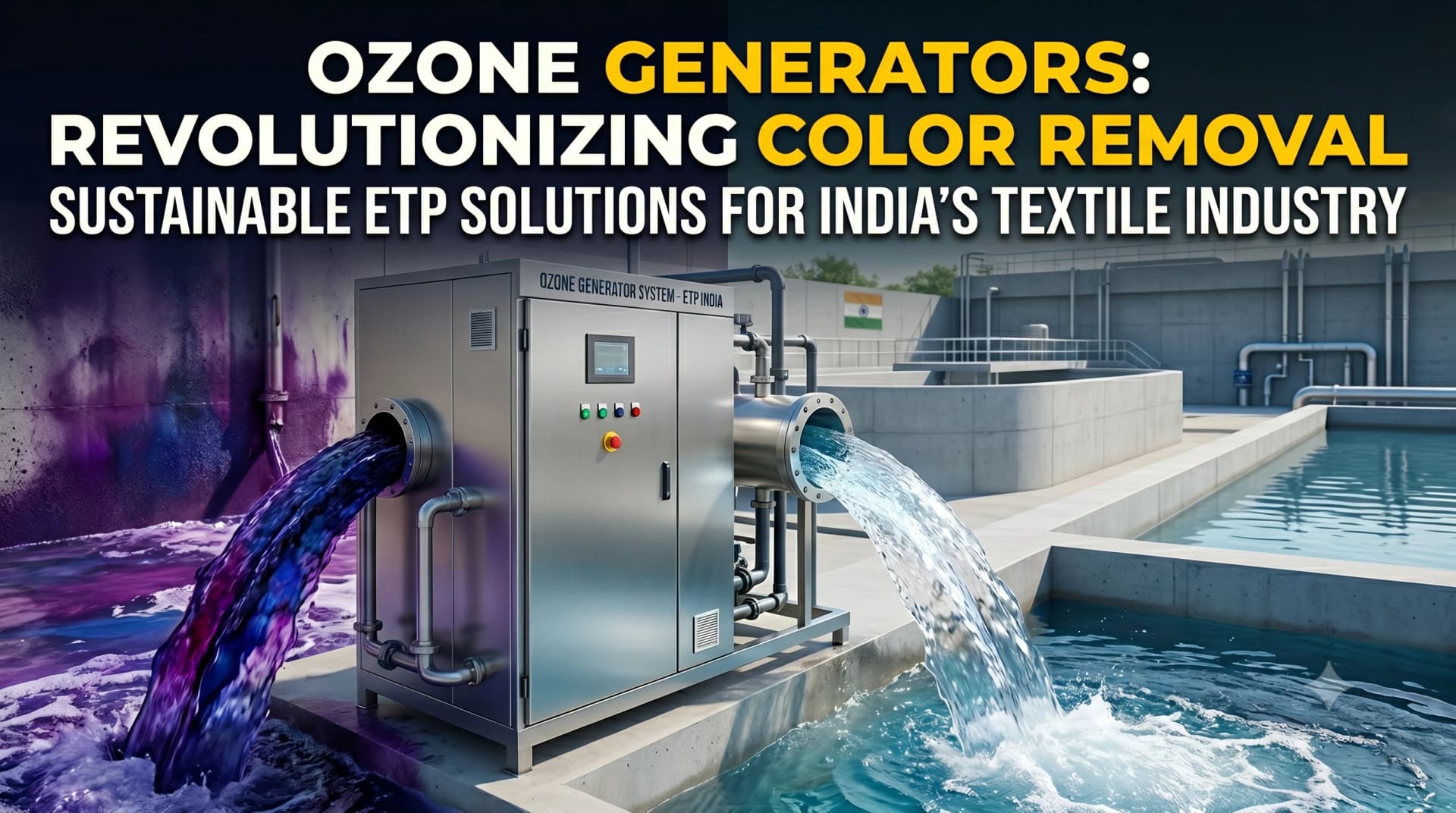
Ozone generator for ETP colour removal textile industry India solves the most persistent compliance problem facing Indian textile manufacturers — coloured effluent discharge that fails CPCB standards despite expensive conventional ETP treatment. India's textile industry is worth Rs 12 lakh crore annually and is one of the country's largest export earners. However it is also one of the top contributors to industrial water pollution. Textile dyeing and finishing operations produce heavily coloured wastewater containing reactive dyes, azo dyes, vat dyes and other synthetic colourants that are specifically designed to be chemically stable and resistant to biological degradation. Ozone India Technology has been supplying ozone generators for textile ETP colour removal across Gujarat, Rajasthan, Tamil Nadu and Maharashtra for 11 years, helping textile manufacturers achieve CPCB compliance that was previously impossible with conventional treatment alone.
Why Conventional ETP Cannot Remove Colour from Textile Wastewater
Most ETPs in India use coagulation-flocculation for primary treatment followed by biological treatment using activated sludge, MBBR or SBR. This treatment sequence is highly effective for BOD reduction, TSS removal and some COD reduction. However it has a fundamental limitation with respect to colour removal from synthetic dye wastewater.
Synthetic dyes used in textile manufacturing are engineered for chemical stability. Their chromophore groups — the molecular structures responsible for colour — are designed to resist washing, oxidation and biodegradation so that dyed fabric retains its colour through repeated washing cycles. This same chemical stability makes synthetic dyes resistant to biological degradation in an activated sludge or MBBR system.
Coagulation-flocculation can remove some dispersed dyes by adsorption onto the floc, but is ineffective against soluble dyes like reactive dyes which remain dissolved even after optimised coagulant dosing. The result is an ETP that meets BOD and TSS standards but consistently fails colour compliance — which is precisely the situation many textile ETPs in India find themselves in.
How Ozone Advanced Oxidation Removes Colour from Textile ETP
Ozone Advanced Oxidation Process works through two pathways — direct molecular ozone oxidation and indirect hydroxyl radical oxidation. Direct ozone oxidation attacks electron-rich functional groups in organic molecules, particularly the double bonds and aromatic rings that are characteristic of synthetic dye chromophores. Ozone specifically attacks the azo bond that is responsible for colour in azo dyes, which account for over 70 percent of synthetic dyes used in Indian textile manufacturing. When the azo bond is cleaved by ozone, the chromophore is destroyed and colour disappears from the water within seconds to minutes.
At higher ozone doses, or in combination with hydrogen peroxide in an AOP system, the decomposition of ozone generates hydroxyl radicals — the most powerful oxidant known to water chemistry with an oxidation potential of 2.8 volts. Hydroxyl radicals react non-selectively with virtually all organic compounds, achieving rapid and complete mineralisation of even the most chemically stable dye compounds.
An ozone generator for ETP colour removal textile industry India, correctly sized and installed, can reduce colour by 85 to 95 percent and COD by 60 to 80 percent in 20 to 30 minutes of contact time.
How to Size an Ozone Generator for Textile ETP Colour Removal
Correctly sizing an ozone generator for ETP colour removal is critical. Three parameters determine the correct size. ETP secondary effluent flow rate — the volume of treated effluent requiring colour removal per day in KLD or cubic metres per hour. Initial colour concentration — measured in ADMI units, APHA colour units or Hazen units using a spectrophotometer. Target outlet colour — the CPCB or State PCB standard for your discharge category, typically 5 to 7 Hazen units.
Based on these three inputs, Ozone India Technology's engineering team calculates the required ozone dose in mg per litre, the total ozone mass transfer rate required in grams per hour, and sizes the corona discharge ozone generator accordingly. We also design the ozone contact chamber with appropriate liquid-to-gas ratio, mixing mechanism and contact time to ensure efficient ozone utilisation and the required colour reduction.
Ozone India Technology manufactures ozone generators from 2g per hour to kilogram-scale. For a typical 200 KLD textile ETP requiring 15 mg per litre ozone dose, a 50g per hour ozone generator is typically required.
Textile Effluent Colour Reduction by Ozone — By Dye Class (ADMI units)
Case Study — Textile Dyeing Unit in Surat CPCB Compliance
A textile dyeing unit in Surat was receiving GPCB compliance notices for coloured ETP discharge. Their 150 KLD ETP with MBBR biological treatment was producing treated water with 120 to 180 ADMI units of colour — far exceeding the permissible limit.
Ozone India Technology installed a 30g per hour corona discharge ozone generator with a 10,000-litre HDPE ozone contact chamber. Ozone is injected through a venturi injector at the ETP secondary outlet. Contact time in the chamber is 25 minutes at maximum flow rate.
Colour in the treated water dropped from 120 to 180 ADMI units to below 10 ADMI units within one week of commissioning. COD reduced by an additional 55 percent. GPCB compliance was achieved and maintained. The unit received no further compliance notices. Monthly ozone system operating cost — power and maintenance — was Rs 18,000 against the Rs 45,000 per month they were previously spending on coagulant chemicals without achieving colour compliance.
ETP Compliance Cost — Ozone vs Chemical Treatment (₹/KLD/day)
Ozone India Technology ETP Ozone System Installation
Adding an ozone generator to an existing ETP is a straightforward retrofit process that can be completed in 2 to 3 working days without shutting down the ETP. The ozone generator and contact chamber are installed after the secondary clarifier and before the treated water storage or discharge point.
Step 1 — Effluent sample collection and quality testing. Step 2 — Ozone generator sizing based on effluent quality and flow rate. Step 3 — HDPE or FRP ozone contact chamber installation downstream of secondary clarifier. Step 4 — Corona discharge ozone generator installation with air dryer and venturi ozone injection. Step 5 — Commissioning and treated water testing to verify colour, COD and coliform compliance. Step 6 — CPCB documentation package provided.
Ozone India Technology provides a complete ETP ozone package including ozone generator, air dryer, venturi injector, ozone contact chamber, dissolved ozone monitor and CPCB-aligned documentation.
Why Ozone India Technology for Textile ETP Ozone
11 years manufacturing ozone systems for textile and chemical industry ETP applications. Installations in Gujarat, Rajasthan, Tamil Nadu and Maharashtra. IIT Patna MBA team with deep ETP ozone expertise. Factory-direct pricing 30 to 40 percent below imported alternatives.
Ozone India Technology provides free effluent quality assessment and ozone generator sizing for every enquiry. We can arrange a 24-hour pilot test at your ETP before you commit to purchase. Our team stays involved through commissioning to ensure your CPCB compliance targets are achieved. Call +91 96500 17943 for a free consultation.
Frequently Asked Questions
Why can't our biological ETP remove colour from textile wastewater?
Synthetic dyes are specifically engineered to resist biological degradation. The chromophore groups responsible for colour in reactive, azo and vat dyes cannot be broken down by the microorganisms in a biological ETP. Ozone Advanced Oxidation is the only practical technology for achieving CPCB colour compliance from textile dye wastewater.
What colour reduction can I expect from an ozone generator for ETP?
Ozone AOP achieves 85 to 95 percent colour reduction from textile ETP secondary effluent in 20 to 30 minutes of contact time. This typically reduces ADMI values from 100 to 300 units down to below 10 units — comfortably within CPCB colour standards.
How much does an ozone ETP system cost for a 200 KLD textile plant?
Ozone India Technology provides factory-direct pricing that is 30 to 40 percent below imported alternatives. For a 200 KLD textile ETP, system cost depends on effluent colour concentration and required ozone dose. Contact us for a free sizing and pricing quotation based on your effluent quality data.
Can ozone be added to our existing ETP without major changes?
Yes. The ozone generator and contact chamber are installed after the existing secondary clarifier, without modifying any existing ETP components. Installation takes 2 to 3 working days without shutting down the ETP.
Does ozone create harmful byproducts in textile ETP discharge?
No. Ozone converts back to pure oxygen after treatment. There are no harmful chemical byproducts. Ozone AOP treatment of textile dye wastewater produces broken-down dye molecules that are readily biodegradable — the biological COD actually improves after ozone treatment, potentially reducing your biological ETP operating costs.