
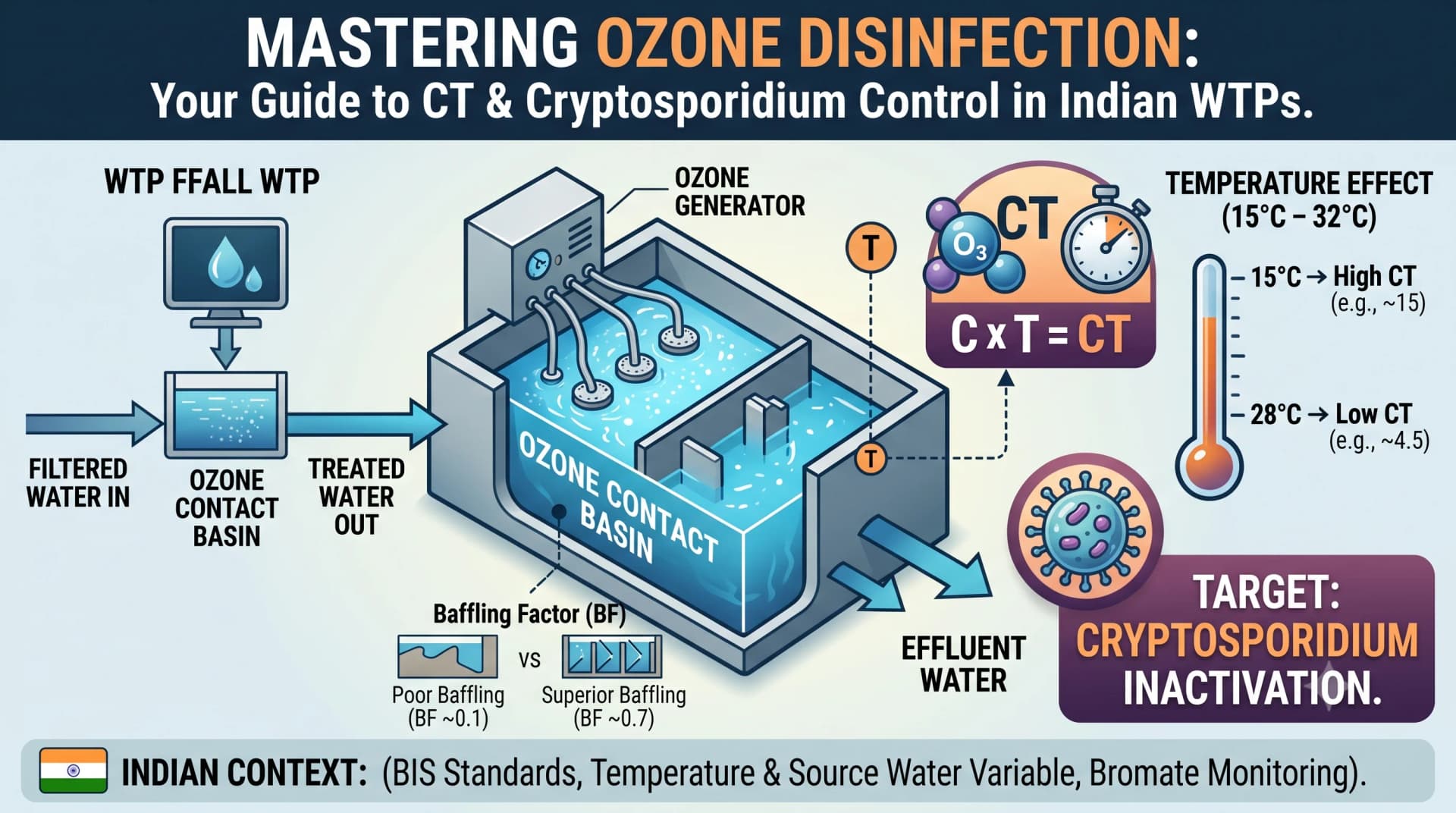
Specifying ozone dosing and contact time for Cryptosporidium inactivation in a surface water WTP in India is the most technically demanding disinfection design problem in municipal water engineering. Cryptosporidium parvum oocysts are completely resistant to chlorine at any concentration used in a drinking water plant, and Indian surface water sources — rivers, reservoirs, canals fed by agricultural runoff — carry increasing oocyst loads from cattle and open defecation near intake points. When a WTP engineer asks how to specify ozone dosing and contact time for Cryptosporidium inactivation in a surface water WTP in India, the answer requires a clear CT value, a correct dose calculation, and a properly designed contactor. This guide provides all three.
Why Cryptosporidium Demands Ozone in Indian Surface Water WTPs
Cryptosporidium parvum completes part of its life cycle in mammalian intestines and releases oocysts that survive in surface water for months. The oocysts — 4 to 6 microns diameter — have a thick protein wall that makes them effectively immune to chlorine. At 15°C, achieving 3-log Cryptosporidium inactivation with free chlorine requires a CT of approximately 7,200 mg·min/L. A typical Indian municipal WTP running 0.5 mg/L residual chlorine with 30 minutes of contact achieves a CT of 15 mg·min/L — 480 times less than required. Chlorine provides zero Cryptosporidium protection in any practical surface water WTP in India.
Ozone and UV are the only two technologies proven effective against Cryptosporidium at doses achievable in a municipal plant. For surface water WTPs above 1 MLD, ozone dosing is strongly preferred over UV because: ozone scales cost-effectively to large flows, provides simultaneous colour and taste removal, improves downstream coagulation performance, and generates a measurable dissolved residual for real-time contact time verification. Understanding how to specify ozone dosing and contact time for Cryptosporidium inactivation in a surface water WTP in India is therefore a core competency for any Indian WTP engineer upgrading a conventional plant to protozoan-safe design.
CT Values for Cryptosporidium Inactivation with Ozone
The CT value — ozone concentration (mg/L) multiplied by contact time (minutes) — is the governing parameter when specifying ozone dosing and contact time for Cryptosporidium inactivation in a surface water WTP in India. The table below is derived from the US EPA Long Term 2 Enhanced Surface Water Treatment Rule (LT2ESWTR, 2006), the reference document used by WHO GDWQ 4th Edition for Cryptosporidium ozone CT guidance.
| Log Inactivation | Removal | CT at 15°C (mg·min/L) | CT at 25°C (mg·min/L) |
|---|---|---|---|
| 0.5 log | 68% | 0.32 | 0.14 |
| 1.0 log | 90% | 0.63 | 0.28 |
| 1.5 log | 96.8% | 0.95 | 0.42 |
| 2.0 log | 99% | 1.27 | 0.56 |
| 2.5 log | 99.7% | 1.58 | 0.70 |
| 3.0 log | 99.9% | 1.90 | 0.84 |
Source: US EPA LT2ESWTR Table 3.1. CT values for ozone, pH 6–9.
For Indian municipal WTPs with river or reservoir intake, the standard design target is 2-log (99%) Cryptosporidium inactivation, corresponding to a CT of 1.27 mg·min/L at 15°C water temperature. Always design for the lowest annual water temperature at your intake — not the seasonal average — because CT requirements are highest in cold water. In the Ganga basin, winter water temperatures of 12 to 15°C are common; in Deccan plateau rivers, temperatures rarely fall below 20°C. Select the conservative value for your specific location.
CT Required for Cryptosporidium Inactivation — Ozone vs Chlorine at 15°C
Step-by-Step Ozone Dose Calculation for a Surface Water WTP in India
Correctly specifying ozone dosing and contact time for Cryptosporidium inactivation in a surface water WTP in India requires four sequential calculations. Skipping any step leads to under-dosing — which means Cryptosporidium survives — or over-dosing — which wastes ozone and generates excessive bromate from bromide in the source water.
Step 1 — Set the target CT. Select 2-log inactivation (CT = 1.27 mg·min/L at 15°C) as the minimum for a river-sourced Indian WTP. Use 3-log (CT = 1.90 mg·min/L) for plants serving hospitals, dialysis centres, or any population with a high proportion of immunocompromised users.
Step 2 — Characterise the post-sedimentation water quality. Ozone demand in Indian surface water after primary sedimentation is the sum of demands from dissolved organic carbon, dissolved iron, manganese, and nitrite. Typical values post-sedimentation: TOC 1.5 to 3.5 mg/L, dissolved iron 0.05 to 0.3 mg/L, manganese 0.02 to 0.1 mg/L. High TOC significantly increases applied ozone dose because ozone reacts with organic matter before residual builds up for CT credit. Measure actual post-settled water TOC at your plant before finalising the dose.
Step 3 — Calculate the applied ozone dose. Applied dose (mg/L) = Ozone demand (mg/L) + Target residual in contactor (mg/L) + Transfer efficiency loss
For post-sedimentation Indian river water: ozone demand is typically 1.5 to 2.5 mg/L. Target dissolved ozone residual at the contactor outlet: 0.2 to 0.4 mg/L (the value used in the CT calculation). With a fine-bubble diffuser transfer efficiency of 85 to 90%, the applied dose formula becomes:
Applied dose = (demand + residual) ÷ transfer efficiency = (2.0 + 0.3) ÷ 0.87 = 2.64 mg/L
Use 2.5 to 3.0 mg/L as the design applied dose for a moderately loaded Indian river WTP.
Step 4 — Size the ozone generator. Ozone generator capacity (g/hr) = Applied dose (mg/L) × Flow rate (m³/hr)
For a 10 MLD WTP (flow = 417 m³/hr) at 2.5 mg/L applied dose: Capacity = 2.5 × 417 = 1,042 g/hr → round up to 1.2 kg/hr with 15% margin → specify 1.5 kg/hr installed capacity. CPHEEO requires a standby unit of equal capacity for all municipal WTP ozone systems.
Ozone Generator Capacity Required for 2-Log Cryptosporidium Inactivation by WTP Size
Contactor Design for CT Credit — T10 Methodology
When specifying ozone dosing and contact time for Cryptosporidium inactivation in a surface water WTP in India, the contactor design determines whether the calculated CT is actually achieved. A poorly designed contactor — even with correct ozone dosing — may deliver only 30 to 50% of the theoretical CT credit because of short-circuiting.
T10 concept: T10 is the time at which 10% of an injected tracer pulse passes through the contactor outlet. It represents the minimum contact time available to 90% of the water volume and is the conservative value used for CT credit in regulatory calculations. The ratio T10/T (where T is the theoretical hydraulic retention time) characterises the hydraulic efficiency of the contactor:
- Completely mixed single tank: T10/T ≈ 0.1 (very poor — almost no CT credit)
- Baffled multi-cell contactor: T10/T = 0.5 to 0.7 (standard for ozone contactors)
- Plug flow pipe reactor: T10/T ≈ 0.9 to 1.0 (ideal but impractical at large scale)
Design the contactor HRT using: HRT = (Target CT ÷ Design residual) × (1 ÷ T10/T factor)
For 2-log inactivation (CT = 1.27 mg·min/L), residual = 0.3 mg/L, T10/T = 0.6: HRT = (1.27 ÷ 0.3) × (1 ÷ 0.6) = 4.23 × 1.67 = 7.1 minutes
Design for 8 to 10 minutes HRT with a 4-cell baffled concrete contactor. For 10 MLD (6.95 m³/min), the contactor volume = 6.95 × 8 = 55.6 m³ — round to 60 m³ with 4 equal cells of 15 m³ each.
Ozone introduction: Fine-bubble ceramic or PTFE membrane diffusers at the base of the first contactor cell. Bubble size 0.5 to 3 mm. Counter-current configuration (water flows downward, ozone bubbles rise) achieves 85 to 95% transfer efficiency. All cells are covered, with off-gas vented through a catalytic ozone destructor rated for the full head-space volume.
Construction: Reinforced concrete with HDPE or epoxy-phenolic lining for cells 1 and 2 (highest ozone exposure). Subsequent cells may be bare concrete. For prefabricated plants below 5 MLD, SS316L modular contactors are available from Ozone India Technology.
Placement in the WTP Treatment Train
The correct placement for ozone dosing for Cryptosporidium inactivation in a surface water WTP in India is intermediate ozonation — after primary sedimentation and before rapid sand filtration. This positioning is specified in the CPHEEO Manual on Water Supply and Treatment (2000) and is aligned with WHO GDWQ guidance.
Why not pre-ozonation (before sedimentation)? Raw river water at 100 to 500 NTU turbidity post-monsoon carries suspended organic matter that consumes 5 to 15 mg/L of ozone before any residual builds up. Pre-ozonation therefore requires an applied dose of 7 to 18 mg/L — expensive and producing excessive bromate. Pre-ozonation is used for taste, colour, and coagulation aid, not for Cryptosporidium CT credit.
Why intermediate ozonation is optimal: After sedimentation, turbidity is below 5 NTU and TOC is below 3 mg/L, reducing ozone demand to 1.5 to 2.5 mg/L. The residual builds up quickly, CT is achieved efficiently, and the biodegradable organic fragments produced by ozone oxidation (assimilable organic carbon, AOC) are removed by biological activity on the downstream rapid sand filters — which also earns an additional 2-log filtration credit under CPHEEO guidelines.
Complete treatment sequence for a surface water WTP in India with Cryptosporidium protection: Raw water intake → Screening → Flash mixer (coagulant) → Flocculator → Sedimentation/Clariflocculator → Ozone contactor (Cryptosporidium CT credit step) → Rapid sand filtration (biological filtration, AOC removal) → Clear water sump → Post-filtration chlorination (distribution residual) → Consumer.
Monitoring Requirements for Ozone CT Compliance
An Indian surface water WTP claiming Cryptosporidium CT credit from ozone dosing must continuously demonstrate that the specified CT is being achieved. The minimum instrumentation package is:
Dissolved ozone analyser at contactor outlet: Amperometric or colorimetric inline sensor, ±5% accuracy, continuous reading. This is the critical instrument — the dissolved residual reading, combined with the flow-derived T10 value, gives the real-time CT at every moment of plant operation. Set a low-residual alarm to halt treated water delivery if the residual falls below the design minimum.
Magnetic flow meter on contactor inlet: Used to verify that the actual flow rate does not exceed the contactor design flow. At flow rates above design, T10 shortens and CT credit decreases.
Gas-phase ozone analyser on generator output: Confirms actual ozone production matches the setpoint. Ozone generators lose output capacity as cells age — the gas-phase analyser detects this before it affects CT compliance.
Ambient ozone monitor in ozone room and contactor gallery: Fixed electrochemical sensor, alarm at 0.05 ppm (half the Indian TLV of 0.1 ppm). Mandatory for operator safety.
Catalytic off-gas destructor: All ozone that is not dissolved in the water exits as head-space gas. This must pass through a catalytic destructor (manganese oxide catalyst or thermal at 350°C) before venting to atmosphere.
Data logger: All parameters logged at 5-minute intervals for CPCB and CPHEEO review. Smart City Mission and Jal Jeevan Mission WTPs require SCADA integration with remote parameter monitoring.
CPHEEO and BIS IS 10500 Regulatory Context
BIS IS 10500:2012 does not specify a numerical Cryptosporidium limit but requires that drinking water be free from pathogenic organisms. The CPHEEO Revised Model Guidelines for Drinking Water Supply Systems (2013) explicitly state that surface water sources with protozoan contamination risk require ozone or UV treatment as an additional disinfection barrier beyond conventional chlorination.
WHO GDWQ 4th Edition sets a health-based target of 10⁻⁶ DALY per person per year for Cryptosporidium from drinking water. For a Ganga basin tributary with 0.5 to 5 oocysts per 10 litres — representative of many Indian river intakes — achieving this target requires 2 to 3 log total inactivation from the treatment train. With sedimentation providing 1 log and filtration providing 2 log removal credit under CPHEEO, the ozone CT step provides the additional safety margin that protects the distribution system against oocyst breakthrough during source water quality events.
For WTPs funded under Jal Jeevan Mission, AMRUT, or Smart Cities Mission, the project DPR must include a source water pathogen risk assessment. An ozone system with CT calculation records and continuous dissolved ozone monitoring documentation satisfies the pathogen log-reduction evidence requirement for state-level CPHEEO and national JJM technical reviews.
Ozone India Technology — Municipal WTP Ozone Systems
Ozone India Technology, Greater Noida, manufactures CE and ISO 9001 certified corona discharge ozone generators from 2 g/hr to 10 kg/hr for surface water WTPs across India. Our IIT-educated engineering team provides complete ozone dosing and contact time calculations for Cryptosporidium inactivation in any surface water WTP in India, including CT analysis, contactor design review, T10 estimation, and full commissioning support.
Every municipal WTP ozone system from Ozone India Technology includes: corona discharge ozone generator with PSA oxygen or dry air feed, fine-bubble diffuser set, dissolved ozone monitoring panel at contactor outlet, catalytic off-gas destructor, ambient ozone safety monitor, and CPHEEO-aligned CT documentation package. Factory-direct pricing is 30 to 40 percent below imported alternatives, with pan-India service coverage.
For a free ozone dosing calculation, generator sizing, and quotation for your surface water WTP Cryptosporidium inactivation requirement, call +91 96500 17943 or WhatsApp 919650017943. Technical response within 2 hours on working days.
Frequently Asked Questions
What CT value should I use for Cryptosporidium inactivation by ozone in my surface water WTP in India?
Design for CT = 1.27 mg·min/L at 15°C for 2-log (99%) Cryptosporidium inactivation — the minimum for any Indian river-intake WTP. Use CT = 1.90 mg·min/L for 3-log inactivation if you serve hospitals, dialysis units, or populations with immunocompromised individuals. Always use the lowest annual water temperature at your intake for the design CT, not the seasonal average. Indian river temperatures in winter range from 10°C (Himalayan tributaries) to 20°C (peninsular rivers) — confirm the correct CT from the EPA LT2ESWTR table for your temperature range.
Why can't I use UV instead of ozone for Cryptosporidium inactivation in a 20 MLD surface water WTP in India?
UV is technically effective — 40 mJ/cm² achieves greater than 3-log Cryptosporidium inactivation — and is the standard choice for plants below 2 MLD. For a 20 MLD surface water WTP, ozone dosing is preferred because ozone scales economically at high flow rates (one generator serves the full plant), provides simultaneous taste, colour, and odour removal that UV cannot achieve, and produces a dissolved residual that can be continuously monitored for CT compliance. UV reactors at 20 MLD flow require very large reactor vessels with high capital cost and provide no additional water quality improvement beyond disinfection.
How do I calculate the contactor volume needed for 2-log Cryptosporidium inactivation in a surface water WTP in India?
Use the formula: Contactor HRT (minutes) = (CT ÷ Design residual) × (1 ÷ T10/T). For 2-log CT = 1.27 mg·min/L, residual = 0.3 mg/L, T10/T = 0.6 for a baffled 4-cell contactor: HRT = (1.27 ÷ 0.3) × (1 ÷ 0.6) = 7.1 minutes. Add 15 to 20% design margin: use 8.5 minutes design HRT. Multiply HRT by the flow rate in m³/min to get the required contactor volume. For 5 MLD (3.47 m³/min): Volume = 3.47 × 8.5 = 29.5 m³, rounded up to 32 m³ as a 4-cell baffled contact tank of 8 m³ per cell.
What ozone residual should I maintain at the contactor outlet for Cryptosporidium CT credit?
Maintain 0.2 to 0.4 mg/L dissolved ozone residual at the final contactor cell outlet. This residual, combined with the T10-based contact time, gives the CT for regulatory credit. Do not allow residual to fall below 0.15 mg/L — set the low-residual alarm at this level and divert or halt production if the alarm triggers. Do not maintain residual above 0.5 mg/L at the contactor outlet if your source water contains measurable bromide — elevated ozone at high bromide concentrations can form bromate above the WHO guideline of 10 μg/L.
What happens to the ozone after the contactor in a surface water WTP in India?
Dissolved ozone at 0.2 to 0.4 mg/L entering the rapid sand filters after the contactor provides a secondary benefit: it oxidises ammonia and manganese, improves biodegradation of organic ozone-oxidation products in the biologically active filter media, and reduces the chlorine demand of the clear water before distribution. Residual dissolved ozone at the filter outlet is typically below 0.1 mg/L — it decomposes naturally in the filter bed. Post-filtration chlorination provides the distribution system residual that ozone cannot maintain due to rapid decomposition.