
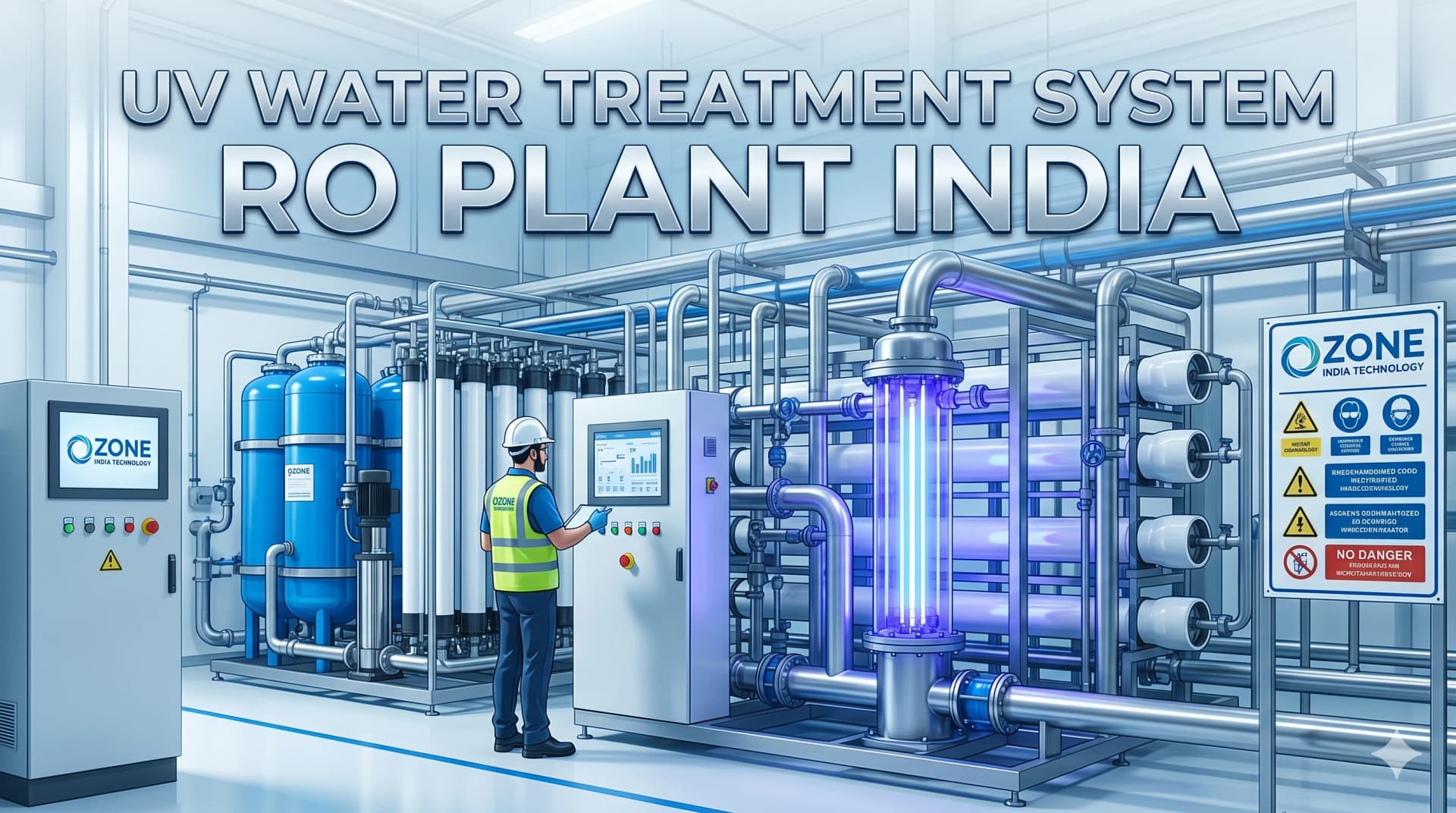
UV water treatment system RO plant post treatment India is the critical final barrier in water purification — addressing the single most common failure point in Indian packaged drinking water and industrial RO systems, where microbially safe water produced by the RO membrane becomes recontaminated in the post-RO distribution system before it reaches the consumer or process point. Ozone India Technology, based in Greater Noida, manufactures CE and ISO 9001 certified UV water treatment systems designed specifically for RO post treatment integration, validated to BIS IS 10500:2012 drinking water standards and WHO Guidelines for Drinking-water Quality (4th Edition).
Why RO Plants Need UV Post Treatment
Reverse osmosis membranes remove dissolved solids, heavy metals, and microorganisms from water with high efficiency — a well-maintained RO system with intact membranes achieves 4 to 6 log reduction of bacteria and viruses. However, the post-RO system — storage tanks, distribution pipework, filling equipment, and point-of-use outlets — presents a significant microbial recontamination risk that the RO membrane cannot address.
BIS IS 10500:2012, India's drinking water quality standard, requires that potable water at the point of consumption contain zero total coliform organisms per 100 mL and zero E. coli per 100 mL. This standard applies to the water as consumed — not as produced at the RO membrane. CPCB Guidelines for Packaged Drinking Water (2019) additionally require that packaged water manufacturers demonstrate zero microbial contamination in the final product through validated online monitoring.
Post-RO recontamination occurs through multiple routes: biofilm formation in storage tanks and pipework, contamination during filter changes or system maintenance, and microbial growth in slow-moving or stagnant sections of the distribution system. WHO Guidelines for Drinking-water Quality (4th Edition) document that biofilm formation in water distribution systems can release viable bacteria, including Legionella, Pseudomonas aeruginosa, and Aeromonas, into otherwise purified water.
UV post treatment, installed immediately before the point of use or filling point, provides a final disinfection barrier that eliminates recontamination regardless of its source. As long as the UV lamp is operational and the water passes through the UV chamber at the validated flow rate, any bacteria or viruses introduced between the RO membrane and the UV unit are inactivated before the water reaches the consumer or process.
UV Dose Requirements for Drinking Water
UV inactivation of waterborne pathogens is a function of UV dose — the product of UV irradiance (mW/cm²) at 254nm and exposure time (seconds), expressed in mJ/cm². WHO Guidelines for Drinking-water Quality recommend a minimum UV dose of 40 mJ/cm² for 3-log (99.9%) inactivation of waterborne viruses including adenovirus (the most UV-resistant human enteric virus). For bacteria and protozoa, lower doses are effective: E. coli is inactivated to 4-log at 10 mJ/cm²; Cryptosporidium and Giardia — which are resistant to chlorine — are inactivated to 3-log at 10 mJ/cm².
BIS IS 10500:2012 does not specify a UV dose, but requires zero total coliform at the point of use — achievable with UV doses above 16 mJ/cm² for clean water (UV transmittance >95%). Ozone India Technology UV units for RO post treatment are sized to deliver a minimum 40 mJ/cm² dose at the rated flow rate, providing the WHO-recommended margin for virus inactivation.
System Design for RO Post Treatment Integration
Ozone India Technology UV post treatment systems for RO plants are designed as inline flow-through units that install on the outlet pipe of the RO system, immediately before the storage tank or filling point. The UV chamber contains one or more low-pressure amalgam UV lamps in quartz sleeves, with the water flowing through the annular space between the sleeve and the stainless steel chamber wall.
System sizing is based on the RO plant output flow rate. A 500 LPH (litres per hour) RO system — standard for domestic or small commercial installations — requires a 6W UV unit to achieve 40 mJ/cm² at the rated flow. A 5,000 LPH commercial RO system requires a 30 to 40W UV unit. Packaged drinking water plants processing 10,000 to 50,000 LPH require multi-lamp UV reactors with UV intensity sensors and automatic flow control.
For CPCB-compliant packaged drinking water production, Ozone India Technology UV systems include an online UV intensity sensor with low-UV alarm and solenoid valve shutoff — automatically stopping water flow if UV intensity drops below the validated setpoint (lamp aging, sleeve fouling, or power interruption).
Validation and Compliance Documentation
BIS Bureau of Indian Standards licensing under IS 14543 (Packaged Drinking Water) requires manufacturers to demonstrate validated microbial kill in their production process. UV post treatment with documented UV dose delivery and lamp intensity monitoring satisfies the BIS requirement for microbiological process control.
WHO guidelines recommend bioassay validation of UV systems using MS2 bacteriophage (surrogate for waterborne viruses) or Bacillus subtilis spores (surrogate for UV-resistant organisms) to confirm actual UV dose delivery under worst-case hydraulic conditions (maximum flow rate, minimum UV transmittance). Ozone India Technology provides commissioning validation reports for all UV systems supplied to packaged drinking water plants.
Applications Beyond Packaged Water
UV post treatment is equally critical in pharmaceutical water systems (USP Purified Water and Water for Injection), food and beverage process water, laboratory water systems, and dialysis water treatment. Each application has specific UV dose requirements: USP Purified Water for pharmaceutical use requires continuous UV treatment at 254nm with regular bioburden monitoring; dialysis water must meet AAMI TIR34 microbiological standards.
For food processing facilities, FSSAI Food Safety and Standards (Food Products Standards and Food Additives) Regulations require that process water used in food production meets IS 10500 quality standards — UV post treatment of RO-purified water is the most efficient method of achieving continuous compliance with this requirement.
RO + UV Water System — Quality Parameters Before and After Treatment
UV System — Log Inactivation at Different Flow Rates (2000 LPH system)
Frequently Asked Questions
What UV dose is required for safe drinking water?
WHO Guidelines for Drinking-water Quality recommend a minimum validated UV dose of 40 mJ/cm² for complete inactivation of waterborne viruses, bacteria, and protozoa at the point of use. For bacteria and protozoa only (in systems where viral contamination is not a concern), 16 mJ/cm² is effective. Ozone India Technology UV units are designed to deliver 40 mJ/cm² at rated flow rate.
How often must the UV lamp be replaced in an RO post treatment system?
Low-pressure UV lamps have a rated output life of 9,000 to 12,000 hours at 254nm. After this period, UV output falls below 70 percent of initial value — the standard replacement threshold. At 24-hour operation, this corresponds to annual replacement. Ozone India Technology UV controllers include a lamp hour counter and replacement reminder.
Does UV treatment remove dissolved solids or heavy metals from water?
No. UV treatment inactivates microorganisms only — it does not remove dissolved minerals, heavy metals, chlorine, or organic compounds. UV post treatment is used after RO, which removes dissolved solids. The combination of RO + UV provides both chemical and microbiological purification.
Can UV be used instead of chlorine for drinking water disinfection?
UV provides no residual disinfection — once treated water leaves the UV chamber, there is no ongoing protection against recontamination. In distribution systems where recontamination is possible, a low residual chlorine dose is maintained alongside UV treatment. For point-of-use RO systems with UV installed immediately before the tap, no residual is required.
What maintenance does an RO post treatment UV system require?
Monthly: wipe quartz sleeve with soft cloth and isopropyl alcohol to remove mineral deposits that reduce UV transmission. Annual: replace UV lamp. Every 3 to 5 years: replace quartz sleeve if etched or discoloured. Ozone India Technology UV controllers include automated maintenance reminders and lamp hour tracking.