
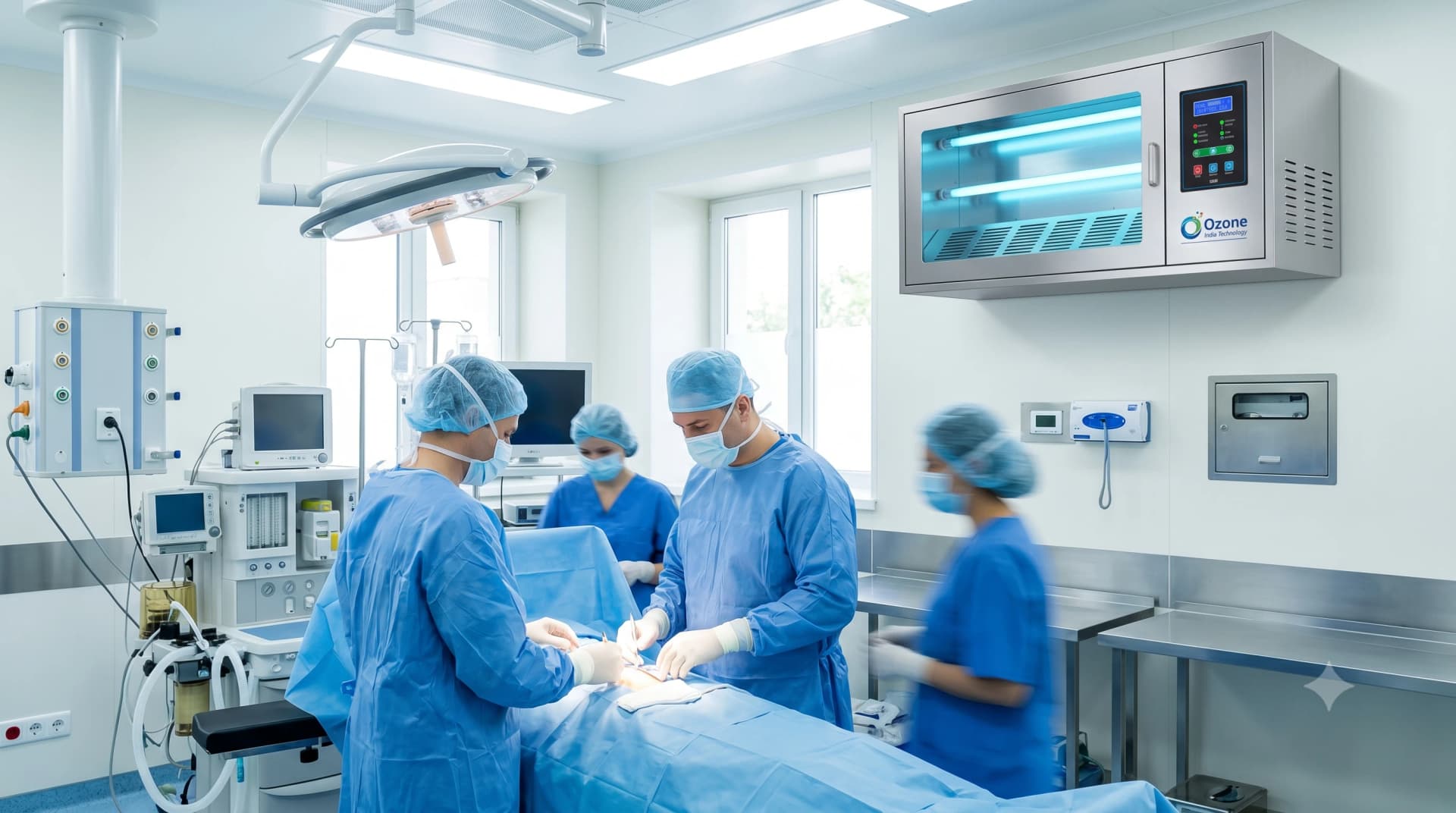
UV air sterilizer hospital operation theatre India addresses the critical challenge facing Indian hospital infection control teams — maintaining the ultra-low airborne bioburden required by NABH standards and WHO guidelines in operation theatres, ICUs, and isolation rooms without relying solely on expensive high-capacity HVAC systems with HEPA filtration. Alpha UV System, the UV division of Ozone India Technology, manufactures CE and ISO 9001 certified upper-room UVGI (Ultraviolet Germicidal Irradiation) air sterilizers and duct-mounted UV systems validated for Indian hospital infection control requirements.
WHO and NABH Standards for Hospital Air Quality
WHO Guidelines on Air Quality in Health Care Facilities (2021) establish specific air quality requirements for different healthcare zones. For operation theatres, the WHO guideline specifies a minimum of 20 to 25 air changes per hour (ACH), positive pressure relative to adjacent areas, and terminal HEPA filtration for supply air. For isolation rooms handling infectious disease patients, the guideline specifies a minimum of 12 ACH, negative pressure relative to adjacent areas, and HEPA filtration of exhaust air.
NABH Standards for Hospitals (4th Edition), Standard IFC.6 — Engineering Controls for Infection Prevention — requires accredited hospitals to implement engineering controls to reduce healthcare-associated infections (HAIs). These include HVAC design per ASHRAE 170, surface disinfection protocols, and supplementary air disinfection technologies for high-risk areas. UVGI is explicitly recognised by WHO and NABH as a validated supplementary air disinfection technology for healthcare settings.
ASHRAE Standard 170-2021 Ventilation of Health Care Facilities — adopted as the Indian reference standard for hospital HVAC design — specifies minimum ACH, temperature, humidity, and pressure relationships for all hospital zones including operating rooms (minimum 20 ACH), delivery rooms (15 ACH), emergency examination rooms (12 ACH), and general patient rooms (4 ACH).
UVGI — How Ultraviolet Germicidal Irradiation Works
Upper-room UVGI uses UV-C lamps mounted at ceiling level (above 2.4m), directed horizontally or upward to irradiate the upper zone of the room while leaving the lower occupied zone safe for patients and staff. Natural air convection currents — thermal stratification, breathing, and HVAC airflow — continuously transport bacteria and viruses from the occupied lower zone to the upper irradiated zone, where they are inactivated by UV-C exposure.
WHO Tuberculosis guidelines specifically recommend upper-room UVGI as a validated airborne infection control technology for rooms with TB patients, HIV/AIDS wards, and respiratory isolation facilities. At a UV irradiance level of 30 to 50 μW/cm² in the upper room zone — achievable with a standard Alpha UV System upper-room fixture — the equivalent of 10 to 15 additional air changes per hour of disinfected air are delivered to the occupied zone, supplementing the mechanical ventilation system.
Duct-mounted UV systems install UV-C lamp arrays inside the HVAC air handling unit (AHU) or ductwork, irradiating all supply or recirculated air at high intensity before delivery to the room. At UV doses of 100 to 1,000 mJ/cm² achieved in duct systems (where airflow allows extended exposure time compared to room air), 4 to 6 log inactivation of airborne bacteria and viruses is achieved in the airstream.
Applications in Indian Hospitals
Operation theatres: Duct-mounted UVGI installed in the OT supply air AHU provides continuous sterilization of supply air, reducing the airborne bioburden from the outside environment and recirculated air. WHO, NABH, and ASHRAE 170 all recognise UVGI as a valid supplementary measure to mechanical filtration for OT air quality.
ICU and isolation rooms: Upper-room UVGI fixtures provide continuous supplementary air disinfection during occupied hours, reducing the transmission of nosocomial pathogens including MRSA, VRE, Acinetobacter, and airborne TB (Mycobacterium tuberculosis).
Pharmacy clean rooms: Duct-mounted UVGI maintains ultra-low airborne bioburden in Class 10,000 and Class 100,000 clean rooms in hospital pharmacies preparing IV admixtures, consistent with CDSCO and WHO GMP requirements for pharmaceutical compounding areas.
Waiting areas and OPD corridors: Upper-room UVGI in high-occupancy areas reduces the transmission of respiratory infections including influenza, COVID-19, and tuberculosis. WHO guidance on COVID-19 infection control specifically recommends upper-room UVGI for areas where ventilation cannot be increased sufficiently.
Technical Specifications �� Alpha UV System Hospital Products
Alpha UV System upper-room UVGI fixtures are available in 30W, 55W, and 110W configurations for room areas of 15 to 60 m². Each fixture uses a low-pressure amalgam UV lamp with a 254nm germicidal output of 28 to 105 μW/cm² at the 2.4m mounting height. Safety louvers direct UV radiation above the 2.0m occupied zone height, preventing direct UV exposure to occupants. All fixtures include a tamper-resistant on/off switch for nurse station control and a UV lamp status indicator.
Duct-mounted systems are custom-configured based on duct dimensions, airflow velocity, and target UV dose. Alpha UV System engineers calculate the required lamp configuration to achieve the validated UV dose at worst-case airflow velocity and UV transmittance of the duct liner material.
Hospital Airborne Pathogen Reduction — UV-C Air Sterilizer vs Standard HVAC (%)
Hospital HCAI Rate — With UV Air Sterilization vs Without (per 1,000 bed-days)
Frequently Asked Questions
Is upper-room UVGI safe for patients and medical staff?
Yes, when properly installed. Upper-room UVGI fixtures are designed to irradiate only the upper room zone (above 2.0m). At the occupant zone (standing height 1.7m and below), UV irradiance is below the ACGIH threshold limit value of 0.2 μW/cm² for 8-hour occupational exposure. Alpha UV System fixtures include safety louvers validated to meet this requirement.
What is the recommended UV dose for hospital air sterilization?
WHO tuberculosis guidelines recommend upper-room UVGI at 30 to 50 μW/cm² in the upper irradiated zone for effective airborne TB control. ASHRAE Handbook — HVAC Applications recommends duct UV systems delivering 50 to 500 mJ/cm² for general HVAC bioburden control.
Can UVGI replace HEPA filtration in an operation theatre?
No. NABH and ASHRAE 170 require terminal HEPA filtration for OT supply air — UVGI is a supplementary technology, not a replacement. UVGI complements HEPA filtration by continuously disinfecting recirculated air and treating surfaces in the HVAC system.
How often must UV lamps be replaced in hospital UVGI systems?
Low-pressure UV lamps: rated life 9,000 to 12,000 hours (approximately 12 months at 24-hour operation). Medium-pressure lamps: 6,000 hours. Alpha UV System includes a lamp hour counter and replacement alert in all hospital-grade fixtures.
Does UVGI inactivate COVID-19 virus in hospital air?
Yes. UV-C at 254nm inactivates SARS-CoV-2 with a D90 dose (90% inactivation) of approximately 1.1 to 3.7 mJ/cm². Upper-room UVGI at 30 to 50 μW/cm² achieves this dose in 0.4 to 1.2 minutes of exposure, making it effective for airborne COVID-19 control in hospital waiting areas and COVID wards.