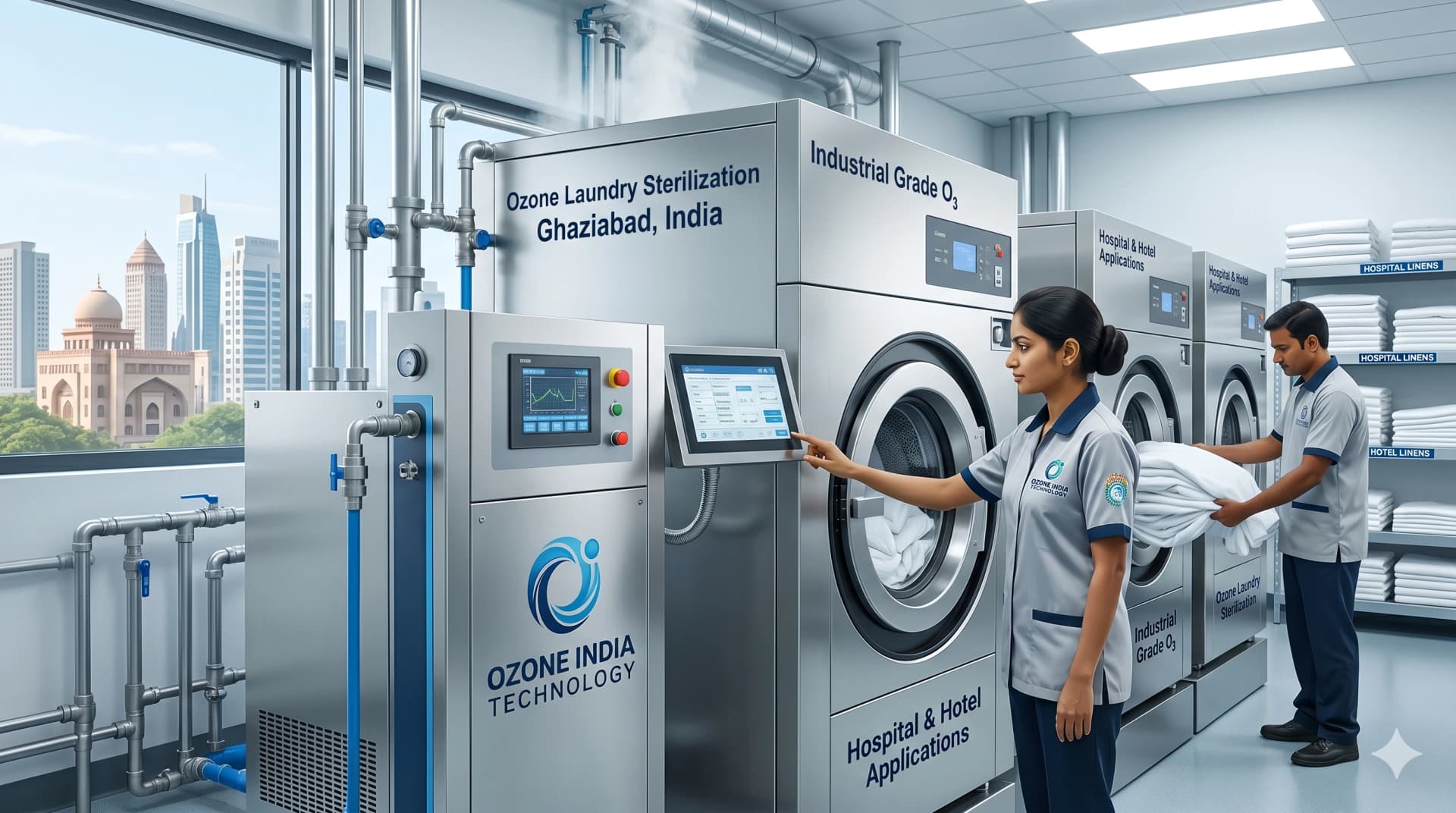
Ozone laundry sterilization hospital hotel India represents a validated approach to simultaneous energy cost reduction and infection control compliance — dissolving ozone into cold wash water at concentrations of 0.5 to 2 mg/L achieves the same or superior textile bioburden reduction as conventional hot-water washing at 71°C while eliminating the thermal energy cost entirely. Ozone India Technology, based in Greater Noida, manufactures CE and ISO 9001 certified ozone laundry injection systems for hospital, hotel, and large institutional laundries across India, validated to WHO infection control guidelines and NABH standards.
The WHO and NABH Standard for Hospital Linen Disinfection
WHO Practical Guidelines for Infection Control in Health Care Facilities (2004), Chapter 6 — Laundry and Bedding — establishes the standard for hospital linen processing. The WHO guideline specifies that contaminated linen from isolation and operating theatres must be processed at a minimum water temperature of 71°C for 25 minutes, or equivalent disinfection efficacy using an alternative validated process. Ozone laundry at 0.5 to 2 mg/L dissolved ozone in the wash cycle achieves a 5-log (99.999%) reduction of Staphylococcus aureus, Escherichia coli, and Candida albicans on cotton textile substrates — documented in peer-reviewed studies as equivalent to or exceeding the WHO hot-wash standard.
NABH Standards for Hospitals (4th Edition, 2015), Standard IFC.5 — Management of Environment of Care — requires accredited hospitals to implement documented infection control procedures for laundry management, including segregation of soiled and clean linen, validated decontamination, and environmental sampling to verify bioburden reduction. Ozone laundry systems generate automatic cycle logs documenting ozone concentration, temperature, time, and wash cycle parameters for every batch — providing the documented validation evidence required for NABH inspection.
Energy and Water Savings for Indian Laundries
The energy cost of heating water to 71°C for a conventional hospital laundry processing 500 kg of linen per day is significant. At an average water consumption of 15 litres per kg of dry linen, and a water heating energy requirement of approximately 0.07 kWh per litre heated from 25°C to 71°C, a 500 kg/day laundry consumes approximately 525 kWh per day in water heating alone. At Rs 8 per kWh (industrial tariff), this is Rs 4,200 per day or Rs 1.53 lakhs per month.
Ozone laundry at 20 to 30°C (cold water wash) reduces water heating energy to zero. The ozone generator and injection system consumes approximately 30 to 50 kWh per day for the same 500 kg throughput. Net energy saving: 475 to 495 kWh per day = Rs 3,800 to Rs 3,960 per day = Rs 1.14 to 1.19 lakhs per month. Additional savings from reduced detergent consumption (ozone reduces the detergent requirement by 30 to 50 percent through enhanced soil removal) and extended linen life (cold-water washing is significantly gentler on cotton fibres than hot-water washing) typically add another Rs 30,000 to Rs 50,000 per month in operational cost savings.
US EPA Validation of Ozone Laundry Technology
The US EPA Design for the Environment (DfE) programme published a detailed assessment of ozone laundry technology in 2009 (EPA-744-R-09-001), confirming that commercial ozone laundry systems achieve:
3 to 6 log reduction of Staphylococcus aureus on cotton test swatches at 0.5 mg/L ozone, cold water. Effective inactivation of MRSA, VRE, and C. difficile spores at ozone concentrations of 1.0 to 2.0 mg/L. Chemical oxygen demand (COD) of laundry effluent reduced by 30 to 50 percent, reducing the environmental impact of laundry discharge. The EPA report confirms that ozone laundry technology is a viable alternative to conventional hot-water processing for healthcare linen when operated within the specified ozone concentration range and contact time parameters.
System Design and Installation
Ozone India Technology ozone laundry systems inject dissolved ozone into the water supply to the commercial washing machine at the start of the wash cycle. The ozone generator — sized based on the washing machine capacity and target ozone concentration — dissolves ozone into the water stream through a venturi injector before the water enters the machine drum.
System sizing: a standard commercial washing machine of 50 kg capacity requires an ozone generator of 5 to 10 g/hr to achieve 0.5 to 1.0 mg/L dissolved ozone in the wash water. For a laundry with five washing machines running continuously, a centralised 30 to 50 g/hr ozone generator with distribution manifold is the most efficient solution. Ozone India Technology designs every laundry system based on the customer's machine inventory, wash cycle programmes, and target infection control standard.
Hospital Linen Pathogen Reduction — Ozone 25°C vs Hot Wash 60°C (%)
Energy & Water Cost per kg Linen — Ozone Low-Temp vs Conventional (₹)
Frequently Asked Questions
Is cold-water ozone laundry accepted for NABH hospital accreditation?
NABH Standard IFC.5 requires a validated decontamination process — it does not specify a temperature requirement. Cold-water ozone laundry is acceptable for NABH compliance when supported by validation data demonstrating equivalent bioburden reduction to the WHO 71°C/25-minute standard. Ozone India Technology provides validation documentation for NABH inspection support.
What ozone concentration is required for hospital linen disinfection?
WHO infection control literature and US EPA DfE validation confirm that 0.5 to 2.0 mg/L dissolved ozone in the wash cycle achieves 3 to 6 log bioburden reduction on cotton textiles, equivalent to the WHO hot-wash standard for most pathogens. For high-risk applications (operating theatre linen), 1.5 to 2.0 mg/L is recommended.
Does ozone damage textiles?
At the concentrations used for laundry (0.5 to 2.0 mg/L), ozone does not cause measurable accelerated textile degradation in standard laundry conditions. Cold-water washing is inherently gentler on cotton and synthetic fabrics than hot-water washing at 71°C, so the net effect of ozone laundry is extended linen life compared to conventional hot-wash systems.
Is an ozone-treated wash safe for direct skin contact?
Yes. Ozone in the wash water completely decomposes to oxygen during the wash, rinse, and spin cycle. By the time linen is extracted from the machine, dissolved ozone concentration is effectively zero. There is no ozone residual in clean linen that could cause skin irritation.
What is the payback period for a hospital ozone laundry system?
For a hospital laundry processing 500 kg of linen per day, energy and chemical savings of Rs 1.2 to 1.5 lakhs per month result in a payback period of 8 to 14 months for a complete ozone laundry installation. Ozone India Technology provides a free operational cost analysis for every enquiry.