
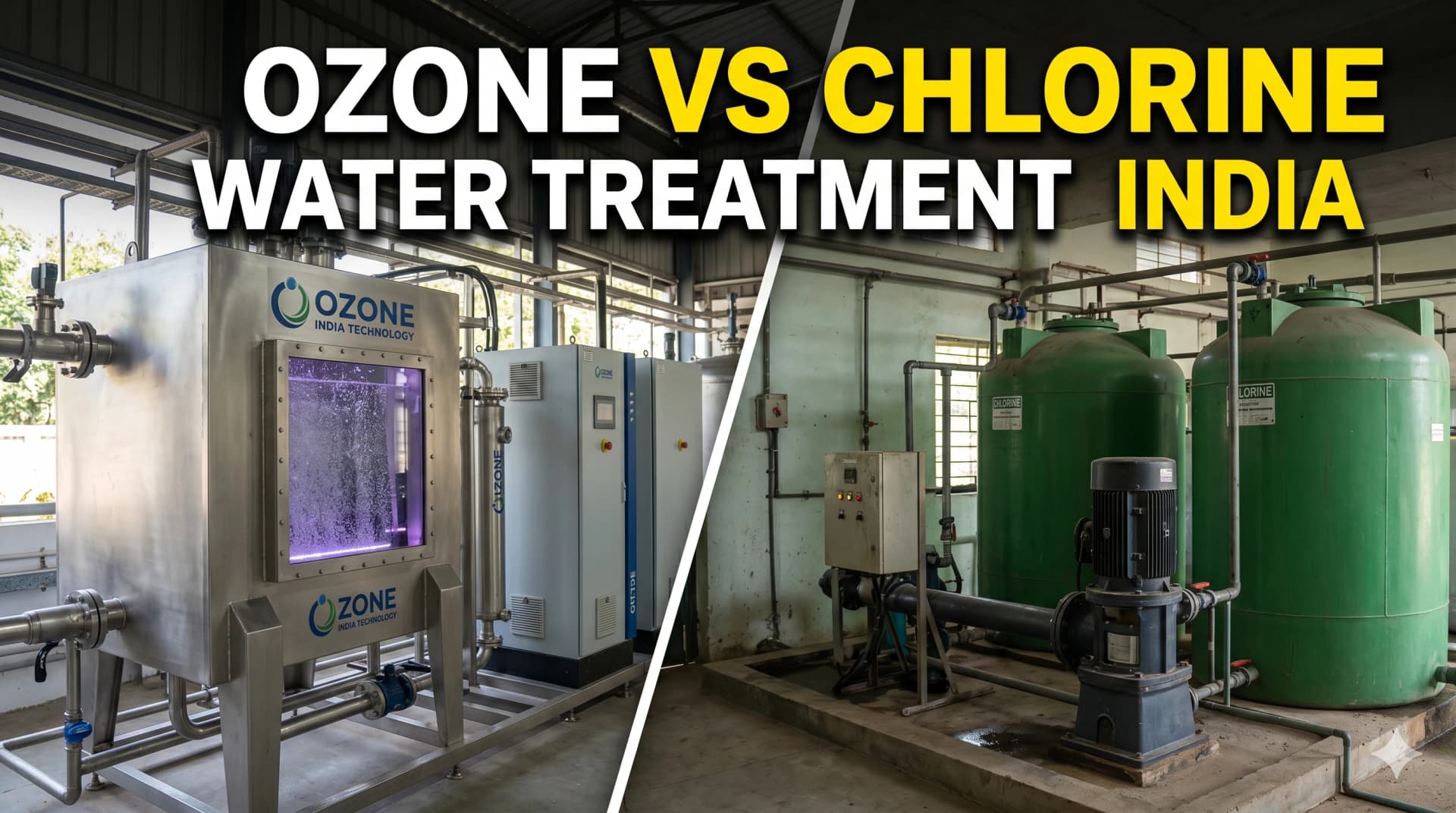
Ozone vs chlorine water treatment India is a decision that water treatment engineers, municipal water authority operators, packaged water manufacturers, and industrial water managers across India face as they balance disinfection efficacy, regulatory compliance, operational cost, and the growing international evidence on disinfection by-product (DBP) formation risks associated with chlorination. WHO Guidelines for Drinking-water Quality (4th Edition, 2011) and BIS IS 10500:2012 — India's national drinking water standard — both address the role of alternative disinfection technologies. This evidence-based comparison draws on WHO and BIS data to guide Indian water treatment decisions.
Disinfection Efficacy: Ozone vs Chlorine
Chlorine at free chlorine concentrations of 0.2 to 0.5 mg/L achieves approximately 3 to 4 log inactivation of E. coli and other gram-negative bacteria within 30 minutes contact time at pH 7.0. However, chlorine efficacy decreases significantly at higher pH, higher temperature, and in the presence of organic matter (NOM) — all common conditions in Indian water sources. At pH 8.0 (common in Indian alkaline groundwater), chlorine efficacy is reduced by approximately 50 percent. Chlorine provides poor inactivation of Cryptosporidium and Giardia — protozoan pathogens documented in Indian surface water and increasingly implicated in waterborne disease outbreaks.
Ozone at doses of 0.4 to 1.0 mg/L achieves 4 to 6 log inactivation of E. coli and gram-negative bacteria within 5 minutes contact time, independent of pH. WHO Guidelines document ozone as the most powerful primary disinfectant for water treatment, achieving: 3-log inactivation of Giardia at 0.5 mg/L·min CT (concentration × time product); 3-log inactivation of Cryptosporidium at 10 to 40 mg/L·min CT; and 4-log inactivation of enteric viruses at 0.5 to 1.0 mg/L·min CT.
Verdict on efficacy: Ozone is significantly more effective than chlorine for protozoan inactivation (critical for Indian surface water) and is effective at a wider pH range. Chlorine provides a distribution system residual; ozone does not.
Disinfection By-Products: The Central Difference
This is the most important difference between ozone and chlorine for Indian water treatment. Chlorine reacts with natural organic matter (NOM) in source water to form trihalomethanes (THMs) — primarily chloroform (CHCl₃) — and haloacetic acids (HAAs). WHO Guidelines classify chloroform as a possible human carcinogen (Group 2B, IARC) and set a guideline value of 300 μg/L for total THMs in drinking water.
BIS IS 10500:2012 sets a maximum allowable limit of 200 μg/L for total THMs in Indian drinking water — below the WHO guideline value. CPCB National Ambient Water Quality Standards (2008) establish the framework for source water protection that affects how much NOM is present in water reaching treatment plants.
In Indian cities where source water contains high NOM — the Ganga, Yamuna, Godavari, and other rivers carrying agricultural and urban organic load — chlorination produces THM concentrations that can approach or exceed BIS limits during monsoon when organic load is highest. Mumbai's municipal water system, for example, uses chlorine for disinfection of Bhatsa and Tulsi reservoir water; THM formation is managed through careful chlorine dosing.
Ozone does not form THMs or HAAs. Ozone reacts with NOM through oxidation, breaking down organic molecules rather than halogenating them. The primary ozone by-products of concern are bromate (BrO₃⁻) — formed when ozone reacts with bromide naturally present in some water sources — with a WHO guideline value of 10 μg/L. Bromate formation is manageable by controlling ozone dose and pH; it is only a concern in water sources with bromide >0.1 mg/L, which is not common in most Indian surface water sources.
Verdict on DBPs: Ozone is significantly safer than chlorine for DBP formation in high-NOM Indian water. For packaged drinking water manufacturers and industrial water users where BIS IS 10500 THM compliance is required, ozone treatment eliminates THM risk.
Disinfection Efficacy — Log Inactivation Ozone vs Chlorine by Pathogen
Taste and Odour
Chlorine imparts a characteristic taste and odour to drinking water at free chlorine concentrations above 0.1 mg/L. The reaction of chlorine with NOM additionally produces chlorophenols — detectable by taste at concentrations as low as 1 μg/L — which are the primary source of "chemical" or "medicinal" taste complaints in chlorinated drinking water.
Ozone improves the taste and odour of water by oxidising taste- and odour-causing compounds including geosmin, 2-methylisoborneol (2-MIB), and hydrogen sulphide. Ozonated water typically has a cleaner, fresher taste than chlorinated water. This is a significant advantage for packaged drinking water manufacturers, where product taste differentiation is commercially important.
DBP Formation — Ozone vs Chlorine in High-NOM Indian Water (μg/L)
Operational Considerations in India
Chlorine is widely available across India as liquid chlorine (Cl₂ gas cylinders), sodium hypochlorite solution (NaOCl), and calcium hypochlorite powder. The supply chain, handling procedures, and dosing technology are well-established in Indian water utilities. Chlorine gas handling requires safety measures (gas detection, emergency procedures) due to the acute inhalation hazard. Hypochlorite solutions degrade over time, requiring careful inventory management.
Ozone is generated on-site by passing air or oxygen through a corona discharge generator — there is no chemical supply chain, no storage of hazardous materials, and no degradation of stockpiled chemical. Ozone generators require electricity (approximately 15 to 20 Wh per gram of ozone produced) and a reliable power supply. At typical Indian industrial electricity tariffs of Rs 7 to 10 per kWh, the operating cost of ozone is Rs 0.10 to 0.20 per gram. Ozone decomposes to oxygen within minutes — there is no waste product to dispose of.
For packaged water manufacturers, ozone eliminates the chlorine dosing and dechlorination steps required in conventional treatment, simplifying the production process and reducing chemical procurement, storage, and disposal costs.
Combined Ozone + Chlorine Treatment
The optimal strategy for large Indian municipal water systems is combined ozone + chlorine treatment: ozone as the primary disinfectant (pre-ozonation for NOM oxidation and pathogen inactivation, reducing chlorine demand) followed by a small chlorine residual (0.1 to 0.2 mg/L) for distribution system protection. WHO Guidelines explicitly endorse this combined approach, noting that ozone primary disinfection significantly reduces the chlorine dose required for distribution system protection, thereby reducing THM formation.
This combined approach is used in Mumbai, Pune, and Bengaluru water treatment plants — and is recommended by Ozone India Technology for Indian municipal water systems where distribution system length necessitates a residual disinfectant.
Frequently Asked Questions
Does ozone completely replace chlorine in drinking water treatment?
For point-of-use and packaged water applications where water is consumed immediately after treatment, ozone can replace chlorine completely. For municipal water distribution systems where distribution time is hours to days, a small chloramine or free chlorine residual is recommended alongside ozone primary treatment. WHO Guidelines endorse this combined approach.
What is the BIS IS 10500 limit for THMs in drinking water?
BIS IS 10500:2012 sets a maximum permissible limit of 200 μg/L for total trihalomethanes (THMs) in Indian drinking water — compared to the WHO guideline of 300 μg/L. This applies at the point of consumption. Ozone treatment eliminates THM formation, achieving zero THM regardless of NOM concentration in source water.
Is ozone more expensive than chlorine for water treatment?
The capital cost of an ozone system (ozone generator, contact tank, off-gas destruction) is higher than a chlorine dosing system. However, operating costs are lower: no chemical procurement, no storage and handling costs, no chemical disposal, and no dechlorination step. For high-volume industrial water users and packaged water manufacturers, the 3 to 5 year total cost of ownership of ozone is typically lower than chlorine, with the additional benefit of zero DBP risk.
Can ozone remove iron and manganese from groundwater?
Yes. Ozone at 0.5 to 1.0 mg/L oxidises dissolved iron (Fe²⁺ → Fe³⁺ precipitate) and manganese (Mn²⁺ → MnO₂ precipitate), enabling removal by subsequent sand filtration. This is a critical advantage for Indian groundwater treatment where elevated iron and manganese are common — chlorine alone does not effectively oxidise manganese at typical water treatment pH values.
Which Indian industries are required to use ozone for water treatment?
FSSAI Food Safety and Standards Regulations require that water used in food production meets IS 10500 quality standards. Packaged drinking water manufacturers licensed under BIS IS 14543 are required to use approved disinfection processes — ozone and UV are both approved methods. Pharmaceutical manufacturers using water for drug production are required by CDSCO and Schedule M to validate their water purification processes to USP or IP standards, for which ozone is a validated treatment technology.