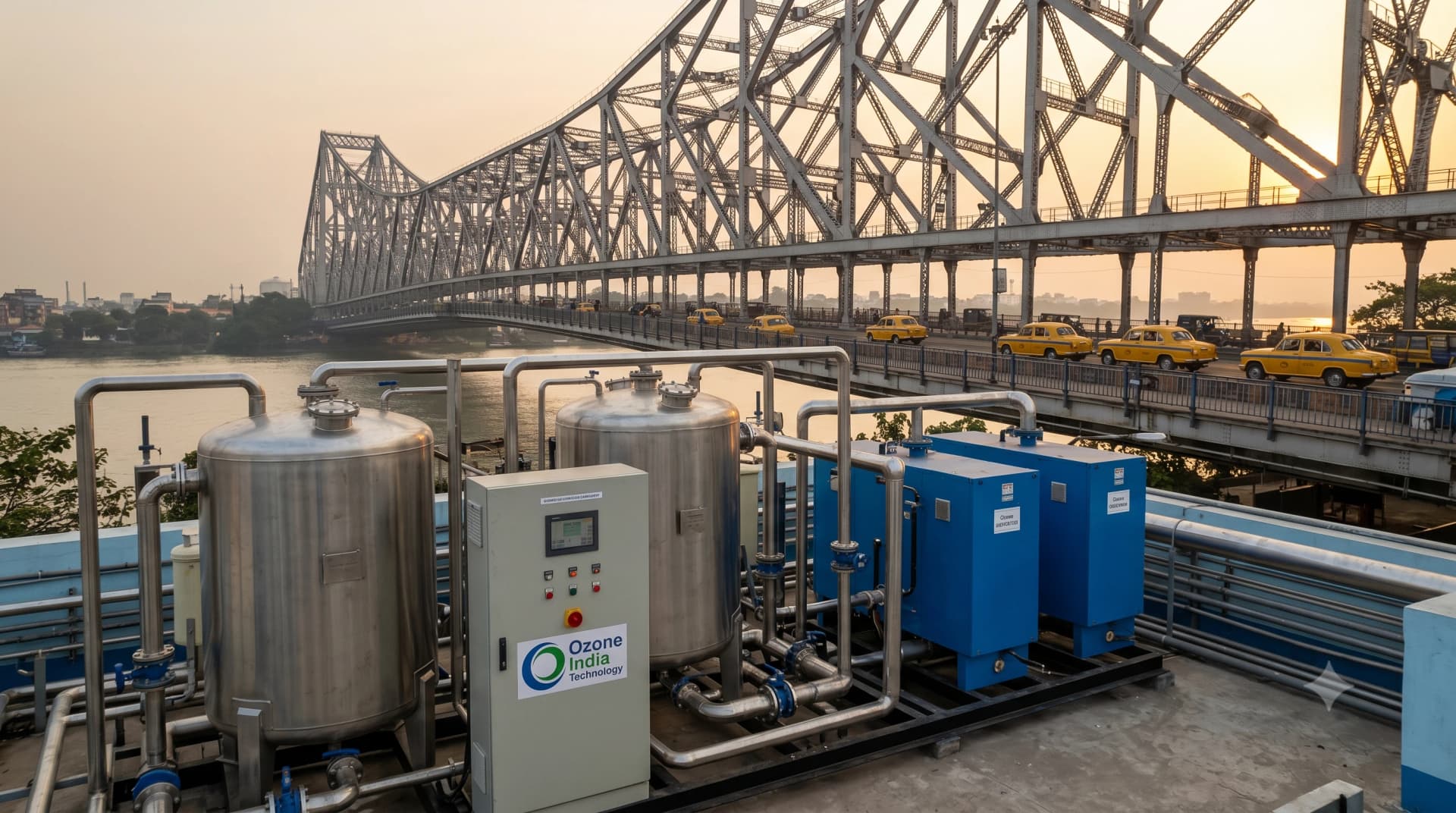
Ozone Generator in Kolkata, West Bengal serves one of India's oldest and most industrially complex urban ecosystems — a city where 19th century jute mills, 20th century leather tanneries and 21st century IT campuses coexist along the Hooghly River's heavily industrialised western bank. The West Bengal Pollution Control Board (WBPCB) enforces CPCB effluent standards with increasing NGT-backed authority, compelling Kolkata's diverse industrial base — from Tangra tanneries to Bandel power plant cooling water to hilsa fish export processors — to adopt advanced effluent treatment. Ozone India Technology — India's CE-certified, ISO 9001:2015 manufacturer of industrial ozone generators — is headquartered in Greater Noida and supplies factory-direct ozone water treatment systems to Kolkata with 36 to 48 hour delivery and full WBPCB compliance documentation. Contact our team at +91 96500 17943 for a free consultation.
Water and Industrial Challenges in Kolkata
Kolkata — with a metropolitan population of 15 million — faces water quality challenges that span multiple industrial legacies. The Hooghly River, a distributary of the Ganges flowing past the Howrah-Kolkata industrial belt, receives effluent from over 1,500 industrial units in the 72 km Howrah-Uluberia industrial corridor — jute mills, chemical plants, engineering workshops, paper mills and food processors that collectively contribute a BOD load of 8 to 12 tonnes per day to the river despite WBPCB enforcement.
The Tangra-Tiljala leather tannery cluster in south Kolkata — once India's largest tanning district, now largely relocated — still operates 150-plus active units producing leather for export to Europe and the US. Chromium (Cr VI) in tannery effluent is the primary compliance challenge: WBPCB standards require total chromium below 2 mg/L in final effluent, but untreated tannery liquor contains Cr VI at 150 to 200 mg/L. Ozone oxidation of Cr III to Cr VI (to be subsequently precipitated as Cr(OH)₃) is a key step in chromium polishing from tannery effluent, with 90 to 95 percent chromium removal achievable with ozone at 5 to 10 mg/L at alkaline pH.
Kolkata's fishing industry is centred at the Kolkata Fish Market (wholesale) and multiple retail markets, with hilsa fish — Bengal's cultural icon — being the primary species. Hilsa is exported fresh-chilled and frozen to Bangladesh (where it commands premium prices), the Middle East and Southeast Asia. MPEDA (Marine Products Export Development Authority) and EIC (Export Inspection Council) require EU HACCP-equivalent process water standards for export-certified processing facilities in Kolkata and neighbouring 24 Parganas districts.
Jute processing is Kolkata's industrial heritage — the Bhatpara-Titagarh-Shyamnagar jute mill belt on the Hooghly's eastern bank processes over 700,000 tonnes of raw jute annually. Jute retting (biological decomposition of the outer bark) generates high-BOD effluent (BOD 4,000 to 8,000 mg/L from retting water) that WBPCB monitoring consistently finds in the Hooghly near jute mill discharge points. Advanced treatment of jute mill effluent with ozone AOP after anaerobic digestion is increasingly required by WBPCB consent conditions.
How Ozone Technology Addresses Kolkata's Challenges
For chromium removal from tannery effluent, ozone applied at 5 to 10 mg/L at pH 8 to 9 oxidises Cr III (which forms stable complexes with organic matter in tanning liquor) to Cr VI, which can then be precipitated as chromium hydroxide by pH adjustment to 8.5 to 9.5, achieving total chromium below 2 mg/L in effluent — meeting WBPCB discharge standards. Ozone simultaneously destroys the organic dye and tanning agent COD, reducing overall BOD and colour.
For hilsa and seafood export processing, dissolved ozone at 0.5 to 1.5 mg/L in chilling water and process wash water eliminates Listeria monocytogenes and Salmonella at 4 to 5 log reduction — meeting both MPEDA export standards and EU Regulation 853/2004 simultaneously. Ozone is the only treatment that maintains hilsa's delicate flavour profile while achieving pathogen reduction, compared to chlorine which affects taste.
For jute mill effluent, ozone at 15 to 25 mg/L after anaerobic digestion reduces residual BOD from 500 to 1,500 mg/L to below 30 mg/L WBPCB limit — a performance that extended aeration alone cannot achieve for recalcitrant jute-derived organic compounds. Colour removal from jute processing water (tannins and plant pigments) is simultaneously achieved, addressing WBPCB colour compliance requirements.
Hooghly River Industrial Load by Sector — BOD Contribution (tonnes/day)
Key Applications in Kolkata
Leather Tannery Chromium ETP — Tangra and Bantala
WBPCB enforcement on Tangra-Tiljala tanneries requires total chromium below 2 mg/L, colour absent and BOD below 30 mg/L. Ozone India Technology supplies 5 to 30 g/hr ozone systems for chromium polishing and colour removal as the final ETP stage after chrome precipitation. Our systems are sized for individual tannery units (100 to 1,000 KLD) and for Bantala Common ETP serving the relocated tannery cluster. CE-certified with WBPCB-aligned operational documentation. Factory-direct pricing 30 to 40 percent below European alternatives with 36 to 48 hour delivery to Kolkata.
Seafood Export Processing — 24 Parganas and Kolkata Fish Market
Export-certified hilsa and shrimp processors in Kolkata and South 24 Parganas require process water meeting MPEDA and EIC HACCP standards for EU export. Ozone India Technology supplies 2 to 10 g/hr food-grade ozone systems for chilling water sanitation, contact surface disinfection and process water treatment. Complete EIC and MPEDA-aligned HACCP documentation is provided with every food processing ozone installation.
Jute Mill Effluent — Bhatpara-Titagarh Belt
Jute mills in the Bhatpara-Titagarh belt require BOD reduction from retting effluent that consistently fails WBPCB standards despite conventional treatment. Ozone AOP at 20 mg/L after primary settling and anaerobic treatment achieves WBPCB-compliant BOD below 30 mg/L. Ozone India Technology's industrial-scale ozone generators (75 to 350 g/hr) serve multi-mill consortium ETP projects in the Hooghly jute belt.
Municipal Water — Garden Reach Waterworks
Kolkata Municipal Corporation's Garden Reach and Palta waterworks draw Hooghly River water for treatment serving 4.5 million residents in southern and central Kolkata. Seasonal raw water turbidity (up to 2,000 NTU during monsoon), algal blooms and increasingly detected pharmaceutical compounds create challenges for conventional alum coagulation treatment. Ozone pre-treatment at 1 to 3 mg/L before coagulation would improve flocculation efficiency, reduce alum dose by 25 to 35 percent and destroy emerging contaminants not addressed by chlorination.
Why Indian-Manufactured Ozone Technology Suits India
Ozone India Technology's Ghaziabad facility — 1,500 km from Kolkata by road, with direct train connections via Howrah — enables 36 to 48 hour delivery of in-stock systems to Kolkata. Our systems are rated for India's climate (45°C/90% RH) and designed for Indian industrial electrical standards (415V/3-phase and 220V/single-phase at 50Hz). CE-2621A and ISO 9001:2015 certification is accepted by WBPCB, CPCB, FSSAI, MPEDA and EIC without additional import or approval processes. Factory-direct pricing 30 to 40 percent below European ozone systems.
Compliance and Standards in Kolkata
WBPCB enforces CPCB Standards under Schedule VI of the Environment Protection Rules: BOD below 30 mg/L, COD below 250 mg/L, total chromium below 2 mg/L, colour absent for discharge to rivers. For seafood export, EIC under the Export Inspection Council Act 1963 and MPEDA under MPEDA Act 1972 jointly certify processing facilities for EU and US markets, requiring HACCP-compatible process water documentation.
Kolkata Tannery Chromium Removal — Before and After Treatment (mg/L)
Frequently Asked Questions
Can ozone remove hexavalent chromium from Kolkata tannery effluent?
Ozone oxidises Cr III (trivalent chromium) to Cr VI (hexavalent chromium) at alkaline pH 8 to 9. This is counterintuitive but useful — Cr VI forms insoluble chromium hydroxide at pH 8.5 to 9.5 that can be settled and separated. After settling, the Cr VI precipitate is removed and the remaining water contains Cr below 2 mg/L, meeting WBPCB standard. Ozone simultaneously destroys organic chromium complexes that prevent precipitation, achieving reliable compliance.
What is the import or delivery situation for Kolkata?
Ozone India Technology is based in India — Ghaziabad, Uttar Pradesh. Delivery to Kolkata is by road freight or rail, typically 36 to 48 hours. No import duties or customs clearance. CE certification and ISO 9001 documents are accepted by all Indian regulatory bodies including WBPCB, CPCB and MPEDA without additional approvals.
Can ozone be used in the East Kolkata Wetlands treated sewage irrigation?
Yes. East Kolkata Wetlands (UNESCO Ramsar site) use sewage for fish cultivation and vegetable cultivation. Ozone treatment at 3 to 5 mg/L applied dose after primary settling would reduce pathogen loads in sewage to levels safe for restricted irrigation per WHO 2006 Wastewater Reuse Guidelines — potentially enabling more intensive productive use of the wetlands while reducing public health risk.
What warranty and service support does Ozone India Technology provide in West Bengal?
All Ozone India Technology systems carry a 12-month comprehensive warranty on all components. Service support is provided by our Ghaziabad engineering team via on-site visits (within 48 to 72 hours) or WhatsApp video call (within 2 hours on working days). Spare parts — corona discharge cells, air dryer consumables — are available from stock with next-day courier to Kolkata.
How to Get an Ozone System for Kolkata
Looking for ozone technology solutions in Kolkata, West Bengal? Ozone India Technology delivers factory-direct to Kolkata with 36 to 48 hour turnaround and full WBPCB compliance documentation.
Contact us:
- Phone / WhatsApp: +91 96500 17943
- Email: [email protected]
Free application assessment, WBPCB-aligned sizing and quotation within 2 hours.