
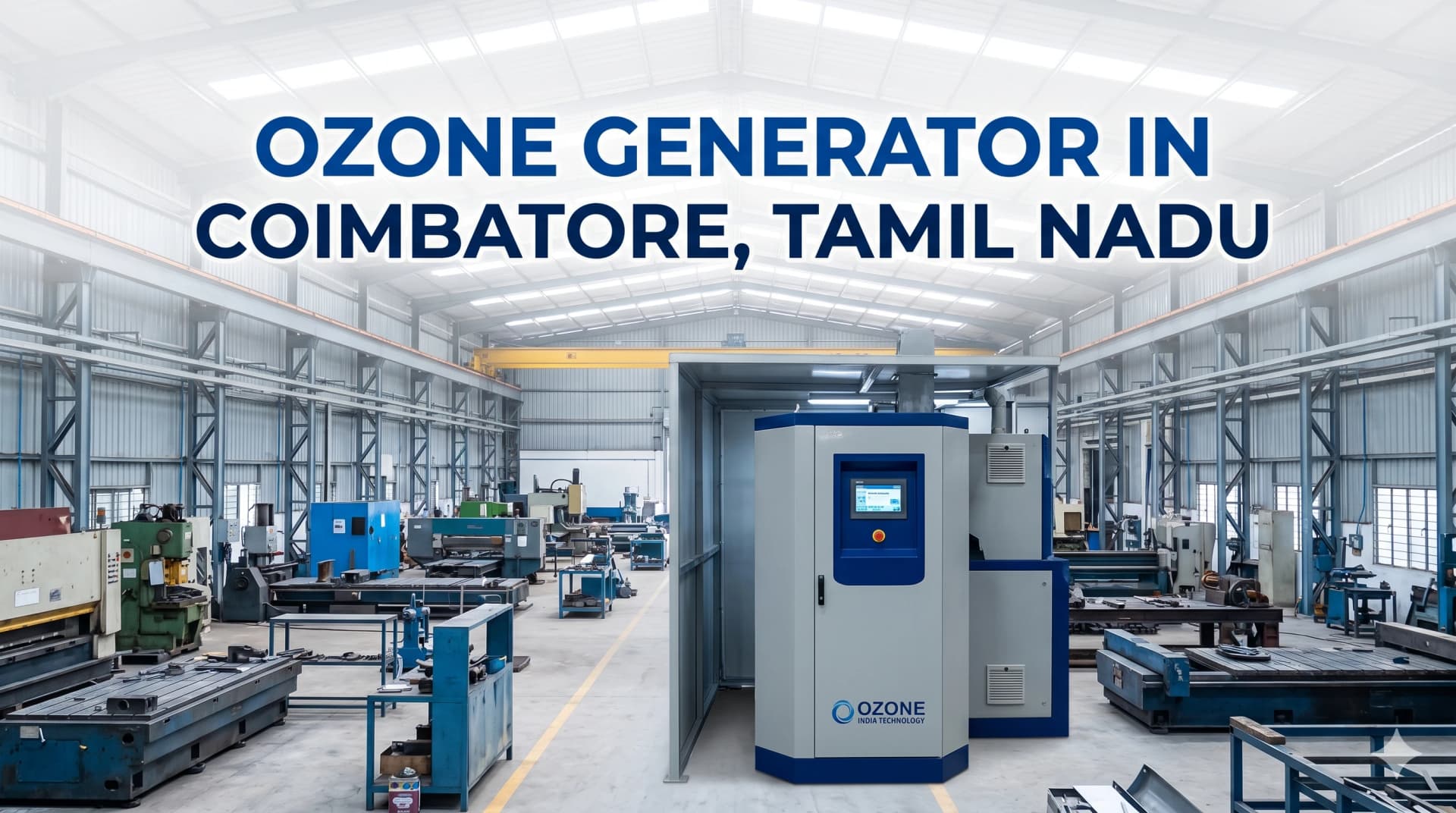
Ozone Generator in Coimbatore, Tamil Nadu addresses the most pressing environmental compliance challenge in South India's textile capital — the chronic failure of Tiruppur and Coimbatore district's textile dyeing CETPs to meet TNPCB's (Tamil Nadu Pollution Control Board) colour-absent discharge standard for the Noyyal River, a failure that has attracted Madras High Court intervention and state government-mandated CETP technology upgrades. Coimbatore — known as the "Manchester of South India" — is the hub of India's spinning, weaving and hosiery industry, and its satellite Tiruppur is the world's third-largest knitwear exporter. Ozone India Technology — India's CE-certified, ISO 9001:2015 manufacturer of industrial ozone generators — supplies factory-direct ozone systems to Coimbatore and Tiruppur with same-week delivery and full TNPCB compliance documentation. Contact our team at +91 96500 17943.
Water and Industrial Challenges in Coimbatore
The Noyyal River — a 175 km Cauvery tributary flowing from the Nilgiri foothills through Tiruppur and Coimbatore to join the Cauvery at Musiri — has been declared biologically dead in its 60 km stretch through the textile industrial belt. The Tiruppur Export Knitwear Industrial Complex (TEKIC) houses 700-plus dyeing and bleaching units that generate 97 million litres of effluent per day, treated by 15 CETPs (Common ETPs). The Supreme Court of India, in Noyyal River case (2011), ordered closure of 700-plus dyeing units for CETP non-compliance and directed Tamil Nadu government to demonstrate measurable Noyyal River quality improvement before units could reopen.
Despite CETP upgrades and the reopening of units, TNPCB monitoring at Noyyal bridge points between Tiruppur and Coimbatore consistently finds residual colour (ADMI values of 40 to 120 vs TNPCB colour-absent standard) in CETP effluent — because biological treatment and coagulation cannot fully remove reactive dye chromophores. The Madras High Court's monitoring committee continues to review Noyyal data, and TNPCB has issued directions requiring CETP operators to demonstrate advanced treatment technology adoption to avoid re-closure.
Coimbatore's own industrial base — pump manufacturing (Coimbatore is India's pump manufacturing hub with 2,500 manufacturers including Grundfos India, Kirloskar Brothers), textile machinery and engineering — generates metalworking coolant waste, electroplating effluent and machining swarf that require TNPCB ETP compliance. The Sidco Industrial Estate (Ganapathy), Mettupalayam Road industrial belt and Singanallur industrial area are primary TNPCB focus zones.
The Kovai Kutralam falls, Anamalai Tiger Reserve's catchment rivers and the Bhavani River system depend on Noyyal water quality — creating environmental and regulatory pressure beyond industrial compliance alone. Coimbatore district's flower farming (jasmine — largest in India) uses river and groundwater for irrigation, creating food safety and product quality implications from contaminated irrigation water.
How Ozone Technology Addresses Coimbatore's Challenges
For Tiruppur-Coimbatore CETP post-treatment, ozone at 15 to 25 mg/L applied dose after secondary biological clarifier reduces ADMI colour from 60 to 120 ADMI (typical CETP secondary output) to below 10 ADMI (TNPCB colour-absent standard) in 15 to 20 minutes — achieving the compliance that the Madras High Court monitoring committee requires. Ozone simultaneously reduces residual COD by 40 to 60 percent and destroys surfactant residuals (foam-causing agents that create visible froth in the Noyyal River during high-discharge periods).
For Coimbatore's pump and engineering sector ETP, ozone at 10 to 15 mg/L destroys cutting oil emulsions, metalworking coolant residuals and solvent degreaser compounds — achieving TNPCB effluent compliance for metal industry parameters (oil and grease below 10 mg/L, hexavalent chromium below 0.1 mg/L from electroplating) without the sludge generation associated with coagulation.
For jasmine flower farming irrigation water, ozone at 0.2 to 0.5 mg/L in stored irrigation water controls Botrytis and Fusarium fungal pathogens that reduce jasmine yield and market quality — enabling Coimbatore's flower farmers to achieve consistent high-grade jasmine output for Chennai and Mumbai flower markets.
Noyyal River CETP Effluent — Colour Reduction by Treatment Technology (ADMI units)
Key Applications in Coimbatore
Tiruppur Textile CETP Post-Treatment — 15 CETPs
Tiruppur's 15 CETPs require ozone polishing to achieve TNPCB colour-absent standard. Ozone India Technology supplies 50 to 200 g/hr CETP-scale ozone generators with Madras High Court-compatible performance documentation. Our systems include dissolved ozone monitoring, automatic dosing and operational data logs aligned to TNPCB and Court monitoring committee audit formats.
Pump and Engineering ETP — Sidco and Ganapathy
Coimbatore's pump manufacturing and engineering clusters require ETP compliance for metal industry parameters. Ozone India Technology supplies 10 to 50 g/hr industrial ETP ozone systems for cutting oil, electroplating and machining coolant effluent treatment. TNPCB-aligned calibration and consent documentation included.
Textile Machinery and Chemicals — Mettupalayam Road
Textile machinery manufacturers and speciality chemical units require BOD and COD compliance for TNPCB consent renewal. Ozone India Technology supplies 5 to 30 g/hr ozone generators for tertiary ETP polishing, achieving TNPCB Standard I and II compliance for the Noyyal River basin area.
Jasmine Flower Farming Irrigation — Coimbatore District
Coimbatore district produces over 60,000 tonnes of jasmine annually. Ozone irrigation water treatment at 0.2 to 0.5 mg/L controls soil-borne and foliar pathogens, reduces chemical fungicide use and improves flower quality grade. Compact 2 to 5 g/hr systems serve 5 to 50 acre jasmine farm clusters.
Why Indian-Manufactured Ozone Technology Suits India
Chennai (closest major hub) to Coimbatore: 500 km by road; our Ghaziabad facility is 2,200 km — delivered in 36 to 48 hours by truck freight or overnight railway. TNPCB audit-ready documentation based on our 50-plus Tamil Nadu installations. CE-2621A and ISO 9001:2015 accepted without additional approvals. Factory-direct pricing 30 to 40 percent below European ozone systems. Tamil Nadu's humid tropical climate (30 to 35°C, 65 to 85% RH) is within our systems' tropical-rated operating range.
Compliance and Standards in Coimbatore
TNPCB enforces CPCB General Standards and special standards for the Noyyal River basin: colour absent (per Madras High Court order), BOD below 30 mg/L, COD below 250 mg/L. CETP operators in Tiruppur are under direct Court monitoring. Individual dyeing units require TNPCB consent-to-operate linked to CETP performance. OCEMS mandatory for large CETPs.
Coimbatore Engineering Sector ETP — Key Parameter Removal (mg/L, by technology)
Frequently Asked Questions
What ozone dose is required for Tiruppur CETP to achieve TNPCB colour-absent standard?
Tiruppur CETP secondary effluent typically has ADMI colour of 60 to 120 and COD of 150 to 250 mg/L. Ozone at 15 to 20 mg/L applied dose in a 20-minute contact time achieves colour below 10 ADMI (colour absent per TNPCB standard) and COD below 100 mg/L in the combined treatment. Contact us for a free sizing calculation based on your CETP volume and effluent quality data.
Has Ozone India Technology installed ozone in Tamil Nadu textile CETPs previously?
Yes. We have installed ozone systems in textile ETP and CETP applications in Tamil Nadu and across India. Contact us for reference site details or to arrange a reference site visit in the Tamil Nadu textile belt.
Can ozone treat Coimbatore electroplating wastewater?
Ozone at 10 to 15 mg/L oxidises hexavalent chromium (Cr VI) in electroplating rinse water — Cr VI is reduced to Cr III which precipitates as chromium hydroxide at pH 8 to 9. Total chromium in effluent is reduced to below TNPCB's 2 mg/L standard. Cyanide (from copper or zinc cyanide plating) is also destroyed by ozone at 5 to 8 mg/L — achieving TNPCB cyanide below 0.2 mg/L.
How quickly can ozone be installed at a Tiruppur CETP without stopping operations?
Ozone post-treatment is added after the existing secondary clarifier without modifying existing CETP infrastructure. A typical 2,000 KLD CETP installation (50 to 75 g/hr ozone system with contact tank and dissolved ozone monitor) takes 3 to 5 working days to install and commission. CETP operations continue during installation.
How to Get an Ozone System for Coimbatore
Contact us:
- Phone / WhatsApp: +91 96500 17943
- Email: [email protected]
Free TNPCB-aligned application assessment and factory-direct quotation within 2 hours. On-site assessment in Coimbatore or Tiruppur available within 72 hours.