
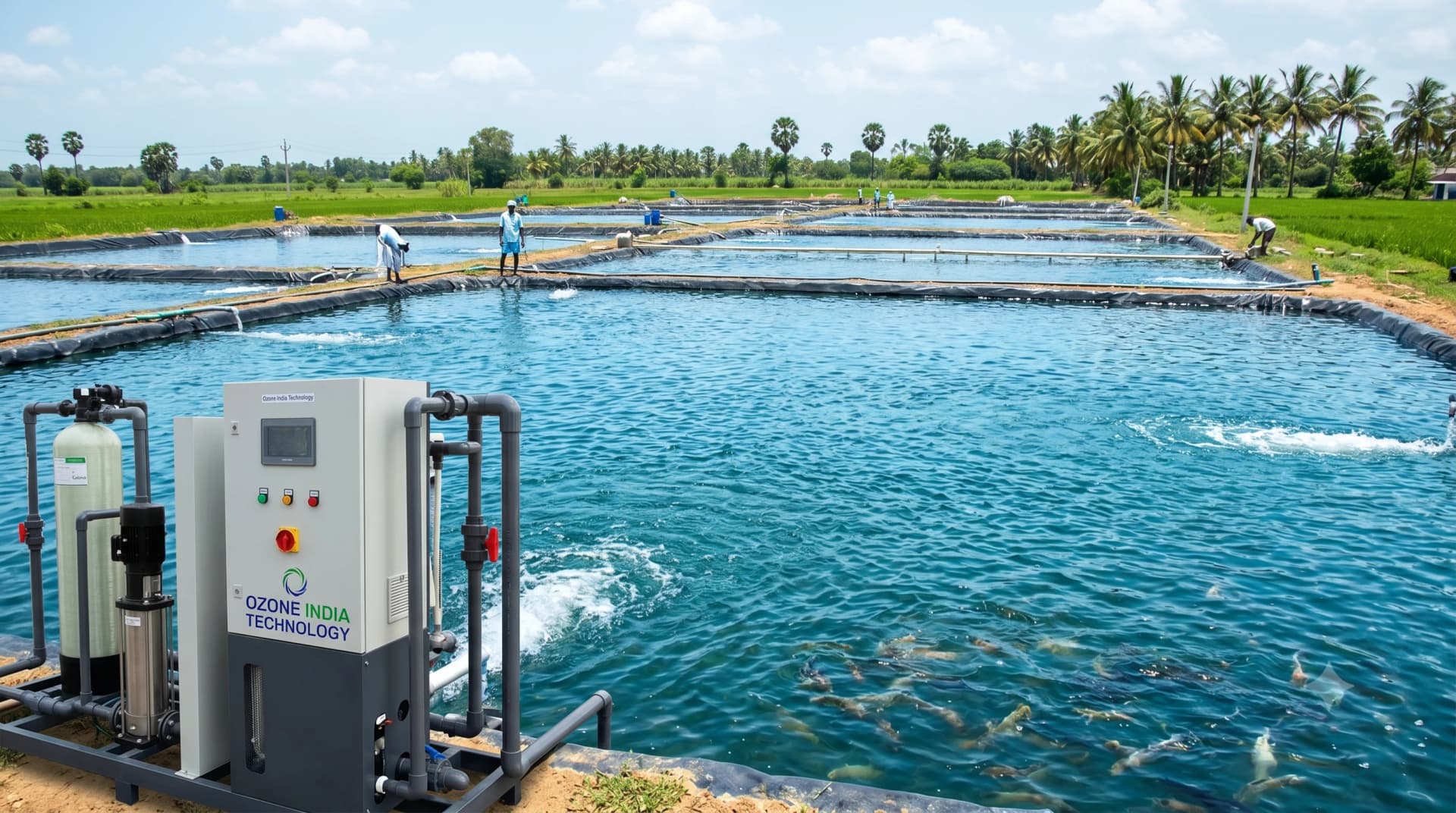
Ozone generator aquaculture fish farm shrimp India applications are transforming vannamei shrimp, tilapia, and catfish production by replacing antibiotic-based disease management with ozone-mediated water quality control — achieving 90 to 94 percent survival rates in Recirculating Aquaculture Systems (RAS) and semi-intensive pond systems while producing antibiotic-residue-free seafood that meets MPEDA export standards, FSSAI domestic market requirements, and the zero-antibiotic-residue requirements of EU, Japan, and US import markets. Ozone India Technology, based in Greater Noida, manufactures CE and ISO 9001 certified corona discharge ozone generators and dissolved ozone monitoring systems specifically designed for Indian aquaculture applications.
How Ozone Improves Water Quality in Aquaculture
Aquaculture water quality deteriorates through the continuous accumulation of fish metabolic waste — ammonia from protein metabolism, dissolved organic carbon from uneaten feed and faecal matter, and bacterial pathogen populations that increase proportionally with organic load. Conventional aquaculture management uses partial water exchange to dilute these parameters, but daily water exchange of 10 to 30 percent of tank volume is costly and environmentally unsustainable. In water-scarce regions of Andhra Pradesh, Odisha, and West Bengal — where Indian shrimp production is concentrated — water exchange also raises concerns about coastal saline groundwater depletion.
Ozone at dissolved concentrations of 0.01 to 0.05 mg/L in aquaculture tank water — well below the acute toxicity threshold for shrimp and fish (NOEC approximately 0.1 mg/L for shrimp larvae) — achieves simultaneous oxidation of organic compounds (COD reduction), nitrite oxidation, colour removal, and bacterial disinfection. FAO Fisheries and Aquaculture Technical Paper 583 (2014) documents that ozone treatment of recirculated aquaculture water at 0.01 to 0.05 mg/L residual achieves: 60 to 80 percent reduction in dissolved organic carbon, 90 percent reduction in total viable bacterial count, nitrite oxidation at a rate of 1.8 mg NO₂-N per mg O₃, and complete removal of suspended particulate matter through micro-flocculation.
Antibiotic-Free Production for Export Markets
India is the world's second-largest shrimp exporter, with vannamei shrimp exports to the EU, USA, Japan, and China exceeding USD 4 billion annually. However, antibiotic residue detection in Indian shrimp consignments has resulted in multiple EU Rapid Alert System for Food and Feed (RASFF) notifications and US FDA import alerts over the past decade, causing significant damage to India's export reputation and resulting in costly batch rejections.
MPEDA (Marine Products Export Development Authority) guidelines require MPEDA-registered shrimp processors and farms to implement antibiotic-free production practices. EU Regulation (EC) No 470/2009 sets Maximum Residue Limits (MRLs) for veterinary drug residues in seafood at levels that effectively ban the use of oxytetracycline, ciprofloxacin, and chloramphenicol — antibiotics commonly used in Indian aquaculture — for export-oriented production.
Ozone-based water quality management in RAS and pond systems reduces the pathogen pressure on fish and shrimp populations, reducing the incidence of bacterial diseases (Vibrio, Aeromonas) that drive antibiotic use. FSSAI under the Food Safety and Standards (Contaminants, Toxins and Residues) Regulations 2011 also sets MRLs for antibiotic residues in seafood intended for the Indian domestic market.
System Design for Shrimp RAS
A standard shrimp RAS unit for vannamei production consists of circular fibre-reinforced plastic (FRP) tanks of 20 to 100 m³ volume with a trickling biofilter, drum filter, and recirculation pump. Ozone India Technology installs a side-stream ozone contact system that treats 20 to 30 percent of the total tank volume per hour: water is drawn from the tank sump, injected with dissolved ozone through a venturi injector at 0.1 to 0.3 mg/L, passed through a short contact column, and returned to the main recirculation loop.
A dissolved ozone monitor on the return line confirms that residual ozone concentration in the treated water returning to the tank is at or below 0.05 mg/L — below the chronic toxicity threshold for shrimp. If ozone residual exceeds the set point, an automatic control valve reduces ozone injection. The system maintains 0.01 to 0.05 mg/L dissolved ozone in the tank water continuously, providing ongoing pathogen suppression without chemical treatment.
Ozone India Technology systems for aquaculture use oxygen-fed corona discharge generators for higher ozone output efficiency — oxygen-fed systems produce 12 to 14% by weight ozone compared to 3 to 5% for air-fed systems, reducing the ozone generator size required and improving dissolved ozone delivery efficiency.
Aquaculture Water Quality — Ozone RAS vs Conventional Management (% improvement)
Fish Farm Survival Rate — With Ozone vs Without (%)
Frequently Asked Questions
What dissolved ozone concentration is safe for vannamei shrimp?
The chronic no-observed-effect concentration (NOEC) for dissolved ozone in vannamei shrimp is approximately 0.04 to 0.05 mg/L for post-larvae and 0.08 to 0.1 mg/L for adult shrimp. Ozone India Technology aquaculture systems are designed to maintain dissolved ozone in the tank at 0.01 to 0.03 mg/L — well below the NOEC — with automatic cutoff if concentration exceeds 0.05 mg/L.
Does ozone treatment eliminate the need for water exchange in shrimp RAS?
Ozone significantly reduces the required water exchange rate by maintaining organic load and bacterial count below critical thresholds with less dilution. In a well-designed ozone-equipped RAS, water exchange rates of 5 to 10 percent per day (compared to 20 to 30 percent in conventional systems) are achievable while maintaining water quality within shrimp tolerance ranges.
How does ozone improve shrimp survival rates?
Ozone reduces the Vibrio bacterial load — the primary pathogen responsible for AHPND (Acute Hepatopancreatic Necrosis Disease, formerly EMS) in Indian shrimp farms — from typical pond water concentrations of 10³ to 10⁴ CFU/mL to below the disease-triggering threshold of 10² CFU/mL. This bacterial load reduction is the primary mechanism by which ozone treatment improves survival rates from the Indian average of 60 to 70 percent to 90 to 94 percent.
Is ozone compatible with the biofilter in an RAS system?
Ozone must be applied in a side-stream, separate from the biofilter recirculation loop. Dissolved ozone at concentrations above 0.1 mg/L can damage the nitrifying bacteria in a biofilter. Ozone India Technology RAS designs include a bypass contact system that treats a fraction of the recirculated water, with residual ozone decomposing before the treated water re-enters the main biofilter loop.
What certification does Ozone India Technology provide for aquaculture systems?
CE certificate, ISO 9001 certificate, and complete technical documentation for MPEDA system audit support. Dissolved ozone monitor calibration certificates and installation commissioning report for farm quality records.