
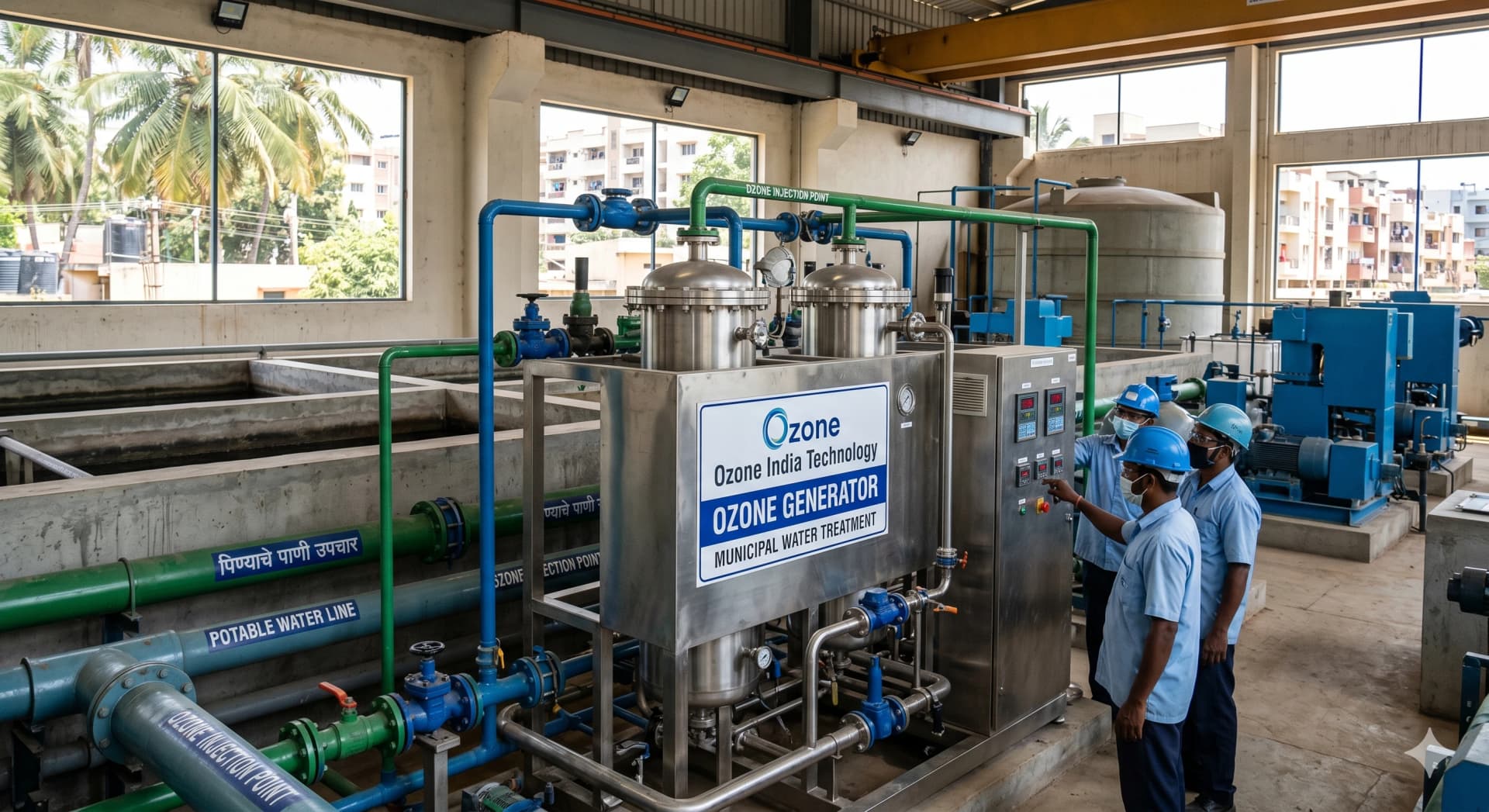
What Is an Ozonation System?
An ozonation system is a complete water or air treatment installation that generates ozone on-site and applies it to destroy pathogens, oxidise organic contaminants, remove colour, and eliminate odour — without leaving chemical residue.
The core of any ozonation system is the ozone generator. Around it are the components that make the system functional for a specific application: feed gas drying, ozone dissolution, contact time management, off-gas destruction, and process monitoring.
An ozonator system is the same thing — the two terms are used interchangeably in the Indian market. Buyers searching for either are looking for the same engineered solution.
Ozonation System — Typical Component Contribution to System Cost
Key Components of an Ozonation System
1. Ozone Generator
The generator uses corona discharge across a dielectric cell (quartz tube or ceramic plate) to split O₂ into atomic oxygen, which recombines as O₃. Output is measured in g/hr. The feed gas is either dried ambient air (producing 1–3% ozone by weight) or PSA oxygen (producing 6–12% ozone by weight).
Feed gas choice matters:
- Dry air systems: lower capital cost, higher operating cost per gram of ozone
- Oxygen-fed systems: higher capital cost, significantly lower energy per gram — preferred above 100g/hr
2. Feed Gas Drying
Moisture destroys ozone cells by creating nitric acid in the discharge gap. Feed air must be dried to a dew point of −40°C or lower before entering the generator. Methods: silica gel towers (small systems), refrigerant air dryers (medium), desiccant dryer towers with regeneration (industrial).
3. Ozone Contactor / Contact Vessel
Ozone must dissolve into water with sufficient contact time to complete the disinfection or oxidation reaction. Common designs:
| Contactor Type | Transfer Efficiency | Typical Application |
|---|---|---|
| Venturi injector | 85–95% | Water treatment, small flow |
| Bubble diffuser | 80–90% | Large volume, municipal |
| Static mixer + pipe | 70–85% | Inline treatment |
| Packed tower | 90–98% | High-demand industrial |
4. Ozone Destructor
Ozone off-gas from the contactor must NOT be vented untreated. An ozone destructor (catalytic or thermal) converts residual ozone back to oxygen before discharge. This is a safety and compliance requirement — CPCB and factory safety regulations require it for any ozonation system above 10g/hr.
5. Dissolved Ozone Monitor
A dissolved ozone sensor confirms actual dose delivery in the treated water — the only way to verify the ozonation system is performing to specification. Critical for pharmaceutical and food applications where compliance documentation is required.
Applications of Ozonation Systems in India
Ozonation System Applications — Typical Ozone Dose Required
Drinking Water & Packaged Water (IS:14543)
Ozone dose: 0.2–0.5 mg/L, 3–5 min contact. Mandated by FSSAI for packaged drinking water under IS:14543. Eliminates Cryptosporidium and Giardia — which chlorine cannot inactivate at normal doses.
ETP / STP Tertiary Treatment (CPCB Compliance)
Ozone dose: 10–30 mg/L for colour removal; 5–10 mg/L for BOD/COD polishing. Textile ETPs use ozone for reactive dye colour destruction — a CPCB compliance requirement that biological treatment cannot achieve alone.
Pharmaceutical Purified Water (USP/WHO GMP)
Ozone dose: 0.1–0.2 mg/L continuous recirculation. Used for biofilm control in purified water distribution loops, replacing thermal sanitization cycles. Documentation package for WHO GMP and CDSCO compliance.
Food Processing CIP (FSSAI)
Ozone dose: 0.5–3 mg/L for surface and equipment sanitization. Replaces chlorine-based sanitizers — no taste residue, no chemical procurement, FSSAI recognised.
Cooling Towers (Legionella Control)
Ozone dose: 0.2–0.5 mg/L basin concentration. Eliminates Legionella, controls scale-forming biofilm, reduces blowdown frequency. ROI typically 12–18 months through water savings alone.
How to Size an Ozonation System
Step 1: Determine flow rate (m³/hr or LPH)
Step 2: Determine ozone dose from application table above (mg/L)
Step 3: Calculate ozone demand:
Ozone demand (g/hr) = Flow (m³/hr) × 1000 × Dose (mg/L) ÷ 1,000,000 × 1,000,000 ÷ 1000
Simplified: g/hr = m³/hr × dose (mg/L)
Step 4: Add 20–30% safety margin for water quality variation
Step 5: Select next standard generator size above calculated demand
Example: STP polishing, 50 m³/hr, 8 mg/L ozone dose → 400 g/hr demand → select 400–500g/hr generator
Ozonation System vs. Chlorination — When to Choose Ozone
| Factor | Ozonation System | Chlorination |
|---|---|---|
| Cryptosporidium kill | ✓ Effective | ✗ Ineffective |
| Colour removal | ✓ Complete | ✗ Partial |
| Chemical residue | Zero | Chlorine taste/smell |
| Disinfection by-products | Minimal | THMs, HAAs |
| Ongoing chemical cost | Electricity only | Chlorine procurement |
| Compliance documentation | CE/ISO available | BIS standard |
Ozone India Technology — Ozonation Systems
Ozone India Technology (Greater Noida, UP) designs, manufactures, and commissions ozonation systems from 2g/hr to 10kg/hr for all applications listed above.
- Certifications: CE-2621A, ISO 9001 UQ-270426AD1, ISO 12100, RoHS, UDYAM
- Delivery: Pan-India with site commissioning
- Documentation: FAT report, O&M manual, compliance certificates
Free sizing consultation: Send water analysis report + flow rate to +91 96500 17943 or WhatsApp.
Conclusion
An ozonation system — whether called an ozonation system or ozonator system — is the most effective water treatment technology for applications where chlorine fails: Cryptosporidium, colour removal, pharmaceutical bioburden, and food safety CIP. Correct sizing, feed gas drying, and proper off-gas management are the three factors that determine long-term system reliability. For a free sizing calculation specific to your application, contact Ozone India Technology.