
Introduction
Ceramic ozone plates are the core component inside most small and medium ozone generators — from portable air purifiers and car purifiers to small water treatment units. Understanding how ceramic ozone plates work, how long they last, and when to replace them helps you get the most from your ozone generator and avoid unexpected downtime.
This guide covers ceramic ozone plates vs. quartz tube cells, replacement intervals, and how to identify a failing plate.
What Are Ceramic Ozone Plates?
Ceramic ozone plates are flat dielectric barrier discharge (DBD) electrodes used to generate ozone. A typical plate consists of:
- Two metal electrodes (usually stainless steel or aluminium mesh)
- A ceramic dielectric layer between them (aluminium oxide or titanium oxide ceramic)
- A narrow air gap across which the electrical discharge occurs
When high-voltage, high-frequency alternating current (typically 8–15 kV at 1,000–5,000 Hz) is applied across the electrodes, a silent discharge (corona discharge) forms in the air gap. This discharge breaks oxygen molecules (O₂) into oxygen atoms (O), which then combine to form ozone (O₃).
The ceramic layer is the critical component — it prevents arcing (spark discharge that would destroy the electrodes), distributes the corona discharge uniformly across the plate surface, and determines both ozone output concentration and plate longevity.
Ceramic vs Quartz Ozone Cell — Performance Comparison
Ceramic Ozone Plates vs. Quartz Tube Cells
| Parameter | Ceramic Plates | Quartz Tubes |
|---|---|---|
| Ozone concentration | 1–3% (w/w in air) | 3–12% (w/w in O₂) |
| Energy efficiency | Lower | Higher |
| Service life | 3–5 years (continuous duty) | 8–15 years |
| Moisture sensitivity | High — ceramic degrades with humidity | Moderate |
| Capital cost | Lower | Higher |
| Repairability | Plate replacement | Cell rebuild possible |
| Typical application | Portable/small units, air treatment | Industrial water treatment |
| Max practical capacity | ~50g/hr | Unlimited |
When to use ceramic plates: Portable ozone generators, car purifiers, small air treatment units (2–10g/hr), food cabinet sanitizers, hotel room disinfection units. The lower capital cost and simple replacement make ceramic plates practical for these applications.
When to use quartz tubes: Any application above 10g/hr for water treatment, industrial water treatment, pharmaceutical water, food processing with continuous 24/7 duty cycles. The higher ozone concentration and longer life give significantly better total cost of ownership at scale.
How Long Do Ceramic Ozone Plates Last?
Ceramic ozone plate lifespan depends heavily on operating conditions:
| Operating Condition | Expected Life |
|---|---|
| Intermittent use (<4 hr/day), dry air, <25°C | 4–6 years |
| Continuous use (8–12 hr/day), dry air, <30°C | 2–4 years |
| Continuous use, humid air (>60% RH), >35°C | 1–2 years |
| Continuous use, no feed gas drying | 6–18 months |
Humidity is the biggest enemy of ceramic plates. When humid air passes through the ozone cell, moisture in the discharge gap leads to nitric acid formation — which etches and erodes the ceramic surface, reducing ozone output and eventually causing plate failure. This is why industrial ozone generators use feed gas dryers (silica gel, refrigerant dryer, or desiccant tower) to reduce feed air humidity below -40°C dew point.
Ceramic Ozone Plate Life vs. Feed Air Humidity
Signs That Ceramic Ozone Plates Need Replacement
- Reduced ozone output: Ozone smell is weaker than when the unit was new; water treatment results are declining
- Increased power draw: The generator consumes more electricity than its rated wattage
- Visible cracking or discolouration: If the plate is accessible for inspection, cracks, pitting, or yellow-brown discolouration indicate ceramic degradation
- Corona discharge visible: In a dark room, healthy plates show a uniform blue-purple glow; failing plates show uneven glow or bright spots indicating arcing
- Overheating: Failing plates generate more heat due to increased resistance from ceramic degradation
- Intermittent output: Ozone concentration varies unpredictably during a single session
How to Replace Ceramic Ozone Plates
Plate replacement difficulty varies by generator design:
- Disconnect power and allow the unit to cool completely (ozone cells can reach 60–80°C during operation)
- Open the housing — typically 4–6 screws on the panel
- Discharge any capacitors if present (use a resistive discharge tool)
- Remove electrode connections — typically push-on spade connectors or screw terminals
- Slide out the old plate noting orientation and spacing
- Install new plate in the same orientation with the same gap distance
- Reconnect electrodes ensuring firm contact
- Test output — ozone smell should be immediately noticeable within 30 seconds of power-on
Safety note: Never operate an ozone generator with the housing open. Ozone concentrations above 0.1 ppm (OSHA 8-hour TWA limit) can cause respiratory irritation. Always operate in ventilated spaces or with an ozone destructor if running continuously in occupied areas.
Buying Replacement Ceramic Ozone Plates in India
Replacement ceramic plates are available from:
- The original equipment manufacturer (OEM)
- Ozone generator spare parts suppliers in major cities
- Industrial electronics distributors
Specification to match when ordering:
- Physical dimensions (length × width × thickness in mm)
- Voltage rating (typically 8–12 kV)
- Frequency rating (typically 1,000–5,000 Hz)
- Ozone output rating (g/hr)
Warning: Generic replacement plates from unverified suppliers may have inconsistent ceramic quality, incorrect dielectric constant, or wrong gap distance — all of which reduce ozone output and accelerate failure. Always source from the OEM or a verified spare parts supplier.
Ceramic Plates vs. Quartz Plates — The Terminology
Some manufacturers label quartz ozone cells as "plates" due to flat plate configurations, but quartz dielectric cells differ fundamentally from ceramic plates in material, construction, and performance. If a supplier quotes you "quartz plates," verify they are genuine fused silica quartz — not glass (which has lower UV transmissivity and shorter life) or ceramic (which has different performance characteristics).
Genuine fused silica quartz has:
- UV transmissivity > 90% at 254nm
- Maximum service temperature > 1,000°C
- Superior resistance to ozone corrosion vs. borosilicate glass
Ozone India Technology — Ozone Generator Products
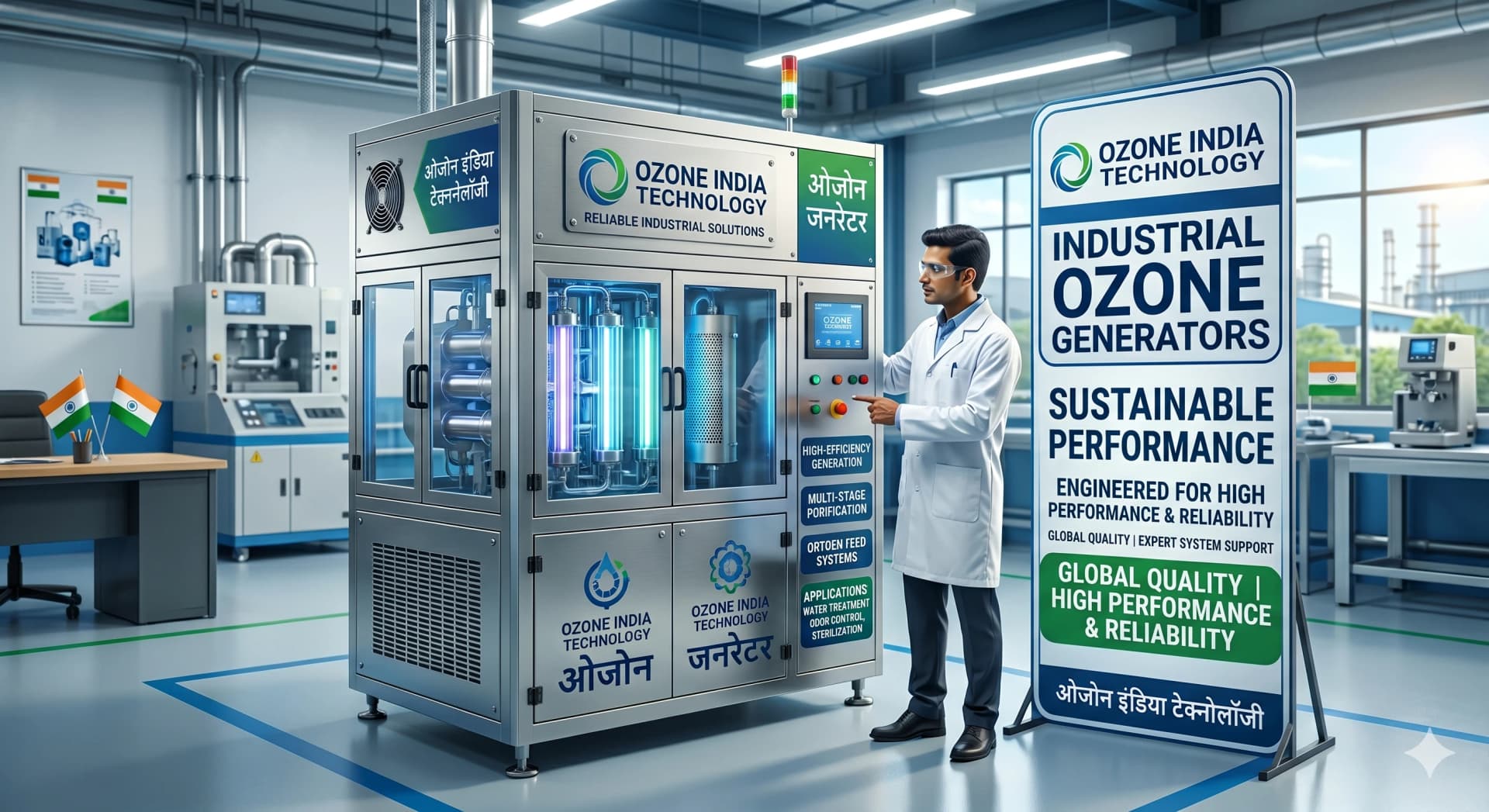
Ozone India Technology manufactures ozone generators from 2g/hr to 10kg/hr. Small portable units (2g/hr, 5g/hr) use optimised ceramic plate cells with aluminium electrode construction and silica gel feed gas drying. Industrial units (10g/hr and above) use cylindrical quartz tube cells in SS316L contact chambers for higher concentration and longer service life.
- Spare parts availability: Ozone India Technology stocks replacement cells for all its models
- Service support: Field engineers available across North India
- Warranty: 1-year comprehensive warranty, 2-year ozone cell warranty on industrial models
Contact for spare parts or new equipment: +91 96500 17943 | WhatsApp | [email protected]
Conclusion
Ceramic ozone plates are the most common dielectric barrier discharge cell type in small and medium ozone generators used across India. They offer low initial cost and simple replacement but have shorter service life than quartz tube cells — particularly in humid operating environments. For applications requiring 24/7 continuous duty above 10g/hr, quartz tube cells are the better long-term investment. Understanding the difference helps you specify the right equipment and plan maintenance correctly for your ozone system.