
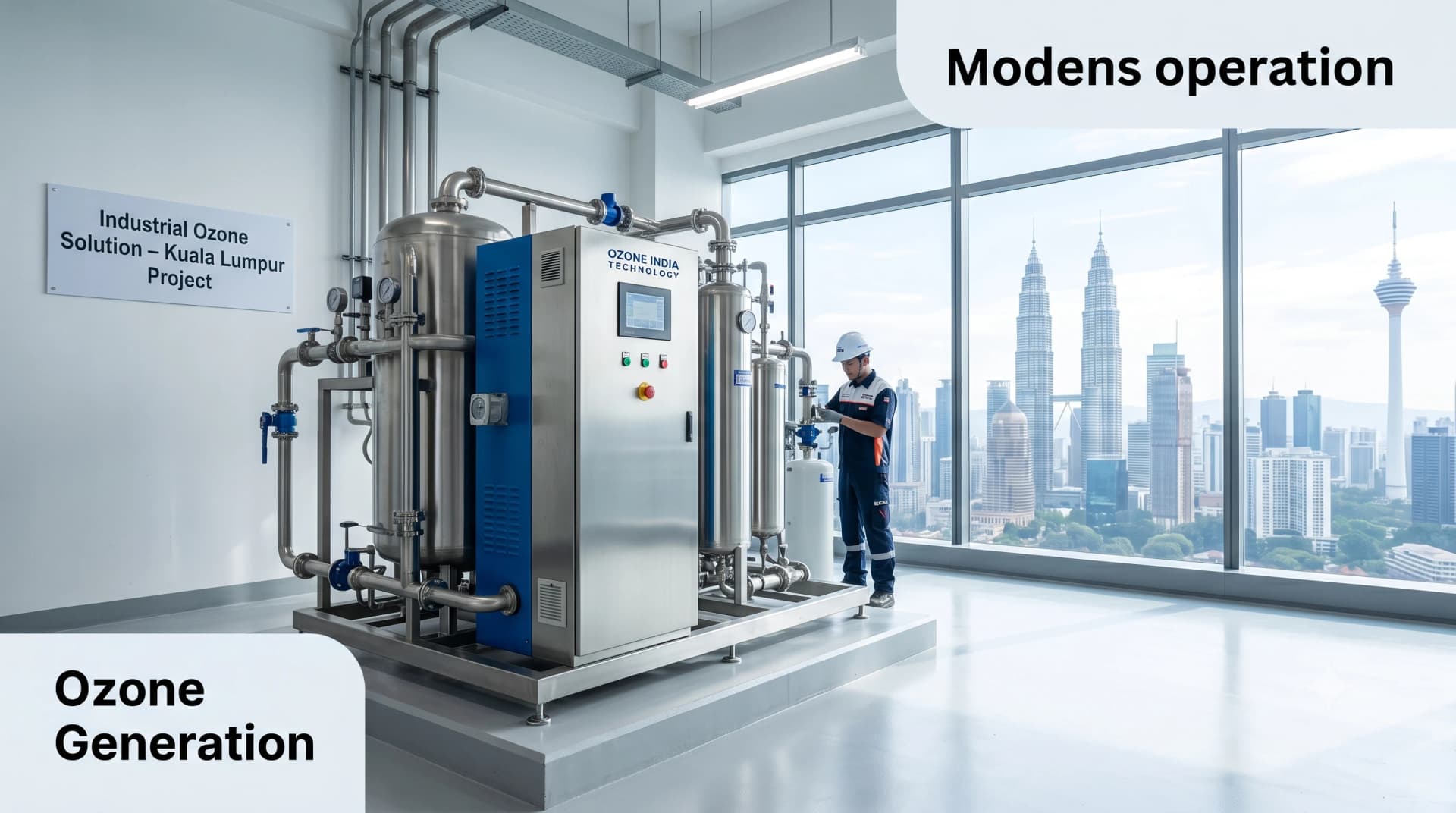
Ozone Generator in Kuala Lumpur, Malaysia serves the country's rapidly expanding industrial base as the Department of Environment (DOE Malaysia) enforces increasingly stringent effluent standards under the Environmental Quality Act 1974, compelling manufacturers in Selangor, Johor and Sabah to adopt advanced treatment technologies. Ozone India Technology — India's CE-certified, ISO 9001:2015 manufacturer of industrial ozone generators — exports to Malaysia under the India-ASEAN Free Trade Agreement (0% import duty on HS 8421.39) with factory-direct pricing 30 to 40 percent below European alternatives. This guide covers Malaysia's specific industrial water challenges, the applications driving ozone adoption, and why Indian-manufactured ozone technology suits Malaysia's tropical climate and DOE regulatory environment. Contact our team at +91 96500 17943 for a free application-specific consultation.
Water and Industrial Challenges in Malaysia
Malaysia faces a paradox of water abundance and water scarcity — the country receives 3,000 mm of annual rainfall yet faces episodic water stress in Selangor (home to 6.5 million people and Malaysia's largest industrial zone) due to river pollution that renders source water unsuitable for treatment without significant pre-treatment. The Klang River, which flows through Kuala Lumpur and Shah Alam before emptying into Port Klang, is classified as "slightly polluted" to "polluted" (Class III-IV) along its lower reaches due to industrial and domestic discharge from the Klang Valley urban agglomeration.
The DOE Malaysia enforces Effluent Standards A and B under the Environmental Quality (Industrial Effluents) Regulations 2009: Standard A (upstream of water intakes) requires COD below 80 mg/L, BOD below 20 mg/L and TSS below 50 mg/L. Standard B (general discharge) allows COD below 200 mg/L and BOD below 50 mg/L. DOE's EIS (Environmental Impact Statement) requirement for new manufacturing facilities and quarterly sampling audits make compliance a high-priority business risk.
Malaysia is the world's second-largest palm oil producer (after Indonesia), producing 18 to 19 million tonnes of crude palm oil annually. Palm Oil Mill Effluent (POME) is Malaysia's most significant industrial effluent challenge — each tonne of crude palm oil produces 5 to 7 tonnes of POME with BOD exceeding 25,000 mg/L. The Malaysian Palm Oil Board (MPOB) estimates that while most large mills have anaerobic digestion ponds, fewer than 15 percent achieve DOE Standard B consistently, creating significant compliance risk under tighter enforcement.
Malaysia's semiconductor manufacturing sector — centred in Penang's Bayan Lepas Free Trade Zone and Selangor's Petaling Jaya — requires ultrapure water (UPW) for chip fabrication at resistivity above 18 MΩ·cm. Intel Malaysia, Micron Technology and Infineon Technologies operate major fabrication facilities requiring immense volumes of ultrapure water, with ozone used for TOC (Total Organic Carbon) reduction in the polishing loop. Penang's water treatment plants are already stretched by this demand, making on-site advanced water treatment a priority investment.
Port Klang, Malaysia's main shipping hub handling 14 million TEUs annually, anchors a major seafood processing cluster exporting shrimp, fish and other seafood to EU, Japan and Korea markets. MAFSA (Malaysian Agricultural Research and Development Institute Food Safety Division) and DOE jointly regulate processing facility effluent and process water quality for export certification.
How Ozone Technology Addresses Malaysia's Challenges
Ozone at 15 to 25 mg/L applied dose achieves 70 to 85 percent COD reduction in palm oil POME post-anaerobic digestion — reducing residual BOD from 500 to 1,500 mg/L down to DOE Standard B's 50 mg/L limit in a 20 to 30 minute contact time. This makes ozone polishing of POME the most practical and cost-effective tertiary treatment pathway for Malaysian mills, compared to membrane bioreactors (MBR) that require intensive maintenance in tropical conditions or Fenton's reagent that generates chemical sludge.
For semiconductor wafer fabrication, ozone is applied in the ultrapure water loop at 1 to 5 mg/L to maintain TOC below 1 ppb (parts per billion) — meeting SEMI F57 standard for semiconductor-grade ultrapure water. Ozone destroys trace organics that ion exchange and RO membranes cannot fully remove, enabling consistent UPW quality for advanced node (below 28 nm) semiconductor fabrication.
For seafood export processing, dissolved ozone at 0.5 to 1.5 mg/L in process wash water eliminates Listeria, Salmonella and Vibrio parahaemolyticus at 4 to 5 log reduction — achieving simultaneous DOE effluent quality improvement and EU Regulation 853/2004 food safety compliance.
Malaysia POME Treatment — BOD Reduction by Technology (mg/L to DOE Standard B)
Key Applications in Malaysia
Palm Oil Mill POME — Johor, Sabah and Sarawak
Malaysia's palm oil mills — concentrated in Johor (212 mills), Sabah (139 mills) and Sarawak (97 mills) — face MPOB license conditions requiring DOE-compliant POME treatment as a prerequisite for Roundtable on Sustainable Palm Oil (RSPO) certification. RSPO certification is increasingly required by European and US buyers of Malaysian palm oil. Ozone India Technology supplies 75 to 350 g/hr large-scale industrial ozone systems for POME polishing post-anaerobic digestion, configured with dissolved ozone monitoring, automatic dosing control and DOE online monitoring data integration. Our IIT-educated engineering team provides free feasibility analysis for POME treatment projects in Johor and Sabah. India-ASEAN FTA provides 0% customs duty for these systems.
Semiconductor UPW — Penang Bayan Lepas FTZ
Semiconductor fabrication facilities in Penang and Selangor require ultrapure water with TOC below 1 ppb and resistivity above 18 MΩ·cm continuously. Ozone India Technology supplies 2 to 30 g/hr ozone systems for UPW TOC polishing loops in semiconductor fabs, removing trace organics that reverse osmosis membranes cannot eliminate. Our UPW ozone systems use UV-assisted decomposition to prevent ozone carry-over into the fab loop — meeting SEMI F57 UPW quality standard. Systems are designed for clean room installation and include stainless steel 316L piping, PTFE fittings and semiconductor-grade materials of construction.
Seafood Export Processing — Port Klang and Johor Bahru
Malaysia's seafood export sector requires MAFSA-certified process water meeting DOE and EU food safety standards simultaneously. Ozone India Technology supplies 5 to 30 g/hr seafood processing ozone systems with food-grade stainless steel components, dissolved ozone monitors and HACCP-compatible documentation. Ozone at 1 to 2 mg/L in shrimp and fish wash water eliminates all pathogenic bacteria — enabling Malaysian processors to meet EU RASFF standards and Japanese Ministry of Health residual limits simultaneously.
Industrial ETP — Shah Alam, Petaling Jaya, Subang
DOE Standard A effluent compliance (COD below 80 mg/L) for industries near Klang River water intakes requires advanced treatment beyond conventional biological SBR. Ozone India Technology supplies 10 to 100 g/hr industrial ETP ozone generators for the Shah Alam-Subang-Petaling Jaya industrial corridor. Textile, pharmaceutical, chemical and automotive manufacturers achieve DOE Standard A compliance with ozone at 15 to 20 mg/L applied dose as a polishing step after biological treatment.
Why Indian-Manufactured Ozone Technology Suits Malaysia
The India-ASEAN Free Trade Agreement (AIFTA) eliminates import duty on ozone generators (HS 8421.39) from India to Malaysia — 0% compared to 5% MFN duty for European and American suppliers. Combined with our 30 to 40 percent factory-direct price advantage over Wedeco (Germany), Ozonia (Switzerland) and Del Ozone (USA), Indian ozone technology offers the lowest total landed cost for Malaysian buyers.
Our systems are designed for tropical operation at 35 to 40°C ambient temperature and 80 to 95 percent relative humidity — matching Malaysia's climate exactly. The voltage regulation in our corona discharge generators handles Malaysia's 240V/50Hz supply with ±10 percent tolerance. All systems carry CE certification accepted by DOE Malaysia and MITI (Ministry of International Trade and Industry) for equipment import approvals.
Compliance and Standards in Malaysia
DOE Malaysia enforces the Environmental Quality (Industrial Effluents) Regulations 2009 under the Environmental Quality Act 1974. Key discharge standards: Standard A — BOD 20 mg/L, COD 80 mg/L, TSS 50 mg/L; Standard B — BOD 50 mg/L, COD 200 mg/L, TSS 100 mg/L. Palm oil mills: BOD 100 mg/L, COD 400 mg/L per MPOB permit conditions. MAFSA HACCP Regulation 2009 governs food processing water quality.
Import: Under India-ASEAN FTA, ozone generators (HS 8421.39) attract 0% import duty from India. GST (Sales and Service Tax) 6% applies and is recoverable for registered manufacturers. Import via Port Klang, Penang Port or Johor Port. Customs clearance 5 to 10 working days with complete CE and ISO documentation.
Malaysia River Class Distribution by Industrial Zone — 2022 (% of monitored rivers)
Frequently Asked Questions
What import duty applies to ozone generators from India to Malaysia?
Under the ASEAN-India Trade in Goods Agreement (AIFTA), ozone generators classified under HS 8421.39 attract 0% import duty from India to Malaysia. This compares to 5% MFN duty for equipment from non-FTA countries. SST (Sales and Service Tax) of 6% applies and is recoverable for GST-registered manufacturers. Ozone India Technology provides complete AIFTA certificate of origin documentation for all Malaysian shipments.
What ozone dose does a Malaysian palm oil mill need for RSPO compliance?
RSPO P&C 2018 requires compliance with local discharge regulations (DOE Standard B: BOD 50 mg/L). After anaerobic digestion, POME typically has BOD 1,000 to 1,500 mg/L. Ozone at 20 to 30 mg/L applied dose in a 30-minute contact chamber reduces POME BOD to below 50 mg/L — meeting both DOE Standard B and RSPO certification requirements. Our team provides free sizing calculations for your mill capacity and POME volume.
Can Ozone India Technology systems handle Malaysian voltage (240V/50Hz)?
Yes. All our systems are configured for 240V/50Hz operation — Malaysia's standard power supply. Voltage regulation handles ±15% variation. For remote Sabah and Sarawak palm oil mills on generator power, we supply systems with wider voltage tolerance and options for 415V 3-phase power input.
Does Ozone India Technology have Malaysian distributors?
We work with water treatment engineering partners in Peninsular Malaysia and East Malaysia for installation and commissioning. Contact us directly for distributor referrals or for direct-supply shipments to your site.
How to Get an Ozone System for Malaysia
Looking for ozone technology solutions in Malaysia? Ozone India Technology exports to Kuala Lumpur, Penang, Johor and all Malaysian states with 0% import duty under India-ASEAN FTA.
Contact us:
- Phone / WhatsApp: +91 96500 17943
- Email: [email protected]
We provide free sizing, factory-direct quotation within 24 hours and complete DOE-aligned compliance documentation.